Building a Motion for Summary Judgement Template That Tracks Rule 56 Requirements
Direct Answer
A motion for summary judgement template is a pre-built civil filing that asks the court to decide a claim before trial because the material facts are not in dispute. Under Federal Rule of Civil Procedure 56(a), the court grants the motion when there is no genuine dispute as to any material fact and the movant is entitled to judgment as a matter of law. A working summary judgment template carries the caption, the notice of motion, a separate statement of undisputed material facts, the memorandum of law, a supporting declaration, and a proposed order. The full document is below, with drafting notes alongside each section.
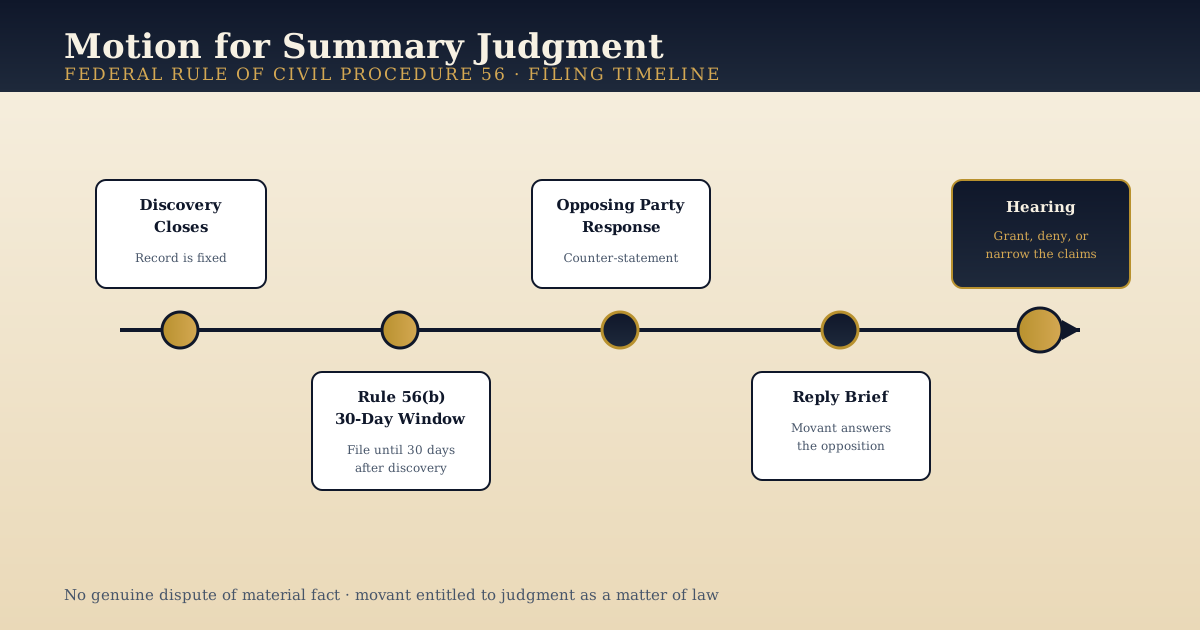
The record is fixed. Rule 56 motions are built on what discovery produced, so the evidentiary record is set before you draft.
A party may file at any time until 30 days after the close of all discovery, unless a local rule or scheduling order sets a different deadline.
The opposing party files a response and a counter-statement disputing specific facts with record citations of its own.
The movant replies, the court may hold a hearing, and the judge grants, denies, or narrows the claims as a matter of law.
The Rule 56 Motion for Summary Judgment Template, Section by Section
The full motion for summary judgment template is below in attorney-grade form. The example caption uses a federal district court and a plaintiff-side motion on liability; the body works for a defense motion with the relief paragraph adjusted, and for either party moving on part of a claim under Rule 56(a). State-court versions of the same summary judgement template swap the rule citation and the briefing schedule while keeping the same sections in the same order. The drafting notes alongside the document explain what each section carries and where the motion most often fails.
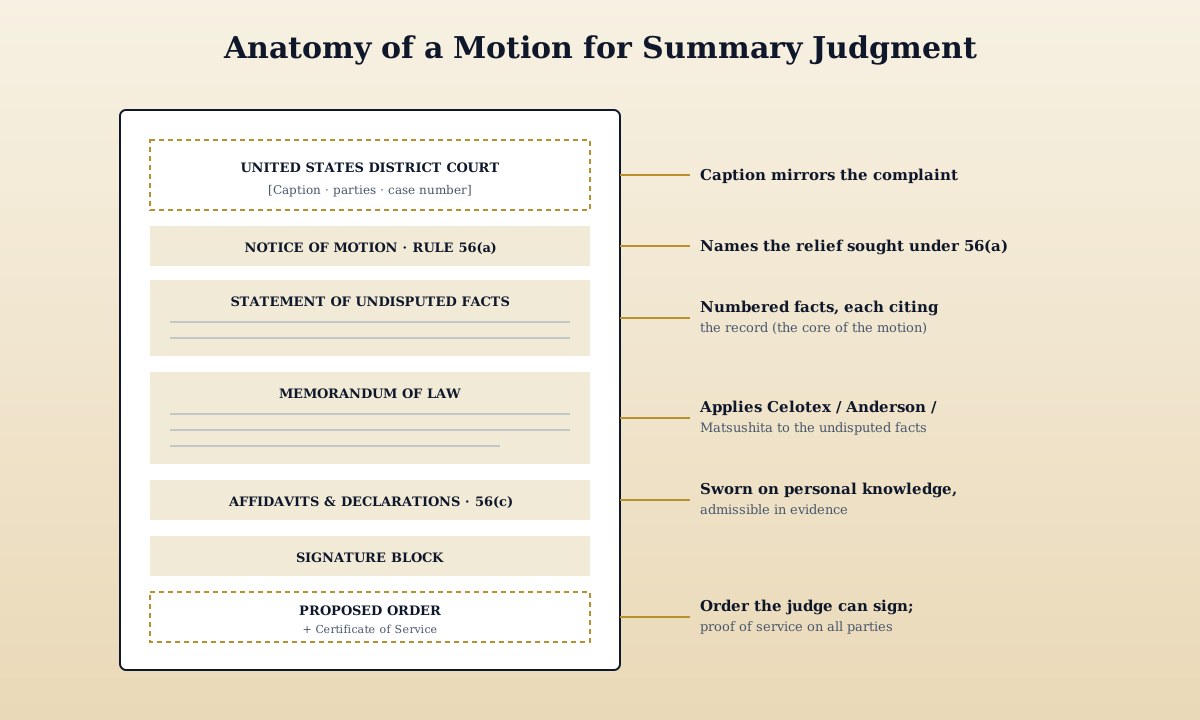
                  UNITED STATES DISTRICT COURT
                  [DISTRICT] DISTRICT OF [STATE]


[PLAINTIFF FULL LEGAL NAME],          )
                                      )
              Plaintiff,              )    Case No. [Case Number]
                                      )
v.                                    )    Judge [Last Name]
                                      )
[DEFENDANT FULL LEGAL NAME],          )
                                      )
              Defendant.              )
______________________________________)


    PLAINTIFF'S MOTION FOR SUMMARY JUDGMENT PURSUANT TO
            FEDERAL RULE OF CIVIL PROCEDURE 56


    Plaintiff [Plaintiff Full Legal Name] ("Plaintiff"), by
and through undersigned counsel, respectfully moves this Court
under Federal Rule of Civil Procedure 56 for summary judgment
on [Count I / the claim for ____] on the ground that there is
no genuine dispute as to any material fact and Plaintiff is
entitled to judgment as a matter of law. This motion is
supported by the accompanying Statement of Undisputed Material
Facts, the Memorandum of Law, the Declaration of [Name] with
exhibits, and a proposed order.


         STATEMENT OF UNDISPUTED MATERIAL FACTS


    1.  [State the first material fact in a single sentence.]
        Cite: [Ex. A, Smith Dep. 42:3-18.]

    2.  [State the second material fact.]
        Cite: [Ex. B, Defendant's Resp. to RFA No. 4.]

    3.  [Continue. Each numbered fact gets a citation to a
        particular part of the record. Facts the opposing
        party cannot dispute on the evidence belong here;
        argument does not.]
        Cite: [Ex. C, ____.]


              MEMORANDUM OF LAW


I.   INTRODUCTION

     [Two to four sentences identifying the claim and why no
     trial is needed. Example: "The signature and the default
     are both admitted. With no evidence supporting any
     defense, only a legal question remains, and it is decided
     for Plaintiff."]


II.  LEGAL STANDARD

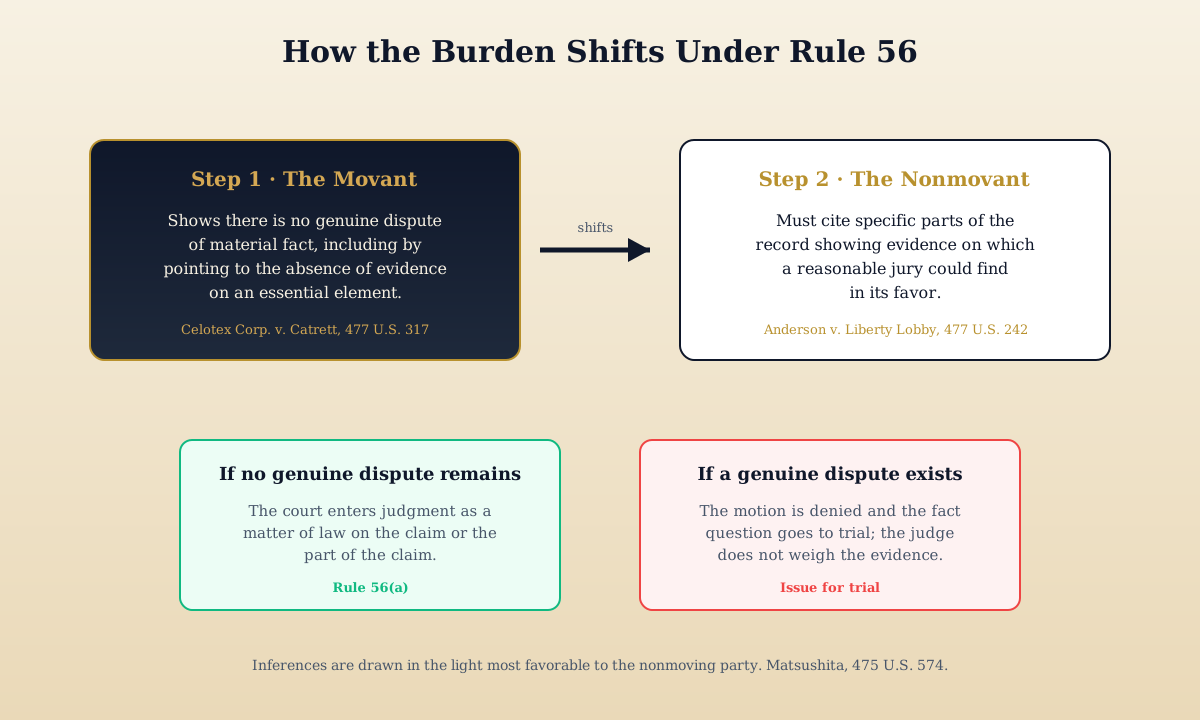
     Summary judgment must be granted "if the movant shows
     that there is no genuine dispute as to any material fact
     and the movant is entitled to judgment as a matter of
     law." Fed. R. Civ. P. 56(a). The movant may carry this
     burden by pointing to the absence of evidence supporting
     an essential element of the nonmovant's case. Celotex
     Corp. v. Catrett, 477 U.S. 317, 325 (1986). A dispute is
     "genuine" only if the evidence is such that a reasonable
     jury could return a verdict for the nonmoving party.
     Anderson v. Liberty Lobby, Inc., 477 U.S. 242, 248
     (1986). The court draws all reasonable inferences in the
     light most favorable to the nonmoving party but does not
     weigh the evidence or make credibility findings.
     Matsushita Elec. Indus. Co. v. Zenith Radio Corp., 475
     U.S. 574, 587-88 (1986).


III. ARGUMENT

     A.  [The first essential element is established by
         undisputed fact.]

         [Tie the numbered undisputed facts above to the
         element. Show that the opposing party has no
         admissible evidence creating a genuine dispute.]


     B.  [The opposing party cannot raise a genuine dispute
         on the remaining element.]

         [Under Celotex, the absence of evidence on an
         element on which the nonmovant bears the burden of
         proof is itself a ground for summary judgment.]


IV.  CONCLUSION

     For the foregoing reasons, Plaintiff respectfully
requests that the Court grant summary judgment on [the claim],
enter judgment as a matter of law in Plaintiff's favor, and
grant such other relief as the Court deems just. A proposed
order is attached.


Dated: ____________, 20____.


                         Respectfully submitted,


                         ______________________________________
                         [Attorney Name], Esq.
                         [State] Bar No. ______________
                         [Firm Name]
                         [Firm Address]
                         Telephone: (___) ___-____
                         Email: __________________
                         Attorney for Plaintiff


================================================================
              DECLARATION IN SUPPORT (RULE 56(c)(4))
================================================================

    I, [Name], declare under penalty of perjury that the
following is true and correct of my own personal knowledge,
and that I am competent to testify to these matters:

    1.  [Fact within the declarant's personal knowledge.]
    2.  [Fact, attaching the referenced document as an
        exhibit.]

    Executed on ____________, 20____.

                         ______________________________________
                         [Declarant Name]


================================================================
                    CERTIFICATE OF SERVICE
================================================================

    I HEREBY CERTIFY that on this _____ day of ____________,
20____, I electronically filed the foregoing with the Clerk of
the Court using the CM/ECF system, which will serve a notice of
electronic filing on all counsel of record.


                         ______________________________________
[Attorney Name], Esq.What a Response to Motion for Summary Judgment Template Has to Do
A response to motion for summary judgment template is the nonmovant’s filing, and it works in the mirror image of the motion. Where the movant says no genuine dispute exists, the response shows that one does. The document carries the same caption, then a counter-statement that answers the movant’s separate statement line by line: admit, dispute, or dispute in part, with a record citation for every fact the responding party calls disputed. A bare denial fails. Under Rule 56(e), if a party fails to properly address a fact, the court may treat that fact as undisputed for purposes of the motion.
The opposing party wins by raising a genuine dispute on even one material fact that a reasonable jury could resolve in its favor, because that single live fact sends the claim to trial. When the responding party needs depositions or documents it has not yet obtained, Rule 56(d) lets it file a declaration explaining why it cannot present essential facts; the court may then defer the motion or allow time for discovery. The standard of review on the response is the same as on the motion: the court does not weigh evidence, it asks only whether a triable issue exists.
A defendant facing a plaintiff’s motion sometimes files its own cross-motion at the same time, arguing that if the facts are truly undisputed the judgment should run the other way. That tactic is handled in the motion drafting service, which also covers cross-motions and Rule 56 opposition filings.
Counter-statement
Respond to each numbered fact: admit, dispute, or dispute in part. Every disputed fact needs a citation to the record, the same evidentiary discipline the moving party owes.
Rule 56(d) request
If discovery is incomplete, attach a declaration stating the specific facts you cannot yet present and why. The court may defer the motion or allow time to obtain them.
Response deadline
Federal local rules set the opposition window. In California the opposition is due at least 20 days before the hearing under Code of Civil Procedure section 437c.
Strategic Goals Behind the Filing
A motion for summary judgment is not only a way to end a case. Even when a full win is unlikely, the filing serves litigation goals that shape the rest of the matter. The four goals below explain why a plaintiff or a defendant commits the time to draft one, and why the document repays careful work.
End the claim as a matter of law
The first goal is the direct one. If the material facts are not in dispute and the law favors the movant, the court enters judgment without a trial. Under Celotex a defendant can win simply by showing the plaintiff has no evidence on an essential element, which makes the motion the standard close-of-discovery tool when a claim has not held up.
Narrow the issues for trial
Rule 56(a) allows a motion on part of a claim. A partial motion that knocks out two of four counts cuts the trial in half and removes the weakest theories from the jury, even if the core claim survives. The order on a partial motion also fixes which facts are no longer contested.
Force the evidence onto the record
The motion forces the opposing party to come forward with its actual proof rather than rest on the pleading. Anderson holds that the nonmovant must point to evidence on which a reasonable jury could find in its favor, so the filing tests whether the other side really has a case.
Improve the settlement position
A well-supported motion changes the settlement math. A party staring at a credible summary judgment template that exposes the gaps in its proof often reassesses its position before the court ever rules, which is why the motion is filed even in cases expected to settle.
The motion for summary judgment sits among several dispositive and post-judgment filings that resolve a case without a full trial. A defendant who never answered draws a different vehicle, explained in how a motion for default judgment works after the clerk enters default. A close cousin on the law alone, before discovery has built a record, is the drafted motion for judgment on the pleadings for civil litigants seeking early resolution.
A Practitioner Drafting Checklist
Six steps from a blank summary judgement template to a filed motion. The work that wins or loses the motion happens in the second and third steps, the separate statement and the legal standard, because that is where the court decides whether a genuine dispute exists. Run this checklist before the document goes to the court clerk.
- 1
Mirror the caption from the complaint
Court name, party order, case number, and judge assignment must match the operative pleading exactly. A mistyped case number is a routine reason the court clerk rejects a filing at intake before the motion reaches the docket.
- 2
Build the separate statement of undisputed facts first
List each material fact in a numbered paragraph, and cite the deposition page, interrogatory answer, document, or declaration that proves it. Under Rule 56(c) every assertion that a fact cannot be genuinely disputed must point to particular parts of the record.
- 3
State the Rule 56 standard before you argue
The memorandum of law sets out the no-genuine-dispute standard and the burden, then applies it. Celotex governs the movant's showing and Anderson governs whether a reasonable jury could find for the nonmovant. Get the standard exact before the argument runs.
- 4
Support every fact with an affidavit or declaration
Rule 56(c) requires that a supporting affidavit or declaration be made on personal knowledge, set out facts admissible in evidence, and show the declarant is competent to testify. A declaration on information and belief does not carry a material fact.
- 5
Calendar the filing window and the response deadlines
Confirm the Rule 56(b) deadline and the local-rule briefing schedule. In California the motion must be heard no later than 30 days before trial under Code of Civil Procedure section 437c; in New York it must be made within 120 days after the note of issue under CPLR 3212(a).
- 6
Attach a proposed order the judge can sign
A proposed order lets the court grant the relief in the words you drafted. Judges frequently sign a clean proposed order verbatim, so the relief language and the list of claims resolved are worth drafting with care.
Related motion drafting services
When the summary judgment fight spills into discovery conduct or a late-emerging claim, two adjacent filings come up most often. Each follows the same caption-and-memorandum anatomy with a different rule at its center.
- Drafting Service for a Motion for Sanctions Targeting Discovery Abuse and Bad-Faith Conduct handles the motion when the record reveals withheld evidence that bears on the undisputed-fact analysis.
- Drafting Service for a Motion to Amend Pleadings After Discovery Reveals New Claims covers the leave-to-amend filing when discovery surfaces a claim the summary judgment briefing exposed.
- If the court denies the motion or enters judgment you want revisited, the motion for reconsideration in federal court and the sections courts expect to see walks through the post-ruling vehicle, and how a motion to vacate reopens a judgment after entry covers reopening a case after entry.
Need the Rule 56 Motion Behind This Template Drafted
Send the claim, the closed discovery, and the jurisdiction. The quote request returns the strongest undisputed facts the record supports, the briefing schedule under the controlling rule, and a finalized separate statement and memorandum before the Rule 56(b) window runs.
Get a Motion for Summary Judgment DraftedFrequently Asked Questions About the Motion for Summary Judgement Template
Sourced from the People Also Ask box for motion for summary judgement template and the related summary judgment queries searchers ask alongside it.
How to write a good motion for summary judgment?
How to write a summary of judgement?
What is an example of a summary judgement?
Who can make a motion for summary judgment?
From the Summary Judgment Template to a Filed Motion
The template gives you the anatomy. We build the separate statement from your record, apply the Rule 56 standard to the undisputed facts, and finalize the filing for your court.
Related motion guides