When a Motion for Leave Is Required and the Showing Courts Expect Before Granting It
A motion for leave is a written request asking the court for permission to take a procedural step that the rules do not authorize as a matter of right. Federal civil practice splits leave motions into two main families: leave to amend the pleadings under FRCP 15, and leave to file something outside the ordinary briefing rules (a sur-reply, an oversized brief, an under-seal exhibit, a notice of supplemental authority, or an amicus brief) under the court's local rules and chambers practice. Both families travel as written motions, attach the document the movant intends to file as an exhibit, and propose an order the judge can sign granting the requested permission.
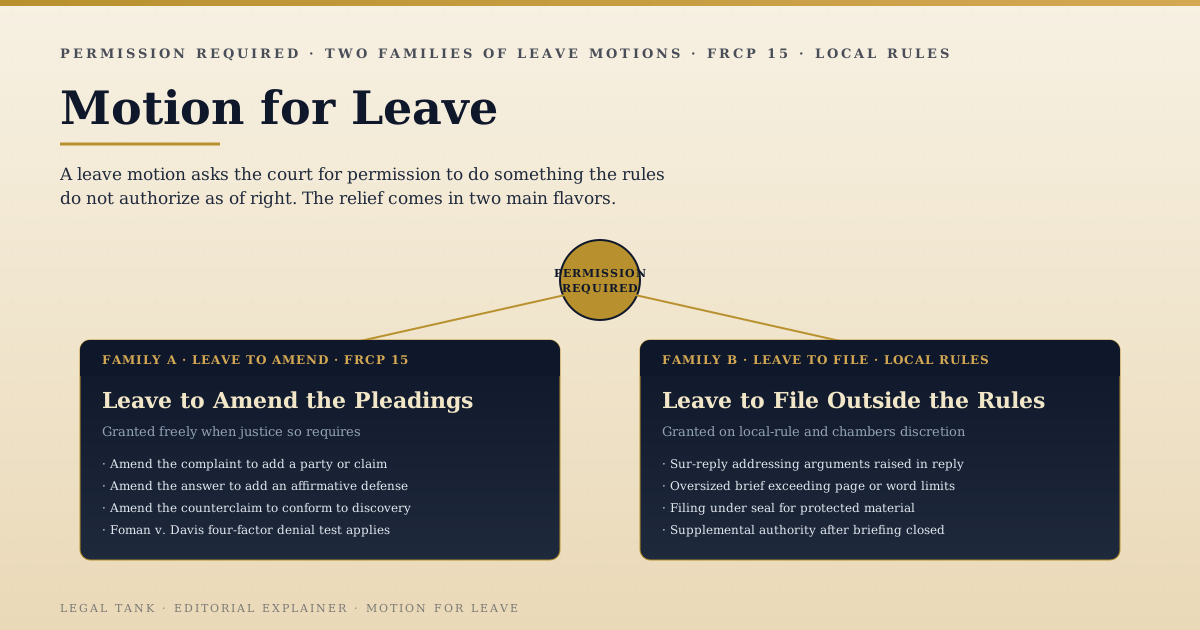
How Leave to Amend Works Under FRCP 15 and the Foman Denial Test
The single most frequently filed motion for leave to amend is the request to amend a pleading after the Rule 15(a)(1) as-of-right window has closed. Rule 15(a)(1) gives a party twenty-one days after serving the pleading to amend it once without permission or, where a responsive pleading is required, twenty-one days after service of a responsive pleading or twenty-one days after service of a Rule 12(b), 12(e), or 12(f) motion, whichever is earlier. After any of those windows expires, Rule 15(a)(2) requires the opposing party's written consent or the court's leave. The rule says leave shall be freely given when justice so requires, and the federal circuits read that language as a strong presumption in favor of granting amendment.
The Supreme Court in Foman v. Davis, 371 U.S. 178 (1962), named five grounds on which a district court may deny leave despite the liberal-amendment language: undue delay, bad faith or dilatory motive on the part of the movant, repeated failure to cure deficiencies by amendments previously allowed, undue prejudice to the opposing party, and futility of amendment. Those grounds are not exclusive, but they capture nearly every denial of a leave-to-amend motion in federal practice. The four that drive contested motions in practice (delay, bad faith, prejudice, and futility) are mapped below. The movant who wants to preempt opposition writes the motion to address all four expressly. The opposing party writes opposition to develop the factor that fits the case (typically prejudice or futility).
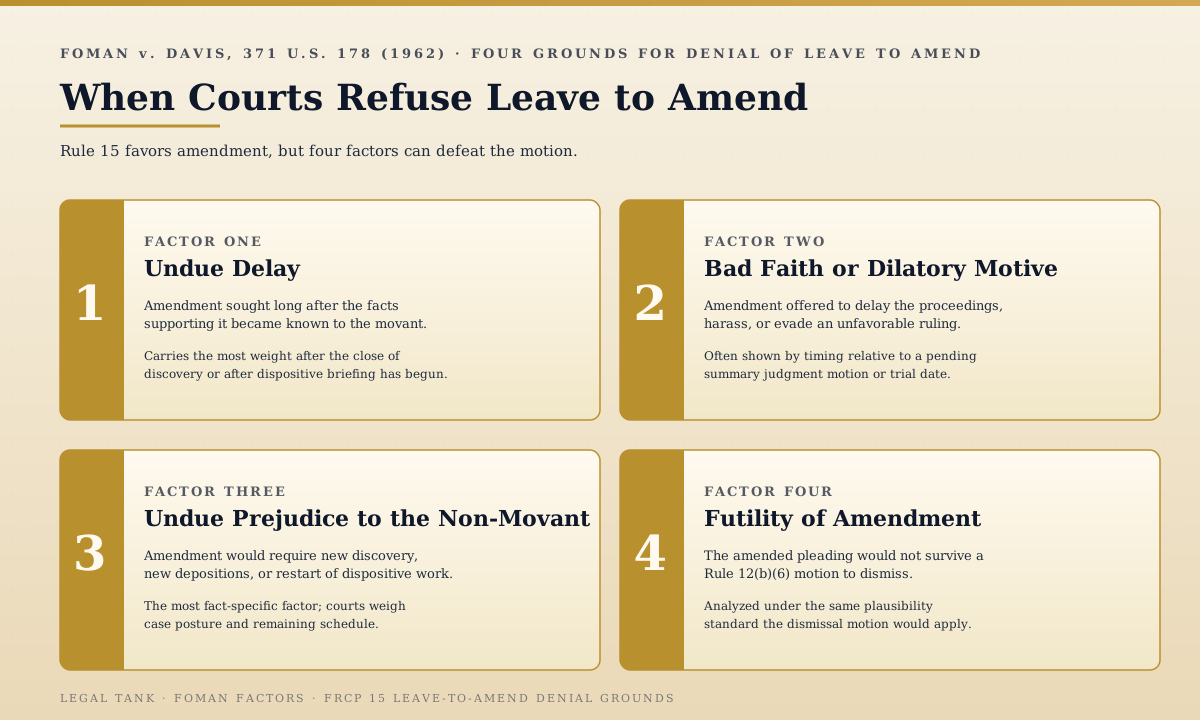
Reading the Foman Factors in Practice
- 1Undue DelayAmendment sought long after the facts supporting it became known to the movant. The factor carries the most weight after the close of discovery or after dispositive briefing has begun.
- 2Bad Faith or Dilatory MotiveAmendment offered to delay the proceedings, harass the opposing party, or evade an unfavorable ruling. Timing relative to a pending summary judgment motion or a trial date often supplies the inference.
- 3Undue Prejudice to the Opposing PartyAmendment would require new discovery, new depositions, or a restart of dispositive work. The most fact-specific factor; courts weigh the case posture and the remaining schedule.
- 4Futility of AmendmentThe amended pleading would not survive a Rule 12(b)(6) motion to dismiss. Analyzed under the same plausibility standard the dismissal motion would apply.
Where Rule 16 Changes the Showing
When the case has already entered the Rule 16 phase and the scheduling order has set a deadline for amendment, the analysis adds a second layer. The federal circuits require the movant to show good cause to modify the Rule 16 scheduling order before the Rule 15 liberal-amendment standard even applies. The Rule 16 good-cause showing focuses on the diligence of the movant: when did the facts supporting the amendment emerge, and how quickly did counsel move once they did. A motion that ignores the Rule 16 layer and argues only Rule 15 is often denied at the diligence step before the court ever reaches Foman. The companion service-firm walkthrough at drafting service for a motion to amend pleadings after discovery reveals new claims covers the Rule 16 / Rule 15 interaction in detail.
How Leave to Amend Sits in the Federal Rules of Civil Procedure
Rule 15 is part of the pleadings chapter of the Federal Rules of Civil Procedure, which also addresses relation back of amendments (Rule 15(c)), supplemental pleadings (Rule 15(d)), and amendments to conform to evidence at trial (Rule 15(b)). Counsel filing a FRCP Rule 15 motion should know which subsection authorizes the relief. Relation back under Rule 15(c) is the doctrinal cousin most often litigated alongside leave to amend because it determines whether the amended pleading is barred by the statute of limitations.
Why a Motion for Leave to File Exists Outside the Briefing Rules
The second family of leave motions is the motion for leave to file. The federal local rules and chambers practice set the default architecture for written briefing in every district: page or word limits, the number of briefs each side may file, the order they appear in, and what each brief may address. When a party needs to deviate from that architecture (a sur-reply because the reply broke new ground, an oversized opening brief because the case requires more space, an under-seal filing because the exhibit contains protected material, a notice of supplemental authority because the law has changed since briefing closed, or an amicus brief by a non-party), the party must ask the court for permission first.
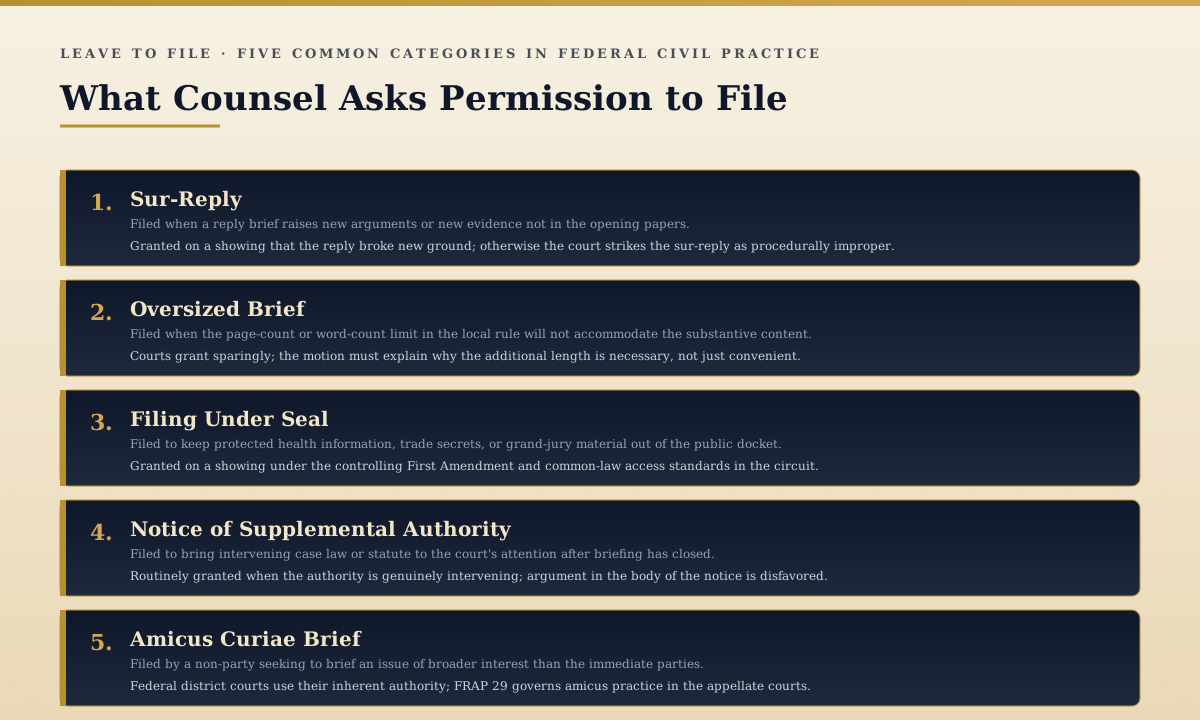
- 1Sur-ReplyWhen the reply brief raises new arguments or new evidence not in the opening papers.Granted on a showing that the reply broke new ground; otherwise the court strikes the sur-reply as procedurally improper.
- 2Oversized BriefWhen the page-count or word-count limit in the local rule will not accommodate the substantive content.Courts grant sparingly; the motion must explain why the additional length is necessary, not just convenient.
- 3Filing Under SealWhen the filing contains protected health information, trade secrets, grand-jury material, or other confidential content.Granted on a showing under the controlling First Amendment and common-law access standards in the circuit.
- 4Notice of Supplemental AuthorityWhen intervening case law or a new statute requires bringing the development to the court's attention after briefing has closed.Routinely granted when the authority is genuinely intervening; argument in the body of the notice is disfavored.
- 5Amicus Curiae BriefWhen a non-party seeks to brief an issue of broader interest than the immediate parties.Federal district courts use their inherent authority to grant amicus participation; FRAP 29 governs amicus practice in the appellate courts.
The Sur-Reply Problem
The most procedurally contested leave-to-file motion is the sur-reply request. The standard federal motion architecture allows the movant to file an opening brief, the responding party to file an opposition brief, and the movant to file a reply brief. The reply is the last word. When the reply introduces a new argument or a new piece of evidence that the opposition had no chance to address, the responding party files a motion for leave to file a sur-reply. Some federal districts (the Northern District of Illinois, for example) disfavor sur-replies categorically; others grant them when the reply genuinely broke new ground. The motion must point to the specific new material in the reply, not just disagree with the reply's framing of the existing arguments.
Filing Under Seal and the Public-Access Standard
Federal courts enforce a strong common-law and First Amendment presumption of public access to judicial filings. A motion for leave to file under seal must overcome that presumption by naming the specific protected interest (trade secrets, protected health information, grand-jury material, business information whose disclosure would cause clearly defined and serious injury) and showing that no less restrictive alternative will protect that interest. Courts routinely require redacted public filings paired with full under-seal versions, rather than complete sealing. The standard is stricter in some circuits than others; the Second Circuit's test in Lugosch v. Pyramid Co. of Onondaga and the Third Circuit's test in Pansy v. Borough of Stroudsburg are frequently invoked. Discovery-side enforcement that interacts with sealing decisions is covered in drafting service for a motion for sanctions targeting discovery abuse and bad-faith conduct.
How a Leave Motion Connects to Other Procedural Devices
Leave motions sit upstream of the substantive motion they accompany. A leave-to-amend motion makes possible the new claim the amended complaint pleads; a leave-to-file-under-seal motion makes possible the substantive evidentiary submission that the under-seal exhibit supports. The companion walkthrough at what a legal motion is and how leave vehicles fit the broader pretrial and discovery-phase architecture covers the broader motion architecture, and the what a motion for summary judgment template includes to satisfy Rule 56 companion piece walks through the briefing schedule into which a leave-to-file-sur-reply motion most often slots.
Building the Filing From Scratch: Caption to Certificate of Service
A leave motion is shorter than most substantive motions but requires the same architectural discipline: a clean caption, a paragraph stating the permission sought, a paragraph or two of grounds, a meet-and-confer recitation, a prayer for relief, and a signature block. The proposed filing (the amended pleading, the sur-reply, the oversized brief) is attached as a numbered exhibit. The six-step walkthrough below covers the drafting choices that produce a granted motion on the papers.
Step 1: Name the Rule and the Specific Permission Sought
The opening paragraph cites the rule that requires leave (FRCP 15(a)(2) for amendment outside the as-of-right window; the local rule that governs sur-replies; the local rule that sets page-count limits) and names the specific permission being sought (leave to file the amended complaint attached as Exhibit A; leave to exceed the twenty-five page limit by ten pages; leave to file the discovery exhibits under seal). Filings that ask for amorphous permission give the court nothing concrete to grant.
Step 2: Attach the Proposed Filing as an Exhibit
Leave-to-amend motions attach the proposed amended pleading as an exhibit, with a redline showing the changes from the prior version. Leave-to-file motions attach the proposed sur-reply, the oversized brief, the under-seal materials, or the amicus brief as exhibits. The court reviews the attached exhibit when deciding whether to grant leave, and a motion that asks for permission without showing what will be filed gives the court an incomplete record.
Step 3: Conduct and Document the Meet and Confer
Most federal districts and major state-court systems impose a meet and confer requirement for non-dispositive motions, including leave motions. Counsel must confer with opposing counsel before filing and state opposing counsel's position in the motion itself. Unopposed leave motions are typically granted on the papers without a hearing; opposed motions require substantive briefing that addresses the opposing position. The conferral certificate must be specific (date, mode of conferral, points discussed) rather than boilerplate.
Step 4: Draft the Proposed Order So It Tracks the Prayer for Relief
The proposed order grants the specific permission requested with no extra relief. A clean proposed order on a leave-to-amend motion reads: 'The motion is granted; Plaintiff shall file the amended complaint attached as Exhibit A within seven days of this order.' A proposed order that overreaches or asks for collateral relief produces a partial grant or a hand-edited order that does not match what the motion sought. Counsel who treat the proposed order as the most important page in the bundle draw signed orders that match what was asked.
Step 5: Address the Foman Factors If Likely to Be Contested
When the opposing party is likely to oppose a leave-to-amend motion, the moving papers should preempt the Foman v. Davis factors by stating expressly that there has been no undue delay (citing when the facts supporting the amendment first emerged), no bad faith (the procedural posture supports the timing), no undue prejudice to the opposing party (the case schedule accommodates the amendment), and no futility (the amended pleading states a plausible claim). A leave motion that ignores Foman and meets resistance often loses ground at oral argument.
Step 6: File With the Court Clerk and Effect Service of Process
The motion is filed with the court clerk through the electronic filing system in most federal courts and many state-court systems. The opposing party must be served the same day, and a certificate of service must be filed showing the date, method, and recipient. Failures at this step (serving by an unauthorized method, neglecting to file proof of service of process) are the most common procedural defects that delay a leave motion from being heard.
The memorandum of law attached to a leave motion is typically short (two to five pages) and centered on the rule citation, the procedural posture, and a brief recitation of why the requested permission is warranted. The docket entry reflects the pending leave motion under the assigned judge's name, and the court clerk applies the local-rule briefing schedule. For pleading-stage work that often follows a granted leave-to-amend motion, see the closely related walkthrough at anatomy of a motion for default judgment template and how each section functions.
Realistic Outcome Ranges for Leave Motions
Leave motions are granted at a high rate in federal practice, but the rate varies by family and posture. A first-filed leave-to-amend motion in the early or middle phase of the case (before the Rule 16 deadline, supported by a clear statement of when the facts emerged) is granted in the substantial majority of federal districts. A leave-to-amend motion filed after the Rule 16 deadline, after the close of discovery, or against a pending summary judgment motion faces far harder scrutiny under the Foman prejudice and bad-faith factors plus the Rule 16 diligence layer. A leave-to-file sur-reply motion is granted when the reply broke new ground, denied or stricken when it merely disagrees with the reply's framing.
The "Granted in Part" Outcome
The most common partial outcome on a leave-to-amend motion is a grant that permits some of the new claims and denies others on futility grounds. The court reviews each proposed amendment against the Rule 12(b)(6) plausibility standard and signs the order with specific notations on which claims survive. The plaintiff who anticipates this outcome structures the proposed amended pleading with separable counts so that a partial grant leaves a coherent operative pleading. The defendant who is opposing the motion structures opposition with separate futility arguments for each new claim. The cross-cutting work that arises after a partial grant is covered in professionally drafted cross-motion for summary judgment briefs and Rule 56 opposition filings.
When the Court Denies Without Prejudice
A denial without prejudice on a leave motion is procedurally different from a denial with prejudice. A without-prejudice denial typically reflects a procedural defect (no meet-and-confer certification, no proposed order, no attached exhibit) that the movant can cure. The movant refiles after curing the defect, often with the same substantive showing, and the second motion is granted. A with-prejudice denial on Foman grounds (typically bad faith, futility, or undue prejudice on the merits) closes the door on the amendment as offered and forces the movant to either appeal the interlocutory denial under the controlling circuit standards or proceed without the amendment.
The Appellate Review Standard
Denials of leave to amend are reviewed for abuse of discretion in every federal circuit. The abuse-of-discretion standard gives the district court substantial latitude, and reversal is uncommon when the district court explained the Foman factor it relied on. The reverse is also true: a denial without a written record of the controlling Foman factor is harder for the district court to defend on appeal. Counsel who anticipate appellate review draft motions and oppositions that produce a record the appellate court can read directly. The post-judgment companion walkthrough at what a motion for reconsideration template contains and the sections courts expect to see covers how reconsideration practice fits with leave practice when a denied amendment is challenged. The enforcement-side companion at attorney-prepared motion for contempt of court for enforcing orders against a noncompliant party covers a different leave-adjacent context, when a court has already entered an order and a party seeks permission to file an enforcement motion outside the original briefing schedule.