Real Estate Templates
4 templatesLease, sublease, and ownership-transfer documents. Lease clauses are floor-set by each state's landlord-tenant act; deeds answer to the recording statute.
22 free legal templates covering contracts, real estate, business formation, estate planning, family law, employment, intellectual property, and compliance. Every free contract template, lease agreement template, and NDA template in the library is reviewed against the controlling state statute and the federal authority before publication, then maintained against legislative updates by the regulatory compliance team. These free legal forms work as ready-to-use legal documents online, downloadable as PDF or DOCX without an account.
The library is organized by practice area because the controlling statute follows the practice area, not the life event. A residential lease answers to the state landlord-tenant act regardless of who the tenant is; an NDA answers to trade secret law regardless of who the parties are. Each card previews the most-used templates inside the category. The category page itself lists every template with its clause anatomy and statutory authority.
Lease, sublease, and ownership-transfer documents. Lease clauses are floor-set by each state's landlord-tenant act; deeds answer to the recording statute.
Bilateral commercial documents. Read against UCC Article 2 for goods, the Restatement (Second) of Contracts for services, and Article 3 for promises to pay.
Constitutional documents for the entity itself. The state LLC act fills any gap the operating agreement leaves silent; the agreement controls otherwise.
Authority and disposition documents. Wills carry their own formality rules; powers of attorney are floor-set by the Uniform Power of Attorney Act in adopting states.
Premarital and post-marital agreements. State family code drives the disclosure and unconscionability rules; courts review prenups for procedural fairness.
Public-facing notices for websites and apps. Privacy policies answer to the GDPR, CCPA, and the FTC Act; terms of service set the contractual layer with users.
Employer-employee documents. Restrictive covenants live or die by the reasonableness test; severance carries ADEA waiver rules for employees over forty.
Pre-litigation enforcement documents. The cease and desist letter is the first paper move; trade secret claims rest on the Defend Trade Secrets Act.
Below the catalog, the seven highest-traffic document families each get a clause-by-clause walkthrough. What the template covers, where the controlling statute takes over, and where an attorney-drafted document is the right product instead.
The case for free contract templates is strongest when the deal economics are settled, the counterparty is known, and the document itself is a record of an agreement the parties already reached in conversation. A good template supplies the offer, acceptance, consideration, and mutual assent language; lists the integration clause; sets governing law; and gives clean signature blocks. The reader provides the facts. That arrangement covers a large share of small-business agreements, freelance engagements, and bilateral service deals.
The case against the same template flips when the deal touches statute-of-frauds writings, when the counterparty arrives with counsel, or when the document will be litigated rather than performed. A purchase order for goods over five hundred dollars falls under UCC section 2-201, which reshapes signature and quantity-term requirements that a generic template will not anticipate. A multi-state services contract pulls in choice-of-law and forum-selection drafting that no static fill-in field can answer. The Restatement (Second) of Contracts is the analytical baseline that courts read against the four corners of the document; the template itself is not the baseline.
Readers who want a deeper anatomy of every clause inside a general-purpose business contract template can move to the editorial companion at the Word contract template anatomy, which walks the eight standard sections and the boilerplate clauses that catch self-prepared agreements. For the broader law of contracts, including formation, defenses, and remedies, see the contract law primer.
A lease agreement template is one of the most statute-driven documents in the library. Every state landlord-tenant act sets the floor for what a residential lease can require: the maximum security deposit, the timeline for returning the deposit, the implied warranty of habitability, the disclosures the landlord owes the tenant, and the grounds on which either side can terminate early. Where the template language conflicts with the statute, the statute wins, and the conflicting clause is read out of the lease.
The clauses that vary most widely across states are the security deposit ceiling, the late-rent grace period, the notice required to raise rent, the rules around keeping a pet, and the procedure a landlord must follow before entering the unit. A template designed for one state will list a deposit ceiling that another state caps differently, a notice period that another state requires to be longer, and a habitability framing that another state has rewritten in the past five years. Customizing a single template across all fifty jurisdictions is more work than starting from a state-specific template that already encodes the local rules.
The clauses that hold steady across states are the parties, the property description, the term, the rent amount and due date, the late fee structure (subject to caps), the assignment and subletting restriction, the holdover rule, and the integration clause. A rental agreement template built around those stable clauses is reusable across jurisdictions provided the statute-driven sections are swapped in for each state.
When a lease has already failed on the deposit side, the next document in the chain is a security deposit demand letter. When rent is owed, the next document is the statutory pay-or-quit notice covered in the eviction notice section below, which begins the unlawful detainer action rather than a private collection demand.
An LLC operating agreement template answers a different question from a contract template. A contract sets the terms between two parties on one transaction. An operating agreement sets the constitutional rules for an entity that will outlive any single transaction. The required sections include the members and their initial capital contributions, the percentage interests, the rules for additional capital calls, the allocation of profits and losses, the distribution waterfall, the management structure (member-managed or manager-managed), the voting thresholds for major decisions, the transfer restrictions on membership interests, and the dissolution procedure.
The most common operating agreement template error in self-prepared LLCs is the absence of a transfer restriction. Without a transfer restriction, a member can sell their interest to an outside party without the consent of the other members, and the buyer steps into the management role the seller occupied. A second common error is the absence of a deadlock provision in two-member LLCs, where a fifty-fifty split with no contractual tie-breaker leaves judicial dissolution under the state LLC act as the practical exit. A third common error is inconsistency between the operating agreement and the articles of organization filed with the secretary of state, which can leave the LLC operating under a default rule the members did not intend.
The state LLC act fills any gap the operating agreement leaves silent. Where the agreement is silent on profit allocation, the statute splits profits in proportion to capital contributions in most states, while a few states default to a per-capita split. A template that does not address allocation explicitly inherits the local default, which is often the opposite of what the members intended at formation.
A promissory note template is a written, signed, unconditional promise to pay a fixed sum of money on demand or at a defined time. The phrase carries technical weight because it is the test for a negotiable instrument under UCC Article 3, and a negotiable instrument can be sold, pledged, or transferred to aholder in due course who takes the note free of most defenses the maker could raise against the original payee. A bare IOU is not a negotiable instrument. A correctly drafted note is.
The required elements are an unconditional promise (no language that makes payment depend on a separate transaction), a fixed sum in money (a stated principal plus a stated interest rate), payable on demand or at a definite time, and signed by the maker. Optional but routine elements include the place of payment, the late-fee rule, the default and acceleration clause that allows the holder to call the entire balance due on a missed payment, prepayment permission, the governing law, and the attorney-fee shifting on collection. State usury laws cap the interest rate, and a rate above the cap can render the note unenforceable for the excess portion or, in some jurisdictions, for the entire interest charge.
The free template is correct for a clean two-party loan with no collateral. Once the loan is secured by personal property, the note pairs with a separate security agreement filed under UCC Article 9. Once the loan is secured by real estate, the note pairs with a mortgage or deed of trust recorded with the county. Both of those pairings are outside the template tier and into the attorney-drafted product line.
The clause language is half the work; the execution formality is the other half. A correctly drafted document signed the wrong way is unenforceable. The four-rung ladder below is the order in which statutory formality stacks across the nine families, from the base case of a plain signature to the top case of a recorded instrument.
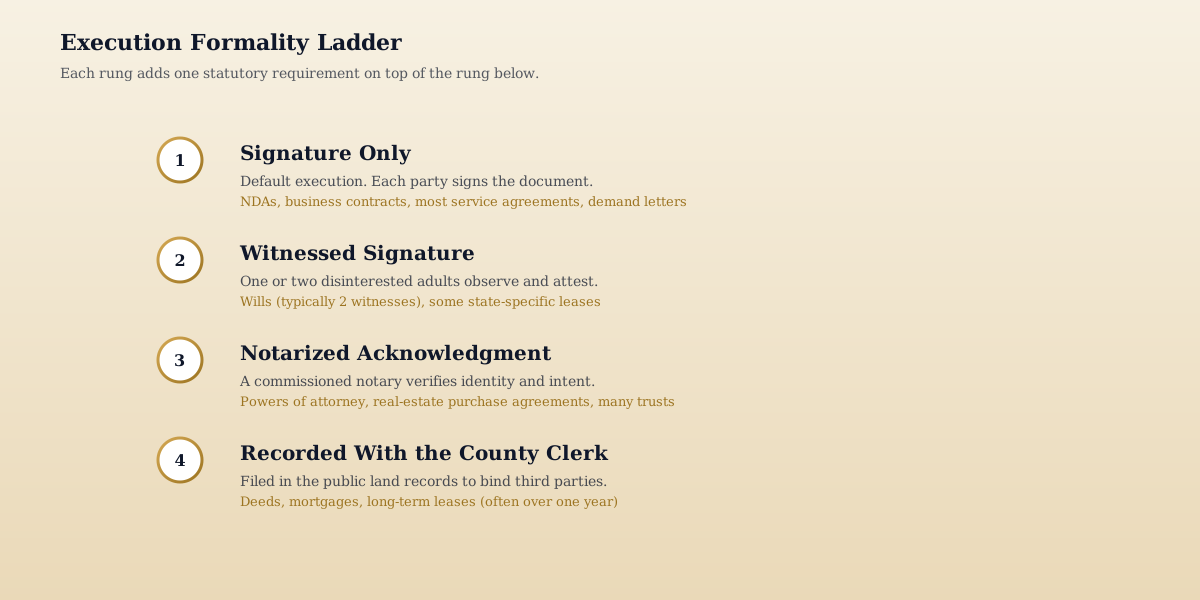
The federal ESIGN Act, 15 U.S.C. section 7001 makes electronic signatures enforceable for most contracts and commercial documents. The act explicitly excludes wills, codicils, and testamentary trusts, and most states layer additional exclusions for negotiable instruments, court documents, and certain real estate instruments. Template users should treat wet-ink signature as the safe default for any document on rungs two, three, or four of the ladder until the relevant exclusions have been confirmed for the document family.
An eviction notice template is the most statute-bound document in the library. The notice is not a letter to the tenant; it is a statutory form, and any deviation from the statutory text is grounds to dismiss the unlawful detainer action that follows. California Code of Civil Procedure section 1161, Florida Statute section 83.56, Texas Property Code section 24.005, and New York Real Property Actions and Proceedings Law section 711 each set the wording, the notice period, the service method, and the proof-of-service form in a way that does not transfer between jurisdictions.
The three categories of notice are pay-or-quit (the tenant cures unpaid rent or vacates within the statutory window), cure-or-quit (the tenant cures a non-rent lease violation or vacates), and unconditional quit (the tenant vacates without an opportunity to cure, reserved for serious or repeat breaches). Each category has a different notice period, a different statutory caption, and a different set of mandatory disclosures. Mixing the categories or using the wrong one is the most common reason an eviction is dismissed and has to be refiled.
For the deeper procedural arc that runs from notice to writ of possession, the editorial counterpart sits at the eviction process guide. The free notice template covers the document itself; the unlawful detainer action that follows is a court proceeding the template does not handle.
The clauses that decide whether an NDA template is useful or merely ceremonial are the definition of confidential information, the term, the carve-outs, and the remedies on breach. A template that defines confidential information so broadly that it covers anything the disclosing party touches will not survive challenge in court. A template that defines it so narrowly that the actual trade secret falls outside the definition is worse than no agreement at all. The working definition lists the categories of information the disclosure covers, ties each to a marking or identification protocol, and excludes information already public, independently developed, or rightfully received from a third party.
The term clause runs the length of the obligation to keep information confidential. Most generic NDAs run two to five years. True trade secrets, by contrast, are protected indefinitely under the Defend Trade Secrets Act and parallel state law for as long as the holder maintains reasonable secrecy measures. An NDA whose term ends at year three on a trade secret with a thirty-year commercial life is functionally an authorization to use the secret in year four. The remedies clause should preserve injunctive relief, list reasonable attorney-fee shifting, and allow recovery of profits attributable to the breach.
For the response-side of the cluster, where confidential information has already been published or shared without authorization, the relevant document is a defamation cease and desist letter where the breach involves false reputational claims, or an attorney-drafted trade secret cease and desist where the breach involves competitive use.
A power of attorney template creates the legal authority of one party (the agent) to act on behalf of another (the principal). The template is not evidence of authority; the signed and witnessed document is the authority. The required elements are the principal, the agent, the powers granted (which can be general or limited to specific transactions), the durability rule (whether the authority survives the principal losing capacity), the springing trigger (whether the authority activates immediately on signing or only on a defined event such as a physician finding the principal incapacitated), the successor agents in priority order, and the revocation procedure.
The Uniform Power of Attorney Act has been adopted in over half the states and harmonizes the powers a general grant covers, the statutory short form, and the third-party reliance protections that allow a bank or hospital to honor the document without legal risk. The remaining states retain their own uniform-act variants. A letter of attorney template from one regime often will not be recognized at face value by an institution in another regime, and the cost of a refused power of attorney is measured in days of delay during a medical or financial emergency.
Notarization is mandatory in nearly every jurisdiction, and many require two witnesses in addition to the notary. A self-proving notarization block on the template gives the document the legal weight it needs without a separate court order. The signature page should leave room for the principal, both witnesses, and the notary. Documents missing any of those signatures are routinely rejected by banks and hospitals at the moment of presentation, which is the worst time to discover the defect.
The free template is the correct product when the deal is settled and the document records what the parties already agreed. The attorney-drafted document is the correct product when the deal is still open, the counterparty arrives with counsel, the dollar value crosses the bracket where small drafting errors compound into seven-figure exposure, or a court is going to read the document line by line. The break point is not the document family; it is the level of judgment the document calls for.
For relationship documents that sit between a contract and an estate plan, the natural next stop is a prenuptial agreement lawyer. For sector-specific commercial drafting, two examples already in the library cover damages-based fee arrangements and energy performance contracting, each of which requires drafting that no static template will capture.