How Courts Define a Contract Under the Restatement and the UCC
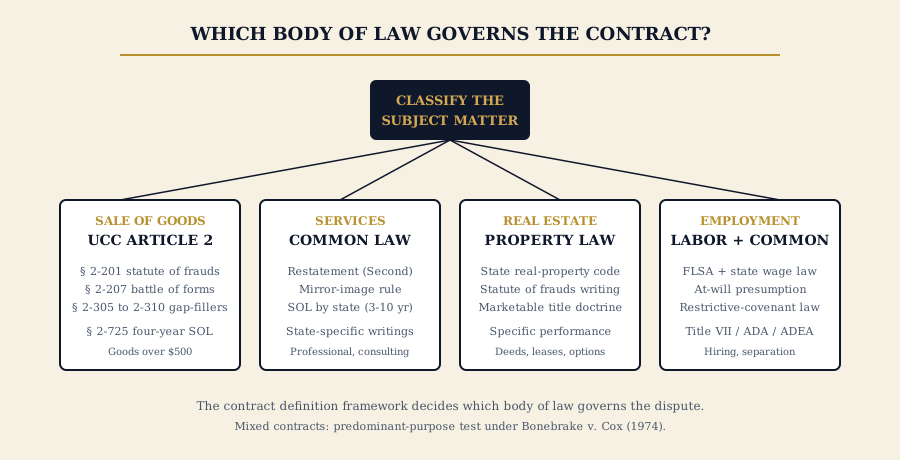
Contract definition law is built on a working framework that has been remarkably stable for the past century. The framework comes from two sources. The first is the Restatement (Second) of Contracts, particularly Section 1 (the formal definition), Sections 17 to 24 (formation requirements), Sections 71 to 81 (consideration), and Sections 235 to 261 (performance and breach). Most state supreme courts adopt the Restatement formulation either expressly or by citation. The second source is Article 2 of the Uniform Commercial Code, which governs sales of goods and modifies several rules: it relaxes the mirror-image rule under § 2-207, supplies gap-fillers for missing terms under §§ 2-305 to 2-310, and replaces the common-law statute of frauds with § 2-201's writing requirement for goods over five hundred dollars.
For other contract categories, the analysis routes through common law as supplemented by specialty statutes. Real-estate contracts are governed by state real-property statutes; employment contracts are layered with state and federal labor statutes; consumer contracts are subject to state consumer-protection acts and the Federal Trade Commission Act. The definition of contract the court uses on day one decides which statutory framework applies and which substantive rules govern the dispute.
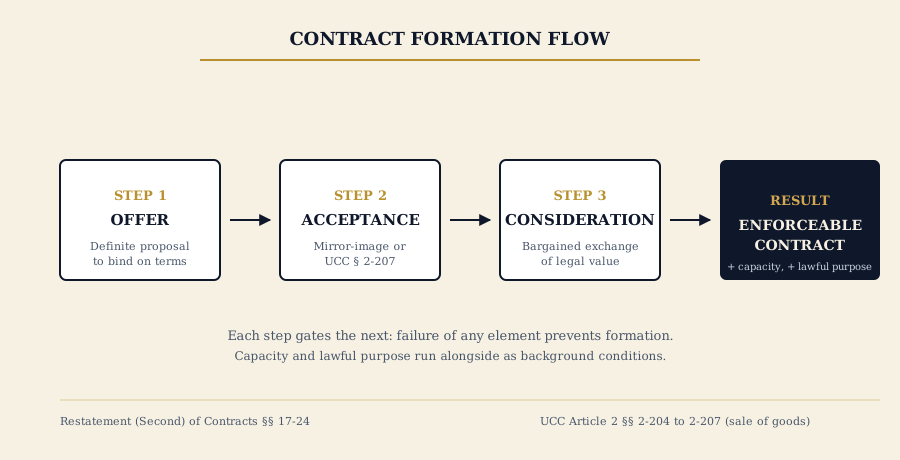
The contracts definition in practice rests on six formation elements. Each element must be present at formation; failure of any element renders the agreement voidable or void. Litigators reading a complaint, drafters reviewing a proposed instrument, and counsel evaluating a demand letter all run the same six-element checklist before the substantive merits begin.
- I
Offer
A definite proposal made by the offeror that, if accepted, will create a binding agreement on the proposed terms. The offer must convey present commitment rather than mere invitation to negotiate, must identify the parties and subject matter, and must set out price, quantity, and material performance terms with enough specificity for a court to enforce the deal.
- II
Acceptance
An unequivocal assent to the offer's terms, communicated to the offeror in the manner the offer permits. At common law the acceptance must mirror the offer; under UCC § 2-207 for sales of goods, additional or different terms can become part of the contract subject to the merchant rule and material-alteration limits.
- III
Consideration
A bargained-for exchange of legal value. Each party must give something the law recognizes as detriment or benefit, sufficient to support the promise. Past consideration, gratuitous promises, and pre-existing duties generally do not satisfy the requirement, though courts apply doctrines (promissory estoppel, modification under UCC § 2-209) to fill gaps where the equities require enforcement.
- IV
Mutual Assent
A meeting of the minds on the essential terms. Mutual assent is judged objectively from the parties' outward conduct rather than their unexpressed subjective intent. Misunderstanding cases (Raffles v. Wichelhaus and its progeny) treat material ambiguity that neither party can fairly resolve as defeating mutual assent.
- V
Capacity
Legal capacity to contract: adults of sound mind, corporate or other entities with authority to bind, and (in the UCC merchant rule) actors holding themselves out as merchants in the relevant trade. Minors, persons adjudicated mentally incompetent, and intoxicated persons may avoid contracts under defined exceptions.
- VI
Lawful Purpose
The contract's subject matter and purpose must not violate statute, public policy, or common-law prohibitions. Contracts to commit a crime, to restrain trade beyond the reach of state restrictive-covenant law, or to evade tax or regulatory obligations are unenforceable as a matter of public policy.
The six-element framework is the same whether the matter is a multi-million-dollar acquisition or a residential service agreement. The distinguishing detail is the documentation each element requires, which scales with the amount at stake. For the broader doctrinal context, our laws of contracts overview walks through how the formation framework interacts with related contract doctrines.
Why Precision in the Definition of a Contract Matters
The definition of a contract looks academic until something goes wrong, at which point it decides four practical questions. Whether you have a claim. Which body of law governs. How long you have to file. Which remedies the court can grant. Each downstream consequence rests on the formation analysis the court applies on day one of the dispute, which is why drafters work so hard at the definition stage to make sure the instrument cleanly satisfies every element.
The same precision matters at the demand-letter stage. A breach of contract demand letter drafter runs the formation analysis before writing anything. If the underlying instrument fails an element, the demand letter shifts from breach claim to unjust-enrichment, promissory-estoppel, or quantum-meruit theory, each of which carries its own framework and limitations.
It Decides Whether You Have a Claim at All
If the agreement fails any formation element, there is no contract to breach. A demand letter, a lawsuit, and the negotiating posture that comes from the implied threat of one all collapse if the underlying instrument was not actually a contract. Precision at the definition stage decides whether you are litigating or merely complaining.
It Routes the Case to the Right Body of Law
A sale of goods over five hundred dollars routes through Article 2 of the Uniform Commercial Code, with its own statute of frauds, gap-fillers, and battle-of-the-forms framework. A services contract routes through common law as restated in the Restatement Second. A real-estate transfer routes through state-specific real-property statutes. The classification turns on the definition of the contract.
It Sets the Statute of Limitations Clock
UCC § 2-725 sets four years for sale-of-goods claims; common-law breach varies by state from three to ten years; specialty contracts (sealed instruments, written-instrument states) carry longer windows. Misclassifying the contract definition can run a claim past the deadline before counsel ever reviews it.
It Frames the Available Remedies
Specific performance is largely reserved for unique goods and real estate; consequential damages are governed by Hadley v. Baxendale foreseeability; liquidated damages must satisfy the reasonableness test at formation. Each remedy exists only where the underlying contract definition supports it, and the available remedies dictate the negotiating posture at the demand-letter stage.
Working with the Legal Definition of Contract in Practice
Translating the legal definition of contract into a usable instrument is the practitioner's task. Most drafting failures trace not to ignorance of the framework but to inattention to one element under deadline pressure. The eight-step practitioner checklist below catches the common drafting failures before the document leaves counsel's desk. Each step maps directly to one of the six formation elements and to the statute-of-frauds writings that the most common contracts must satisfy.
For a step-by-step walkthrough oriented toward in-house teams or solo practitioners, our contract drafting guide pairs each formation element with a sample clause and a drafting note.
- 01
Identify the parties by full legal name and place of business; corporate entities by exact registered name, individuals by full legal name, partnerships by partnership name and authorized signatory.
- 02
Confirm the offer is definite enough to enforce: price, quantity, material performance, time for performance, and any conditions precedent stated with the specificity a court needs.
- 03
Document acceptance unambiguously: signed writing, electronic signature with audit trail, or for sale-of-goods conduct sufficient to satisfy UCC § 2-204 acceptance by performance.
- 04
Recite the consideration in the contract itself: fee schedule, deliverables, exchanged property, cross-promises, or whatever the parties have actually bargained for. Do not rely on recitals that say only "good and valuable consideration" when the bargain is more concrete.
- 05
Establish capacity: corporate authority through resolutions or officer signatures, individual capacity through age and mental-capacity confirmations where the matter is high-stakes.
- 06
Address statute-of-frauds writings where the contract falls within UCC § 2-201 (goods over five hundred dollars), the one-year rule, real-property transfers, suretyship, or marriage-related promises.
- 07
Document mutual assent through a recital of the parties' intent, an entire-agreement clause, and a counterpart-execution provision that prevents disputes about which version the parties signed.
- 08
Confirm the purpose is lawful and the contract does not exceed restrictive-covenant or public-policy limits in the controlling jurisdiction.
The checklist is the working translation of the contract meaning in practice. Drafters who run the eight steps on every instrument catch the formation defects that would otherwise surface only at the demand-letter or motion-practice stage. For specialized instruments, the same framework applies but the documentation differs: a partnership agreement walkthrough covers the entity-formation overlay, while real-property transfers carry their own state-specific writing requirements under the statute of frauds.
Four Scenarios Where the Definition Decides the Outcome
The contract definition is most visible in the four scenario categories below. In each, the dispositive question is not the strength of the substantive claim but whether the underlying agreement satisfies the definition at all, which body of law governs it, and which statute-of-limitations clock is running. Practitioners who have run the formation analysis at the drafting stage see these scenarios coming; those who have not learn the doctrine the hard way during motion practice.
Closely related disputes about contract enforcement often surface in breach of contract litigation once formation is established. The same six-element framework that defined the contract at the outset becomes the analytical baseline for the breach pleading and the remedies discussion that follows.
Failed Formation: No Contract, No Claim
A purchaser sends a price-quote request; the seller responds with a quote; the purchaser issues a purchase order with new payment terms; the seller delivers goods. No clear acceptance ever occurred. Under UCC § 2-207 a contract may still arise from conduct, but on conflicting terms the gap-fillers govern. Without precise application of the contract definition framework, the parties cannot tell what they actually agreed to.
Wrong Statute Applied: The Limitations Trap
Counsel files a sale-of-goods claim under the six-year common-law limitations period; the defendant moves to dismiss under UCC § 2-725's four-year window; the case is dismissed as time-barred. The mistake was treating a sale-of-goods contract as a common-law services contract because the work also included installation. The mixed-contract analysis (predominant-purpose test) decides whether Article 2 applies.
Capacity Defect: The Contract Voidable
A seventeen-year-old executes a one-year residential lease, lives in the unit for nine months, then disaffirms the contract on reaching majority. Most jurisdictions allow the minor to avoid the contract subject to restitution of any benefit retained. The landlord's enforcement claim collapses because the contract definition framework requires capacity at formation.
Lawful Purpose Failure: Unenforceable Restraint
An employer sues to enforce a non-compete that bars competition in any state for ten years post-termination. The court finds the restraint exceeds the reasonable-scope limit under controlling state law, holds the contract unenforceable as to the restraint, and applies the blue-pencil rule to narrow or strike the offending clause. The lawful-purpose element of the contract definition determines the outcome.
Frequently Asked Questions
Common questions about the contract definition, the Restatement framework, and the formation elements as applied in everyday legal practice.
What is a simple definition of a contract?
What are the two meanings of contract?
What does contract mean in biology?
What is the legal definition of contract?
What is the statutory definition of a contract?
What makes a contract legally binding?
What are the 7 essential elements of a contract?

Our team drafts and reviews commercial contracts, service agreements, and business-to-business instruments.