Energy Performance Contracts and How ESPC, Shared Savings, and UESC Differ
An energy performance contract is the only commercial agreement in which the vendor contractually guarantees the financial outcome of its own installation work for the next ten to twenty-five years. The structure trades cash up front for a promise that verified utility savings will exceed the periodic payments, and the document spends most of its length defining how savings get measured, how shortfalls get cured, and how the guarantee survives an early termination.
Key terms at a glance
ESCO
Energy service company. Designs, installs, and verifies the upgrades, and signs the savings guarantee.
Baseline
Measured utility cost in the twelve months preceding the retrofit. The benchmark every saving is compared against.
M&V
Measurement and verification, almost always under the International Performance Measurement and Verification Protocol.
ECM
Energy-conservation measure. The discrete equipment item or building-system change funded by the contract.
Updated May 7, 2026·~14 minute read·By the Legal Tank editorial team
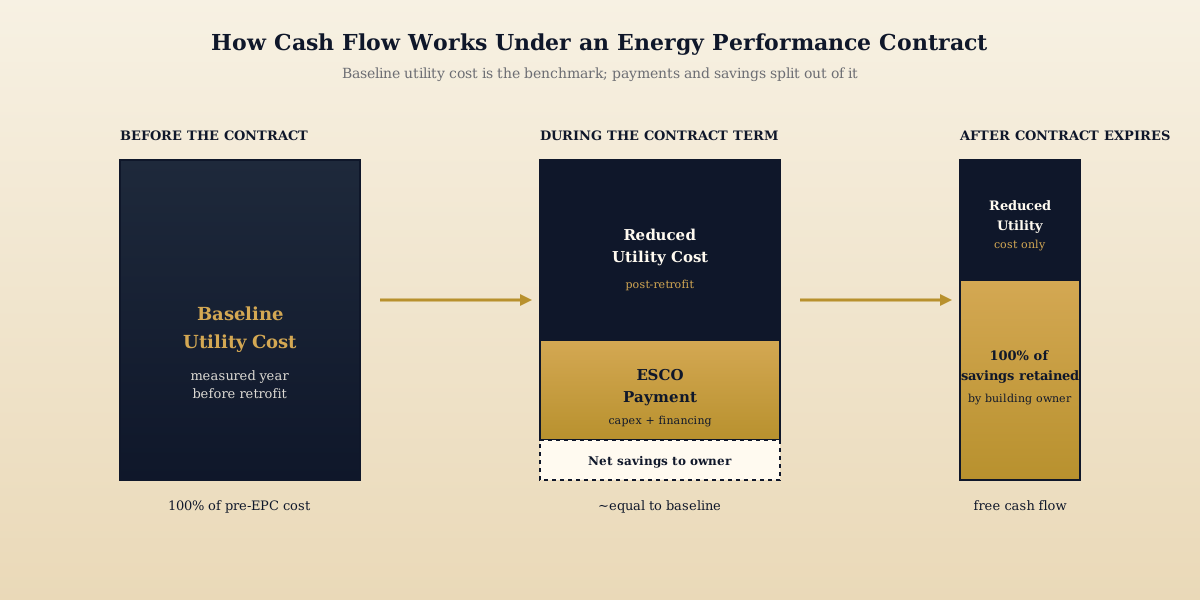
Strip away the trade jargon and an energy performance contract is a hybrid instrument: partly a construction agreement for the installation of energy upgrades, partly a service agreement for ongoing measurement and verification, and partly a financial guarantee in which the vendor warrants the savings stream that pays for the work. None of those three components stands alone in the document. Each section cross-references the others, and a defect in any one of them propagates through the contract life.
The legal foundation is ordinary contract law. The Restatement (Second) of Contracts treats the agreement as a bilateral contract with two streams of consideration: the ESCO performs by designing, installing, financing, and verifying; the owner performs by paying. What makes the document unusual is the layered conditional structure on the owner side. The owner's obligation to make each periodic payment is conditioned on the ESCO's prior verification that savings in the reconciliation period met the contractual benchmark. If the verified savings fall short, the savings guarantee triggers, and the ESCO writes a cash check for the shortfall before the owner's payment becomes due. Treating the document as anything simpler than that misreads the deal.
A contract is a promise or a set of promises for the breach of which the law gives a remedy, or the performance of which the law in some way recognizes as a duty.
Federal procurement law treats the instrument as a recognized statutory category. Under 42 U.S.C. section 8287, executive agencies may enter Energy Savings Performance Contracts for terms up to twenty-five years and may rely on future verified savings as the source of payment. The companion authority at 42 U.S.C. section 8256 enables Utility Energy Service Contracts. State and municipal versions are creatures of enabling legislation in nearly every state, with statutory caps on term length, statutory floors on the savings guarantee, and statutory disclosures the ESCO must deliver before contract award. Counsel reviewing one of these instruments must read both the contract and the enabling statute, because the statute writes certain terms into the deal whether the parties drafted them or not.
The other reading-glass that helps is to treat the document as a project-finance instrument disguised as a service contract. The ESCO, or its lender, looks at the savings stream as collateral. The owner looks at the same stream as the source of debt service. That shared dependence on a single cash flow drives the heavy drafting attention spent on precise definitional language: baseline year, weather normalization, occupancy normalization, stipulated values, retained savings, and avoided cost. Each of those terms is a lever that, set the wrong way, redirects millions of dollars over the contract term. Standard breach analysis still applies to disputes, but the front-end definitional work is what determines whether a breach can be proved at all.
Part Two
Why Owners Use Energy Performance Contracts
The reason a building owner signs an energy performance contract rather than a traditional construction contract is almost always financial rather than technical. The structure converts a capital expenditure into an operating expense covered by savings, and it shifts the performance risk of the upgrade onto the vendor. Owners with constrained capital budgets, owners constrained by debt covenants, and owners with statutory restrictions on capital procurement reach for this instrument first.
Federal agencies are the largest single user. Under the Federal Energy Management Program, agencies have signed billions of dollars of energy performance contracts since the statutory authority was created. The federal use case is driven by appropriations: capital procurement is hard to schedule through the appropriations cycle, but a deal that pays itself out of avoided utility cost can be signed without a separate appropriation. The Department of Energy maintains a list of qualified ESCOs the agencies may use without a fresh competitive award, which compresses the procurement timeline from years to months.
State and local government uses follow the same logic. School districts, public universities, and municipal facilities run on tight capital budgets and aging building stock. The statutory authority in each state typically caps the contract term, sets the procurement procedure (often allowing direct negotiation or a competitive request for proposals rather than a strict low-bid procurement), and writes a savings guarantee into every contract entered under the authority. Public-sector counsel reviewing a state-law deal works through both the contract and the enabling statute on every clause, because terms in the contract that contradict the statute are unenforceable.
Private institutional owners use the structure for a different reason. Hospitals, life-science campuses, and data-center operators buy into an EPC because the vendor accepts performance risk on equipment the owner does not have the in-house engineering to validate independently. The savings guarantee functions as a warranty backed by cash flow, which is more bankable than a standard equipment warranty. Private-sector deals tend to be shorter (eight to fifteen years), more aggressive on covenant packages, and more likely to use shared savings rather than theguaranteed-savings model that dominates federal practice.
The financing layer sits underneath whichever contract model the parties choose. Public owners in guaranteed-savings deals rarely issue bonds for these projects; the workhorse is the tax-exempt lease-purchase, also called a municipal lease, in which a lender funds the installation and the government makes lease payments sized to track the guaranteed savings, protected by a non-appropriation clause. The obligation generally lands on the owner's balance sheet, and finance officers should confirm the current GASB reporting treatment with their auditors rather than assume off-balance-sheet accounting. The financing documents and the performance contract must be drafted as a matched set, because a lease that accelerates on default while the performance contract preserves a cure right puts the owner in two inconsistent postures at once. Coordinating those instruments is exactly the kind of work our document drafting team handles for transaction counsel.
The measure package itself follows a bundling logic that counsel should understand before negotiating scope. Every ECM has a simple payback: cost divided by annual savings. A lighting retrofit may pay back in two to four years while a building-envelope or chiller-plant upgrade needs fifteen or more, so ESCOs blend the portfolio deliberately, and the fast-payback lighting measures subsidize the deep envelope and mechanical work inside a single guaranteed cash flow. An owner who lets the fast-payback measures be carved out and self-performed strands the deep retrofits without an economic engine, which is why exclusivity over the audited measure list during development is one of the ESCO's hardest-fought asks.
The three principal contract types differ in how they allocate capital, savings, and risk. Treat them as a menu, not a binary choice, because most large facilities mix elements of each in a hybrid structure.
ESPC
Guaranteed Savings (ESPC)
42 U.S.C. § 8287
The owner borrows or appropriates the capital. The ESCO guarantees that verified savings will meet or exceed the debt service over the contract term and pays any shortfall in cash. Used by federal agencies, public universities, and most state-level deals because it preserves owner ownership of the equipment and tax-exempt financing.
Shared
Shared Savings
Common-law contract
The ESCO finances the project off its own balance sheet or through a project-finance vehicle. Verified savings are split with the owner under a contractual percentage. The ESCO bears utility-rate risk, consumption risk, and savings-shortfall risk. Faster to close, but more expensive to the owner over the contract life because the ESCO prices in its full cost of capital.
UESC
Utility Energy Service Contract
42 U.S.C. § 8256
A franchise utility designs and installs the upgrades and recovers the cost through the agency's existing utility bill, often without a separate procurement. Limited to federal use and to projects served by the franchise utility. Procurement is faster than ESPC, but the savings guarantee is generally weaker and the equipment package is narrower.
Part Three
Drafting Mechanics, Caption to Signatures
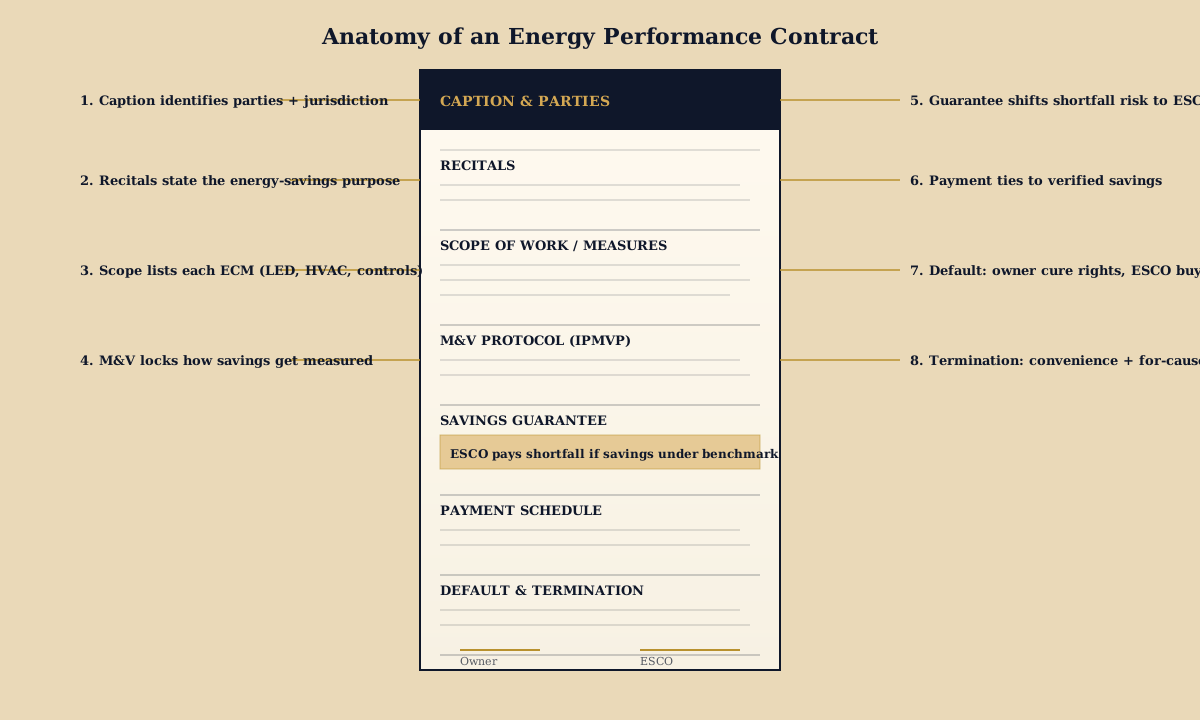
The drafting work on a long-form performance contract moves through eight recognizable sections. Each section carries weight far beyond its page count, because the dispute logic of the document depends on the way these sections cross-reference each other. The anatomy below shows the standard order; the commentary explains the drafting consequences of getting any one piece wrong.
Caption, recitals, and definitions
The caption identifies the parties, the agency or owner, the controlling jurisdiction, and the contract number. Recitals state the purpose, the authority for the procurement, and the central premise that the agreement is contingent on the savings guarantee. Definitions lock the meaning of baseline, energy-conservation measure, performance period, and avoided cost so the same words carry the same weight in every later section.
Scope of work and energy-conservation measures
Each ECM is itemized: lighting, HVAC, controls, building envelope, water-conservation, distributed generation, and any operations and maintenance services bundled into the package. The schedule lists the manufacturer, model, installation location, and acceptance criteria. Vague scope here is the most common drafting failure and the most common driver of later disputes about whether savings shortfalls trace to a defective measure or to outside conditions.
Measurement and verification protocol
The M&V section is the financial spine of the contract. Most agreements adopt the International Performance Measurement and Verification Protocol and elect one of its four options. Option A relies on stipulated values for the unmeasured variable; Option B measures continuously; Option C uses whole-facility utility bills; Option D models the building. The choice drives what counts as a verified saving, how disputes are resolved, and how the ESCO can be held to the guarantee.
Savings guarantee and reconciliation
The guarantee provision states that the ESCO will pay the difference if verified savings fall below the contractual benchmark in any reconciliation period. The reconciliation period is typically annual. The provision must address how the ESCO pays, the cure right for one period of underperformance before the guarantee triggers, and the cap on cumulative ESCO liability over the term. A guarantee with no cap is unusual; a cap of one to two years of payments is the market norm.
Payment schedule and security
The payment schedule ties periodic payments to the financing model. For ESPC, the schedule is the debt service amortization. For shared savings, payments float with verified savings. The security package usually includes a performance bond at acceptance, a payment bond covering the construction phase, and warranty bonds covering the performance period.
Investment-grade audit and baseline adjustments
The investment-grade audit, an ASHRAE Level 3 study hardened for underwriting, rides as an exhibit and supplies the contractual baseline. The adjustments clause then keeps that baseline honest over a two-decade term: routine adjustments normalize for weather using heating and cooling degree days, and non-routine adjustments handle occupancy changes, altered operating hours, and building additions. Contracts that never say who calculates a non-routine adjustment, or by what method, hand the losing party its best litigation argument.
Equipment title, O&M, and standards of comfort
The contract states when title to each installed measure passes to the owner, usually at acceptance in guaranteed savings deals and at term expiration in shared savings deals, and allocates operations and maintenance duties measure by measure in an O&M responsibility matrix. A standards-of-comfort clause fixes minimum temperature, lighting, and ventilation levels so the ESCO cannot manufacture savings by degrading the occupants' environment. A buyout schedule prices early termination year by year so a refinancing or sale never requires a negotiation from scratch.
Default, termination, and assignment
The default and termination article addresses owner default, ESCO default, termination for convenience, termination for material breach of the savings guarantee, and the buy-out price the owner pays to retire the contract early. Assignment provisions are heavily negotiated because the ESCO often assigns its receivable to a project lender, and the owner needs comfort that assignment will not strip the savings guarantee from the financing party.
The eight sections combine into a document that typically runs eighty to two hundred pages plus exhibits. Two recurring drafting failures show up in litigation often enough to flag as standalone risks. First, baseline assumptions written into the recitals rather than the M&V section are unenforceable because the recitals do not survive contract integration; the protocol clause has to import them by reference. Second, the savings guarantee written into the payment schedule rather than its own article gets parsed as a payment-side covenant rather than a vendor warranty, which subtly changes the remedies framework if the ESCO refuses to pay. A clean draft places each substantive promise in its own article and never lets a recital do the work of an operative provision.
Where the ESCO is also the construction contractor, the contract should be drafted with a clear severability of the construction and performance phases. The dispute logic at construction acceptance differs from the dispute logic during the performance period, and treating both phases under a single warranty regime compresses the owner's remedies. Counsel familiar with hybrid construction-and-service drafting, or with the related discipline of mid-term contract amendments, has a real advantage on these instruments because the same issues show up at the change-order stage every contract sees over its life.
Part Four
How Courts Rule and What Tilts the Balance
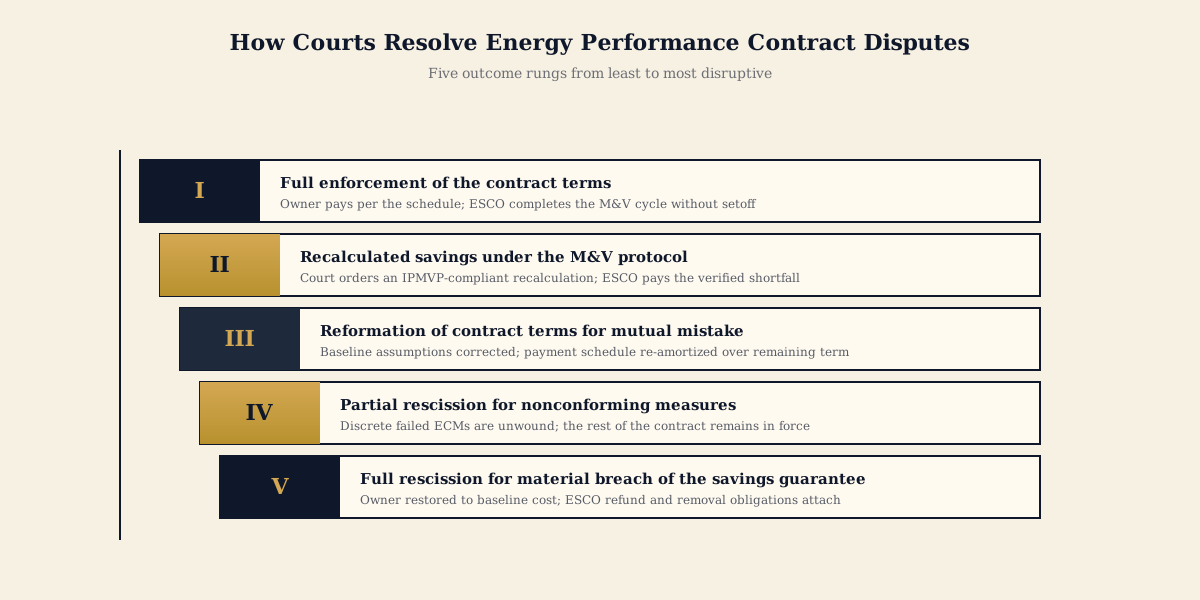
When an energy performance contract reaches a courtroom, the dispute almost always centers on whether verified savings actually fell short of the benchmark and, if so, whether the shortfall traces to the ESCO's installation work or to changes in the building's use. The court's outcome choice runs along a five-rung ladder, from full enforcement at one extreme to full rescission at the other, with three intermediate remedies that get the most use in practice.
Federal courts handling EPC disputes generally hold disputes that involve a federal agency to a docket schedule under Federal Rule of Civil Procedure 16, with a scheduling order that frontloads the M&V fact-finding before any merits motion is heard. Owners that cannot produce the baseline calculation, the IPMVP option election, and a year of post-installation utility data inside the first ninety days of the schedule almost always lose the materiality argument and drop down to outcome rung I or II. State-court analogs follow the same pattern under each state's civil rules.
Four factors do most of the work in determining where on the ladder a particular dispute lands. None of them is novel contract law, but each appears in EPC litigation with unusual frequency and unusual weight.
M&V protocol compliance
Courts uphold the savings guarantee when the M&V record is clean and reproducible under the elected IPMVP option. Drift from the elected protocol, undocumented adjustments to the baseline, or after-the-fact recasting of stipulated values gives the owner a strong path to reformation and pushes outcomes down the ladder.
Documentation of the baseline year
The single most outcome-determinative document in litigation is the baseline calculation. A contemporaneous baseline supported by twelve consecutive months of utility data, normalized for weather and occupancy, holds up. A reconstructed baseline assembled after the work is finished, or a baseline reliant on engineering estimates rather than metered data, almost always produces a recalculation order under outcome rung II.
Conformity of the installed measures
Where one or two ECMs underperform but the rest of the package delivers, courts gravitate to partial rescission of the failed measures rather than unwinding the entire contract. The drafting consequence is real: schedule the ECMs separately, allocate capital and savings to each, and the contract becomes severable on its face.
Cure-right exhaustion
Most energy performance contracts bake in a cure period of thirty to ninety days for any ESCO underperformance. Courts examine whether the owner gave the cure notice, whether the ESCO responded with a cure plan, and whether the plan was implemented in good faith. An owner who skips the cure right and goes straight to suit usually drops down at least one rung on the outcome ladder.
The practical takeaway for either side preparing to litigate an EPC is that the contractual record matters more than the witness testimony. The baseline file, the M&V option election, the cure-notice exchange, and the reconciliation reports are what the judge reads first. Where those documents are clean, the outcome tracks the contractual allocation. Where any of them are weak, the court redistributes risk under reformation or partial rescission rather than enforcing the document as written. An experienced commercial-contract litigator reviewing the file at the outset of a dispute can usually predict the outcome rung within a single rung of the eventual ruling, simply by reading those four document sets. For the doctrinal framework that EPC courts borrow when classifying a guarantee shortfall as material rather than minor, see our breach of contract demand letter page.
Before Litigation
The Pre-Suit Notice and Demand Step
Most energy performance contract disputes resolve before a complaint is filed. The reason is structural: the savings guarantee is contractually self-executing, and the cure provisions force the ESCO and the owner to exchange documented positions about the shortfall before either side accumulates legal exposure. A written demand that itemizes the reconciliation period, the verified savings, the contractual benchmark, and the cure notice triggers the ESCO's contractual response window and preserves the record for any later proceeding.
A precise notice of breach for the savings guarantee does three things at once. It activates the ESCO's contractual cure right and starts the cure clock. It documents the owner's damages calculation in a form that survives later challenge under the parol-evidence rule. And it forces the ESCO's lender, who usually holds an assignment of the savings stream, to come to the table along with the ESCO. Counsel handling these instruments works the demand step as a project rather than as correspondence, because every word of the notice ends up in the litigation file if the matter does not settle.
An energy performance contract is a long-term agreement under which an energy service company designs, finances, installs, and verifies energy-conservation upgrades to a building, and the building owner repays the cost out of the verified utility savings produced by those upgrades. The defining feature is the savings guarantee. The energy service company, generally referred to as the ESCO, contractually commits that the verified savings will meet or exceed the periodic payment, and the ESCO pays any shortfall. The structure is widely used for federal facilities under the Federal Energy Management Program, for state and municipal buildings, for school districts, and for large institutional owners. The contract typically runs ten to twenty-five years and is the only commercial contract format in which a vendor warrants the financial outcome of its own installation work over its useful life.
What are the types of energy performance contracts?
Three principal types of energy performance contract are in common use. A guaranteed savings contract has the building owner finance the project directly and the ESCO contractually guarantee that verified savings will cover the debt service; this is the dominant federal model under 42 U.S.C. section 8287, including the Energy Savings Performance Contract used by federal agencies. A shared savings contract has the ESCO finance the project and split the savings stream with the owner over the term, with the ESCO bearing utility-rate and consumption risk. A Utility Energy Service Contract, used by federal agencies under 42 U.S.C. section 8256, allows a serving utility to design, install, and finance the upgrades and recover the cost through the agency's monthly utility bill. Each model allocates capital, savings, and shortfall risk differently and triggers a different drafting strategy.
What is the difference between guaranteed savings and shared savings contracts?
The two structures split performance risk and credit risk differently. In a guaranteed savings contract the owner borrows the capital, so the lender underwrites the owner's credit, and the ESCO carries only performance risk through the savings guarantee. In a shared savings contract the ESCO or its project-finance vehicle supplies the capital, so the ESCO carries both the performance risk and the customer's credit risk, and it prices both into its percentage of the savings stream. Guaranteed savings dominates the United States market because public owners can borrow at tax-exempt rates far below any ESCO's cost of capital, and because the owner keeps title to the equipment from installation. Shared savings persists as the workable option for customers with weak credit or no borrowing capacity, since the deal closes on the strength of the project rather than the owner's balance sheet.
What is an investment-grade energy audit?
An investment-grade audit is the engineering study that becomes the contractual baseline of an energy performance contract. ASHRAE recognizes three audit levels: a Level 1 walk-through that screens a building for obvious savings, a Level 2 energy survey with measure-by-measure savings and cost estimates, and a Level 3 detailed analysis of capital-intensive modifications with hourly modeling. An investment-grade audit applies Level 3 rigor tightened for underwriting: metered baseline data, measure-level savings calculations an independent reviewer can reproduce, and cost estimates firm enough to finance against. The audit is attached to the contract as an exhibit, its baseline calculation becomes the benchmark every future saving is compared against, and most enabling statutes require the owner to pay for the audit only if the parties fail to proceed to a contract that meets the audit's projections.
How are savings measured and verified under IPMVP options A through D?
The International Performance Measurement and Verification Protocol offers four options that the contract must elect measure by measure. Option A is retrofit isolation with key-parameter stipulation: one variable, such as operating hours, is stipulated and the rest is measured. Option B is retrofit isolation with full measurement of the affected system. Option C is whole-facility analysis built on the utility bills for the entire building, used when measures interact too much to isolate. Option D is calibrated simulation, a computer model of the building tuned to actual consumption, used for new construction or where no usable baseline exists. Stipulated values cost less to administer but shift consumption risk to the owner; fully measured savings cost more but make the guarantee harder to dispute. The ESCO documents results in an annual M&V report, and the contract should also distinguish routine baseline adjustments, such as weather normalization using heating and cooling degree days, from non-routine adjustments for changes in occupancy, operating hours, or building additions.
How are energy performance contracts financed?
Public-sector guaranteed savings projects are most often funded through a tax-exempt lease-purchase, sometimes called a municipal lease, in which a lender funds the installation and the owner makes lease payments sized to the guaranteed savings, with a non-appropriation clause that lets the government terminate if future funds are not appropriated. These obligations generally sit on the public owner's balance sheet, and public finance officers should confirm current GASB reporting treatment with their auditors before closing. Federal agencies use the ESPC authority at 42 U.S.C. section 8287, commonly through the Department of Energy's indefinite-delivery, indefinite-quantity ESPC contract vehicle, which permits terms up to twenty-five years and requires no upfront appropriation because payments come from avoided utility cost. Private owners either borrow conventionally under a guaranteed savings structure or let the ESCO finance the project in a shared savings structure at a higher all-in cost.