Pre-Litigation Contract Drafting

Breach of Contract Attorney Drafted Notices, Demand Letters, and Cure Correspondence

A breach of contract attorney drafts the notice of breach, the demand letter, and the cure-or-quit correspondence that put the dispute in front of the recipient's counsel before any complaint is filed. Letters cite Restatement (Second) of Contracts §241, §250, and §347, plus UCC §2-607, §2-609, and §2-610 where the contract is for goods. Most disputes resolve at the cure deadline. The same drafting attorney also handles breach of contract demand letter drafting as a standalone deliverable.

By Jessica Henwick, Editor-in-ChiefLegally reviewed by David Chen, Esq.
4.9 / 5 from commercial clients
Restatement §347 / UCC §2-607 framework
24-hour AI / 3-5 day attorney
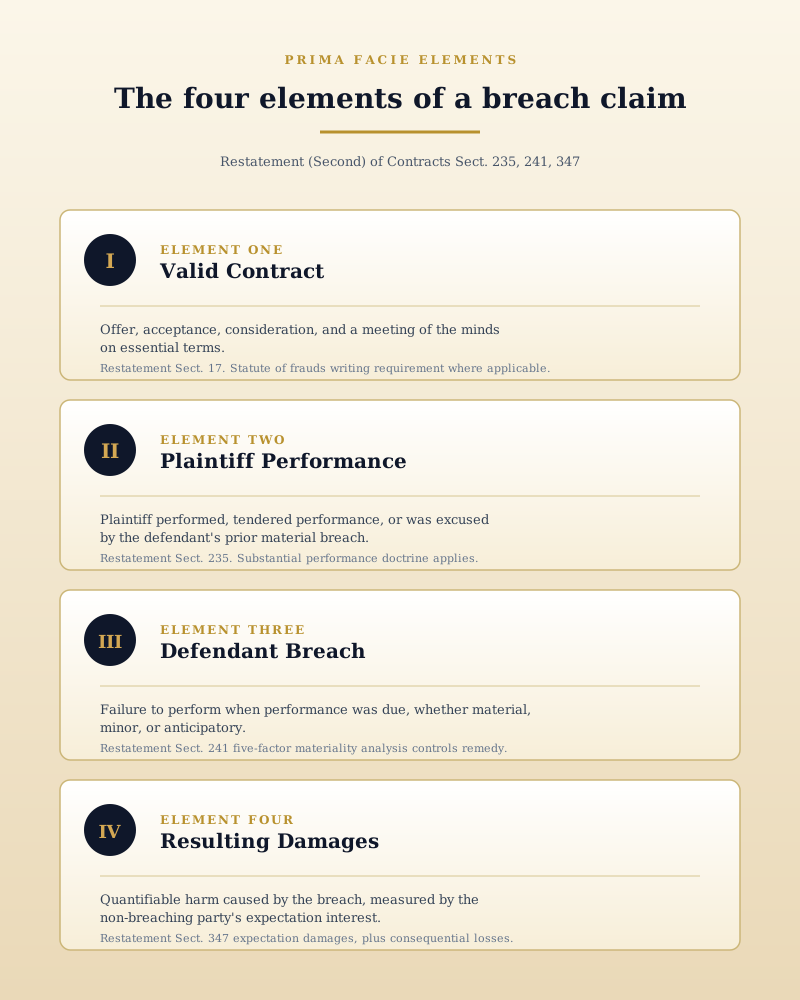
The four prima facie elements of a breach of contract claim diagrammed with Restatement (Second) §235, §241, and §347 citations
01Doctrinal Foundation

What Is a Breach of Contract

A breach of contract is the failure, without legal excuse, to perform a duty owed under a valid contract. The breach of contract definition is doctrinal and consistent across jurisdictions: the four breach of contract elements for a prima facie claim are a valid contract, the plaintiff's performance or excused non-performance, the defendant's failure to perform a contractual duty, and damages caused by the failure. Each element is recited in the drafted demand letter in evidentiary order, which both shortens the dispute and pre-builds the complaint paragraphs if the matter does not settle.

Breach of contract law in the United States is governed by the common law of contracts as restated in the Restatement (Second) of Contracts, and for sales of goods, by Article 2 of the Uniform Commercial Code as enacted in each state. The controlling state law applies in diversity actions under Erie Railroad Co. v. Tompkins, 304 U.S. 64 (1938), and the contract's own choice-of-law provision controls the substantive analysis where the chosen state has a reasonable relationship to the transaction.

The strongest breach of contract case is one where the contract is written and integrated, the breached provision is identified by section, the non-breaching-party performance is documented, and the damages calculation is arithmetic rather than expert-driven. The drafted breach of contract letter is built around those four pillars. A breach of contract claim that the recipient's counsel evaluates as trial-ready almost always settles at the cure deadline.

01

A Valid Contract

A breach of contract claim begins with proving a valid contract: offer, acceptance, consideration, mutual assent, and capacity. Statute-of-frauds categories (sales of goods over $500 under UCC §2-201, real-estate transfers, contracts not performable within one year) require a writing. Oral contracts outside those categories are enforceable but harder to prove because parol-evidence work is required.

02

Plaintiff's Performance

The non-breaching party must show performance or a legally excused non-performance. Substantial performance suffices in service contracts; perfect tender is required in sales of goods under UCC §2-601. Excuses include impossibility, frustration of purpose, prior breach by the other party, and a valid condition not satisfied.

03

Defendant's Failure to Perform

The defendant's failure to perform a contractual duty when due. The breach is characterized as material under Restatement (Second) §241, minor (partial), anticipatory under §250, or fundamental. Characterization controls available remedies and the cure rights the recipient retains.

04

Damages Caused by the Breach

Recoverable damages under §347 (expectation, the most common measure), §349 (reliance, where expectation cannot be measured), and §351 (Hadley v. Baxendale foreseeability cap). Punitive damages are not recoverable for ordinary breach of contract. UCC Article 2 governs damages for sales of goods (§§ 2-708, 2-709, 2-712 through 2-715).

Statute of Limitations Warning

Breach of contract limitations periods range from three to fifteen years by state for written contracts (most commonly four to six), and from two to six years for oral contracts. Sales of goods are governed by UCC §2-725, which sets a four-year period that the parties may shorten to one year by agreement but may not extend. Sending a notice of breach or a demand letter does not toll the limitations clock. Calendar the exact expiration date, set the cure deadline well before that date, and be prepared to file suit on schedule even if the recipient has not responded.

02Pre-Litigation Posture

Why the Letter Goes Out Before Any Complaint Is Filed

A breach of contract attorney's first deliverable is a drafted letter, not a pleading. The letter applies settlement pressure that the complaint cannot.

The drafted notice of breach of contract starts the cure clock under Restatement (Second) of Contracts §237 and the contract's own cure-period provision. Filing a complaint without first sending a drafted demand forfeits that cure window and often violates a contractual condition precedent to suit. Most commercial contracts contain a notice provision that requires written breach of contract notice with a defined cure period before the non-breaching party may treat the contract as terminated.

The drafted letter also preserves the statutory prerequisites for state commercial fee-shifting. Massachusetts Chapter 93A demand letters, California Civil Code §1717 attorney-fee provisions, and Texas Business & Commerce Code §17.50 deceptive-trade claims each require a written demand before treble damages or attorney fees are recoverable. A formal breach of contract demand is the document that satisfies these statutory predicates.

For sales of goods, UCC §2-607(3)(a) requires the buyer to give notice of breach within a reasonable time after the buyer discovered or should have discovered the breach, on pain of being barred from any remedy. The drafted letter satisfies this statutory bar; without it, an otherwise valid breach of contract claim is gone. A termination notice with reservation of rights follows once the cure window has expired without performance.

03Breach Categories

Four Breach Types the Drafted Letter Characterizes

The breach characterization controls what remedies the letter can demand and what cure rights the recipient retains. The four categories, material breach, minor breach, anticipatory breach, and fundamental breach, each carry their own remedy posture. Misclassifying the breach is the most common wrongful-termination counterclaim trigger; the drafted letter recites the characterization with the supporting authority before any termination right is exercised.

Material Breach

Restatement (Second) §241 five-factor test

A material breach defeats the central purpose of the contract under Restatement (Second) of Contracts §241, evaluated on extent of benefit deprived, adequacy of compensation, forfeiture suffered by the breaching party, likelihood of cure, and good faith. The drafted notice recites each §241 factor against the recipient's conduct so the materiality determination is documented before any termination right is exercised.

Minor or Partial Breach

Damages remedy, no termination right

A minor breach allows the non-breaching party to recover damages but does not authorize termination of the contract. The drafted demand letter is calibrated to recover the partial-performance shortfall and to put the recipient on notice that further partial breaches will be treated cumulatively. Misclassifying a minor breach as material is a primary source of wrongful-termination counterclaims; the drafted letter avoids that exposure.

Anticipatory Repudiation

Restatement §250 + UCC §2-610

An anticipatory breach occurs when the recipient declares (by word or conduct) that it will not perform a future obligation. Under Restatement (Second) §250 and UCC §2-610 for sales of goods, the non-breaching party may treat the contract as broken immediately, suspend its own performance, and recover damages without waiting for the performance date. The drafted letter documents the repudiating statement, demands adequate assurance under UCC §2-609 where applicable, and sets the deadline beyond which performance will be deemed breached.

Fundamental Breach (Common Law)

Goes to root of the contract

A fundamental breach defeats the consideration the non-breaching party bargained for, justifying termination and full expectation damages under §347. Recognized in common-law contract jurisdictions and in international contracts under the Convention on Contracts for the International Sale of Goods (CISG) Article 25. The drafted letter frames the breach as fundamental where the facts support the characterization, and as material under §241 where common-law treatment governs.

04Letter Anatomy

Anatomy of a Breach of Contract Letter

A drafted breach of contract letter is structured in six sequential components. Each component does specific procedural work; the letter as a whole is the document the recipient's counsel evaluates when deciding whether to settle, cure, or litigate.

A breach of contract letter, sometimes commissioned as a cure letter, sometimes as a standalone letter for breach of contract performance, and sometimes as a sequenced notice and demand, follows the same six-component structure regardless of label. A drafting attorney recognizes which sequence the contract's notice provision and the controlling state law require, then assembles the components in the order that satisfies each procedural prerequisite without forfeiting the cure period.

Component 01

The Notice of Breach Section

Identifies the breached provision and starts the cure clock

A breach of contract letter opens with a notice of breach: the contract section identified by number, the conduct that constitutes the breach, and the date the breach was discovered. For sales of goods, this section is mandatory under UCC §2-607(3)(a); the buyer who fails to give notice within a reasonable time after discovery is barred from any remedy. The notice of breach also starts the cure clock under Restatement (Second) §237 and any contractual cure-period provision.

Component 02

The Materiality Recitation

Restatement §241 five-factor analysis

The letter recites each Restatement (Second) §241 factor against the recipient's conduct: the extent the non-breaching party is deprived of the benefit reasonably expected, the adequacy of compensation for the part of that benefit forfeited, the extent of forfeiture by the breaching party if treated as material, the likelihood the breaching party will cure, and the breaching party's good faith. Documenting the materiality determination in the letter forecloses a wrongful-termination counterclaim if termination follows.

Component 03

The Damages Calculation

§347 expectation, §349 reliance, §351 foreseeability cap

Damages are recited under the controlling rule. Expectation damages under §347 are the default: the dollar amount that puts the non-breaching party in the position it would have occupied had the contract been performed, including consequential damages foreseeable under §351. Reliance damages under §349 are pleaded in the alternative where expectation cannot be measured. For sales of goods, the calculation is under UCC §2-708 (seller) or §§ 2-712 through 2-715 (buyer cover and consequentials). The letter shows the math, not just the number.

Component 04

The Cure Period and Deadline

Calibrated to the contract's own cure provision

The letter recites the cure period set by the contract or, where the contract is silent, by Restatement §237 reasonableness. AIA Form A401 §13.2 and most master service agreements specify a fixed window (commonly seven, fifteen, or thirty days). UCC §2-609 adequate-assurance demands carry a thirty-day reasonableness ceiling. The cure deadline is set to a calendar date and time so the consequence of non-cure is documented and unambiguous.

Component 05

The Specific Remedy Demanded

Payment, performance, or termination with damages

The letter demands a specific remedy: payment of a stated dollar amount, performance of an identified contractual duty, or termination of the contract with damages preserved. The remedy is matched to the breach characterization (material breach permits termination; minor breach does not) and to the contract's own remedies provision. Optional clauses include AAA Commercial Arbitration Rules invocation, forum-selection enforcement, and prevailing-party attorney-fee notice under any §17.50 (Texas DTPA) or Chapter 93A (Massachusetts) statute that gates fee recovery.

Component 06

Reservation of Rights and Litigation Hold

Preserves accrued damages and document preservation

The letter closes with a reservation-of-rights paragraph that preserves accrued damages, the right to suspend further performance, and the right to sue for unperformed obligations. A litigation-hold notice is included where suit is realistic: the recipient and its custodians are placed on notice to preserve documents and electronically stored information, and spoliation is identified as the basis for an adverse-inference application at trial.

04BAnnotated Sample

Sample Breach of Contract Demand Letter

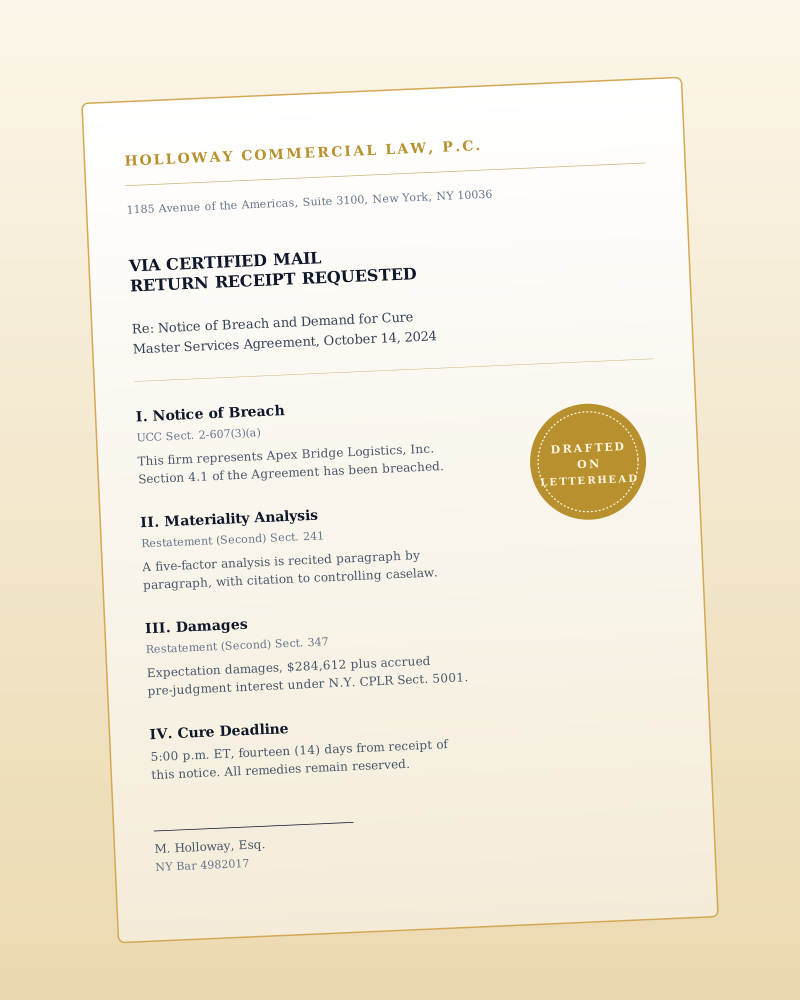
The sample below is the kind of pre-suit breach demand we draft against a defaulted commercial counterparty under a master services agreement, with material breach framing under Restatement (Second) of Contracts § 241, expectation damages under § 347, prejudgment interest accrual, and a fixed acceptance window. The legal substance, citations, and demand mechanics mirror live retained matters; only the names, invoice numbers, and dollar figures are illustrative.

Real Sample, Pre-Suit Demand on a Defaulted Commercial Receivable

Drafted in the voice of commercial collections counsel after a 96-day default on a six-figure invoice, with full UCC framework, prejudgment-interest accrual, and time-limited acceptance terms. Names, dates, invoice numbers, and dollar figures are illustrative; the legal substance, statutory citations, case authority, and demand mechanics are how a competent demand letter lawyer drafts a real pre-suit collections demand under a master services agreement.

Preview the full sample letter

Sample only. Names, dates, invoice numbers, dollar figures, and the law firm shown above are illustrative. The legal substance, statutory citations, case authority, evidentiary structure, damages framework, and time-limited acceptance mechanics shown here reflect how a competent commercial collections attorney drafts a real pre-suit demand letter on a defaulted receivable governed by New York law.

Holloway Commercial Law, P.C.

1185 Avenue of the Americas, Suite 3100

New York, NY 10036

Tel: (212) 555-0177 · mholloway@holloway-commercial.example

May 4, 2026

VIA CERTIFIED MAIL,

RETURN RECEIPT REQUESTED

AND ELECTRONIC TRANSMISSION

(accounts.payable@meridian-procurement.example)

Ms. Kara M. Donovan, Chief Financial Officer

Meridian Procurement Group, Inc.

88 Pine Street, 18th Floor

New York, NY 10005

Re: Final Demand for Payment — Master Services Agreement dated October 14, 2024 (the “Agreement”); Invoice Nos. AB-2025-1182, AB-2025-1241, and AB-2025-1289

Outstanding Balance: $284,612.00 in unpaid principal, plus accrued contract interest, late fees, and collection costs

Demand Open Through: 5:00 p.m. Eastern Time, May 18, 2026 (fourteen days)

Dear Ms. Donovan:

This firm represents Apex Bridge Logistics, Inc. (“Apex Bridge” or our “Client”) in connection with the unpaid balance owed by Meridian Procurement Group, Inc. (“Meridian”) under the Master Services Agreement dated October 14, 2024 between the parties (the “Agreement”). As of the date of this letter, three undisputed invoices remain unpaid in the aggregate principal amount of $284,612.00, the oldest of which is now ninety-six days past due. We write to make a final pre-suit demand for payment in full, with contract interest, late fees, and collection costs, on or before 5:00 p.m. Eastern Time on May 18, 2026. The deadline is set in good faith and is fully sufficient to authorize and execute a wire transfer through any commercially reasonable treasury function.

Failure to remit on the terms set out below will result in the immediate filing of a verified complaint in the Supreme Court of the State of New York, County of New York, for breach of contract, account stated, and unjust enrichment. The Agreement contains an exclusive New York forum-selection clause (§ 14.4) and a contractual attorney’s-fee shifting provision in favor of the prevailing party (§ 14.6). Both will be enforced.

I. The Agreement and the Unpaid Invoices

On October 14, 2024, Apex Bridge and Meridian entered into the Agreement, under which Apex Bridge furnishes contract logistics services on Meridian’s behalf, including dedicated cross-dock capacity at Apex Bridge’s Newark, New Jersey facility, line-haul scheduling, and chain-of-custody manifesting for Meridian’s electronics-grade freight. Meridian’s payment obligations are governed by Sections 4 and 5 of the Agreement and by the Statement of Work executed concurrently (Exhibit A). Standard payment terms are net thirty.

Apex Bridge issued, and Meridian received, the three invoices listed below. Each invoice was timely transmitted, conforms to the Agreement’s invoicing requirements, and identifies the related Statement of Work line items. None has been the subject of any written objection, counterclaim, or set-off notice within the fifteen-day dispute window prescribed by Section 5.3 of the Agreement.

InvoiceService periodIssuedDueDays past dueAmount
AB-2025-1182Dec 16-31, 2025Jan 2, 2026Feb 1, 202696$118,940.00
AB-2025-1241Jan 1-15, 2026Jan 17, 2026Feb 16, 202681$87,420.00
AB-2025-1289Jan 16-31, 2026Feb 2, 2026Mar 4, 202665$78,252.00
Unpaid principal$284,612.00

Apex Bridge has fully and faithfully performed all conditions, covenants, and obligations under the Agreement that, on its part, are required to be performed. Acceptance of the underlying services is documented by Meridian’s signed bills of lading, ASN confirmations, and absence of any rejection notice within the acceptance period defined at Section 6.2 of the Agreement.

II. Default and Causes of Action

Breach of contract. Meridian’s failure to remit payment on each of the invoices identified above is a material breach of Sections 4.1 and 5.1 of the Agreement. Under New York law, the elements of breach of contract are (1) a valid contract, (2) plaintiff’s performance, (3) defendant’s breach, and (4) damages. Harris v. Seward Park Hous. Corp., 79 A.D.3d 425, 426 (1st Dep’t 2010). All four elements are met on the face of the Agreement and the invoices.

Account stated. An account stated arises from the retention of invoices by a debtor who, having received them, fails to object within a reasonable time. Morrison Cohen Singer & Weinstein, LLP v. Waters, 13 A.D.3d 51, 52 (1st Dep’t 2004). Meridian’s receipt of each invoice is documented; Meridian raised no written objection within the contractual fifteen-day window or at any subsequent time. The unpaid balance is therefore an account stated and may be liquidated on summary judgment.

Unjust enrichment. In the alternative, Meridian has been enriched at Apex Bridge’s expense by accepting and consuming the contract logistics services and would be unjustly enriched if permitted to retain that benefit without payment. Mandarin Trading Ltd. v. Wildenstein, 16 N.Y.3d 173, 182 (2011).

III. Contract Interest, Late Fees, and Total Demand

Section 5.4 of the Agreement provides for contract interest on past-due amounts at the rate of one and one-half percent (1.5%) per month, or the maximum rate permitted by applicable law, whichever is less. That rate is enforceable as a matter of New York law and is below the criminal-usury threshold of N.Y. Penal Law § 190.40. Section 5.5 provides for a late fee of one percent of the invoice amount per calendar month, capped at five percent of the invoice. The accrued amounts as of the date of this letter are itemized below and are recalculated daily until paid.

ComponentBasisAmount
Unpaid principalThree invoices, supra$284,612.00
Contract interest at 1.5%/mo§ 5.4 (per-invoice accrual through May 4, 2026)$10,488.42
Late fees§ 5.5 (capped 5% per invoice)$10,212.96
Pre-suit collection costs§ 14.6 (Apex Bridge ledger, Exhibit B)$3,820.00
Total demand as of May 4, 2026$309,133.38

Interest accrues each day at $140.32. Should suit be filed, prejudgment statutory interest at nine percent per annum from the earliest date the cause of action accrued is also recoverable as a matter of right under N.Y. C.P.L.R. §§ 5001 and 5004; the contract rate (1.5% per month, 18% per annum) controls between contracting parties and exceeds the statutory rate, so the contract rate will be sought in any verified complaint.

Goods component, if any. To the extent any portion of the underlying transactions is characterized as a sale of goods rather than services, the New York Uniform Commercial Code applies. Buyer’s acceptance under N.Y. U.C.C. § 2-606, and the seller’s right to recover the contract price under § 2-709, fully support the demand. The hybrid character of contract logistics services does not affect the result on the facts presented.

IV. Time-Limited Demand and Acceptance Terms

On the basis of the documented breach and the documented damages above, Apex Bridge hereby demands payment of $309,133.38, plus per-diem interest of $140.32 from May 5, 2026 until the date funds are received, by wire transfer to the Apex Bridge operating account at JPMorgan Chase Bank, N.A., wire instructions attached as Exhibit C.

Acceptance. This demand is open through 5:00 p.m. Eastern Time on May 18, 2026. Acceptance is effected by Meridian’s receipt by Apex Bridge’s bank of cleared funds in the demanded amount on or before the deadline. No partial tender, post-dated commitment, or course-of-dealing extension will satisfy this demand.

Reservation of rights. Apex Bridge reserves all rights, including the right to suspend further performance under Section 7.3 of the Agreement, the right to declare the Agreement terminated for cause under Section 12.2, the right to accelerate any future-billed minimum-volume obligations under Section 4.5, the right to assert claims for consequential and incidental damages where contractually recoverable, and the right to register the unpaid balance with credit-reporting agencies and trade associations within the meaning of the Fair Credit Reporting Act, 15 U.S.C. § 1681 et seq., once the demand window closes.

V. Litigation Hold and Statute of Limitations

Litigation hold. Meridian and each of its officers, agents, and contractors are hereby placed on notice of a pending dispute and are required to preserve, and to instruct each custodian to preserve, all documents and electronically stored information relating to the Agreement and the unpaid invoices, including but not limited to: signed bills of lading; ASN confirmations and EDI transaction logs; accounts-payable ledgers and aging reports; treasury-function communications; emails, Slack messages, and Teams chats discussing the Apex Bridge relationship; and any minutes or memoranda referencing the unpaid balance. Spoliation will be the subject of an adverse-inference application at trial.

Statute of limitations. The applicable limitations period is six years for contract claims under N.Y. C.P.L.R. § 213(2), and four years for any U.C.C. Article 2 claim under N.Y. U.C.C. § 2-725. Apex Bridge does not waive and will not extend the statute and intends to file suit promptly upon expiration of this demand if it is not paid in full on the terms set forth above.

VI. Exhibits Indexed to This Demand

  • Exhibit A — Master Services Agreement and Statement of Work, fully executed
  • Exhibit B — Pre-suit collection-cost ledger
  • Exhibit C — Wire transfer instructions, Apex Bridge operating account
  • Exhibit D — Invoices AB-2025-1182, AB-2025-1241, AB-2025-1289 with detail
  • Exhibit E — Signed bills of lading and ASN confirmations
  • Exhibit F — Aging report and contemporaneous accounts-payable correspondence

Apex Bridge values its commercial relationship with Meridian and would prefer to resolve this matter without litigation. The terms of the Agreement nonetheless require performance and provide for fee-shifting and interest at the rates set out above. Please direct your written response, and any settlement counterproposal, to the undersigned at the address above or by email to mholloway@holloway-commercial.example. We are willing to discuss a brief payment plan supported by a confessed-judgment instrument and personal guaranty if that is the only path to full satisfaction.

We are not willing to extend the deadline absent a confirmed and creditable proposal in writing. Govern yourself accordingly.

Very truly yours,

Holloway Commercial Law, P.C.

By: ____________________________

Marcus T. Holloway, Esq.

NY Bar #4582019 · NJ Bar #034712019

cc: Apex Bridge Logistics, Inc. (client); claim file

Enclosures: Exhibits A through F (indexed)

Sample only. Names, dates, invoice numbers, dollar figures, and the law firm shown above are illustrative. The legal substance, statutory citations, case authority, evidentiary structure, damages framework, and time-limited acceptance mechanics shown here reflect how a competent commercial collections attorney drafts a real pre-suit demand letter on a defaulted receivable governed by New York law.

Want this drafted on your facts, with a real attorney’s signature on the page?

05Document Catalog

The Seven Documents the Drafting Practice Produces

A breach of contract attorney's drafted output is not a single letter. The dispute is sequenced across notice, demand, cure, settlement, repudiation, and termination correspondence, with each document calibrated to the contract's own provisions and to the controlling state contract law.

Notice of Breach

Declares the breached provision, cites the contract section, and starts the cure clock. Required under UCC §2-607(3)(a) for goods to preserve the buyer's remedies.

Cure-or-Quit / Notice to Cure

Frames the cure window required by the contract or by AIA Form A401 §13.2, and identifies the consequence of non-cure (termination, liquidated damages, suit). Common in construction and SaaS contexts.

Settlement Offer Letter

Proposes resolution at a defined dollar amount with release language, structured to be admissible as an offer of compromise under Federal Rule of Evidence 408 if litigation follows.

Anticipatory Repudiation Notice

Documents the repudiating conduct, demands adequate assurance under UCC §2-609 for goods or under common-law contract principles, and sets the deadline for performance confirmation.

Termination Notice With Reservation of Rights

Exercises the contract's termination right while preserving accrued damages and the right to sue for unperformed obligations. Avoids the accidental-waiver trap of bare termination letters.

Response to Recipient's Counter-Letter

Where the recipient responds with denials or affirmative defenses, the drafted reply addresses each defense, preserves the cure clock if still running, and prepares the evidentiary record for filing.

06Service Tiers

Two Drafting Paths

Single-recipient demands against commercial counterparties are well-served by an AI-drafted letter at a fixed price. Multi-letter sequencing, UCC adequate-assurance work, AAA arbitration framing, and high-stakes commercial counterparties require the attorney-drafted tier.

AI-Generated Breach of Contract Letter

An AI-drafted notice of breach or demand letter prepared from the supplied contract, the section breached, and the requested remedy. Restatement §347 damages framing and UCC §2-607 notice language included where the underlying transaction governs goods. Suitable for clear-cut breaches against commercial counterparties where an attorney signature is not strategically required.

  • Twenty-four-hour delivery
  • Restatement §347 damages framing
  • UCC notice language for goods contracts
  • Cure deadline and consequence language
  • PDF and DOCX export
Generate from $99

Attorney-Drafted Breach of Contract Letter

A breach of contract attorney drafts and signs the letter on attorney letterhead, calibrated to the contract's own cure and arbitration provisions, the controlling state contract law, and the recipient's likely counsel posture. Used where the contract value exceeds $25,000, where the recipient has previously ignored a demand, or where UCC §2-609 adequate-assurance work or AAA arbitration framing is needed.

  • Drafted from the contract and the breach record
  • Restatement and UCC citation framework
  • Cure-period calibration to contract terms
  • Arbitration / forum-selection drafting where applicable
  • Response-letter drafting if recipient counters
Request Attorney-Drafted Letter

Drafting, Not Litigation

This service drafts and signs the pre-litigation correspondence: notices, demands, cure letters, settlement offers, and termination notices. If the matter proceeds to suit, the documents and the citation framework transfer to the rights-holder's retained trial counsel for the complaint, discovery, and trial. A drafting practice complements a contract litigation attorney; it does not replace one.

The same separation applies to arbitration. AAA Commercial Arbitration Rules framing in the demand letter is part of the drafting work; the actual arbitration filing, hearing, and award proceedings are handled by retained arbitration counsel.

07Pricing

Breach of Contract Attorney Pricing

AI generation is fixed price. Attorney-drafted tiers scope to contract complexity, recipient counsel posture, and whether multi-letter sequencing is required.

AI-Generated Letter

$99

Single notice of breach or demand letter generated from the contract, the breach record, and the requested remedy. Formatted to the controlling state's contract law and to UCC Article 2 where the transaction is for goods.

  • Restatement §347 damages framing
  • UCC §2-607 notice language for goods
  • Cure deadline and consequence
  • Single recipient, single contract
  • Twenty-four-hour delivery
  • PDF and DOCX export
Generate AI Letter
Most chosen

Attorney-Drafted Letter

Custom Quote

A breach of contract attorney prepares the letter on attorney letterhead, calibrated to the contract's cure and arbitration provisions and the recipient's expected counsel posture. Includes response-letter drafting if the recipient counters within the cure window.

  • Drafted on attorney letterhead
  • Restatement / UCC citation framework
  • Cure-period calibration to the contract
  • Forum-selection or arbitration framing
  • Response-letter drafting included
  • Sign-ready PDF
Request Attorney-Drafted Letter

Multi-Letter Sequence

Custom Quote

Coordinated drafting of the notice of breach, the demand letter, and the termination-with-damages letter as a sequenced package. Used where the contract requires layered notice and the recipient is expected to test each step. Drafted by retained drafting attorney; filed by retained trial counsel if litigation follows.

  • Notice of breach (UCC §2-607 if goods)
  • Demand letter with Restatement §347 framing
  • Termination-with-damages letter
  • Coordinated cure deadlines
  • Reservation-of-rights drafting
  • Hand-off package for retained trial counsel
Request Multi-Letter Package
08Drafting Counsel

The Attorneys Drafting Breach of Contract Letters

Every attorney-drafted letter is prepared by a drafting attorney whose document work centers on commercial breach, contractor disputes, and restrictive-covenant enforcement. The drafting attorney signs the letter; retained trial counsel files the complaint and conducts discovery if the dispute does not resolve at the cure deadline.

MH

Marcus Holloway, Esq.

Senior Litigation Attorney

Federal Civil Litigation: Pre-Suit Demand & Discovery Motions

Senior civil litigation attorney with twelve years in S.D.N.Y. and D.N.J. Drafts pre-suit demand letters for commercial collections and breach-of-contract recovery, plus FRCP 37 motions to compel discovery, protective-order motions, and 30(b)(6) follow-on motions for federal commercial, trade-secret, and securities matters.

4.9 (487)2,100+ drafted
New YorkNew JerseyS.D.N.Y.D.N.J.
NB

Nathan Brookfield, Esq.

Construction, Consumer & Federal Discovery Counsel

Contractor Disputes, Consumer Protection & 30(b)(6) Motion Practice

Drafts demand letters under Chapter 93A, CLRA, and state contractor lien statutes, plus cease and desist letters against contractors continuing unauthorized work. Also drafts FRCP 30(b)(6) designee-deficiency motions and FRCP 37 deposition compulsion motions in Massachusetts federal court for consumer-class-action and commercial discovery disputes.

4.8 (176)710+ drafted
MassachusettsRhode IslandD. Mass.
AC

Alexandra Chen-Park, Esq.

Employment, Restrictive Covenants & Civil Litigation Counsel

Workplace Disputes & State-Court Discovery Motion Practice

Drafts demand letters for unpaid wages and severance disputes, cease and desist letters for harassment and non-compete enforcement, and state-court motions to compel discovery under New York CPLR 3124, Illinois Supreme Court Rule 219, and California CCP 2030.300 / 2031.310. Practices across the three jurisdictions in employment, restrictive-covenant, and trade-secret matters.

4.9 (221)950+ drafted
CaliforniaNew YorkIllinois
DW

Daniel Whitaker, Esq.

Defamation, First Amendment & Commercial Litigation Counsel

Anti-SLAPP Practice & Federal Privilege-Log Challenges

Drafts defamation cease and desist letters calibrated against state anti-SLAPP statutes for online defamation, false reviews, and reputation matters. Also drafts FRCP 26(b)(5)(A) privilege-log challenges, in-camera review motions, and FRCP 34(b) production-deficiency motions for federal commercial litigation in Texas and Colorado, including federal-court motion practice in the Southern District of Texas.

4.8 (198)780+ drafted
TexasColoradoS.D. Tex.
09Outcomes

What Commercial Clients Say About the Drafted Letters

Our SaaS vendor was nine weeks behind on a six-figure milestone delivery and the master services agreement gave us a thirty-day cure right before termination. Their attorney drafted a notice of breach citing the specific SOW provisions, the Restatement (Second) of Contracts §241 material-breach factors, and a precise damages calculation. Vendor cured fifteen days into the cure period and waived $84,000 in disputed late fees rather than face the termination notice.

Renaud Pellerin

COO, B2B Software Company, Boston

Material Breach

Our co-packer told us in writing they would not deliver the next two purchase orders unless we agreed to a unilateral price hike. Their drafting attorney prepared a UCC §2-609 demand for adequate assurance and a UCC §2-610 anticipatory repudiation notice combined into a single letter. We sent it under our own signature; the supplier rescinded the threat in writing within seventy-two hours and shipped on the original terms. Saved a holiday production run that would have cost us roughly $310,000 in lost margin.

Yelena Markovic

VP Operations, Consumer Packaged Goods, Chicago

Anticipatory Repudiation

Construction subcontractor walked off our commercial buildout three weeks before substantial completion claiming a payment dispute that did not exist. Their attorney drafted a notice to cure under the AIA A401 cure provisions, attached the payment ledger and lien waivers, and gave a five-day deadline tied to the prime contract liquidated damages. Sub returned with a full crew the next morning and finished the punch list inside the cure window.

Hollis Tremaine

Owner, Commercial General Contractor, Denver

Notice to Cure

Bought $240,000 of specialty steel that arrived out of spec under our purchase order. Their attorney drafted a UCC §2-607(3)(a) notice of breach, preserved our right of rejection under §2-602, and demanded conforming goods or refund within twenty days. Seller credited the full purchase price and arranged return freight rather than litigate the rejection. Without the timely notice we would have been deemed to have accepted the goods.

Padraic Oduya

Procurement Director, Industrial Manufacturer, Houston

UCC Goods Breach

Our outsourced accounting firm missed three consecutive monthly close deadlines and refused to acknowledge the service-level provisions in the engagement letter. Their attorney drafted a service-contract breach demand citing the SLA section, the liquidated damages clause, and the AAA Commercial Arbitration Rules forum selection. Firm waived $26,000 in unpaid fees, refunded our prepayment, and released us from the remaining term inside ten days.

Beatrice Solfrizzi

CFO, Mid-Market Logistics Company, Atlanta

Service Contract Breach

10Common Questions

Frequently Asked Questions

The questions buyers ask before hiring a breach of contract attorney, with the answers our drafting team gives in intake.

What kind of lawyer do I need to sue for breach of contract?
Suing for breach of contract is handled by a contract litigation attorney admitted to the court where the matter will be filed. Before suit, the dispute is handled by a breach of contract attorney who drafts the pre-litigation correspondence: the notice of breach, the demand letter, the cure-or-quit letter, and any UCC §2-607(3)(a) notice required for goods. Most contract disputes resolve at the drafted-letter stage because the recipient's counsel reads the citation pattern and the cure deadline and recommends settlement rather than litigate. Hiring a contract litigation attorney to file a complaint without first sending a drafted demand exposes the plaintiff to fee-shifting risk under any prevailing-party clause in the contract and forfeits the inexpensive settlement window the cure period creates. The drafting attorney prepares the documents that put the dispute in front of the recipient's counsel; if the matter does not resolve within the cure window or by settlement, the same documents and authorities transfer to retained trial counsel for the complaint and discovery.
Is it worth suing for breach of contract?
Whether suit is worth filing turns on three numbers: the dollar amount of the breach, the recoverable expectation damages under Restatement (Second) of Contracts §347, and the litigation cost net of any prevailing-party fee-shifting clause. As a working rule, contract suits below $25,000 are net-negative against the litigation cost without a fee-shifting provision, but become net-positive at much lower amounts when the contract awards reasonable attorney fees to the prevailing party. The drafted demand-letter stage is almost always net-positive on its own merits because the cost is fixed and most disputes resolve at the cure deadline. The decision to file suit is reached after the cure window expires and the recipient has either ignored the demand or refused to perform; at that point the breach of contract attorney's drafted record (notice of breach, demand letter, response correspondence) becomes the evidentiary spine for the complaint that retained trial counsel files.
How much money can you sue for breach of contract?
Damages for breach of contract are governed by Restatement (Second) of Contracts §347 (expectation damages, the position the non-breaching party would have occupied had the contract been performed), §349 (reliance damages where expectation cannot be measured), and §351 (Hadley v. Baxendale foreseeability limitation, capping recovery at damages reasonably foreseeable when the contract was made). For sales of goods, UCC §2-708 and §2-709 govern seller's remedies and §2-712 through §2-715 govern buyer's remedies including cover damages and incidental and consequential damages. Punitive damages are not available for ordinary breach of contract; tortious-conduct exceptions (fraud, conversion, tortious interference) carry their own analysis. The drafted demand letter recites the specific damages calculation under the controlling rule so the recipient sees the dollar exposure without ambiguity.
How hard is it to prove a breach of contract?
A prima facie breach of contract claim has four elements: (1) the existence of a valid contract supported by offer, acceptance, and consideration; (2) the plaintiff's performance or excused non-performance; (3) the defendant's failure to perform a contractual duty; (4) damages caused by the failure. Proof difficulty turns on whether the contract is written or oral, whether performance was tendered, and whether the breach was material under Restatement (Second) §241. Written contracts with integrated language and clear performance metrics are the easiest to prove; oral contracts require parol-evidence work and are subject to statute-of-frauds defenses for matters within UCC §2-201 (goods over $500) or state real-estate or one-year-performance categories. The drafting attorney structures the demand letter so each of the four elements is recited in evidentiary order, which both shortens the dispute (recipient sees the case theory) and pre-builds the complaint paragraphs if the matter does not settle.
Is a breach letter the same as a demand letter?
A notice of breach and a demand letter are distinct documents that serve sequential functions, although a single drafted letter often combines them. A notice of breach declares that the recipient has breached a specified contract provision, identifies the section breached, and starts the cure clock under Restatement (Second) of Contracts §237 and the contract's own cure-period provision. A demand letter requests a specific remedy: payment of damages, performance of the duty, or termination with damages. Sequence matters in three contexts. Sales of goods require a UCC §2-607(3)(a) notice of breach to preserve the buyer's remedies; if no notice is given within a reasonable time after discovery, the buyer is barred from any remedy. Construction and AIA-form contracts require a notice of cure before termination. State commercial fee-shifting statutes (Massachusetts Chapter 93A, California Civil Code §1717) require a written demand before treble or fee recovery is available. A breach of contract attorney sequences these documents (or combines them in a single letter) to satisfy each procedural prerequisite without forfeiting the cure period.
11Related Services

Related Drafting Services

Breach of contract drafting sits alongside the standalone demand-letter document practice and the broader pre-suit correspondence catalog. Different page, different deliverable, same drafting attorneys.

Breach of Contract Demand Letter

The standalone demand-letter document used in most breach disputes. Companion to the broader attorney engagement on this page.

NDA Breach Demand Letter

Specific drafting practice for non-disclosure agreement breaches, with DTSA, state trade secret act, and §1836 exposure framing.

Demand Letter Lawyer

Parent demand-letter drafting practice covering payment, performance, and pre-suit notice work across all matter types.

Commission a Breach of Contract Letter

A breach of contract letter drafted by a commercial drafting attorney, calibrated to Restatement (Second) §241 material breach analysis, UCC §2-607 notice for goods, and the contract's own cure-period provision, is the document that puts the dispute in front of recipient counsel before any complaint is filed. We draft and sign the letter; retained trial counsel handles any complaint or arbitration that follows.