Laws of Contracts from Formation through Breach and Remedies
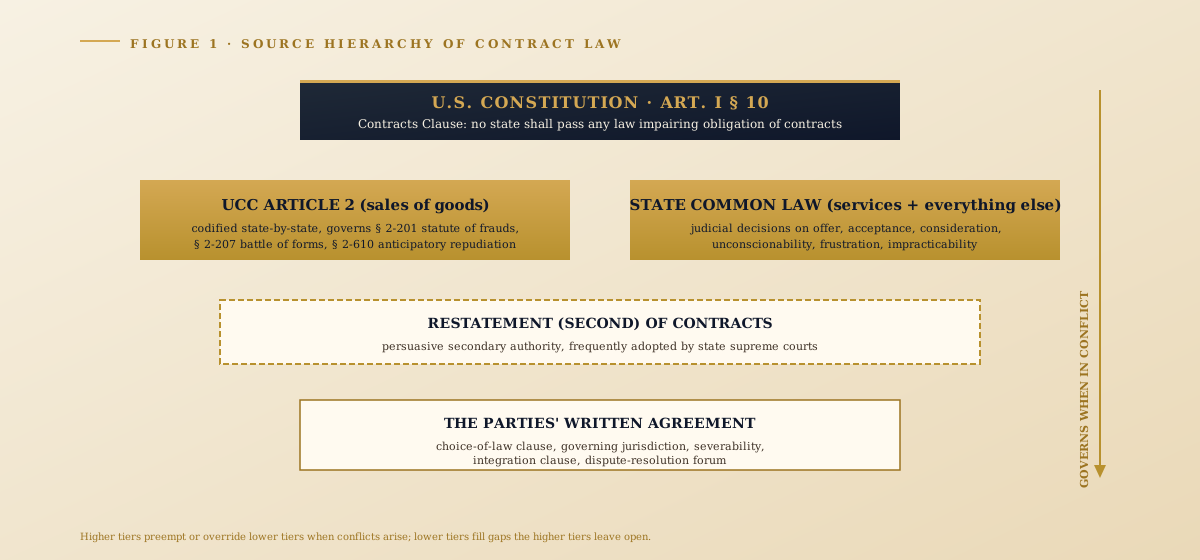
The laws of contracts govern when a promise is enforceable, what the parties must do while the agreement is in force, and what a court will award when one side fails to perform. In American practice the rules come from four overlapping sources that work together as a hierarchy: the United States Constitution at the top, the Uniform Commercial Code Article 2 and the state common law in the middle, the Restatement (Second) of Contracts as persuasive authority, and the parties' own written agreement at the base.

- 01U.S. Const., Art. I § 10
Contracts Clause, ceiling on state legislation impairing existing contracts
- 02UCC Article 2
Goods, codified state-by-state
- 03State common law
Services, real estate, employment, everything outside Article 2
- 04Restatement (Second) of Contracts
Persuasive secondary authority
- 05The parties' agreement
Operative document, governed by but never displacing the higher tiers
What the Laws About Contracts Actually Cover
When American lawyers refer to the laws about contracts, they mean a layered set of rules drawn from four sources, each with its own scope and weight in court. The sale of a tractor and the sale of a software-development service are governed by different primary authorities, and a court that ignores which set applies will produce the wrong answer. The first move in any contract analysis is identifying the source. For the doctrinal definition of a contract and the elements that must be present before any source-hierarchy analysis even begins, see our companion definition guide.
The Uniform Commercial Code Article 2 governs transactions in goods. Every state except Louisiana has adopted some version of it, and the case law applies it to the sale of equipment, inventory, vehicles, and tangible commercial product. The state common law of contracts, developed through judicial decisions over two centuries, governs everything outside Article 2: services, real-estate transfers, employment, licensing, construction. The Restatement (Second) of Contracts § 1 sits as a persuasive secondary authority that synthesizes the common-law rules and is widely cited by state supreme courts.
The Constitutional Floor: Article I, Section 10
Above all of these sits the Contracts Clause of the United States Constitution. It bars any state from enacting a law that impairs the obligation of existing contracts. The Clause is rarely outcome-determinative in private disputes, but it sets the ceiling: no state legislature can rewrite a private agreement after the fact without satisfying constitutional scrutiny.
UCC Article 2 and the Sale of Goods
Article 2 modifies several common-law rules in ways that practitioners must know cold. UCC § 2-201 imposes a writing requirement for sales of goods over five hundred dollars. UCC § 2-207 displaces the common-law mirror-image rule and lets a contract form even where the offer and acceptance differ on non-material terms. UCC § 2-610 permits the non-breaching party to treat an anticipatory repudiation as a present material breach and seek immediate remedy. UCC § 2-715 governs consequential and incidental damages on the buyer's side. Once the dispute is identified as a goods case, these specific rules supplant the common-law defaults.
State Common Law for Services, Real Estate, and Employment
Outside Article 2, state common law governs. The mirror-image rule requires acceptance to track the offer exactly. Consideration must be a bargained-for exchange of legal value, with mere moral consideration insufficient. Real-estate contracts must satisfy the statute of frauds, which every state codifies in some form. Employment contracts beyond at-will arrangements involve restrictive covenants, severance terms, and increasingly aggressive state statutes that override common-law freedom of contract in the non-compete and trade-secret area. These rules vary enough by jurisdiction that practitioners working across state lines must check the controlling state code before drafting.
The Restatement as Persuasive Authority
The Restatement is not law. It is a treatise published by the American Law Institute that distills the majority rules from decided cases and explains the reasoning behind them. State supreme courts cite it heavily, and many opinions adopt Restatement sections almost verbatim as the law of the state. The most-cited sections cluster around §§ 17 (the bargain requirement), 71 (consideration), 90 (promissory estoppel), 235 to 261 (performance and breach), and 344 to 385 (remedies). When a state has not decided a question directly, briefs that cite the Restatement persuasively often carry the day.
What the Laws on Contracts Are For
The point of the laws on contracts is to make promises reliable enough that strangers can transact at scale. A contract that is enforceable in court lets a buyer commit capital to a project before the goods arrive, lets a seller ship product before payment clears, and lets a lender extend credit on the strength of a written promise rather than personal trust. Without the enforceability backstop, every commercial relationship would collapse to face-to-face exchanges with friends, and the modern economy would not exist.
Three policy goals run through the doctrine. The first is the expectation principle: the non-breaching party should be put in the position they would have occupied had the contract been performed. The second is the certainty principle: rules of formation and interpretation should be predictable enough that parties can plan. The third is the fairness principle: courts retain power to refuse enforcement of agreements that offend public policy, were procured by fraud, or impose unconscionable terms on a party with no meaningful alternative.
Enforceability and the Predictability of Bargains
The doctrine prizes predictability. The objective theory of contract evaluates assent by what a reasonable person in the position of the offeree would understand, not by the offeror's subjective intent. The mirror-image rule (and its UCC § 2-207 modification for goods) defines when offer and acceptance match closely enough to form a contract. The parol evidence rule excludes prior negotiations that contradict an integrated writing. Each rule trades flexibility for the planning value of certain outcomes.
Allocating Risk Through the Written Agreement
The deal lawyer's job is to allocate risk in the document itself. Indemnification clauses shift the cost of third-party claims to the party best positioned to control the underlying risk. Limitation-of-liability clauses cap exposure at the bargained-for amount. Choice-of-law and forum-selection clauses decide whose courts and whose substantive law will control if a dispute arises. Each of these is a tool the laws on contracts make available to commercial parties. A well-drafted agreement uses these tools deliberately rather than copying boilerplate from a prior file.
The Implied Covenant of Good Faith and Fair Dealing
Every contract carries an implied covenant of good faith and fair dealing. The non-breaching party can sue on the covenant when the counterparty exploits a discretionary provision in a way that defeats the contract's purpose, even without violating the express text. The covenant cannot create substantive rights the contract did not contemplate, but it provides a check on opportunistic conduct that the drafter could not have anticipated when the writing was prepared.
Public Policy Limits on Freedom of Contract
Freedom of contract is the default but not absolute. Courts refuse to enforce agreements to commit crimes, agreements that impose penal liquidated damages, agreements that release a party from liability for gross negligence or intentional misconduct, and agreements unconscionable at formation. State legislatures override default rules in specific contexts (consumer protection, non-compete reform, residential lease habitability) where the legislature concludes that bargaining power is structurally unequal. The laws on contracts therefore reach both the formation moment and the long tail of how the parties actually behave under the contract.
How to Apply the Laws for Contracts to Any Dispute
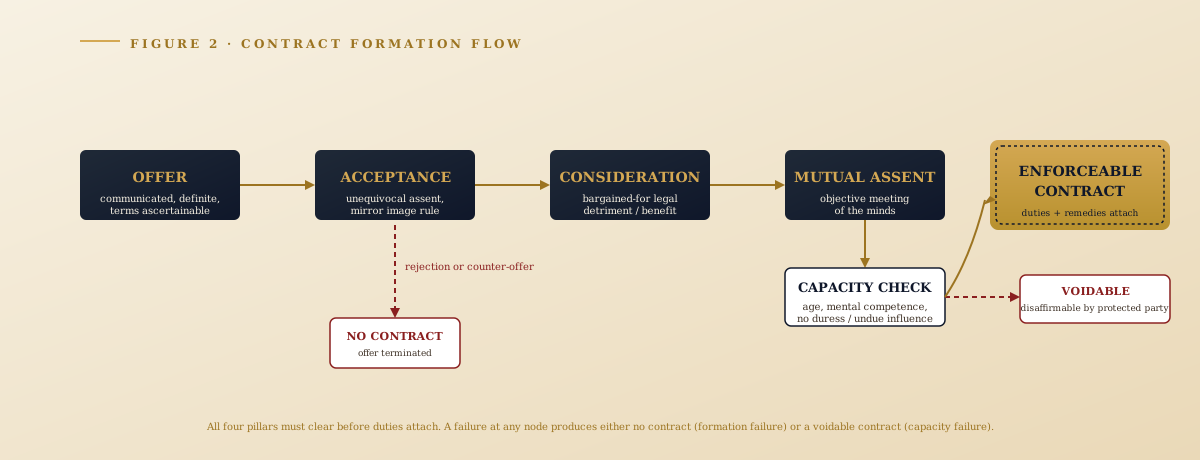
The laws for contracts resolve every dispute through the same four-pillar walk. Identify which source applies, then test formation, performance, breach, and remedies in order. A failure at any pillar ends the analysis at that pillar, and the parties return to where they started. Each pillar carries its own doctrinal vocabulary and its own decisive test.
- 01
Formation
Whether an enforceable agreement exists at all. Offer, acceptance, consideration, mutual assent, and capacity. The statute of frauds requires a writing for sales of goods over five hundred dollars under UCC § 2-201, real-estate transfers, agreements not performable within one year, and suretyship. Courts also apply unconscionability, fraud, and duress doctrines at this stage to refuse enforcement of agreements that cleared the formal requirements but offend bargaining-process norms.
- 02
Performance
What each party must actually do once the contract is in force. The duty to render substantial performance, the implied covenant of good faith and fair dealing, conditions precedent and concurrent, the perfect-tender rule under UCC § 2-601 for goods, and excuse doctrines (impossibility, impracticability, frustration of purpose). The Restatement (Second) of Contracts §§ 235 to 261 maps the performance and excuse rules that most state courts apply almost verbatim.
- 03
Breach
The failure to perform a duty owed, classified by severity. A material breach defeats the contract and excuses the non-breaching party from further performance. A minor breach allows damages but does not discharge the contract. Anticipatory breach occurs when a party signals before the performance date that they will not perform, codified at UCC § 2-610 for goods. Each classification controls what remedies the non-breaching party can pursue and whether they remain bound to perform.
- 04
Remedies
What courts will award the non-breaching party. Compensatory damages, measured by the expectation interest, are the default. Consequential damages cover foreseeable downstream losses under the Hadley v. Baxendale rule. Liquidated damages, specific performance, restitution, and rescission round out the menu. Equitable remedies remain reserved for situations where money cannot adequately compensate the loss, most commonly real-estate transfers and contracts for unique goods.
Walk Pillar One Before Walking the Others
Many contract disputes are decided at pillar one. If the offer was indefinite, if no consideration was exchanged, if the agreement falls within the statute of frauds and was never reduced to writing, or if a party lacked capacity at the moment of signing, no enforceable contract exists and the remedies discussion never starts. The plaintiff who skips pillar one and argues damages first will be sent home empty-handed.
Test Performance Against the Express and Implied Duties
Pillar two asks whether each party did what the contract required. Express duties come from the writing. Implied duties come from the gap-filling default rules under UCC § 2-309 (reasonable time), § 2-308 (place of delivery), and the common-law analogues for services. The substantial-performance doctrine forgives minor deviations on the obligor's side, while the perfect-tender rule under UCC § 2-601 imposes near-strict performance for goods. Conditions precedent, conditions concurrent, and conditions subsequent shift the obligation to perform on the other side.
Classify the Breach Before Pursuing Remedies
Pillar three asks how serious the failure was. The classification between minor and material breach controls whether the non-breaching party remains bound to perform. Anticipatory repudiation accelerates the cause of action. The key rule for this overview is that the classification controls both the remedy menu and the non-breaching party's ongoing duty to perform. Our breach of contract demand letter page walks through the material-versus-minor analysis with the case law most courts apply and the engagement path for a contested dispute.
Apply the Remedy Menu to the Specific Loss
Pillar four matches the loss to the available remedy. Money damages are the default; equitable remedies are the exception. The expectation interest, the reliance interest, and the restitution interest are the three measures the doctrine recognizes, and the choice depends on what the plaintiff can prove. The duty to mitigate runs throughout. Foreseeability under Hadley v. Baxendale caps consequential damages. Liquidated damages clauses are enforced only when reasonable at formation; penal clauses are struck.
How Courts Rule and What Tilts the Balance
Once a contract dispute is in front of a judge, the same laws of contracts that govern the deal also decide how the case is resolved. The plaintiff bears the burden of proving each pillar by a preponderance of the evidence: that a contract was formed, that the parties' performance was due, that the defendant materially breached, and that the loss claimed was a foreseeable consequence of the breach. The defendant can attack any pillar on the pleadings, at summary judgment, or at trial. Most rulings turn on four substantive factors that sit beneath the procedural posture.
- The Plain Language of the Writing
Most disputes are decided on the four corners of the document. The parol evidence rule excludes prior oral or written negotiations that contradict an integrated writing, and the integration clause that lawyers paste into every commercial template exists precisely to invoke that exclusion. When the language is unambiguous, courts enforce it as written, even where the result feels harsh.
- Trade Usage and Course of Dealing
When the writing is silent or ambiguous, UCC § 1-303 and the parallel common-law doctrine direct the court to fill gaps using trade usage (industry custom), course of dealing (the parties' prior contracts), and course of performance (their conduct under the present contract). These tools rarely override clear text, but they often resolve close calls in favor of the party whose reading aligns with industry practice.
- The Implied Covenant of Good Faith and Fair Dealing
Every contract carries an implied duty of good faith. Courts use it to police opportunistic conduct that the contract did not expressly forbid: refusing to cooperate with a condition, exercising a discretionary right in bad faith, or invoking a technical provision to defeat the other party's reasonable expectations. The covenant cannot create new substantive rights, but it can defeat a literal-text defense to a material breach.
- Comparative Fault and the Duty to Mitigate
Even a winning plaintiff has obligations. The duty to mitigate damages requires the non-breaching party to take reasonable steps to limit losses after a breach, and damages that could have been avoided are not recoverable. Reasonableness is judged by the circumstances at the time of the breach, not with hindsight, and the breaching party carries the burden of proving the failure to mitigate.
Where Contract Cases Are Actually Decided
Most contract cases never reach trial. They are decided on motions: motion to dismiss for failure to state a claim, motion for judgment on the pleadings, or motion for summary judgment. At the dismissal stage the court takes the complaint as true and asks whether the four pillars are pleaded; at summary judgment it looks to the evidentiary record and asks whether a reasonable jury could find for the non-moving party on any pillar. On appeal, questions of contract interpretation are reviewed de novo, which is why a clean integration clause and unambiguous language at drafting do most of the work later.
What a Contract Judgment Does
A contract judgment enters relief in a specific dollar amount tied to the expectation interest, with consequential damages limited by foreseeability under Hadley v. Baxendale and reduced by any failure to mitigate. Prejudgment and post-judgment interest run from the dates the controlling state statute specifies. Attorney-fee shifting follows the contract or the controlling fee-shifting statute, not the American rule default. Equitable relief like specific performance is reserved for real-estate transfers and unique goods where money cannot substitute for the bargained-for performance.
Settlement Pressure Throughout
The vast majority of contract disputes settle, often on the strength of a pre-suit demand letter and the defendant's evaluation of litigation cost. A well-drafted demand identifies the contract, the breach, the damages, the authorities, and the cure window in a way that makes the recipient's litigation risk concrete. Most commercial disputes resolve at the demand stage rather than through filed litigation, and the pressure point is a written demand built on the same four pillars the court would walk if the matter were filed.
Need a Contract Built on the Four Pillars
Reading the doctrine is one step. Translating it into a writing that actually allocates risk is another. Legal Tank builds the agreement against the controlling source code: UCC Article 2 for goods, the Restatement-aligned common law for services, the relevant state statute for employment and real estate, and the parties' allocation of risk through indemnity, limitation, and dispute-resolution provisions.