Damages-Based Agreements in the UK and What U.S. Lawyers Need to Know
A damages-based agreement is a written retainer that pays the lawyer a percentage of any compensation the client recovers, with no fee owed if the claim fails. The model shifts the financial risk of litigation from the client to the lawyer, sits inside a tightly regulated drafting framework, and competes with hourly billing and conditional fee agreements as one of three principal funding routes for civil claims.
A damages-based agreement, in relation to a matter that is the subject of legal services provided to a client, means an agreement under which the recipient of the services pays the provider an amount calculated by reference to those damages.

DBAs cap the lawyer's share at 25% in personal injury,35% in employment tribunal claims, and 50% in commercial matters. Disbursements such as court fees and expert fees sit outside that cap only if the retainer says so in writing.
What Is a Damages-Based Agreement? The Doctrine and How It Works
A damages-based agreement is a contingent retainer. The solicitor and the client sign a document that fixes a percentage figure; if the claim recovers compensation, the solicitor is paid that percentage of the recovery; if the claim fails, the solicitor receives nothing for time spent running the file. The structure is statutory in England and Wales, regulated under section 58AA of the Courts and Legal Services Act 1990 and the Damages-Based Agreements Regulations 2013, and it is the closest civil-procedure analogue to the American contingency fee retainer used in personal injury, commercial collections, and class proceedings.
The retainer differs from an ordinary hourly engagement in two ways. First, the lawyer carries the time risk of the matter rather than the client. Second, the fee is a fraction of a future, uncertain sum rather than a multiple of recorded hours, so the value of the lawyer's work is set by the outcome of the case rather than by the inputs measured in six-minute units. The Civil Procedure Rules treat properly drafted DBAs as between-solicitor-and-client documents, separate from the between-the-parties costs the court orders at conclusion.
The agreement does not mean the lawyer takes on every economic burden of the file. Court fees, expert reports, counsel fees, investigative work, and search fees are disbursementsthat the regulations treat separately. A compliant DBA can allocate those disbursements either to the lawyer (paid from the percentage if the claim wins, written off if it loses) or to the client (paid as incurred regardless of outcome). The drafting choice has to be express; otherwise courts read the ambiguity against the firm and the lawyer absorbs the cost.
Outside England and Wales, the closest cousin is the United States contingency fee. The contingency model is permitted under state bar professional-conduct rules, policed by ABA Model Rule 1.5 reasonableness, and capped by statute in medical malpractice and certain aviation matters. The structural overlap with a DBA is recovery-linked payment and risk-shift onto the lawyer; the structural difference is that US contingency fees sit inside bar-rule supervision rather than a single statutory regulation, and the percentage ceilings vary by state and case type rather than by a unified cap.
The defining characteristic of damages based work is therefore not the percentage figure itself, but the allocation of risk and the regulatory frame inside which the percentage is fixed. The cap, the disbursement clause, the termination clause, and the complaints pathway are the four drafting points where DBAs most often unravel in costs proceedings.
When Lawyers Use a Damages-Based Agreement, and Why
A solicitor reaches for a DBA in three recurring fact patterns, and the choice is almost always driven by client cash position rather than by the merits of the claim. The first pattern is the high-merit, low-resource claimant who has a genuine cause of action but cannot service an hourly retainer to judgment. Without a contingent retainer the claim never reaches a court clerk, the defendant goes unanswered, and the wrong is left undisturbed. The DBA puts the file on the docket.
The second pattern is the merits-driven commercial recovery where the plaintiff has the resources for hourly fees but prefers to transfer outcome risk. Group litigation, professional negligence, and large-scale breach of contract claims fall into this category. The defendant in those matters is on hourly billing, and the plaintiff's DBA flips the cost asymmetry: the plaintiff negotiates from a position where settlement does not cost the client anything off the top of cash flow, while the defendant watches its legal spend escalate with every motion practice cycle.
The third pattern is the employment tribunal claim, where the tribunal's no-costs default leaves a represented claimant exposed to legal fees with no inter-partes recovery available even on a clear win. The 35% employment cap recognises that the lawyer cannot recover from the losing party, so the contingent retainer is the only realistic delivery model for a tribunal-bound discrimination or unfair dismissal matter.
The economics of the choice depend on three variables: the probability of success, the expected size of the recovery, and the duration to settlement or judgment. The diagram below puts those variables into a side-by-side fee comparison at three illustrative recovery values, against an hourly retainer and a conditional fee agreement with the standard 25% uplift.
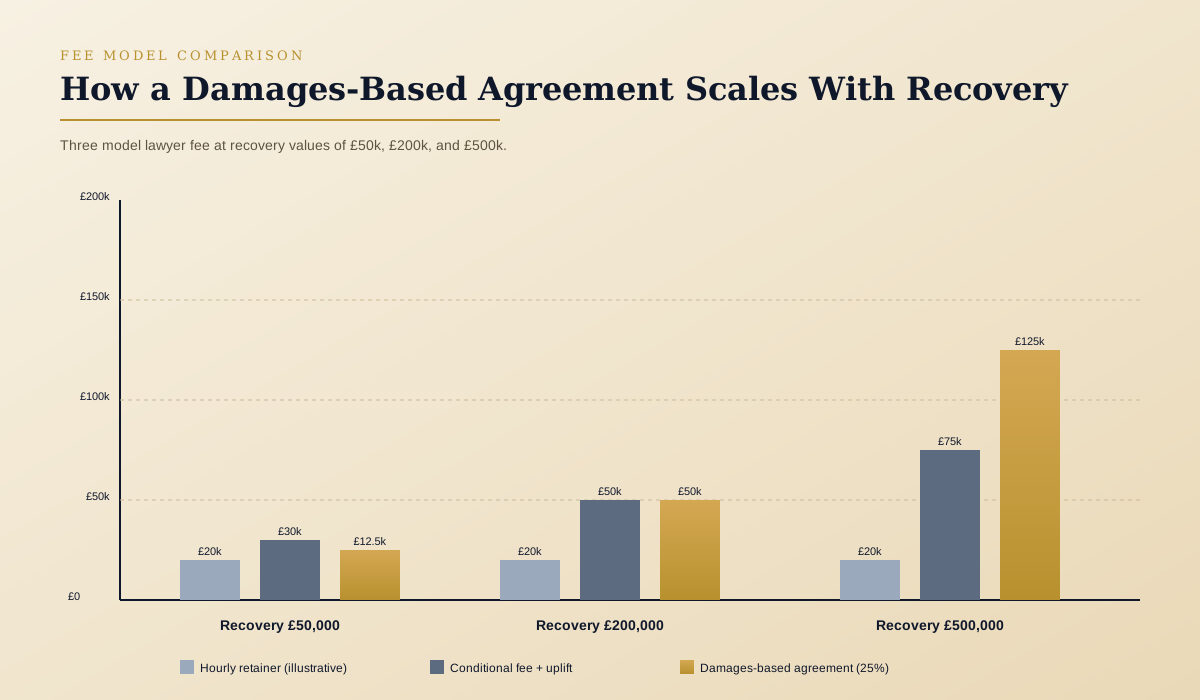
The chart shows the inflection point clearly. At low recoveries the hourly retainer is the cheapest fee structure for the client, but also the riskiest because the bill arrives whether or not the case wins. At medium recoveries the conditional fee agreement and the DBA converge: a 25% DBA on a £200,000 recovery is mathematically identical to a CFA priced at the same uplift level, though the CFA accrues some between-the-parties recovery that the DBA does not. At higher recoveries the DBA grows faster than either alternative, which is the model's economic profile for the lawyer and the client's reason to negotiate the percentage downward at engagement.
Three matter types where the DBA route is rarely the right answer: criminal defense (statutorily prohibited), most domestic relations work in the United States (prohibited under state ethics rules), and any claim where the realistic recovery is largely non-monetary relief. Specific performance, an injunction, or a declaration cannot easily be valued at the moment of recovery, and a percentage-of-nothing fee leaves the lawyer working without prospect of payment.
DBA vs CFA vs Litigation Funding vs Legal Expense Insurance
None of these routes existed at common law. The medieval doctrines of champerty and maintenance prohibited strangers from financing another person's lawsuit for a share of the spoils, and for centuries that public policy made any contingency arrangement between an English lawyer and client unlawful. The Criminal Law Act 1967 abolished champerty as a crime and a tort, but the arrangements themselves stayed unenforceable until Parliament carved out statutory exceptions: conditional fee agreements in the 1990s, then damages-based agreements for civil litigation generally from April 2013. That history explains why the modern regime is so prescriptive; each funding route below is a licensed departure from the old prohibition, valid only inside its statutory rails.
Damages-Based Agreement
Fee is a fixed percentage of the recovery, capped at 25% (personal injury, excluding damages for future care and future loss), 35% (employment tribunal), or 50% (other civil litigation), inclusive of counsel fees. Nothing is owed for the firm's time on a loss. The caps apply to proceedings at first instance.
Conditional Fee Agreement
Base costs plus a success fee uplift payable only on a win. The uplift is capped at 100% of base costs, and in personal injury at 25% of general damages and past losses. Since LASPO 2013 the success fee is not recoverable from the losing opponent and comes out of the client's damages.
Third-Party Litigation Funding
A commercial funder, not the lawyer, pays the legal costs in exchange for a share of the proceeds or a multiple of its outlay. Used where the claim is large and the claimant wants the firm on ordinary billing. Funding agreements priced as a percentage of damages can themselves be caught by the DBA regime.
Legal Expense Insurance (ATE and BTE)
Before-the-event (BTE) cover sits inside household or motor policies and pays legal costs for disputes that arise later; after-the-event (ATE) cover is bought once the dispute exists and insures against the risk of paying the opponent's costs on a loss. Both are routinely layered on top of a DBA or CFA rather than replacing it.
Costs recovery under a DBA follows what practitioners call the Ontario model, borrowed from the Canadian province whose contingency regime inspired the 2013 Regulations. A winning client still recovers costs from the losing opponent on the ordinary between-the-parties basis, and the client then pays the firm the DBA percentage less the costs recovered, so the recovered costs operate as a credit against the contingent fee rather than a windfall on top of it. The indemnity principle polices the other direction: the opponent can never be ordered to pay more in costs than the client is contractually liable to pay the firm under the DBA, so a low percentage on a modest recovery quietly shrinks what is recoverable from the loser as well.
The regime's most litigated uncertainty was the hybrid DBA, a retainer mixing a contingent percentage with some non-contingent element such as discounted hourly fees or a charge for work done before termination. For years firms feared that any hybrid element made the whole agreement non-compliant and therefore worthless. The Court of Appeal resolved the sharpest version of that fear in Zuberi v Lexlaw (2021), holding that a clause requiring the client to pay for work performed if the client terminates early does not turn the retainer into a non-compliant DBA; the regulations bite on the provisions dealing with payment out of damages, not on every clause in the document. Sequential hybrids (a discounted-rate CFA running alongside a DBA for different stages) remain an area where careful drafting by an experienced litigation team matters, which is one reason firms hand the retainer itself to specialist legal document drafting support rather than adapting a precedent from the shelf.
Suitability is a triage question, and three factors do most of the work. First, strong merits: the firm is underwriting the claim, so a DBA is realistic only where liability evidence is solid enough to survive summary scrutiny. Second, quantifiable damages: the fee is a percentage of money recovered, so claims whose real value lies in injunctions or declarations price at zero. Third, a solvent defendant: a judgment against an empty shell pays neither the client nor the firm, which is why pre-engagement asset and enforceability checks by a litigation support team sit at the front of every serious DBA intake.
For American readers the comparison lands differently. The US contingency fee typically runs 33% to 40% of the recovery, often on a sliding scale that rises if the case reaches trial, and it is governed by state ethics rules and ABA Model Rule 1.5 reasonableness rather than by a single statute. There is no national percentage cap, no equivalent of the regulation 3 term list, and no all-or-nothing unenforceability trap; an unreasonable fee is reduced, not erased. The English DBA is the more tightly caged instrument, which is precisely why its drafting carries more risk per clause.
How to Prepare a Compliant DBA, Step by Step
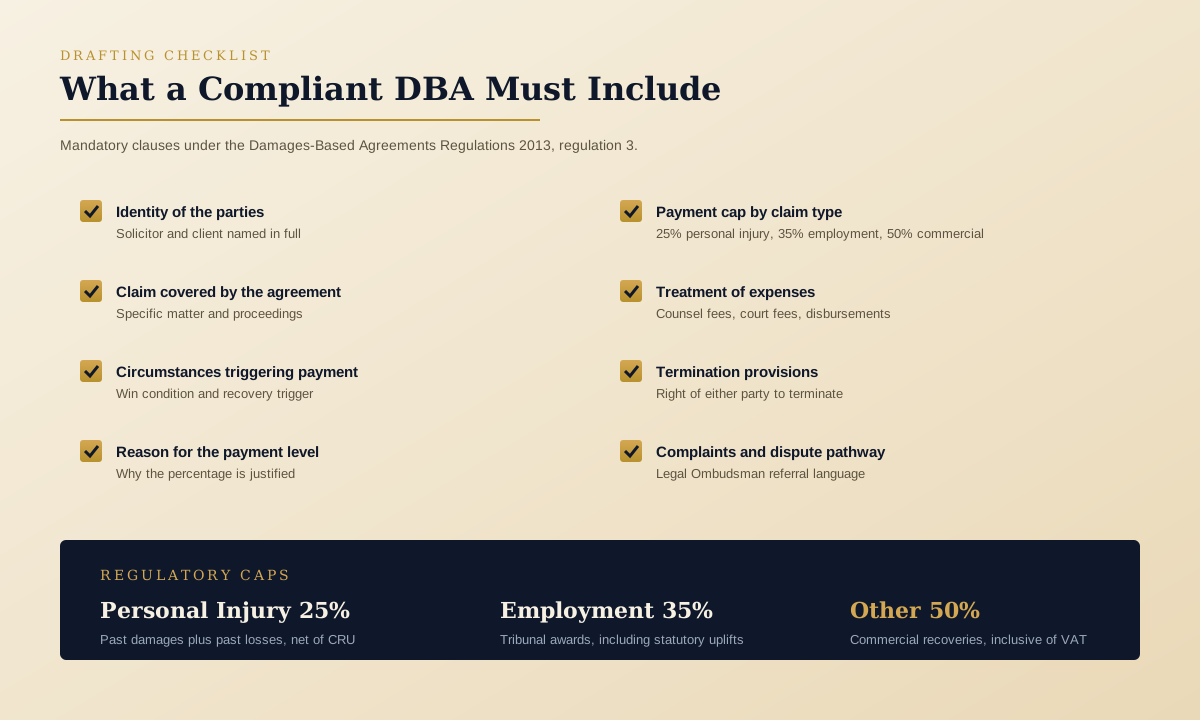
The drafting workflow for a damages-based agreement is shorter than for an ordinary commercial retainer, but the cost of a defective clause is higher. Regulation 3 of the 2013 Regulations fixes the core terms every DBA must specify, the claim covered, the circumstances in which payment becomes due, and the reason for the percentage, and the courts have set aside DBAs that omitted a required term as unenforceable, leaving the firm with no contractual basis to charge. The eight-point checklist below pairs those mandatory terms with the payment caps in regulations 4 and 7 and the client-care disclosures a compliant retainer also needs, in the order the drafting attorney works through them before testing the draft against the client's realistic loss scenarios.
Each step is anchored to the regulatory provision that demands it. Where the regulation gives the firm drafting flexibility, the checklist favours express allocation of disbursement risk and clear termination rights, which are the two areas where retainer language most often fails when challenged.
Identity of the Parties
Full legal name of the solicitor or firm and the client, with addresses for service and a SRA number for the firm. Joint clients should be named separately so that liability for any unrecovered disbursements is apportioned on the face of the agreement.
Claim Covered
A precise description of the matter and the proceedings. Vague references to a wider relationship will not satisfy regulation 3 and risk the agreement being held unenforceable in subsequent costs proceedings.
Circumstances Triggering Payment
What counts as success under the agreement. The retainer should specify whether settlement, judgment, an arbitration award, or a non-monetary outcome triggers the percentage, and whether part-payment over time triggers staged fees.
Reason for the Percentage
A short justification for the chosen percentage, tied to the assessed strength of the claim, the likely duration, and the disbursement burden. Courts have set this aside as a hollow recital where the percentage was selected without genuine consideration.
Payment Cap by Claim Type
The agreed percentage, expressly capped at the regulatory ceiling: 25% for personal injury claims (excluding future loss), 35% for employment tribunal claims, and 50% for any other commercial matter, all inclusive of VAT and counsel fees.
Treatment of Expenses and Disbursements
How counsel fees, expert witness fees, court fees, and search fees are paid in the event of a win and in the event of a loss. The regulations permit recovery of disbursements outside the percentage cap, but only if the agreement says so clearly and the client signs that allocation.
Termination Provisions
The right of either party to terminate, the consequences of termination, and the position on time spent before termination. Without express termination terms a solicitor who comes off the record mid-claim may recover nothing for the work performed.
Complaints and Dispute Pathway
Information about the firm's internal complaints procedure and the client's right to refer the matter to the Legal Ombudsman within six months. SRA Code of Conduct rule 8.3 makes this disclosure mandatory in any client-care document, including a DBA retainer.
Where the firm anticipates a possible application for post-judgment relief on grounds of fraud or excusable neglect, or other contingent recovery routes, the DBA should expressly allocate that future work either inside or outside the percentage. Silence forces the firm into a fresh retainer negotiation at the worst possible moment for the client, after the original judgment has already been disturbed.
Wins, Losses, and Settlement Patterns
The most reliable data on DBA outcomes comes from the Civil Justice Council's 2019 review and the Bar Council's periodic reporting on contingent funding. The headline pattern is that DBA-funded claims settle earlier and at higher rates than equivalent hourly-billed matters, because the lawyer's economic interest in conversion to cash aligns with the client's interest in quantifiable recovery. Settlement at 80% of pleaded value within twelve months is a markedly better outcome for the lawyer than judgment for 100% of pleaded value after three years of unbilled time.
The pattern flips on the loss side. A failed DBA claim is total for the firm: no fees for the matter, possible exposure for unrecovered disbursements depending on the retainer drafting, and an opportunity cost equal to the alternative work the partners and associates could have billed during the same period. Firms that run a portfolio of DBAs price the percentage to absorb the loss rate, which is why a higher-risk matter sees a percentage closer to the regulatory cap than a strong-merit case.
Maximum percentage recoverable on personal injury damages-based agreements, inclusive of VAT and counsel fees, taken from past damages and past losses net of recoupable benefits under the Compensation Recovery Unit scheme.
Ceiling for employment tribunal claims, including unfair dismissal, discrimination, and equal pay matters. The cap applies to the total tribunal award, including any uplift for failure to follow ACAS procedures.
The catch-all ceiling for commercial DBAs, used in breach of contract recoveries, professional negligence, financial mis-selling, and group litigation orders. The figure is inclusive of VAT and is calculated against gross damages recovered.
Approximate share of DBA-funded civil claims that resolve through settlement before a final hearing, according to Civil Justice Council reporting. The settlement rate is materially higher than for hourly-billed litigation, reflecting the lawyer's incentive to convert exposure into recovered cash.
The settlement pattern has a procedural footprint as well as an economic one. DBA-funded claimants are more willing to engage in early offers under Part 36 of the Civil Procedure Rules, and the tactical use of staged offers is sharper because every reasonable settlement compresses the lawyer's exposure window. On the defense side, knowing the plaintiff is on a DBA changes the negotiation profile: the defendant cannot expect attrition to wear the file out, because the lawyer is not running the meter.
Recovery percentages move differently across claim types. Contract breach claims grounded in indemnity and capital-call provisions tend to resolve faster than tort claims of equivalent quantum, because the documentary record carries most of the liability question and leaves only quantum in dispute. Real property recovery claims, where the title and lease record fix the contractual baseline, see a similar compression. International commercial claims with cross-border enforcement add a treaty recognition layer that lengthens the recovery window and presses the firm to push the percentage closer to the regulatory cap. Rental-recovery DBA work, where the underlying terms are usually standard form, sits at the predictable end of the spectrum and draws lower percentages as a result.
Need a damages-based agreement drafted to regulation 3 standards?
Legal Tank's litigation drafters prepare DBA retainers with the eight required clauses, the disbursement allocation written expressly, and the percentage justification on the face of the document. Pricing is fixed, the turnaround is documented at engagement, and the draft is reviewed against the regulation 3 term list before delivery.