What Are Prenuptial Agreements?
A prenuptial agreement is a written contract two people sign before marriage that overrides the state’s default rules for marital property, separate property, and spousal support if the marriage later ends in divorce or death. The instrument is sometimes called a premarital agreement or, colloquially, a prenup.
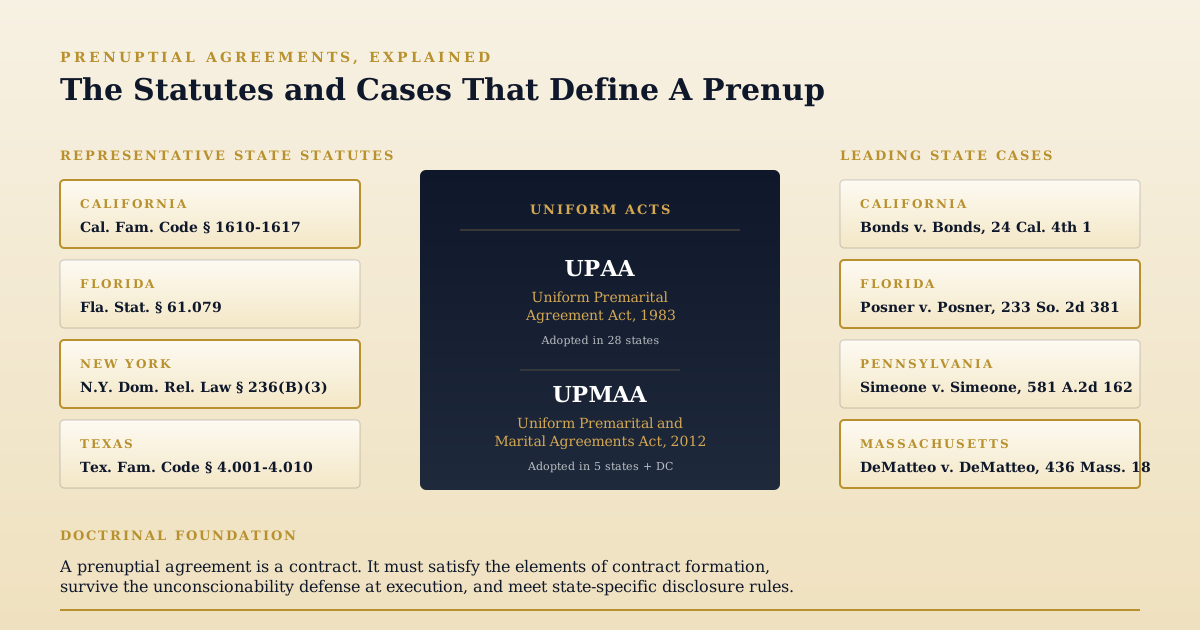
Twenty-eight states adopted the Uniform Premarital Agreement Act (UPAA, 1983), and a smaller group has since adopted the more recent Uniform Premarital and Marital Agreements Act (UPMAA, 2012). The remaining states apply their own family code, but the doctrinal core is the same: a prenup is a contract, and the same elements that make any contract enforceable, plus a layer of family-law protections, govern whether the document will hold up at divorce.
By the Legal Tank editorial team
How Courts Define A Prenuptial Agreement
“An agreement between prospective spouses made in contemplation of marriage and to be effective upon marriage.”
A contract is a promise or set of promises for the breach of which the law gives a remedy.
A prenuptial agreement has a precise statutory answer in the twenty-eight states that adopted the Uniform Premarital Agreement Act. Section 1(1) defines the instrument as an agreement between prospective spouses made in contemplation of marriage and effective upon the marriage occurring. The contract has no force unless and until the wedding takes place. If the engagement is broken, the document fails for lack of the marriage condition. If the wedding goes forward, the document becomes binding the moment the officiant pronounces the couple married.
Doctrinally, a prenup is a bilateral contract. It needs the same elements every contract needs: offer, acceptance, consideration, meeting of the minds, capacity, and a lawful purpose. The marriage itself supplies consideration, which is why the document fails if the marriage does not occur. State family codes layer additional protections on top of ordinary contract law: a writing requirement that displaces the default oral-contract rule, mandatory financial disclosure that displaces the buyer-beware default, and a heightened unconscionability test that looks at execution and at enforcement separately rather than only at execution.
The two governing uniform acts share the same backbone but differ on enforcement. Under UPAA § 6, an agreement is unenforceable only if the challenger proves involuntary execution or that the agreement was unconscionable at execution and was made without fair financial disclosure. UPMAA, drafted in 2012 and adopted in a smaller group of states, adds a procedural fairness layer including access to independent counsel and a meaningful opportunity to review the document. Prenuptial agreement laws in the remaining jurisdictions, including community-property states like California and Texas, draw from both acts and from local case law.
Courts read the document the same way they read any other contract. If the language is clear, the four-corners rule applies and parol evidence stays out. If the language is ambiguous, the court looks to the parties’ intent and the disclosure schedules attached to the agreement. Where a prenup conflicts with the state’s public policy on a particular subject, courts strike the offending clause and enforce the remainder under the severability provision the document should always include. This is why the contract definition framework is the right starting point even when the topic is a wedding, and why an attorney drafting a prenup needs to understand both family law and basic state contract law.
What Is a Prenuptial Agreement? The Definition In One Line
The shortest accurate definition of a prenuptial agreement: a contract two people sign before they marry that tells the family court, in advance, how to treat their assets, debts, and spousal-support rights if the marriage later dissolves. The longer formulation pulls in three additional ideas. First, it overrides the state’s default rule, whether that default is community property in California, equitable distribution in New York, or a hybrid like Florida’s. Second, it must be in writing and signed, no oral side deals. Third, it cannot bind the family court on issues involving the children of the marriage, so any clause attempting to fix child support or custody is treated as advisory at best.
Where Prenups Are Recognized, State By State
Prenups are legal in all fifty states; the differences are in formality and enforceability. California codifies its rules at Cal. Fam. Code §§ 1610-1617; after In re Marriage of Bonds, 24 Cal. 4th 1 (2000), upheld a prenup the wife signed without independent counsel on the eve of the wedding, the legislature enacted the seven-day rule now at § 1615(c)(2) that drives the voluntariness inquiry. Florida codified prenup enforcement at Fla. Stat. § 61.079 after Posner v. Posner, 233 So. 2d 381 (Fla. 1970), held that prenups in contemplation of divorce are not contrary to public policy. New York applies N.Y. Domestic Relations Law § 236(B)(3) and requires acknowledgment in the form used for a recordable deed. Texas codified prenups at Tex. Fam. Code §§ 4.001-4.010. Pennsylvania does not require independent counsel under Simeone v. Simeone, 581 A.2d 162 (Pa. 1990), and Massachusetts applies the two-look review under DeMatteo v. DeMatteo, 436 Mass. 18 (2002).
Who Can Sign A Prenup, And Do You Need An Attorney
Two questions shape eligibility. First, does the couple meet the threshold capacity, age, and timing requirements that allow a binding contract to form before marriage. Second, will a court enforce the document at divorce, which depends on the six validity conditions a court tests at enforcement. Whether you need an attorney for a prenuptial agreement is not strictly a legal-capacity question, it is a procedural-fairness question, and the answer is yes in most states unless an explicit written waiver of independent counsel is signed.
Threshold Eligibility
- Age of majority, eighteen or older in every state, no parental-consent prenup workaround.
- Mental capacity at the time of signing, no intoxication, no documented incapacity.
- Contemplated marriage, a real engagement and a real wedding date on the calendar.
- Voluntariness, no documented coercion, threat, duress, or undue influence.
- Time to read and understand the document; some states impose a waiting period, such as California’s seven calendar days between presentation and signing.
- A signed writing, oral premarital promises do not satisfy the statute of frauds.
When You Need An Attorney
- Each spouse retains independent counsel, joint representation by one lawyer is a per-se conflict.
- UPMAA states require either independent counsel or a written, knowing waiver of counsel.
- California deems a prenup involuntary unless at least seven calendar days pass between first presenting it and signing (Cal. Fam. Code § 1615(c)(2)).
- New York requires the signature to be acknowledged in the form for a recordable deed.
- Self-drafted prenups are at the highest risk of voidness on procedural-fairness grounds.
- Drafting through an attorney drafting service creates a clean documentary record.
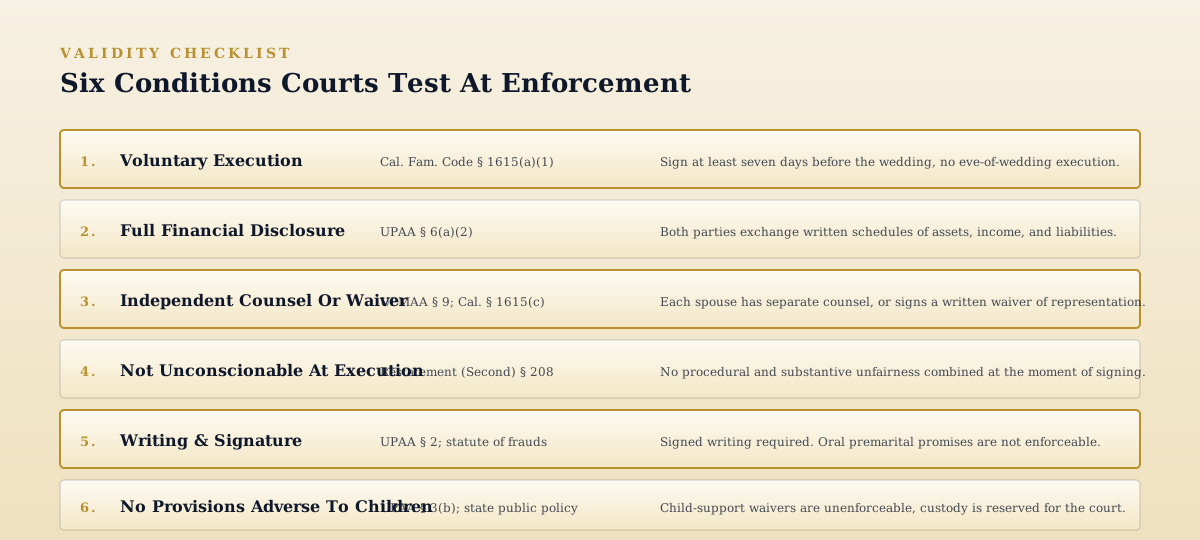
Voluntary execution
Cal. Fam. Code § 1615(c)(2)
At least seven calendar days must pass between first presenting the final agreement and signing it, no rushed eve-of-wedding execution.
Full financial disclosure
UPAA § 6(a)(2)
Both parties exchange written schedules of assets, income, and liabilities.
Independent counsel or waiver
UPMAA § 9; Cal. § 1615(c)
Each spouse has separate counsel, or signs a written waiver of representation.
Not unconscionable at execution
Restatement (Second) of Contracts § 208
No procedural and substantive unfairness combined at the moment of signing.
The eligibility analysis is not symmetric. The economically stronger spouse generally has more flexibility, while the economically weaker spouse is the protected party at enforcement. Courts watch for one-sided drafting under conditions that suggest pressure, and the most reliable way to neutralize the procedural-fairness defense is for both parties to sign in front of independent counsel after a real opportunity to review and revise. The contemporaneous record of independent review is what carries the document past a later enforcement challenge, more than any single contract clause inside the document itself.
Why Couples Sign Them, The Practical Stakes
The classic prenup has shifted in the last twenty years. The original use case, protecting an older wealthy spouse’s premarital estate from a younger second spouse, is now a minority of the prenups Legal Tank drafts. The majority of contemporary prenups address dual-career first marriages, debt allocation between two spouses with student loans, business equity that one spouse already owns, inheritance protection from a family trust, and choice-of-law provisions for couples who plan to relocate.
The most useful framing for the meaning of a prenuptial agreement is to ask what specific default the contract is designed to override. The four most common defaults a prenup overrides are the marital-property classification rule, the spousal-support default, the inheritance-and-elective-share default, and the debt-allocation default. Each has its own statutory home, and a well-drafted prenup names the default it is overriding rather than relying on a generic blanket clause.
Marital Property Classification
Default: assets acquired during marriage are presumptively marital property (community property in nine states, equitable-distribution property in the rest). Override: a prenup can re-classify wages, business equity, and appreciation on premarital assets as separate property.
Spousal Support
Default: the family court applies the state alimony statute at divorce, weighing factors like length of marriage and earning capacity. Override: a prenup can waive spousal support entirely or set a formula (typically dollars per year of marriage), subject to a second-look review for unconscionability at enforcement.
Estate & Elective Share
Default: the surviving spouse can claim a statutory elective share of the deceased spouse’s estate, even if the will omits them. Override: a prenup can waive the elective share so a will or trust controls inheritance, common where one spouse has children from a prior marriage.
Debt Allocation
Default: marital debts incurred during the marriage are jointly allocated regardless of which spouse signed the loan. Override: a prenup can keep premarital debt, student loans, and post-marital business borrowings on the borrowing spouse’s side of the ledger.
The Two Attorney Roles, And What Each One Actually Does
Two distinct lawyering roles sit behind every prenuptial agreement. The drafting attorney represents one spouse, runs the asset and liability inventory, designs the substantive clauses, and circulates the red-line. The reviewing attorney represents the other spouse, audits the document for procedural and substantive fairness, suggests revisions on disclosure or carve-outs, and signs the certificate of independent representation. The two roles are mirror images, and they cannot be played by the same lawyer in the same engagement, joint representation in a prenup is a per-se conflict in every state. A well-run prenup engagement will run roughly thirty to ninety days from term-sheet to execution, with the drafting attorney leading and the reviewing attorney pacing the red-line.
Cost is a function of complexity. A clean prenup with two W-2 incomes and modest assets is fixed-scope work. A prenup with a closely-held business, a family trust beneficial interest, or international assets requires valuation, choice-of-law analysis, and coordinated contract-law review of inter-party drafting. Self-drafted prenups, downloaded from an online template store and signed without counsel, fail at higher rates than professionally drafted prenups under the procedural-fairness inquiry, both UPAA § 6 and UPMAA § 9 give the challenger a procedural foothold when no attorney was involved.
If the prenup is later breached, for example by a hidden asset surfacing or a unilateral disposition of separate property, enforcement proceeds as a contract-breach matter within the divorce action. The remedies are the contract remedies the document itself names: specific performance for transfers of titled property, damages for the non-disclosure, attorneys’ fees if the prenup includes a fee-shifting clause.
Are Prenuptial Agreements Worth Signing
For couples where one spouse already owns business equity, real estate, or significant retirement assets, a prenup is almost always worth the drafting cost: the alternative is a two-step asset-tracing project at divorce, with no contemporaneous record. For first marriages with modest assets, the case is less clear-cut, and the most common reason to sign is the spousal-support framework rather than the property classification. For couples relocating across state lines, the choice-of-law clause alone is often worth the engagement, because community-property and equitable-distribution states reach materially different outcomes on the same fact pattern.
How To Draft Prenuptial Agreements That Survive Enforcement
The drafting workflow for prenuptial agreements tracks a five-step arc, from engagement through execution. Each step builds the documentary record that defeats a later enforcement challenge. Skipping any step, particularly the financial-disclosure exchange or the seven-day review window, is the single biggest predictor of an unenforceable prenup at divorce.
Engagement and conflict check
Each spouse retains separate counsel. The drafting attorney runs a conflict check, sends an engagement letter scoped to the prenuptial agreement only, and confirms the wedding date so that the seven-day execution buffer is preserved.
Financial disclosure exchange
Each party prepares Schedule A (assets) and Schedule B (liabilities), with supporting documents for any asset class above a threshold the parties set. Real estate is appraised, closely-held business interests are valued, and trust beneficial interests are described in writing.
Term-sheet alignment
Counsel exchange a one-page term sheet covering separate-property treatment, marital-property classification, debt allocation, spousal-support framework, estate-planning interaction, and choice of law. The term sheet is signed and attached to the engagement file.
Drafting and red-line
The drafting attorney prepares a full document tracking the term sheet, then sends a Word red-line to opposing counsel. Two revision rounds are typical. Carve-outs for inheritances, gifts, and post-marital appreciation of pre-marital assets are common red-line subjects.
Execution and notarization
Each party signs in the presence of a notary. Schedules are initialed page-by-page. Both originals are dated, the wedding date is recited, and the choice-of-law provision is acknowledged. A clean PDF and a signed paper original are delivered to each spouse for safekeeping.
The Last Two Validity Conditions
Two of the six validity conditions deserve their own treatment because they are the most common grounds for setting a prenup aside at divorce: the writing-and-signature requirement, and the rule against provisions adverse to the children of the marriage.
Writing and signature
UPAA § 2; statute of frauds
Signed writing required. Oral premarital promises are not enforceable.
No provisions adverse to children
UPAA § 3(b); state public policy
Child-support waivers are unenforceable, custody is reserved for the court.
What Goes In The Final Document
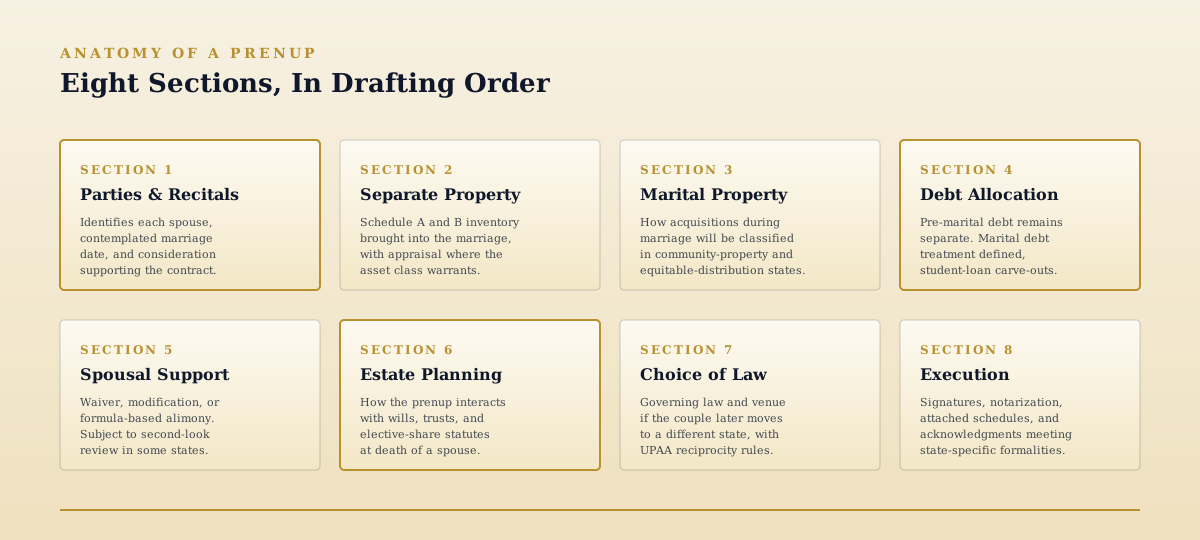
The final eight sections of a prenup track the anatomy diagram above. The recitals identify the parties and the contemplated marriage. The separate-property schedules inventory each spouse’s premarital holdings, with appraisals where the asset class warrants. The marital-property section says how acquisitions during marriage will be classified and whether income from premarital separate property remains separate. The debt-allocation section assigns premarital and marital obligations. The spousal-support section sets the alimony framework. The estate-planning section coordinates with the parties’ existing wills, trusts, and any power of attorney instruments. The choice-of-law section names governing law and venue. The execution section completes the formalities, signatures, notarization, attached schedules, and dated acknowledgments meeting state-specific requirements.
A correctly drafted prenup is also a contemporaneous evidentiary record. The disclosure schedules attached at signing become the baseline for tracing separate property at divorce, sometimes years later. The signed acknowledgments of independent counsel become the answer to a later voluntariness challenge. The merger and integration clause closes off any side-deal argument. None of these features are optional in serious drafting, and none of them are typically present in the self-drafted prenups Legal Tank sees come in for review.
Couples whose financial pattern is straightforward and who want to read a properly drafted instrument before deciding which route to take can review the full document, all fifteen Articles plus the dual signature and notary blocks and Schedule A and B disclosure references, on the prenuptial agreement template page. The template page also lays out the enforceability checklist and the most common drafting mistakes side by side with the document itself, which is the right context for a self-drafted decision.
Questions People Ask About Prenuptial Agreements
These are the two questions that surface most consistently in the “People Also Ask” box on Google for the prenup query cluster. The answers above and below are written for the lay reader, not the practitioner, and they are not a substitute for advice from an attorney licensed in the state where the prenup will be signed.
What is the main purpose of a prenuptial agreement?
What does it mean if you have a prenuptial agreement?
Drafting A Prenuptial Agreement
Legal Tank drafts attorney-quality prenuptial agreements at a fixed quote, with a senior family law attorney on the engagement and a clean documentary record of disclosure, review, and execution. Get a custom quote at intake, or read the dedicated drafting service overview.