
How to Write a Rent Contract Agreement, Step by Step
Drafting a binding rent contract agreement follows a seven-step preparation sequence. Each step closes a category of ambiguity that becomes a litigation cost when the relationship breaks down: a missing security-deposit cap, an undefined late fee, a vague premises description, an unstated notice period. The goal is the same at every step: every party, every dollar, every date, and every duty expressed in terms a court can read off the page.
The framework below applies to residential, commercial, and lease-to-own instruments. The Restatement (Second) of Contracts § 1 defines a contract as a promise that the law will enforce. For residential leases, the federal lead-based paint disclosure rule (42 U.S.C. § 4852d) attaches at signing for pre-1978 housing, and the Fair Housing Act sets the screening boundaries. The seven steps below produce that promise in the form a court will recognize. Even a plain-language simple contract agreement for a roommate sublet should hit each step in some form.
- 01Step 01
Identify the Parties and Verify Capacity
Capture the full legal name of the landlord and the tenant. For corporate or trust parties, include the entity type and the signing officer. Verify that each signer has legal capacity (eighteen years or older, mentally competent, not under guardianship). The identification clause is what makes the instrument enforceable against the right person; ambiguous parties are the single most common reason that an otherwise valid rent contract agreement is challenged on a default judgment motion.
- 02Step 02
Describe the Premises with Precision
Use the exact street address, unit number, and any parking or storage allocation. For multi-tenant buildings, identify common-area access. For commercial space, attach a floor plan as an exhibit. The premises clause anchors the entire instrument: a vague premises description creates a vague obligation, and a vague obligation cannot ground an eviction or a damages claim.
- 03Step 03
Fix the Term and Renewal Mechanics
State the commencement date and the expiration date. Address holdover (does the tenancy convert to month-to-month, or does it terminate?). Specify renewal mechanics if a renewal option is granted: written notice within a defined window, fixed renewal rent or market-rate adjustment, and the default rule if the option is not exercised. The expiration mechanics deserve the same precision as the rent number; an ambiguous end date is what turns an orderly move-out into a holdover dispute.
- 04Step 04
Set Rent, Due Date, and Late Fee Architecture
State the monthly rent in dollars, identify the due date, define the grace period, and fix the late fee schedule. Many state statutes cap the late fee at a percentage of the monthly rent or at a specific dollar amount; the cap varies by jurisdiction. Address NSF fees for returned checks and the rent-acceleration consequences of repeated late payment. Every dollar figure here (base rent, grace period, late fee, NSF charge) must be unambiguous, because a court enforces only what the instrument actually states.
- 05Step 05
Cap the Security Deposit and Define Return Procedure
Many state statutes cap residential security deposits, commonly at one or two months of rent; others, including Texas, impose no statutory cap at all. State the deposit amount, identify the holding rules (a segregated trust account in some jurisdictions), and define the return procedure with the statutory deadline. Texas Property Code Section 92.103, for example, requires the landlord to refund the deposit within thirty days of surrender, less itemized deductions for damage beyond ordinary wear and tear. Conform the deposit clause to the controlling state statute or risk paying double damages plus attorney fees.
- 06Step 06
Allocate Maintenance, Use, and Insurance Duties
Identify what the landlord maintains and what the tenant maintains. Address habitability obligations (the implied warranty of habitability is non-waivable in most residential jurisdictions). Restrict use of the premises (residential, no commercial activity, no nuisance). Require liability insurance where appropriate. Commercial agreements add operating-expense pass-throughs, common-area maintenance, and tax-and-insurance reconciliation; residential agreements stay simpler.
- 07Step 07
Define Default, Cure, and Signatures
Identify what counts as default (non-payment, unauthorized assignment, prohibited use, breach of any covenant). Set notice and cure periods (most states require a statutory notice before eviction, with a defined cure period). Address remedies (eviction, damages, accelerated rent, attorney fees where the controlling state permits). Close the instrument with a signature block for each party, the date of execution, and a witness or notary line where the state requires one.
The Four Clauses Self-Drafted Rent Contracts Omit Most Often
Beyond the seven core elements, four clauses drop out of self-drafted rent contracts more often than any others: occupancy limits, landlord right of entry, a notices clause, and joint and several liability for co-tenants. None of them affects validity, but each one decides a dispute that the seven core clauses cannot reach. The notices clause in particular is what a court checks first when a landlord serves a statutory notice to vacate and the tenant claims it never arrived.
Name every authorized occupant, cap long-term guests, and require written consent before anyone new moves in. Without an occupancy clause the landlord has no contractual basis to object when a two-person tenancy quietly becomes five. Keep the cap tied to a reasonable occupancy standard (HUD treats two persons per bedroom as a common-sense baseline) so the limit cannot be read as familial-status discrimination under the Fair Housing Act.
State the advance notice for non-emergency entry (24 to 48 hours is the prevailing convention), the permitted purposes (repairs, inspections, showings), reasonable hours, and a no-notice exception for emergencies. The clause protects the tenant's quiet enjoyment and gives the landlord an agreed path to perform the maintenance the lease assigns to the landlord.
Fix how formal communications are delivered (hand delivery, certified mail, or email where the state permits electronic notice) and the address for each party. Default, cure, and termination notices are only as good as the proof of delivery behind them; a statutory notice to vacate served the wrong way can reset an entire eviction timeline.
Where two or more tenants sign, make each one liable for the full rent and the full cost of damage, not a per-person share. The clause lets the landlord collect the whole obligation from any one signer if a roommate leaves mid-term, and it keeps the departing roommate on the hook until the landlord grants a written release.
For a ready-to-fill residential form built on these seven elements, see the fillable rental agreement template; for a free starting point, the free rental agreement template walks the same clauses in plain language.
What a Rent Contract Agreement Costs: Free Template vs. Professionally Drafted
The cost of a rent contract agreement runs from nothing (a generic blank form) to a meaningful legal spend (a heavily negotiated commercial lease). Most renters and small landlords sit at one of the three tiers below. Each tier exists for a reason; each carries a trade-off between cost and risk. A free template contract agreement is the right tool for a low-stakes deal between people who already trust each other; it is the wrong tool when material money is at stake or the parties are strangers.
The free template tier is built from open-source forms; the professionally drafted tier produces a state-conformed, fully reviewed lease in three to seven business days on a flat fee; the custom tier is for commercial and multi-tenant work that requires negotiation and ongoing support.
Free Template
Generic blank form for low-stakes family or roommate use.
- Self-serve fill-in
- No professional review
- Generic state-neutral language
- No habitability or notice clauses
- No security-deposit cap
Professionally Drafted Residential
Residential rent contract professionally drafted to your state statute.
- State statute conformance
- Security-deposit cap and return clauses
- Late fee schedule sized to state cap
- Implied warranty of habitability addressed
- Notice and cure architecture per state law
- Final review sign-off, execution-ready
- Three to seven business day delivery
Commercial and Multi-Tenant
Custom commercial lease, retail, office, industrial, or multi-tenant residential.
- CPI rent escalators and base-year reconciliation
- Triple-net or full-service expense allocations
- Assignment, sublet, and recapture mechanics
- Indemnity, insurance, and certificate floors
- Estoppel and subordination architecture
- Negotiation support with counterparty counsel
For renters comparing a generic form to a state-conformed lease, the free rental agreement template explainer walks through what a generic form does and does not contain. For landlords scaling beyond a single unit, the closely related free agreement contract template reviews when an open-source form is sufficient and when a custom draft is the better economic choice.
Rent Contract Agreement Examples: Residential, Commercial, and Lease-to-Own
The three annotated examples below show how a template contract agreement is filled in across three common deal types: a residential single-family lease, a commercial retail triple-net lease, and a hybrid lease-to-own. Each example reproduces the operative clause language at the level of detail a court would expect to see; each example anchors a different combination of state statute, payment architecture, and remedy structure.
The same residential template form that anchors Example One can be retrofitted for short-term and seasonal rentals, but the commercial and lease-to-own forms require purpose-built drafting. For a fully populated single-family form annotated clause by clause, see the residential lease sample on the lease drafting page.
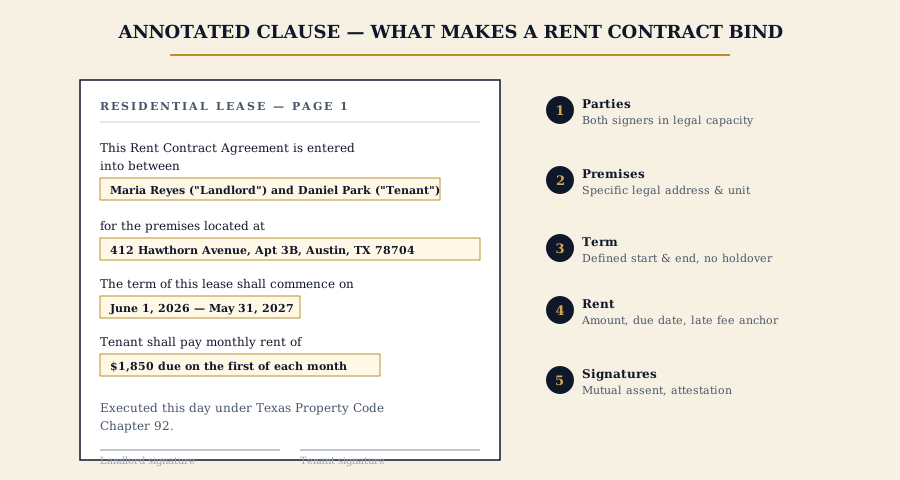
Residential Single-Family Rent Contract
A twelve-month single-family residential lease in Texas. The instrument carries a single tenant, a fixed monthly rent, and a one-month security deposit. The clauses below are the architecture every residential rent contract agreement should display.
Maria Reyes ('Landlord') and Daniel Park ('Tenant'), each in individual capacity.
412 Hawthorn Avenue, Austin, Texas 78704, including the attached single-car garage.
Twelve months commencing June 1, 2026 and terminating May 31, 2027, with no holdover converting to month-to-month.
$1,850 per month, due on the first day of each month, with a $75 late fee after the fifth.
$1,850 security deposit, held per Texas Property Code Section 92.103, refundable within thirty days of surrender less itemized deductions.
Commercial Retail Triple-Net Lease
A five-year retail triple-net lease for a corner storefront in Atlanta. The base rent is supplemented by tenant pass-throughs for taxes, insurance, and common-area maintenance. The clauses below are the operating-expense architecture that distinguishes a commercial lease from the simple residential template contract agreement.
Peachtree Holdings, LLC ('Landlord') and Crescent Coffee Roasters, Inc. ('Tenant'), with personal guaranty by Tenant's principal.
Approximately 1,840 rentable square feet at 1212 Peachtree Street NE, Suite 110, Atlanta, Georgia 30309, with a floor plan attached as Exhibit A.
Five years commencing September 1, 2026, with one five-year renewal option exercisable on twelve months' written notice.
Base rent of $48 per rentable square foot per year, escalating at 3% annually, payable in equal monthly installments on the first.
Tenant pays its proportionate share of real estate taxes, building insurance, and common-area maintenance, reconciled within ninety days after each calendar year-end.
Lease-to-Own Hybrid Agreement
A two-year lease-to-own agreement on a townhome in Charlotte. The tenant pays monthly rent, accrues a credit toward purchase, and holds an option to buy at a fixed price during the option window. The clauses below illustrate how a hybrid template contract agreement combines lease and purchase mechanics in one instrument.
Catawba Properties, LLC ('Landlord-Seller') and Jamal Foster ('Tenant-Buyer'), with cohabiting family members listed as occupants.
729 Idlewild Road, Townhome Unit C, Charlotte, North Carolina 28212.
Twenty-four-month lease term, with a parallel option to purchase exercisable any time during the final twelve months.
$2,200 per month base rent, with $400 of each payment credited toward the purchase price upon timely receipt.
Option price of $312,000, fixed at execution, with rent credit applied at closing as a deposit toward the purchase price.
The commercial and lease-to-own examples each have a dedicated guide. The commercial lease guide covers triple-net and operating-expense structures in depth, and the real estate purchase agreement guide covers the purchase mechanics that a lease-to-own option triggers at closing.
Frequently Asked Questions
Common questions about rent contract agreements: writing your own, lease versus rental agreement, notarization, handwritten and verbal validity, and where to find free rental templates.
Can you write your own contract agreement?
How do I write a simple contract agreement?
Is a rental agreement the same as a lease?
Does a rental agreement have to be notarized to be valid?
Is a handwritten or verbal rental agreement legally binding?
Where can I get free contract templates?
What clauses make a rent contract agreement void or unenforceable?
How much notice must a landlord give before entering a rented property?
Are co-tenants each responsible for the full rent under one agreement?
Can a landlord raise the rent in the middle of a rent contract agreement?
What is the federal lead-based paint disclosure requirement for rentals?

Every Legal Tank residential rent contract is reviewed for state statute conformance before delivery, covering deposit caps, notice architecture, and habitability language.