LLC Operating Agreements Template, Section by Section
An llc operating agreements template is the pre-built private contract that members sign to govern the internal affairs of a limited liability company. Unlike the articles of organization (filed with the secretary of state to bring the company into legal existence), the operating agreement is signed by the members and stored privately. It controls capital, profits and losses, voting, distributions, transfer of membership interests, and dissolution. The same template fills both single-member and multi-member companies; the populated sections shift to fit the governance the members want.

LLC Operating Agreement Template (PDF or DOCX)
Professionally reviewed twelve-section operating agreement covering members, capital, allocations, distributions, management, voting, transfers, dissociation, dissolution, indemnity, books, and amendments. Single-member and multi-member ready. Underscore-filled blanks for parties, contribution amounts, percentages, voting thresholds, and signatures.
State-specific edits often required. For your jurisdiction, members, and tax election (disregarded entity vs partnership vs S-corp), the professionally drafted operating agreement service tailors capital contributions, voting thresholds, distribution waterfall, and buyout clauses to your members and state statute.
Three Annotated Sample Drafts of an LLC Operating Agreement Template
The three sample drafts below show how an llc operating agreement template is populated across three common entity profiles. Each draft reproduces the operative clause language at the level of detail a court would expect to see; each draft anchors a different combination of member count, tax classification, and governance complexity. The first is the simplest single-member LLC operating agreement form. The second is a standard four-member multi-member LLC operating agreement. The third layers additional clauses on top of the multi-member form for a professional service LLC.
For a deeper walkthrough of populated single-member and multi-member forms with clause-by-clause analysis, the related guide on examples of operating agreements for LLC walks through six fully populated drafts. The companion form walkthrough on the template of operating agreement guide unpacks each section against the Uniform Limited Liability Company Act baseline.
Single-Member LLC Operating Agreement
An eight-page operating agreement for a single-member consulting LLC formed in Delaware, federally taxed as a disregarded entity. The document establishes the company, identifies the sole member, addresses capital contribution, and provides for the transfer of the membership interest at death. The clauses below display the architecture every single-member llc operating agreement template carries.
Hawthorn Strategy Group LLC, a Delaware limited liability company, with principal office in Wilmington, Delaware.
Daniel Park, individually, holding 100% of the membership interests as the sole member of the company.
$25,000 cash contributed at formation, recorded on Schedule A as the initial capital account balance.
Disregarded entity for federal income tax purposes, with the sole member reporting income and expense on Schedule C of Form 1040.
Membership interest transfers on the sole member's death to the trust identified on Schedule B, avoiding probate of the LLC interest.
Multi-Member LLC Operating Agreement
A thirty-four-page operating agreement for a four-member real estate investment LLC formed in Texas, federally taxed as a partnership under IRS Form 1065. The instrument establishes capital accounts, defines the distribution waterfall, sets voting thresholds, and provides for member buyouts. The clauses below illustrate the additional architecture a multi-member llc operating agreement template carries beyond the single-member form.
Four members holding 35%, 30%, 20%, and 15% membership interests respectively, with capital contributions itemized on Schedule A.
First, return of unreturned capital contributions pro rata; second, preferred return at 8% of unreturned capital; third, remaining cash flow pro rata by percentage interest.
Simple majority of percentage interests for ordinary matters; supermajority of 75% for amendments, admission of new members, and major debt; unanimous consent for dissolution.
Members may be required to contribute up to two times the original contribution upon manager call; defaulting members suffer dilution at a stated rate.
On a member's death, disability, or withdrawal, the company has thirty days to elect to redeem the interest at book value plus three times trailing-twelve-month allocations.
Professional Service LLC Operating Agreement
A forty-eight-page operating agreement for a six-member professional service LLC (a law firm professional limited liability company formed in California), federally taxed as a partnership. The instrument carries additional clauses required by the controlling state professional code, including licensing eligibility, peer review, and exit on loss of license. The clauses below illustrate the additional architecture a professional service operating agreement template llc carries beyond the standard multi-member form.
Each member must hold a current license to practice law in California; the company suspends voting rights of any member whose license becomes inactive.
Distributions are split fifty percent on percentage interest and fifty percent on origination credit calculated under Schedule C, reconciled annually.
Each member's work product is subject to annual peer review by the management committee; consistent failure to meet professional standards is grounds for expulsion.
Suspension or revocation of a member's license to practice law triggers automatic dissociation, with redemption at book value.
Withdrawing members agree to a non-solicitation covenant for clients of the firm in active matters, and to client-list shielding under California Rule of Professional Conduct 1.6.
For a parallel template framework on the partnership form (the non-corporate cousin of the multi-member LLC), the related business partnership agreement template walks through the same architecture under the Uniform Partnership Act.
What Is an LLC Operating Agreement? Operating Agreement Template LLC Defined
An operating agreement template llc is a pre-drafted private governance contract that members of a limited liability company sign to allocate ownership, control, profits, losses, and exit rights. It is not a public filing. It is not what creates the company. The articles of organization (called a certificate of formation in Delaware) are filed with the secretary of state to bring the LLC into legal existence; the operating agreement is the second-stage instrument the members adopt to govern how the company runs.
The distinction is the single most-overlooked point in LLC formation. A founder who files articles of organization but never signs an operating agreement still has a legally formed LLC, and the company is still treated as a separate legal person for liability purposes. What that founder lacks is the governance instrument that displaces the state default rules. Every state LLC act carries default provisions that fill in whatever the members did not agree to in writing: per-capita allocation of profits, simple-majority voting, at-will withdrawal of members. These defaults are designed to be fair to two-equal-partner startups, and they fail almost every other deal.
The operating agreement is what makes the LLC act like the deal the members actually struck. The Uniform Limited Liability Company Act, adopted in many jurisdictions, makes the operating agreement the controlling source of internal governance and treats the statutory defaults as a residual baseline that applies only where the agreement is silent. The Delaware act goes further: it elevates freedom of contract among members above almost every default rule, including some fiduciary duties.
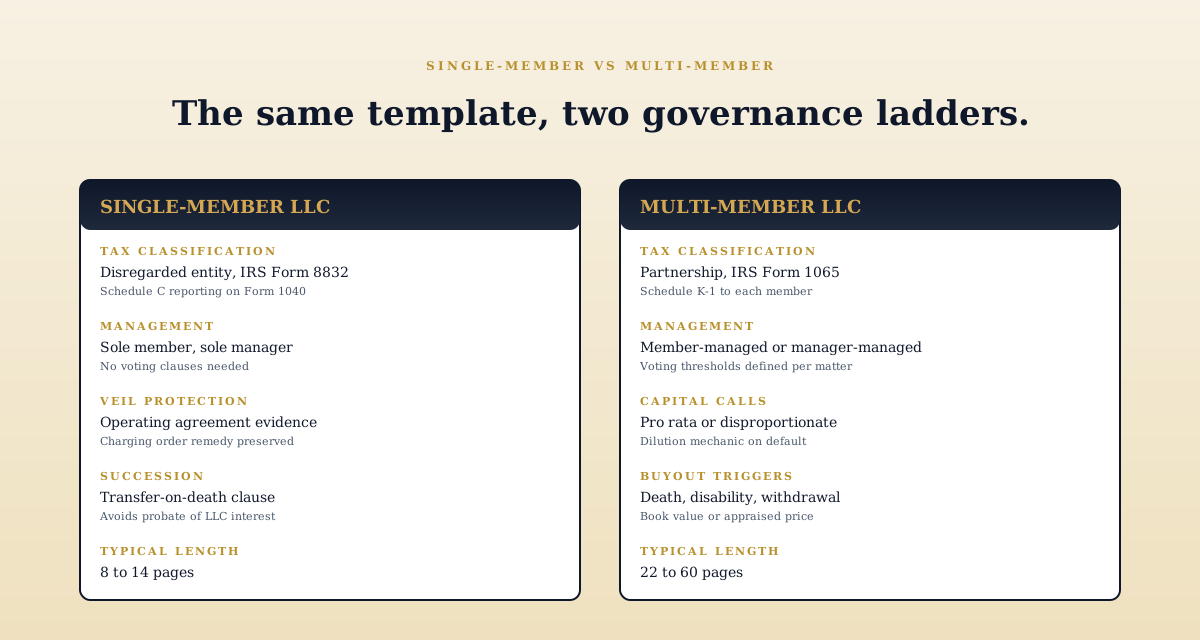
Single-Member Operating Agreement
Used when one person owns 100% of the membership interests. The document is shorter (typically eight to fourteen pages), skips voting clauses, and focuses on capital contribution, tax classification (disregarded entity), and transfer of the interest at death. Reinforces the liability shield by evidencing observance of LLC formalities.
Federal default is disregarded-entity status; the sole member files Schedule C of Form 1040. Election to corporate status is available on Form 8832.
Multi-Member Operating Agreement
Used when two or more persons or entities hold membership interests. The document is longer (twenty-two to sixty pages), addresses voting thresholds, capital calls, transfer restrictions, buyout triggers, and dissolution sequence. The allocation of profits and losses is the single most-negotiated clause in the agreement.
Federal default is partnership status, with the company filing IRS Form 1065 and issuing Schedule K-1 to each member. Election to corporate status is available on Form 8832 or Form 2553.
For a parallel doctrinal walkthrough of the contract elements that make any private agreement enforceable (offer, acceptance, consideration, capacity, mutual assent, lawful purpose), the related contract definition guide steps through the formation framework that anchors every operating agreement.
What Should Be Included in an LLC Operating Agreement? Required, Recommended, Optional Clauses
The clauses inside a populated template llc operating agreement sort into three tiers. Required clauses are the ones every operating agreement must carry to be a complete instrument; the missing entries default to the state LLC act baseline. Recommended clauses are the ones that distinguish a thoughtful agreement from a generic one; their absence does not invalidate the document, but their absence is what surfaces years later in a member dispute.Optional clauses respond to specific deal economics: preferred return waterfalls, origination credit splits, drag-along rights.
The checklist below is the minimum set most operating agreements should display. Member voting, distributions, and buyout mechanics together account for roughly two-thirds of the drafting time on any multi-member operating agreement, and they are the three sections most often left at the state-default baseline by accident.
- Members and Membership Classes
Identifies parties; without it the company has no recognized owners.
- Capital Contributions
Anchors each member's stake; the missing entry is the per-capita-default trap.
- Allocations of Profits and Losses
Required under state LLC act; sets the tax allocation under Subchapter K.
- Distributions
Cash flow rule; pro rata by interest is the default unless the agreement says otherwise.
- Management Structure
Member-managed or manager-managed; controls signing authority and agency.
- Signatures and Effective Date
Without member signatures the agreement is a draft, not an executed instrument.
- Voting Thresholds
Ordinary, major, and unanimous matters; closes the simple-majority gap.
- Transfer Restrictions
Right of first refusal, tag-along, drag-along; prevents sale to outside parties.
- Buyout on Dissociation
Death, disability, withdrawal triggers; book value plus earnings multiple is the standard formula.
- Capital Calls
Compels additional contribution; dilutes defaulting members at a stated rate.
- Indemnification
Covers members and managers acting in scope; advancement clause funds defense costs.
- Dissolution and Winding Up
Triggers, sequence, and distribution priority on liquidation.
- Preferred Return
Carries unreturned capital at a stated annual rate before pro-rata cash flow.
- Origination Credit Split
Common in professional service LLCs; allocates distribution by source of revenue.
- Drag-Along Rights
Forces minority members into a sale of the company on supermajority approval.
- Tax Distribution Clause
Annual cash distribution sized to cover member tax liability on allocations.
- Confidentiality and Non-Solicit
Common in service businesses; survives dissociation and dissolution.
The Three Sections That Decide Whether the Agreement Held Up
Voting sets the rule for who can move the company. A simple-majority threshold is the workable floor for ordinary matters; a supermajority of 67% to 75% protects minority members from being washed out on capital calls; a unanimous threshold protects the original deal from amendment. Distributions set the rule for who gets paid first. Pro-rata-by-percentage-interest is the simple form; the multi-tier waterfall (return of capital, preferred return, pro rata, optional promote) is the investment-LLC form. Buyouts set the rule for what happens when a member dies, withdraws, or is expelled. Without a buyout clause, the death of a member can force a windup of the company. With a buyout clause, the company has thirty days to elect to redeem at book value plus an earnings multiple, and the company keeps operating.
For the partnership-form cousin (the non-LLC governance instrument under the Uniform Partnership Act), the related business partnership agreement template walks through equivalent capital, voting, and buy-sell mechanics, and the dedicated dissolve partnership agreement template covers the windup sequence on exit.
Building the LLC Template Operating Agreement, Step by Step
Building a populated llc template operating agreement is a seven-stage workflow that runs from the secretary-of-state filing through execution and storage. Each stage closes a category of ambiguity that surfaces during a member dispute or a tax audit. The state-specific filing rules that layer on top (California, New York, Delaware, Texas, Florida) are summarized in the matrix that follows the build sequence; the same template fills any state, and only the filing layer and tax baseline change.
The references to specific Internal Revenue Service forms and state filings below assume formation of a domestic LLC; foreign registration (registering an LLC formed in one state to do business in another) carries its own filing layer and is outside the scope of this guide. The Uniform Limited Liability Company Act (ULLCA) and the Delaware Limited Liability Company Act are the two reference statutes most agreements track.
- 01Stage 01
File Articles of Organization with the Secretary of State
The articles of organization (called a certificate of formation in Delaware) is the public filing that brings the LLC into existence; the operating agreement is the private contract that governs how the LLC operates. The articles state the company name, principal office, registered agent, and (in some jurisdictions) the management structure. Filing fees range from approximately $50 in some states to several hundred dollars in others. New York layers a publication requirement on top: the LLC must publish a notice in two newspapers in the county of formation for six consecutive weeks within 120 days of formation. The llc template operating agreement is drafted and signed only after the articles are filed and the formation date is fixed.
- 02Stage 02
Identify the Members and Capture Capital Contributions
List each member by full legal name and tax identification (social security number for individuals, employer identification number for entity members). State each member's capital contribution in dollars; for non-cash contributions (real estate, intellectual property, services), state the agreed valuation and attach supporting documentation as a schedule. The capital account balance for each member is the contribution amount adjusted by allocations and distributions over the life of the company. For a multi-member LLC with unequal contributions, the capital-account schedule is the document that prevents the per-capita default rule from overriding the members' actual deal.
- 03Stage 03
Choose the Federal Tax Classification and File the Election
A single-member LLC defaults to disregarded-entity status with the sole member reporting income on Schedule C of Form 1040; a multi-member LLC defaults to partnership status with the company filing Form 1065 and issuing Schedule K-1 to each member. Either default may be overridden by filing IRS Form 8832 to elect corporate status, or by filing IRS Form 2553 to elect S-corporation status (which carries shareholder-eligibility restrictions). State the chosen classification in the operating agreement, including the calendar-year or fiscal-year tax-reporting election. The classification is the single most consequential tax decision in LLC formation; the wrong election produces double taxation or self-employment tax exposure that the right election would have avoided.
- 04Stage 04
Set Voting Thresholds and Management Structure
State whether the company is member-managed (every member has signing authority and acts as an agent of the company) or manager-managed (only the named manager has signing authority). For member-managed companies with more than one member, define voting thresholds for three categories: ordinary matters (simple majority of percentage interests is the workable default); major matters (supermajority of 67% to 75% for capital calls, debt above a stated threshold, hiring of senior management, real estate transactions); and fundamental matters (unanimous consent for amendments to the operating agreement, admission of new members, dissolution). For manager-managed companies, define how the manager is selected, the term, and the removal procedure.
- 05Stage 05
Build the Distribution Waterfall and Tax Distribution Clause
The distribution waterfall is the order in which cash flow leaves the company. For a simple LLC, the waterfall is a single tier: distributions made pro rata in proportion to percentage interest. For a real estate or investment LLC, the waterfall typically carries three or four tiers: return of unreturned capital contributions; preferred return on unreturned capital (commonly 6% to 10% per year); distribution of remaining cash flow pro rata, sometimes with a promote tier rewarding the sponsor for performance above a hurdle. Layered on top is the tax distribution clause, which obligates the company to distribute enough cash each year to cover each member's tax liability on the allocated income (often calculated at the highest marginal federal-plus-state rate applied to the year's allocations).
- 06Stage 06
Define Buyout Triggers and Transfer Restrictions
The buyout clause names the events that trigger redemption of a member's interest and the formula for calculating the redemption price. Common triggers are death, disability, voluntary withdrawal, expulsion for cause, bankruptcy, divorce, and loss of professional license (for professional LLCs). Common formulas are book value, fixed price stated in the agreement, appraised value, and book value plus a multiple of trailing-twelve-month earnings or distributions. The transfer restriction clause prevents a member from selling, gifting, or pledging their interest to an outside party without consent of the remaining members; the right of first refusal mechanic gives the company and the remaining members the option to buy at the third-party offer price before any outside transfer.
- 07Stage 07
Sign, Store, and Layer State-Specific Filings
Each member signs the operating agreement, the date of execution is captured on the signature page, and the original is stored with the company minute book. State filings follow: California imposes the $800 annual franchise tax and the Statement of Information; New York requires the publication confirmation; Delaware imposes the $300 annual franchise tax. Federal filings include the SS-4 application for the employer identification number and (for multi-member LLCs) the partnership return on Form 1065 each year. Annual maintenance includes the franchise-tax filing, the registered-agent renewal, and any operating-agreement amendments captured by member vote at the threshold the agreement requires.
State Filing Matrix for the Five Highest-Volume Jurisdictions
The matrix below summarizes the operating-agreement requirement, the filing layer, and the default voting rule for the five jurisdictions where LLC formation activity concentrates. Use it as a starting reference; the controlling statute always governs.
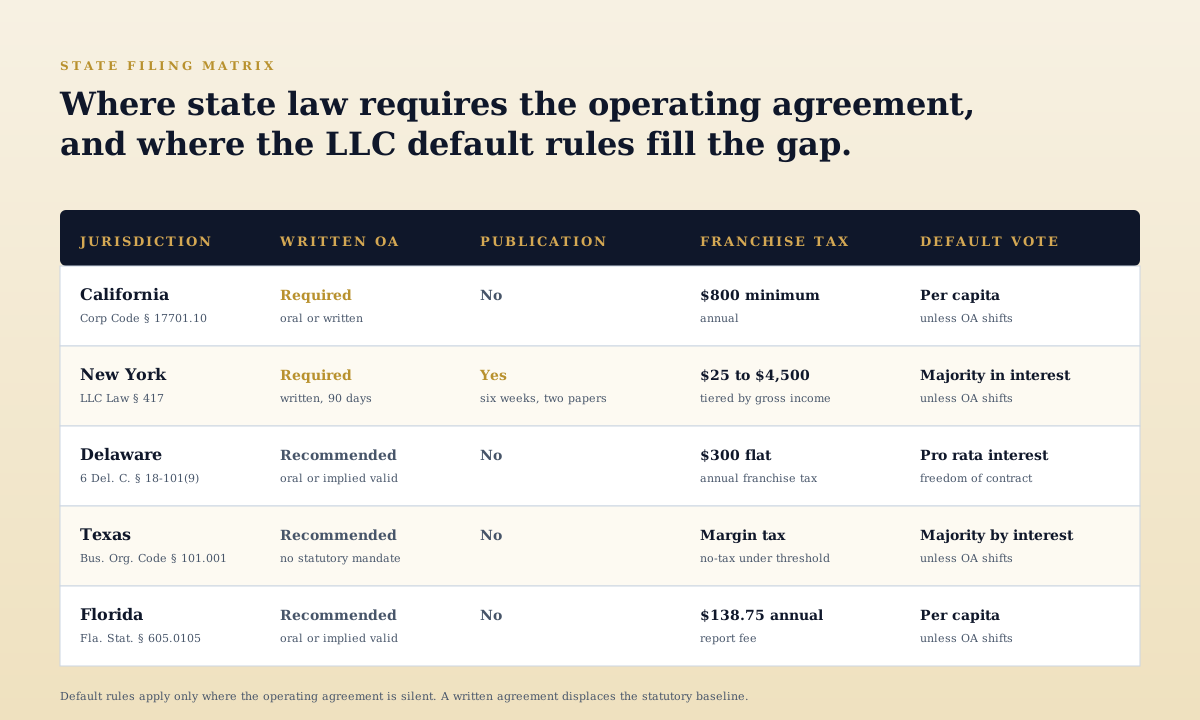
| Jurisdiction | Operating Agreement | Filing Layer | Default Vote |
|---|---|---|---|
California | Required Cal. Corp. Code § 17701.10; oral or written. | $800 minimum annual franchise tax | Per capita unless OA shifts |
New York | Required NY LLC Law § 417; written within 90 days. | Tiered fee + six-week publication requirement | Majority in interest |
Delaware | Recommended 6 Del. C. § 18-101(9); oral or implied valid. | $300 flat annual franchise tax | Pro rata by interest, freedom of contract |
Texas | Recommended Tex. Bus. Org. Code § 101.001; no statutory mandate. | Margin tax; no-tax under threshold | Majority by interest |
Florida | Recommended Fla. Stat. § 605.0105; oral or implied valid. | $138.75 annual report fee | Per capita unless OA shifts |
For founders comparing the cost of a generic free template to a state-conformed instrument, the related free agreement contract template guide compares the trade-offs across rental, partnership, service, and operating-agreement forms. For the broader doctrinal source of the contract-law principles that make any operating agreement enforceable, the laws of contracts guide tracks the source hierarchy. For the contract-drafting counsel side that handles the populated operating agreement at signing, the related professional services contract attorney page covers the engagement model for service-business members forming a multi-member LLC.
Frequently Asked Questions
Common questions about llc operating agreements, single-member and multi-member templates, drafting your own instrument, and avoiding the mistakes that show up at a member dispute or audit.