What Are NDA Agreements?
NDA agreements are written contracts that let parties share information they treat as confidential without losing the legal protection that surrounds it. The agreement defines what counts as confidential, restricts how the receiving party may use it, sets the period the obligation runs, lists the exclusions that take information out of scope, and names the remedies if the obligation is broken. Most NDAs in commercial practice fall into three structural families: unilateral, mutual, and multilateral.
Reasonable measures to maintain secrecy. The owner of the trade secret has taken reasonable measures to keep such information secret.

A workable NDA carries seven clauses: parties, definition of confidential information, permitted use, term, exclusions, return or destruction, and remedies. Most enforcement fights turn on the definition and the exclusions, not the signature.
What NDA Agreements Are in Black-Letter Law
In black-letter law, what are NDA agreements answers in two layers. The same instrument travels under several names: a confidentiality agreement, a CDA (confidential disclosure agreement), and a PIA (proprietary information agreement) all describe the same contract, walked through in plain language in the what is an NDA explainer. The first layer is contract law: an NDA is a bilateral or multilateral promise, supported by consideration and mutual assent (the consideration most often being the underlying business relationship the NDA enables), governed by the Restatement (Second) of Contracts in service matters and by the Uniform Commercial Code only where the NDA is folded into a sale of goods. The second layer is trade-secret law: an NDA is a source-of-law instrument that supplies the reasonable-measures element of the Defend Trade Secrets Act. Without an NDA, voluntarily handing confidential information to an outsider can defeat trade-secret status, because the statute requires the owner to take reasonable measures to keep the information secret. The NDA supplies that measure in writing.
The contract itself does not create the secret. Trade-secret status attaches to information the owner already protects through hiring, access controls, and document discipline. The NDA preserves the legal status of the information as the owner shares it outward, and allocates the cost of breach if the receiving party leaks. A useful way to read any NDA is to ask, for each clause, which of those two jobs (preservation, allocation) the clause is doing.
Marked & Documented
Information stamped CONFIDENTIAL on a written document, marked in an email subject line, or labeled in source code. The strongest evidence at trial; courts treat marking as proof the disclosing party identified the information as a secret at the time of disclosure.
Oral, Confirmed in Writing
Information conveyed verbally during a meeting and then summarized in a follow-up writing within a defined window (commonly thirty days). Falls inside scope when the agreement permits oral disclosures and the writing requirement is met. A frequent failure point when the writing never arrives.
Public Domain
Information already known to the public through no fault of the receiving party. Outside scope under every standard exclusion clause. The receiving party bears the burden of producing evidence the information was public at the time of disclosure.
Independently Developed
Information developed by the receiving party without reference to the disclosing party's materials, ideally through a documented clean-room process with personnel who never accessed the disclosure. Outside scope when the development records hold up at deposition.
The taxonomy resolves most everyday questions about whether a piece of information is covered. What it does not resolve is the harder edge case: information that started inside scope but became public after disclosure through no fault of either party. The exclusions clause (covered in the drafting section below) handles that drift. For background on contract sources beyond the NDA, see the types of agreements in business survey, which places confidentiality instruments alongside service contracts, leases, and licensing structures.
Three Types of NDAs and When Each Is Used
The structural family decides everything else about the NDA: who owes what, how the definition is written, where the exclusions cluster, and which side carries the bargaining position. Most commercial practitioners encounter all three families, but a general counsel will see unilateral NDAs by an order of magnitude more than mutual or multilateral. Reading an NDA starts with identifying which family it belongs to and whether the family choice fits the business reason for the disclosure.
Only the disclosing party shares confidential information; only the receiving party owes confidentiality obligations. Standard form for employer-to-employee onboarding, vendor evaluation, beta-tester arrangements, and pitch meetings. Drafting is usually firm-favorable to the disclosing party.
Employee onboarding, pitch meetings, vendor evaluation, beta access, financing pitch decks.
Both parties disclose and both parties owe confidentiality obligations to one another. Standard form for merger-and-acquisition diligence, joint development, partnership exploration, and licensing negotiations. Drafting starts symmetrical, then each side negotiates carve-outs for its own pre-existing know-how.
Acquisition diligence, joint ventures, technology licensing talks, strategic alliances.
Three or more parties bound to one another. At least one party discloses and the rest receive, but every signatory owes confidentiality on whatever flows their way. Drafting requires a careful definition of who is disclosing what to whom; the matrix is rarely symmetrical.
Consortium negotiations, multi-investor financing, standards bodies, supplier consortia.
Choosing the wrong family is one of the most common drafting mistakes. A vendor who signs a unilateral NDA cannot complain when the customer later refuses to be bound by symmetric obligations on the vendor's pre-existing know-how. A pair of merger candidates who sign two separate unilateral NDAs end up with mismatched terms, mismatched durations, and a hole in the middle where neither side's information is properly protected. A consortium that signs a chain of bilateral NDAs creates a coordination nightmare; a multilateral instrument is the cleaner answer. The companion explainer what is an NDA contract walks the structural choices through a single fact pattern.
The family also shapes the negotiation. In a unilateral NDA, the disclosing party drafts and the receiving party negotiates carve- outs around the definition and the term. In a mutual NDA, the symmetry forces both sides to live with whatever they push on the other, which produces tighter, shorter agreements. In a multilateral NDA, drafting starts from a matrix that names who discloses what to whom, and any party who refuses to sign the common form forces the deal team back to bilateral instruments.
Drafting an NDA, Clause by Clause
A workable NDA carries seven clauses, each of which serves a distinct legal job. Removing a clause to shorten the document usually transfers the missing function to a default rule that favors the party with the stronger bargaining position. The order below is the order most commercial NDAs follow on the page, and the order in which a redlining attorney walks the document.
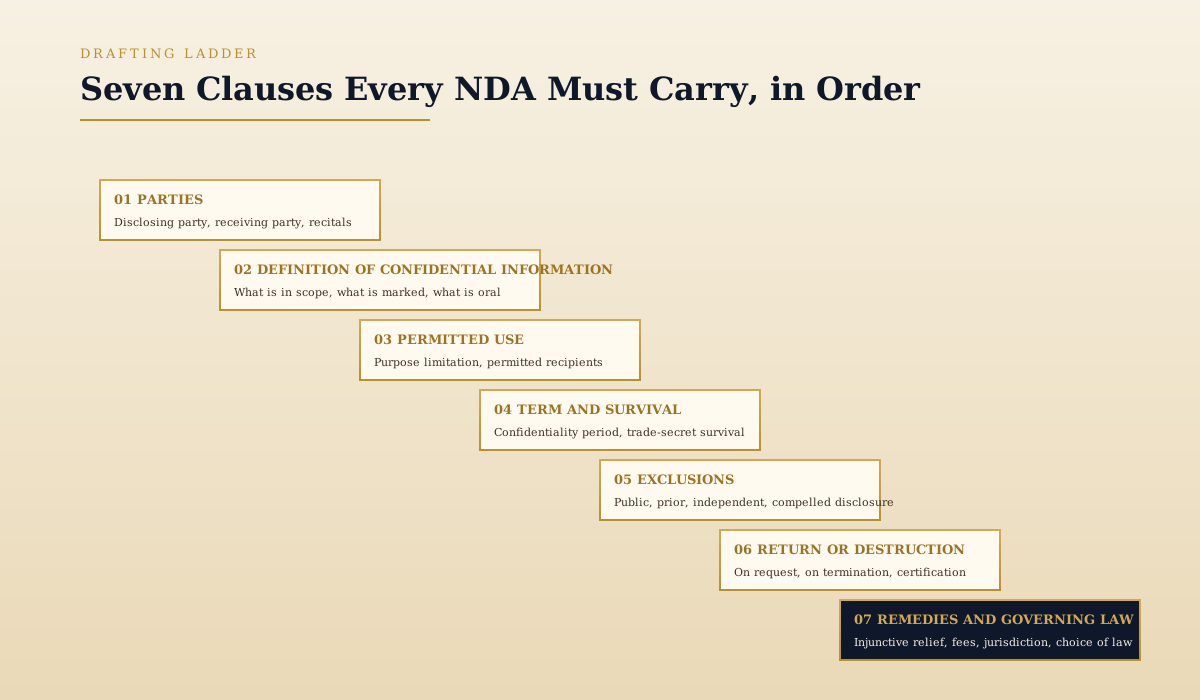
Parties and Recitals
Identify the disclosing party and the receiving party by full legal name, with addresses for service. Recitals state the business purpose: a contemplated transaction, a possible employment relationship, a vendor evaluation. The recitals matter because they later anchor the purpose-limitation and the scope of the permitted use.
Definition of Confidential Information
The most negotiated clause in any NDA. A receiving-party-friendly definition limits scope to information marked CONFIDENTIAL in writing, or summarized in writing within thirty days of an oral disclosure. A disclosing-party-friendly definition sweeps in everything seen or learned during the relationship. Most negotiated NDAs land in the middle: marked items plus oral disclosures confirmed in a follow-up writing.
Permitted Use and Permitted Recipients
Restricts the receiving party's use of the confidential information to the recital purpose and lists who inside the receiving party may see it. Standard formulation: only employees, advisors, and contractors with a need to know who are themselves bound by written confidentiality obligations at least as protective as this NDA.
Term and Survival
Two clocks run side by side: the disclosure period (how long the receiving party may receive new information) and the confidentiality period (how long the obligation to protect already-received information continues after disclosure stops). Two to five years is the commercial norm for general business information; trade-secret protection commonly survives for as long as the information remains a secret, mirroring the Defend Trade Secrets Act framework.
Exclusions
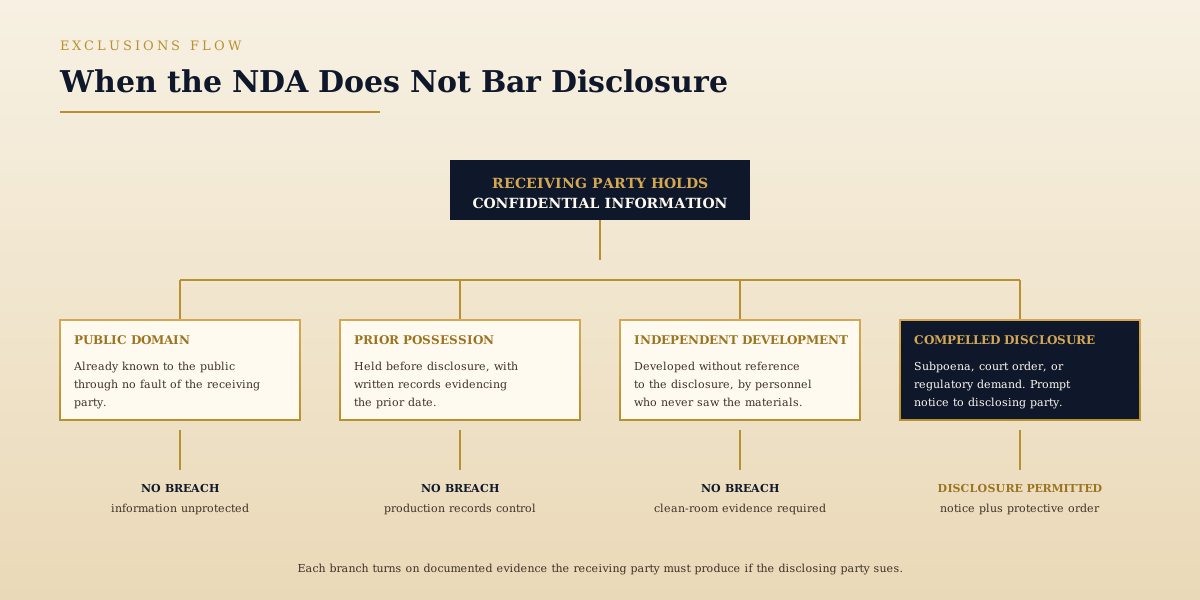
Four standard exclusions remove information from scope: information already in the public domain through no fault of the receiving party, information already in the receiving party's possession before disclosure, information independently developed without reference to the disclosure, and information compelled by court order or subpoena. The compelled-disclosure exclusion typically requires the receiving party to give prompt notice to the disclosing party so the disclosing party can move for a protective order.
Return or Destruction
On request or termination, the receiving party returns or destroys all confidential information and certifies the return or destruction in writing. A practical exception preserves backup copies kept under standard retention policies and information embedded in board minutes, regulatory filings, or audit work papers.
Remedies and Governing Law
Confirms that monetary damages may be inadequate and that the disclosing party may seek injunctive relief, often without bond. Names the governing law and the forum for disputes. Allocates attorney fees on an as-the-court-orders or prevailing-party basis. The remedies clause drives the cost of any later breach claim and deserves as much negotiation attention as the definition.
Further clauses NDAs commonly negotiate
Beyond the core seven, three provisions show up often enough to know by name, and one of them is a common reason a court narrows an otherwise-valid agreement.
Non-Circumvention
Bars the receiving party from using the introductions, contacts, or deal structures it learns under the NDA to go around the disclosing party and transact directly with its customers, suppliers, or partners. Common in brokered deals, finder arrangements, and supply-chain talks. Drafted too broadly, it drifts toward a restraint on trade and draws the same scrutiny as a non-compete.
Arbitration and Venue
Names where and how a dispute is resolved: binding arbitration under a stated set of rules, or litigation in a named court, with a governing-law and forum-selection clause. A disclosing party usually wants its home forum and, for speed and secrecy, confidential arbitration; a receiving party weighs the cost of defending far from home against the privacy that arbitration provides.
Geographic Scope (an Unenforceability Trigger)
An NDA that ties confidentiality to an unreasonably broad territory, or couples the confidentiality duty with a worldwide activity restraint untethered to any real business interest, invites a court to narrow or refuse the restriction. Confidentiality itself is not bounded by geography, but pairing it with sweeping geographic limits is a frequent overbreadth failure at enforcement.
Two clauses do most of the negotiating work. The definition of confidential information sets the scope of the obligation. The remedies clause sets the cost of breaching it. Everything in between (use, term, exclusions, return) calibrates how the obligation runs. A practical redline starts with the definition, moves to the remedies, and only then walks the rest. For sample clause language across the broader confidentiality family, see the NDA confidentiality agreement template walkthrough, which annotates each clause with both disclosing-friendly and receiving-friendly language. To assemble a draft from your own facts, the self-serve NDA generator builds each clause in order. Adjacent form instruments such as the LLC operating agreement form, residential rental forms, and the lease agreement library sit alongside NDAs in the formation file most counsel keeps for new commercial relationships.
One drafting trap deserves a callout. Definitions that promise confidentiality on any information disclosed during the relationship are popular in templates and unenforceable in practice; courts read them down to a reasonable subset, and that judicial rewriting rarely matches what the disclosing party thought it was buying. Better to mark the documents at the time of disclosure and define scope around the marked set, with a thirty-day confirming-writing window for oral disclosures.
How Courts Rule on NDA Enforcement
Most NDAs never reach court. Of those that do, enforcementturns on a small set of recurring questions: was the definition clear enough to enforce, was the term within the bounds of reasonableness, did the receiving party fall inside an exclusion, and did public policy override the silence the agreement tried to buy. The four outcome scenarios below cover the dominant patterns.
Definition Too Broad: Unenforceable in Part
An NDA defined confidential information as any information the receiving party learns during the relationship. The court found the definition swept in commonly available industry knowledge and refused to enjoin the receiving party from using that general knowledge in a competing venture. The disclosing party recovered only on the marked, documented portion of the disclosure. Lesson: definitions need a marking discipline to survive scope review.
Term Indefinite, Court Sets Reasonable Limit
An NDA with no stated term left the receiving party perpetually bound. On enforcement, the court read in a reasonable confidentiality period drawn from industry custom and the type of information at issue. Lesson: indefinite terms invite judicial rewriting; better to negotiate a stated period that matches the trade-secret life cycle.
Public Policy Defense Defeats Enforcement
An NDA tried to bar a former employee from reporting suspected securities fraud to the SEC. The court refused to enforce the silencing provision, citing the SEC whistleblower rule and Dodd-Frank protections. The remainder of the NDA stood. Lesson: silencing clauses that override statutory whistleblower or anti-retaliation protections fail at the public-policy gate.
Compelled Disclosure with Prompt Notice: No Breach
A receiving party was served with a third-party subpoena that demanded confidential information covered by an NDA. The receiving party gave prompt notice to the disclosing party, who then moved for a protective order. Production occurred under the protective order. The disclosing party later sued for breach; the court held no breach occurred because the compelled-disclosure exclusion and the notice procedure were followed exactly. Lesson: the notice procedure is the safety valve, and skipping it converts a permitted disclosure into a breach.
Remedies sit at the back of every enforcement opinion. Courts grant injunctive relief where the disclosing party shows the information meets the trade-secret definition under 18 U.S.C. § 1836 and the receiving party's threatened use creates irreparable harm that money cannot reverse. Compensatory damages are available for losses the disclosing party can prove with reasonable certainty. Attorney fees follow either the contract's fee-shifting clause or the prevailing-party rule of the controlling jurisdiction. The remedies analysis in turn drives the bargaining posture in any pre-suit posture, which is why a careful disclosing party often opens the dispute with a written demand before filing.
One last point worth flagging. NDAs cannot displace whistleblower protections, anti-retaliation rules, or the right to participate in lawful governmental investigations. Drafters who try to silence those channels usually find the broader agreement narrowed or read down at enforcement, even when the rest of the NDA is otherwise clean. The Uniform Trade Secrets Act preserves these channels in every state that has adopted it.
Limits the law puts on NDAs
Two limits sit outside anything the parties can bargain around. First, the federal Speak Out Act of 2022 makes a nondisclosure or non-disparagement clause unenforceable when it was agreed to before a dispute arose and it covers a claim of sexual assault or sexual harassment. A clause signed at the start of a relationship cannot later be used to silence such a claim. Second, no NDA can bar a person from reporting suspected illegal activity to a government agency: whistleblower channels to bodies such as the SEC, the EEOC, and the Department of Justice survive any confidentiality promise, and a clause that tries to close them is read down or struck at enforcement.
Need a demand letter that cites the breached clause and the statute behind it?
We draft NDA breach demand letters that cite the specific clause violated, the controlling state UTSA, and the federal Defend Trade Secrets Act. Most matters resolve before suit when the demand is calibrated to the receiving party's actual exposure under the agreement.
The Contract Law That Makes an NDA Enforceable
Every NDA is a contract first and a confidentiality device second. Whether a court will enforce it turns on the same common-law elements that govern any agreement: offer, acceptance, consideration, and mutual assent. A signed NDA without consideration (for example, given after the employee already started work, with no raise, bonus, or new access) can fail under the doctrine of past consideration. Courts also test the document under the parol evidence rule. If your NDA includes an integration clause, prior side conversations about scope or carve-outs generally cannot be used to vary its terms.
The statute of frauds rarely reaches an ordinary one-year NDA, but multi-year confidentiality covenants that cannot possibly be performed within one year must be in writing. NDAs that travel with a sale of goods will also be read against UCC § 2-204 (formation by any manner sufficient to show agreement) and UCC § 2-207 (the "battle of the forms"), which controls when the NDA is exchanged as part of purchase-order paperwork and the parties have inconsistent boilerplate.
Conditions, severability, and tail clauses
A condition precedent is something that must happen before the duty of confidentiality attaches, for example, the receiving party must first be granted access to a specific data room. A condition subsequent ends the duty when a defined event occurs, such as the information becoming public through no fault of the receiver. A severability clause lets a court excise an overbroad term (say, a 25-year nondisclosure period a court finds unreasonably long for the information at issue) without voiding the whole agreement. Assignment language controls whether the NDA travels with a corporate sale, and novation language addresses what happens when the original signer is replaced by a successor entity. A choice of law clause locks the construction rules to a specific jurisdiction so that a Delaware company suing a California vendor does not get its NDA reinterpreted under California's strong public-policy carve-outs.
What Happens If You Break a Non-Disclosure Agreement? Breach, Repudiation, and Remedies
When the receiving party signals before the duty is triggered that it will not honor the NDA, that anticipatory repudiation entitles the disclosing party to treat the contract as broken and sue immediately. After actual breach, courts award three families of money damages: expectation damages (the value of the benefit the disclosing party should have received), reliance damages (out-of-pocket costs incurred because of the disclosure), and restitution (the unjust gain the breaching party kept). For information that cannot be unspilled, the more powerful remedy is specific performance: an injunction forcing the receiver to retrieve disclosed copies and stop using the information. Many NDAs also include liquidated damages setting a fixed dollar amount per disclosure event; courts uphold these only when the actual loss is genuinely hard to compute and the figure is not a penalty.
How Long Does an NDA Last? Duration and Statute of Limitations
An NDA's duration of confidentiality is whatever the parties bargained for: trade-secret NDAs commonly run indefinitely (or "for as long as the information remains a trade secret"); employee and vendor NDAs typically tail for two to five years after the relationship ends; commercial M&A NDAs run one to three years from signing. Separately, the statute of limitations for SUING on a breach is shorter: most states impose a four- to ten-year window on written-contract claims, typically measured from the date of breach. Federal trade-secret claims under the Defend Trade Secrets Act run on a three-year clock from discovery. Delay past those windows extinguishes the right to sue even where the breach is clear, which is why a well-drafted NDA also includes notice and cure timing that pauses the clock while the parties try to resolve the issue.
Whistleblower Notices, Residuals Clauses, and Other NDA Strategy Points
The DTSA whistleblower immunity notice, 18 U.S.C. 1833(b)
Every employee, contractor, and consultant NDA should carry one paragraph most templates omit. 18 U.S.C. 1833(b) immunizes a person who discloses a trade secret in confidence to a government official or an attorney solely to report a suspected violation of law, or who files it under seal in litigation, and it requires employers to give notice of that immunity in any agreement with an employee, contractor, or consultant that governs trade secrets or other confidential information. The penalty for omission is quiet but real: in a later Defend Trade Secrets Act suit against that individual, the employer forfeits exemplary damages and attorney fees. The same policy line runs through SEC Rule 21F-17, which prohibits any provision that impedes reporting a possible securities violation to the SEC, and through the NLRB's 2023 McLaren Macomb decision, which held that merely offering non-supervisory employees a severance agreement with overbroad confidentiality or non-disparagement terms violates the National Labor Relations Act.
Residuals clauses and the fifth carve-out
Beyond the four standard exclusions, sophisticated forms add a fifth carve-out: information rightfully received from a third party who owed no duty of confidentiality to the disclosing party. Receiving parties that review many disclosures (venture funds, large acquirers, platform companies) also push for a residuals clause, which frees them to use whatever their people retain in unaided memory after access ends. Disclosing parties resist residuals hard, because the most valuable confidential information (architecture decisions, pricing logic, negotiation strategy) is exactly the kind that travels in memory. A related timing trap: putting a two-year confidentiality term on genuine trade secrets can itself be argued as evidence the owner stopped taking reasonable secrecy measures at year two, undermining trade-secret status. The standard fix is a two-tier term, a fixed period for ordinary business information and an obligation on trade secrets that runs for as long as the information remains a trade secret.
NDA vs non-compete vs non-solicit
The three restrictive covenants answer different questions. An NDA governs what you may say or use; a non-compete governs where you may work; a non-solicit governs whom you may recruit or sell to. Confidentiality promises are enforced almost everywhere, while covenants not to compete face reasonableness review in every state and outright bans in several. The line blurs through the inevitable disclosure doctrine, which some courts (following the Seventh Circuit's 1995 PepsiCo v. Redmond decision) use to enjoin a departing employee from a new role the employee could not perform without drawing on the old employer's secrets. Other states, California most emphatically, reject the doctrine as a disguised non-compete, so the NDA's choice-of-law clause can decide whether the theory is even available.
Proving a breach in practice
NDA breach cases are won on records, not indignation. The disclosing party must prove the specific information qualified as confidential under the definition, that the defendant received it under the agreement, and that the disclosure or use actually happened: forensic artifacts (downloads, forwards to personal accounts, USB activity), suspicious similarity between the defendant's later work product and the protected material, and timeline evidence tying the defendant's access to the competitor's sudden capability. Damages are measured by the owner's lost profits, the breaching party's unjust enrichment, or a reasonable royalty for the use, and a well-drafted fee-shifting clause determines whether winning is economically worth the fight. Because injunctions depend on speed, most disputes open with a preservation demand and a cease-and-desist letter within days of discovery, long before any complaint is filed.