Free Contract Templates, Five Categories Compared
A free agreement contract template is a pre-formatted document, usually in editable Word or PDF format, that supplies the standard clauses for a common contract type. The template fills the structural skeleton, the user fills the deal-specific values, and the parties sign. The template is a starting point, not a substitute for legal review when the deal is high-stakes.
The five most-downloaded categories cover roughly ninety percent of the consumer and small-business contract market: rental agreements, partnership agreements, service agreements, employment agreements, and loan and promissory note templates. Each category has a standard skeleton, a small number of dealbreaker clauses that frequently get edited wrong, and a state-specific overlay that the free template rarely supplies.
By the Legal Tank editorial team

- Residential lease
- Month-to-month
- Room rental
- Lease-to-own
- General partnership
- Limited partnership
- Joint venture
- Buy-sell rider
- Independent contractor
- Master services
- Catering, photography
- Statement of work
- Offer letter
- At-will employment
- Severance
- Non-compete rider
- Personal-loan IOU
- Family-loan promissory note
- Secured loan with collateral
- Balloon-payment rider
Free Doesn’t Mean Lower Quality, Where Free Templates Come From
A free rental agreement contract template from a state-bar website, a state landlord-tenant agency, or a reputable commercial-template publisher will, in most cases, hit the same statutory requirements as a paid version. The substantive clauses are not proprietary, the Restatement (Second) of Contracts and the Uniform Commercial Code are public, and the standard skeleton of a residential lease has been stable for forty years. What free templates lack is not the legal content, it is the legal judgment about which clauses your specific deal needs and which clauses you can drop.
Three Sources Of Quality Free Templates
- State-bar websites. Many state bars publish lay-friendly contract templates as part of their access-to-justice mandate. The California State Bar lawyer-finder, the Florida Bar consumer pamphlet library, and the New York State Unified Court System self-help center are examples. These templates are vetted by lawyers but are deliberately conservative, designed for the median user.
- State agency forms. Landlord-tenant agencies, secretary-of-state business filings, and state department-of-labor offices publish standardized forms (residential lease, partnership-registration certificate, employee-handbook acknowledgment). These are mandatory or strongly preferred in their jurisdiction.
- Commercial template publishers. Reputable commercial publishers offer a free tier and a paid tier. The free tier is usually fine for low-stakes consumer transactions. The paid tier is for higher-value commercial contracts where the publisher updates clauses to track recent case law.
Where Free Falls Short
The trade-off with a free contract template is not the form, it is the absence of judgment about what to add and what to remove. A free .docx contract template ships a generic indemnity clause that is fine for a low-stakes deal and a disaster for a high-stakes commercial agreement. A free service-agreement template ships a generic limitation-of-liability cap that is overly aggressive for a consumer contract and indefensibly weak for a vendor contract. The fix is not to abandon free templates, it is to know which clauses are the dealbreakers, and to escalate to attorney review when those dealbreakers are at stake.
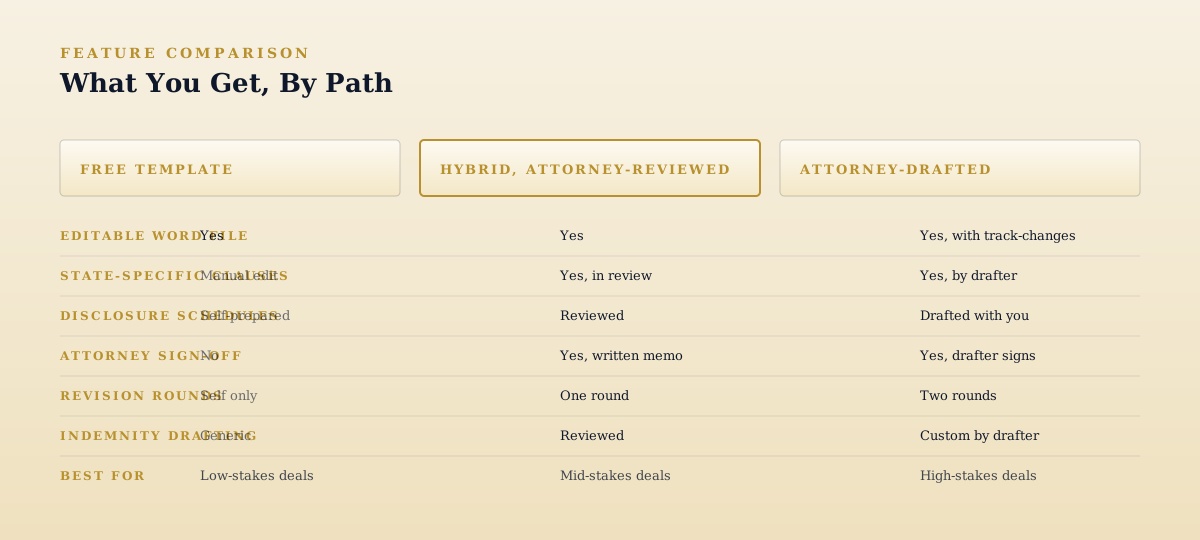
| Feature | Free Template | Hybrid, Professionally Reviewed | Professionally Drafted |
|---|---|---|---|
| Editable Word file | Yes | Yes | Yes, with track-changes |
| State-specific clauses | Manual edit by you | Yes, in professional review | Yes, written by drafter |
| Disclosure schedules | Self-prepared | Reviewed | Drafted with you |
| Professional sign-off | No | Yes, written memo | Yes, drafter signs |
| Revision rounds | Self only | One round | Two rounds |
| Indemnity & limitation | Generic | Reviewed | Custom by drafter |
| Best for | Low-stakes deals | Mid-stakes deals | High-stakes deals |
Sample Drafts, Partnership Agreement Contract Template And Three Companions
The fastest way to understand what a partnership agreement contract template actually contains is to read the most-edited clause from each of the four most popular template categories side by side. The clauses below are stripped down to the operative language, with the bracketed values the user fills in. The complete template is two to twelve pages depending on the type, but ninety percent of the negotiation between drafter and other party happens around these four clauses.
For a complete walkthrough of the rental clause, see the rental and contract agreement guide. For service-agreement templates governed by California or New York commercial law, the dedicated professional services contract drafting service handles the indemnity and limitation-of-liability calibration that free templates always under-do.

Rent & Late-Fee Clause
The two values the tenant edits are the monthly rent and the late-fee amount. The two values the tenant frequently misses are the late-fee cap (New York caps it by statute at five percent of monthly rent or fifty dollars, whichever is less; California sets no statutory cap but voids any late fee above a reasonable estimate of damages under Civil Code section 1671, which courts treat as roughly five percent of rent in practice) and the grace-period day count.
Profit-Loss Split Clause
The default UPA rule is per-capita allocation regardless of capital contribution. A partner who put in eighty percent of the capital and got a fifty-fifty split has overridden the default, but only by saying so explicitly in the agreement. The free template is fine for documenting the override, the negotiation about the percentage is not the template’s job.
Scope-of-Work Clause
The most common scope-of-work mistake is letting the verbal pre-signing conversation become the binding scope. The fix is to attach a written Statement of Work as Exhibit A and require any change to be a signed change order. The free service-agreement template usually includes this mechanic, the user just has to use it.
At-Will Employment Clause
At-will is the default rule in every state except Montana, but the free employment-agreement template should still recite the at-will language explicitly to defeat any later implied-contract claim under the Toussaint doctrine. Watch for the post-termination obligations clause, which carves non-compete, non-solicit, and confidentiality obligations through the at-will fence.
What A Service Agreement Contract Template Actually Is
A service agreement contract template is a pre-formatted contract that documents a one-side-performs-services, the-other-side-pays relationship. The structure tracks the elements of contract formation under the Restatement (Second) of Contracts: an offer (the scope of work), an acceptance (the signed agreement), consideration on both sides (services for money), mutual assent (both parties signing the same document), and a lawful subject matter. A service agreement is not a sale-of-goods contract, so the Uniform Commercial Code Article 2 does not apply, and the common-law contract framework controls.
Sub-Type One: Independent Contractor
Used when one party hires the other to perform discrete services as a non-employee. The template needs an explicit independent-contractor classification clause to defeat misclassification claims under the IRS common-law control test (behavioral control, financial control, and the relationship of the parties) and stricter state-law equivalents (California’s ABC test under Dynamex). Free templates often skip this clause, which becomes a problem when the contractor later files for unemployment benefits.
Sub-Type Two: Master Services Agreement
A master services agreement (MSA) is a long-term framework contract paired with project-by-project Statements of Work. The MSA covers the durable terms (indemnity, limitation of liability, IP ownership, confidentiality, term and termination), the SOW covers the deal-specific terms (deliverables, timeline, fees). Free MSA templates exist but usually need an attorney pass to calibrate the indemnity scope.
Sub-Type Three: Catering, Photography, Personal Services
Single-event personal-services contracts. The template is usually two pages, the operative clauses are deposit-and-cancellation policy, force-majeure carve-out for weather events, and rights to use deliverables (especially the photographer’s right to portfolio images). A free template handles this well unless the event is a destination wedding crossing state lines.
Sub-Type Four: Statement of Work
A standalone or MSA-attached document that spells out the deliverables, timeline, acceptance criteria, and fees for a single engagement. The SOW is where the scope of work lives. The most common SOW failure is treating it as a casual one-pager rather than a binding contract addendum, the SOW should be signed and dated like any other contract.
Six Elements Every Service Agreement Template Should Hit
- Identification of parties, with full legal entity name, state of formation, and signing authority of the individual signer.
- Scope of work, attached as Exhibit A and subject to a signed change order for any addition or removal.
- Fees and payment terms, including invoice schedule, net-payment window, and late-payment interest under the state usury cap.
- Term and termination, fixed term with renewal mechanic, plus termination-for-convenience and termination-for-cause carve-outs.
- IP ownership and license, naming who owns the deliverables, who owns the pre-existing tools, and what license the other side gets.
- Indemnity, limitation of liability, choice of law, dispute resolution, the four boilerplate clauses that survive most negotiations untouched and most disputes uncited.
Why Companies Still Use An Employment Agreement Contract Template
The employment agreement contract template is the most heavily lawyered template category, because the consequences of a defective employment contract are higher than the consequences of any other consumer-grade template failure. Employment contracts trigger wage-and-hour exposure under the federal Fair Labor Standards Act, restrictive-covenant exposure under fifty different state non-compete regimes, and wrongful-termination exposure under the public-policy and implied-contract exceptions to the at-will doctrine.
Adair v. United States
The Supreme Court enshrines the at-will doctrine in federal law, the idea that an employer can terminate an employee for any reason or no reason at all unless a contract says otherwise.
Petermann v. Teamsters
California opens the public-policy exception, holding that a written employment contract cannot insulate an employer from a wrongful-discharge claim where the firing violates public policy.
Toussaint v. Blue Cross
Michigan recognizes the implied-contract exception, where an employee handbook can create a binding employment-contract obligation even without a signed agreement.
FTC Non-Compete Rule, Set Aside
The FTC issues a near-total ban on non-compete clauses in employment agreements, effective September 2024. Before it takes effect, the Northern District of Texas sets the rule aside nationwide in Ryan LLC v. FTC; the FTC abandons its appeal in September 2025, leaving the rule vacated. Non-compete enforceability stays governed by state law, so employment-agreement templates still calibrate restrictive covenants state by state.
Three Reasons The Free Employment Template Persists
Employment contracts are the most-used free template category by volume, despite being the highest-risk category. Three reasons explain why companies stay on free templates rather than escalate every offer letter to attorney review.
Volume Economics
A growing company hires twenty employees a year. Attorney-drafting each offer letter at three hours per offer is sixty hours of legal work a year. A standardized free template, customized once with a state-specific clause pack, drops that to about four hours of legal work a year.
Standardization Reduces Disputes
A consistent employment-contract template across all hires means every employee is on the same at-will, severance, and non-solicit framework. Disputes that do arise turn on facts rather than on contract interpretation. The downstream litigation cost is lower with one well-drafted template than with twenty separately-drafted contracts.
Audit-Friendly
Standardized templates simplify wage-and-hour audits, FLSA exemption defenses, and employment-class action discovery. A defendant company with a single template can produce a clean record of consistent treatment, a defendant company with twenty different employment contracts has to explain why.
When To Drop The Template And Hire A Drafter
Three triggers should bump a deal from free template to professionally drafted document. First, the dollar value of the deal exceeds what the user can afford to lose, the rule of thumb is one percent of the contract value spent on drafting saves ten percent at dispute. Second, the deal involves contract-formation issues or novel legal questions that no template addresses. Third, the deal crosses a regulatory line (a service contract for a regulated industry, an employment contract with a tipped-employee carve-out, a lease for commercial premises with a triple-net mechanic). At those triggers, the template stops being a starting point and starts being a liability. For commercial-grade leasing, a contract and lease drafting attorney is the right move. For tiered fixed-scope agreements covering vehicle service plans, a vehicle service contracts attorney handles the regulator-facing layer that templates do not touch.
The Universal Skeleton, What Every Agreement Template Shares
Strip away the category-specific clauses and the same twelve-part skeleton runs through every agreement category above. Knowing the skeleton lets you audit any contract template in minutes: read top to bottom, confirm each part is present, and confirm the deal-specific values landed in the right part.
Twelve Parts, In Reading Order
- Title and effective date, naming the instrument and the date obligations begin.
- Parties block, full legal names, entity type (individual, LLC, corporation), state of formation, and the defined short name used for the rest of the document.
- Recitals, the “Whereas” background paragraphs; context, not operative promises, but courts read them when the operative clauses are ambiguous.
- Definitions, capitalized terms defined once and used consistently.
- Operative terms, the core exchange: what is delivered, what is paid, when.
- Representations and warranties, statements of present fact each party stands behind (authority to sign, ownership of what is being sold or licensed).
- Covenants, ongoing promises about future conduct (maintain insurance, keep information confidential).
- Conditions precedent, events that must occur before a duty ripens (financing approval, permit issuance).
- Term and termination, how long the contract runs and how each side exits.
- Remedies and dispute resolution, what breach costs and where the fight happens.
- General provisions, the boilerplate glossary at right.
- Signature blocks and exhibits, printed name, title, entity, date; every exhibit referenced in the body attached and, where the template calls for it, initialed.
Signatures, The Statute Of Frauds, And E-Signing
Most contracts are enforceable without any writing at all, but four categories require a signed writing under the statute of frauds: contracts for an interest in land, suretyship promises to answer for another’s debt, agreements that cannot be performed within one year, and sales of goods priced at $500 or more under UCC section 2-201. Every category on this page either falls inside one of those boxes or is close enough that signing is the only sensible practice.
Electronic signatures satisfy the writing-and-signature requirement under the federal ESIGN Act and the Uniform Electronic Transactions Act (UETA), which nearly every state has adopted (New York reaches the same result under its own ESRA statute). A typed name, a click-to-sign platform record, or a scanned wet signature all count, provided both parties consented to transact electronically.
Five Execution Errors That Sink Free Templates
- Bracketed placeholders left in. A signed contract that still reads [PARTY NAME] or [STATE] hands the other side an ambiguity argument on the exact term you needed most.
- Wrong party names. Signing under a trade name instead of the registered legal entity, or signing personally where the officer meant to sign for the company, can put the signer’s personal assets on the hook.
- Unsigned or missing exhibits. If the scope of work lives in Exhibit A and Exhibit A was never attached, the contract’s core term is whatever each side remembers.
- Frankenstein templates. Pasting clauses from two different templates produces mismatched defined terms and, in the worst cases, two conflicting governing-law or remedies clauses in one document.
- Deleted consideration recitals. Trimming a one-sided agreement (a release, a guaranty) down to the promise alone can strip out the recited exchange of value that makes the promise enforceable.
The Boilerplate Glossary, Nine Clauses Nobody Reads Until The Dispute
The general-provisions section at the back of every template does the heaviest lifting in a dispute. These nine clauses appear in nearly identical form across all five categories, and each one changes a real outcome.
Entire Agreement (Integration)
States that the signed document is the complete deal and supersedes every earlier draft, email, and verbal promise. Under the parol evidence rule, a fully integrated agreement blocks either side from introducing prior negotiations to contradict the written terms. Deleting this clause from a template reopens the door to he-said-she-said disputes.
Severability
If a court strikes one clause as unenforceable (an overbroad non-compete, an above-cap late fee), the rest of the contract survives. Without it, a single bad clause can risk voiding the whole agreement.
Governing Law & Venue
Names the state whose contract law interprets the agreement and the county or federal district where suit must be filed. Free templates ship with a placeholder state; leaving the wrong state in is one of the most common execution errors.
Force Majeure
Excuses performance during events beyond either party's control: natural disaster, government order, epidemic. Courts read these clauses literally, so an event not listed is generally not excused.
Assignment
Controls whether a party can hand its rights or duties to someone else, by sale of the business or otherwise. The standard template rule is no assignment without written consent, often with a carve-out for assignment to an affiliate or a purchaser of substantially all assets.
Notices
Specifies the address and method (certified mail, courier, email) for legally effective notice, and when notice is deemed received. Termination and cure rights run from the notice date, so a stale address in this clause can quietly waive rights.
Counterparts
Lets each party sign a separate copy, with all signed copies together forming one contract. Essential for remote signings; modern versions also confirm that electronic and scanned signatures count as originals.
Waiver
Confirms that letting one breach slide (accepting late rent in March) does not surrender the right to enforce the same term later (demanding on-time rent in April). Waiver must be in a signed writing to be effective.
Amendment
Requires every change to the contract to be in a writing signed by both parties. This clause is what makes the signed change order mechanic in a service agreement work, and it is why penciled margin edits initialed by one side do not bind the other.
Questions People Ask About Free Contract Templates
These eleven questions are the ones that show up most consistently in the “People Also Ask” box on Google for the rental, partnership, and contract-template query cluster. Each answer is written for the lay reader and is not a substitute for advice from an attorney licensed in the state where the contract will be signed.
Can I create my own lease agreement?
Can I write my own partnership agreement?
How do you create a simple partnership agreement?
How to write a simple rent agreement?
Is a handwritten rental agreement legal?
What are 5 things that should be included in a partnership agreement?
What is an example of a partnership agreement?
Are free contract templates legally binding?
Does a contract have to be notarized or witnessed to be valid?
What is the difference between a unilateral and a bilateral contract?
Is a letter of intent the same as a contract?
Free Templates, Or Custom-Drafted
The Legal Tank library has free, professionally verified agreement contract templates for every category covered above. When the deal is high-stakes enough to need a custom-drafted document with state-specific clauses and revision rounds, get a fixed-scope quote from the drafting team instead.