
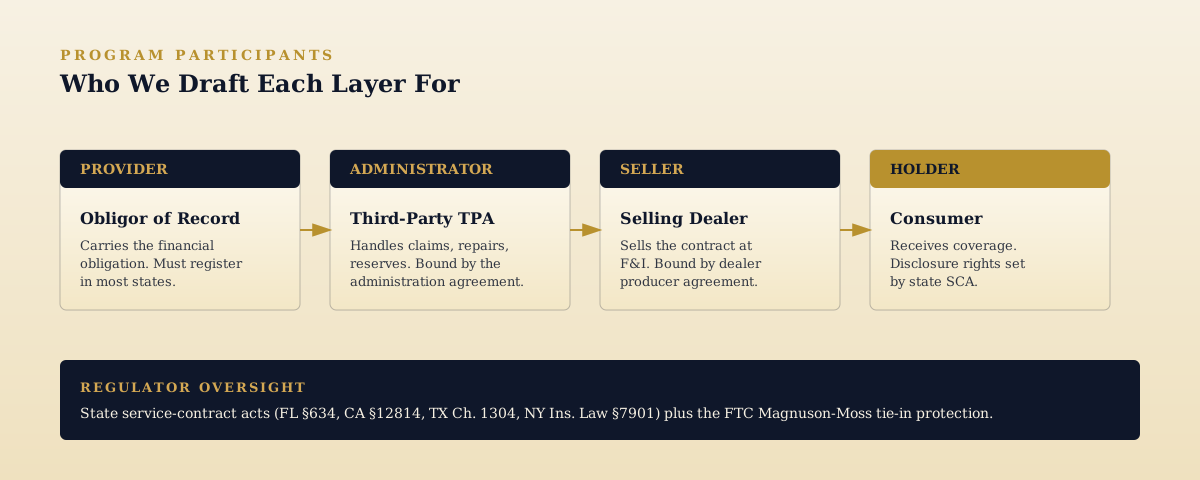
A vehicle service contract is a written agreement under which a provider, the obligor of record, promises to repair or replace defined mechanical components of a covered vehicle in exchange for a fee paid by the consumer. Legal Tank drafts the master contract, the administration agreement that binds the third-party administrator, the dealer producer agreement that governs the sale at finance and insurance, and the consumer disclosure packet that satisfies the controlling state service-contract act and the federal Magnuson-Moss tie-in rule.
By the Legal Tank editorial team
I, Catalog
Vehicle Service Contracts We Draft, by Coverage Tier
Our drafting catalog spans three coverage tiers and four program archetypes. The question every program owner answers first is whether the vehicle service contract is worth issuing at the cover-schedule level, which depends on whether loss ratios stay inside the actuarial reserve once the exclusion schedule and the claims procedure are stress-tested. We draft each tier so the answer is yes, with documentation an actuary can defend.
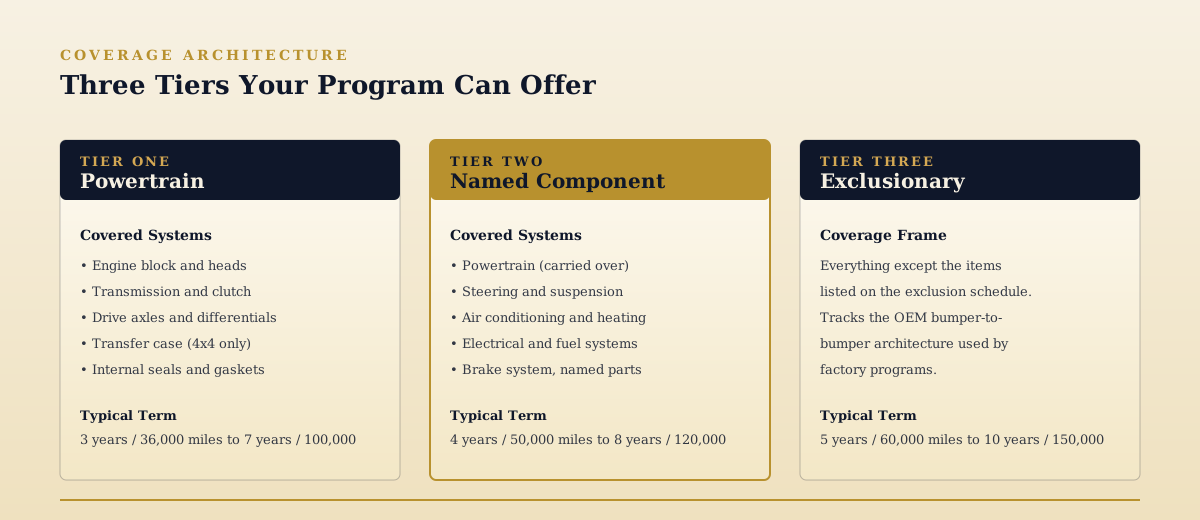
Tier One
Powertrain Coverage
Covers the engine block and heads, transmission and clutch, drive axles and differentials, and the transfer case on four-wheel-drive vehicles. We draft the named-component exclusion schedule, the seal-and-gasket carve-in language, and the wear-and-tear ceiling that keeps loss ratios inside the actuarial reserve. Powertrain tiers usually run 3 years and 36,000 miles up to 7 years and 100,000 miles. Typical for budget-tier resale programs and certified pre-owned wraparounds.
Tier Two
Named-Component Coverage
Picks up the powertrain coverage and adds steering and suspension, air conditioning and heating, fuel and electrical, and a defined slice of the brake system. We draft each component group as a discrete schedule so a future revision can swap in or out a system without rewriting the master document. Named-component tiers run 4 years and 50,000 miles up to 8 years and 120,000 miles. Most third-party administrators sell two or three named-component variants to avoid the price compression that a single SKU produces.
Tier Three
Exclusionary Contracts
Frames coverage as everything not listed on the exclusion schedule, parallel to the original-equipment bumper-to-bumper architecture. We draft the exclusion schedule to track factory programs that consumers already recognize, and we layer in the wear-item carve-out and the maintenance-failure carve-out so that misuse and neglected service do not produce a covered claim. Exclusionary tiers run 5 years and 60,000 miles up to 10 years and 150,000 miles. The drafting risk is the exclusion schedule itself: too narrow and the program loses money, too broad and the attorney-general gets a complaint about the cover sheet not matching the schedule.
Extended Vehicle Service Contracts
An extended vehicle service contract picks up after the original-equipment factory warranty expires. We draft the bridge language so the term clock and the mileage clock both start at the factory-warranty expiry, not at the consumer purchase date, which is the source of most disputed-claim letters from holders who believed they had double coverage. The extended program runs in parallel with whatever residual factory coverage remains, and the cover schedule explicitly states the order in which the obligor and the original manufacturer respond to a claim.
II, Purpose
When a Vehicle Service Contract Earns Its Place at Finance and Insurance
Three instruments compete for the same buyer dollar at finance and insurance: the manufacturer extended warranty, the mechanical breakdown insurance product, and the vehicle service contract. The right choice depends on which entity is the obligor, what regulatory regime governs that entity, and how claims are actually paid. We draft programs only after that question is settled, because the wrong instrument creates licensure exposure that no amount of clever cover-schedule writing can repair.
A vehicle service contract treats the agreement as a bilateral commercial promise: the consumer pays consideration, and the obligor undertakes a defined repair or replacement obligation. The bilateral structure traces back to Restatement (Second) of Contracts § 1, which defines a contract as a promise the law enforces. State service-contract acts then layer disclosure, registration, and reserve requirements on top of that base, distinguishing the instrument from a mechanical breakdown insurance product that would otherwise sit under the state insurance code.
Coordinating Coverage With Existing Factory Warranties
Most consumer-facing programs are sold to buyers who already hold an unexpired factory warranty or a manufacturer-administered protection plan. The drafting risk is duplication of covered components, which produces refund disputes when both obligors decline a claim citing the other contract. We draft the order-of-response language so the consumer document states which obligor pays first, what happens at exhaustion, and how subrogation between the two programs is handled. The drafting work focuses on the document's text, not the brand of the underlying factory product.
Reserve Backstops and Contractual Liability Insurance
A service contract obligor agreement often sits inside a two-layer architecture: the consumer-facing contract on the surface, and an insurer-backed contractual liability instrument backstopping the obligor reserve underneath. We draft the second-layer instrument so the reserve is properly cedable and the insurer's notice, defense, and cooperation obligations are explicit. Vehicle service contract providers running insurer-backed programs without that second instrument expose the obligor to unfunded loss when the reserve runs short.
Dealer Channel Integration and Producer Agreements
Programs sold through franchised dealers ride on a vsc dealer producer agreement that governs how the dealer markets the program at finance and insurance, what disclosures must accompany the sale, what commissions and chargebacks apply, and what happens to the file when a dealer terminates the relationship. We draft the producer agreement so the program owner controls the consumer experience without exposing the obligor to vicarious liability for representations the dealer's F and I manager makes off-script.
A Service Contract Is Not a Warranty Under Magnuson-Moss
The word warranty is the most expensive drafting error in this product line. 15 U.S.C. § 2301 defines a written warranty as a promise that is part of the basis of the bargain and given without separate charge, while a service contract is a separately priced undertaking to perform maintenance or repair services. A vehicle service contract, sold for its own consideration at the F and I desk, therefore sits outside the federal warranty definition; the phrase extended warranty is marketing shorthand, not a legal category. We draft the consumer document to name itself a service contract on every page, because the mislabel invites Magnuson-Moss remedies the reserve never priced and hands a regulator an easy deceptive-practice count. California adds a second trap: the same economic product sold outside the dealer channel is regulated as mechanical breakdown insurance under the Department of Insurance, so channel determines regulator, and the draft must match the channel.
Claims Mechanics: Prior Authorization, Teardown, and Deductible Structure
Claims language decides whether the program pays inside the reserve or bleeds through it. The sequence we draft runs first notice of loss, prior authorization before any teardown or repair begins, then inspection and payment; a repair started without authorization is the single most litigated denial ground, so the contract must state the authorization rule and the phone-line hours in the same clause. The draft also fixes who bears diagnostic and teardown fees when the diagnosis reveals a non-covered failure, whether the holder may choose any licensed repair facility or must use a network shop, and whether the deductible applies per visit or per repair: on a multi-component failure the difference is one deductible versus three, and holders notice. Finally, the wear-and-tear exclusion and the pre-existing-condition exclusion need objective anchors, measured tolerances for wear items and a documented waiting period or inspection for pre-existing failures, because a denial that rests on an adjuster's unaided judgment is the complaint file a state regulator reads first.
Cancellation, Refunds, and Transfer on Private Sale
State service-contract acts commonly mandate a free-look right of return, usually 30 to 60 days for a full refund when no claim has been paid, followed by pro-rata cancellation refunds net of claims and a statutorily capped fee. We draft the refund waterfall explicitly: cancellation on loan payoff, cancellation on total loss or repossession, and the rule that a refund on a financed contract runs to the lienholder against the loan balance. The transfer clause carries the resale-value case for the product, one transfer to a private buyer on notice and a small fee, with dealer trade-ins and auction sales excluded by name. Program owners who inherit an existing form and want these clauses benchmarked against the controlling statute before reprinting can route the form through our contract review service ahead of a full redraft.
III, Process
How We Draft Your Vehicle Service Contract, From Dealer Intake to State Filing
Our drafting pipeline runs in six discrete stages. Whether the program is sold by franchise dealers or by an independent third-party administrator, the work moves through the same six stages. The difference shows up at the state-conformance stage and at the consumer-disclosure stage, where dealer-aligned programs frequently inherit a stricter disclosure overlay than the generic statute requires.
Step 01
VSC Intake and Risk Profile
We capture the deal terms in one structured intake: program type (provider, dealer, TPA), states of intended sale, target tier mix, target term and mileage band, target loss ratio, any factory-program adjacency or co-marketing arrangement, and any contractual-liability backstop or reserve-insurance layer the program will use. The intake doubles as the data model for the draft so the drafter is not chasing missing facts during drafting.
Step 02
Master Contract Drafting
We draft the consumer-facing vehicle service contract to your program parameters and the controlling state act. The cover schedule is written so the consumer can read what is covered before signing; the exclusion schedule is written so the program can defend a denial; the claims procedure sequences first-notice-of-loss through inspection, authorization, and reimbursement. We draft each provision to the bargained allocation, not to a generic form.
Step 03
Administrator and Producer Agreements
If the program is administered by a third-party administrator, we draft the administration agreement that binds the TPA to the claims procedure, the reserve-handling rules, and the data-sharing limits. If the contract is sold through dealers, we draft the dealer producer agreement that governs how the dealer markets the program, what disclosures must accompany the sale, and how chargebacks are handled. These two instruments sit alongside the consumer contract; without them, the program has gaps that surface only at audit.
Step 04
Internal Peer Review
A second reviewer checks the draft against our checklist of 38 vehicle-service-contract failure modes: exclusion schedule that contradicts the cover sheet, ambiguous transfer-on-sale provision, missing free-look right of return, unenforceable cancellation-fee cap, silent treatment of total-loss salvage, and the dozens of other issues that surface only on the second read. Peer review is built into our delivery timeline at no separate cost.
Step 05
State Service-Contract Act Conformance
Service-contract law is state-specific. We conform the draft to the controlling state's service-contract act (Florida Statutes Chapter 634, California Insurance Code Section 12814, Texas Occupations Code Chapter 1304, New York Insurance Law Article 79, Illinois 215 ILCS 152) and to the federal Magnuson-Moss tie-in rule. Cross-referencing the controlling rule during drafting prevents the common error of a generic form running into a state-specific consumer-protection overlay at the first audit.
Step 06
Sign-Ready Delivery and Consumer Disclosures
You receive the master contract, the administrator agreement, the dealer producer agreement, and the consumer disclosure packet (free-look notice, cancellation form, transfer-on-sale instructions) as DOCX and PDF. Standard turnaround is 7 to 14 business days for a single-state program and 14 to 21 business days for a full multi-state program; rush option compresses to 5 to 7 business days at a 30 percent premium.
Throughout the pipeline, the controlling reference for the bilateral promise structure is the contract-law base described in our contract drafting services. For program owners who want to read the foundational doctrine before reviewing the draft, our laws of contracts reference walks through formation, performance, breach, and remedies in plain English.
IV, Engagement
Engagement Tracks and How to Request a Quote
Three engagement tracks fit the most common scopes we see: a light edit on an existing program, a single-state professionally drafted program, and a full multi-state program with administrator and producer agreements. Each track is quoted per matter; we return scope and fee in writing before any drafting begins. The structured intake captures the variables that drive scope, so the quote is meaningful, not generic.
Light Edit
Refresh of a contract already in the field
Same-day draft on an existing form
- AI-drafted edit pass over an existing master contract
- Single state of intended sale
- Cover schedule and exclusion schedule clean-up
- Free-look, cancellation, and transfer language
Most Common
Single-State VSC
First-time provider launching in one state
7 to 14 business days
- Professionally drafted master contract
- One state service-contract act conformance
- Administrator agreement template
- Dealer producer agreement template
Multi-State VSC
Multi-state TPA or dealer group
14 to 21 business days
- Master contract plus state-specific addenda
- Administrator and producer agreements
- Consumer disclosure packet (free-look, cancellation, transfer)
- Magnuson-Moss tie-in compliance memo
What Drives Scope
Variables We Capture Before Quoting
- Number of states of intended sale and the controlling service-contract acts
- Whether an administrator agreement and dealer producer agreement are in scope
- Coverage tier mix (powertrain, named-component, exclusionary)
- Reserve architecture and any contractual-liability backstop
- Consumer-disclosure scope (free-look, cancellation, transfer, complaint procedure)
- Magnuson-Moss tie-in compliance and the disclosures it triggers
Programs with non-listed scopes (book-of-business consolidation, multi-administrator coordination, or non-U.S. holder coverage) sit outside the standard tracks. Request a custom quote and we return scope and fee in writing before drafting starts.
V, Why Us
Who Drafts Your Vehicle Service Contract at Legal Tank
Our drafters build commercial contracts at scale and write to the bargained allocation, not to a binder template. Every program file gets a lead drafter and a separate peer review before delivery, and we return scope and fee in writing before the engagement starts.
Peer-Reviewed File
Lead drafter plus a separate peer review on every program file. Peer review built into the standard delivery timeline.
38-Point Failure-Mode List
Internal checklist of recurring vehicle service contract drafting errors, applied at peer review.
Sign-Ready DOCX and PDF
Master contract, administrator agreement, dealer producer agreement, and consumer disclosure packet, all formatted for execution.
VI, Adjacent
Adjacent Drafting for Dealer and Provider Clients
Once your vehicle service contract program is live, three adjacent drafting needs surface within the first twelve months. We draft each instrument so the program owner has one drafter on the file across the connected agreements.
When a holder dispute reaches active litigation
When a holder dispute escalates to discovery and the opposing side stonewalls, we draft the motion for sanctions package that preserves the fee-shifting record and forces production. The motion sits alongside the program's claims-denial file.
motion for sanctions drafting serviceWhen the program needs a parent contract umbrella
Master service agreements between the obligor and the dealer network, between the obligor and the administrator, or between two providers consolidating books of business sit one layer above the consumer contract. We draft the umbrella instrument so the program has a clean parent.
contract drafting servicesWhen the dealer needs a cleaning or facilities service contract
Dealer service operations frequently sign cleaning, detailing, and facilities-services contracts that follow the same service-contract architecture as the consumer-facing vehicle program. We draft the dealer-side service contract with parallel exclusion and termination logic.
cleaning service contract attorneyOther adjacent drafting we handle for the same program owner: our free contract templates library for ancillary forms, our motion to amend pleadings drafting when discovery surfaces additional defendants in a multi-administrator dispute, and a service contract format reference for in-house draft check-throughs. Dealers running connected-car or telematics offerings also benefit from our no-contract carrier service drafting and device service plan drafting.
FAQ
Vehicle Service Contract Drafting Questions
Are vehicle maintenance contracts worth it?
How much does a vehicle service contract cost?
What does a vehicle service contract mean?
Is a service contract a good idea?
Is a vehicle service contract the same as an extended warranty?
Can a vehicle service contract be canceled for a refund?
Does a vehicle service contract transfer when the car is sold?
How does a buyer vet a vehicle service contract provider?
Ready to Draft Your Vehicle Service Contract?
Send us the program parameters and we will return a sign-ready master contract, administrator agreement, dealer producer agreement, and consumer disclosure packet inside the published timeline.
Want a doctrinal primer first? Read our contract definition guide. Need ancillary forms? Browse the free contracts template library.