8
Contract Families
14 Days
Review Window
4 Attorneys
Drafting Roster
Written and legally reviewed by our editorial team
Eight Commercial Contract Families Our Attorneys Draft
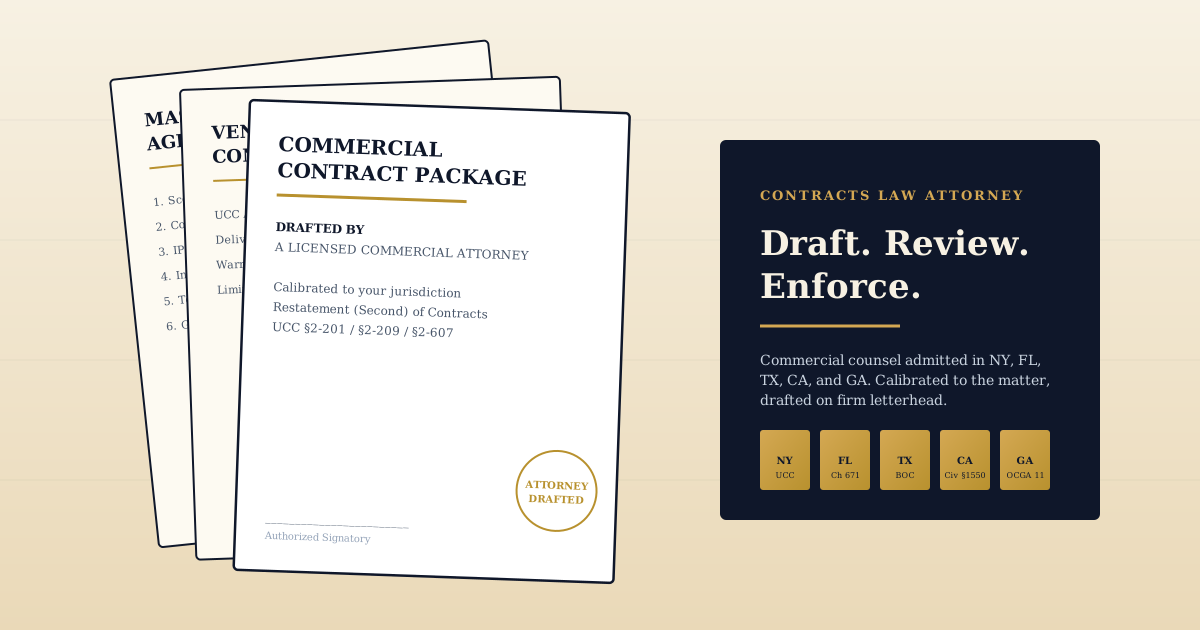
Our contract law attorney roster drafts the eight commercial contract families that cover the majority of business engagements. Each instrument shares the same architectural spine (governing law, parties, scope, fees, performance, IP, indemnity, termination, remedies) but the clause weight shifts based on the matter. A master services agreement loads the indemnity cap and IP assignment; a vendor contract loads the UCC warranty disclaimers and limitation of liability; a partnership instrument loads the deadlock and buyout mechanics. Our drafters pair the right base instrument with the right clause weighting so the contract reads as a calibrated allocation rather than a generic template.
Under the Restatement (Second) of Contracts § 1, a contract is a promise for the breach of which the law gives a remedy, supported by mutual consideration. Each clause our contract law lawyer drafts turns that promise into an enforceable instrument by specifying performance, fixing the price, sequencing the IP transfer, and pre-bargaining the consequences of breach. For sales of goods, the same architecture overlays UCC Article 2 (perfect tender, cure rights, anticipatory repudiation, statute of frauds for goods over $500). For service engagements, our professional services contract attorney team handles the scope-of-work-driven matters where deliverable acceptance is the central calibration.
Master Services Agreement
The umbrella commercial framework for an open-ended provider relationship. The MSA fixes the heavy clauses (governing law, IP, indemnity, cap, dispute forum) once, then incorporates each engagement by exhibit. Used by clients who anticipate multiple statements of work with the same provider.
Vendor & Supply Contract
Goods-side contracts governed by UCC Article 2: delivery and risk of loss, warranty disclaimers under §2-316, perfect-tender and cure under §2-601 and §2-508, and limitations of liability calibrated to the supply chain. We draft the vendor side, the buyer side, or the integrated framework.
Partnership & Joint Venture
Capital contributions, profit and loss allocation, management governance, deadlock procedures, transfer restrictions, and exit mechanics. Drafted to the controlling state partnership statute (Revised Uniform Partnership Act in most states) with a fallback path if a partner withdraws or becomes incapacitated.
NDA & Confidentiality Agreement
Mutual or one-way confidentiality covering trade-secret-grade information under the Defend Trade Secrets Act. Includes return-or-destroy obligations, residual-knowledge carve-outs, and an injunctive-relief clause so a breach is enforceable without proving irreparable harm from scratch.
Commercial Lease & Real Estate
Office, retail, and industrial leases with landlord and tenant variants. CAM provisions, rent escalation, build-out allowances, tenant improvement schedules, and assignment and subletting restrictions calibrated to the property type and the local market.
Software & SaaS Contract
License grants, subscription terms, security and uptime service-level commitments, data processing addenda for GDPR and CCPA, and IP assignment for custom development work. Source-code escrow and open-source attribution where the engagement includes custom code.
Employment & Independent Contractor
Employment agreements, executive packages, independent contractor classifications, non-compete and non-solicit covenants calibrated to the controlling state's enforceability regime, and severance instruments. Drafted for at-will or fixed-term arrangements with the appropriate change-of-control protection.
Distribution, Licensing & IP
Trademark and patent licensing, distribution agreements with territory and exclusivity provisions, royalty schedules, audit rights, and termination consequences. Drafted to preserve the licensor's quality control while giving the licensee a workable commercial runway.
For matters where the dispute has already crystallized and the contract is in breach, our breach of contract counsel drafts the pre-suit demand and cure correspondence. For consumer-side mobile and connectivity questions about no-contract carrier engagements, our no-contract carrier counsel covers month-to-month service framing. And if your engagement starts from a free template that our attorneys still need to upgrade for execution, our contract template library is the fastest entry point.
Calibrating Each Contract to NY, FL, TX, CA, or GA Law
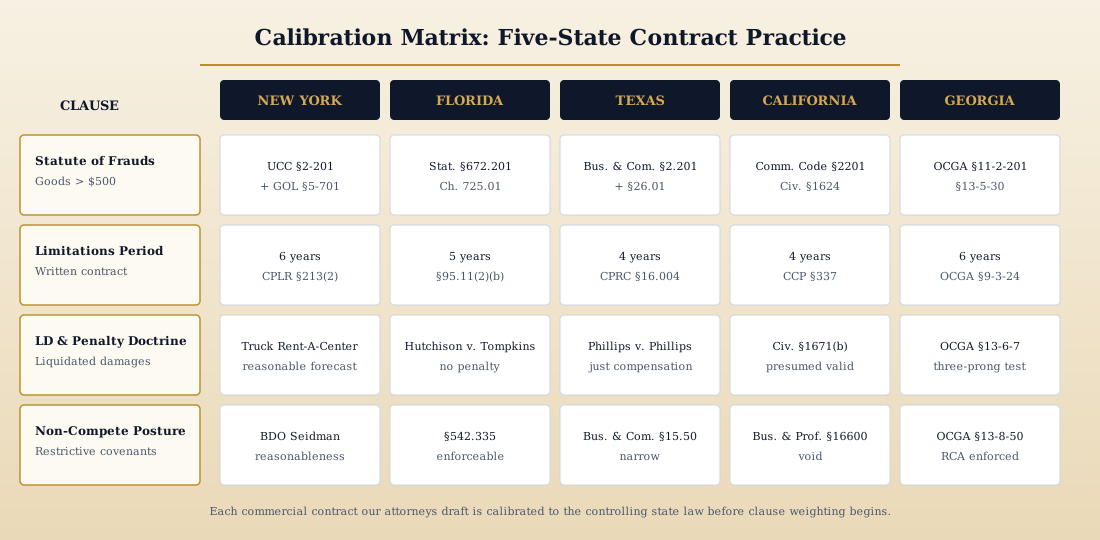
The first hour of every drafting engagement runs the same calibration: which state's UCC adoption, statute of frauds language, limitations period, liquidated-damages doctrine, and non-compete enforceability regime governs the contract. A New York contract does not read the same as a Florida contract or a Texas contract, and a generic template that splits the difference often complies with none of them. Our drafters lock the governing law and forum selection before clause weighting begins, so the substantive provisions are calibrated to a single legal regime rather than a hybrid.
The five-state matrix below covers the majority of our engagements. For matters that cross jurisdictions (a delivery in New York under a contract performed in Florida), we draft the choice-of-law clause to a controlling state and add the conflict-of-laws fallback so the contract still resolves cleanly if a court applies a different law. The same matrix shapes our Los Angeles, San Diego, and Dallas engagements, with California-specific and Texas-specific overlays applied at the calibration stage.
New York
Admitted: N.Y. Bar
Our New York commercial attorneys calibrate to the New York Uniform Commercial Code, General Obligations Law §5-701 statute of frauds, CPLR §213(2) six-year limitations period, and the New York Court of Appeals reasonableness test for liquidated damages. New York engagements that touch foreign parties also require the New York Convention on the face of the arbitration clause.
Florida
Admitted: Fla. Bar
Florida contract drafting calibrates to Florida Statutes Chapter 671 (UCC adoption), Chapter 725.01 statute of frauds, the §95.11(2)(b) five-year limitations period, and §542.335 non-compete enforceability standards. Florida also enforces choice-of-law clauses subject to a strong-public-policy carve-out, which our Florida-admitted commercial attorneys handle at the calibration stage.
Texas
Admitted: Tex. Bar
Texas contracts run on Business and Commerce Code §2.201 and §26.01 statute of frauds, the four-year limitations period under Civil Practice and Remedies Code §16.004, and the §15.50 narrow non-compete posture. Dallas and Austin engagements often require Business Organizations Code coordination for Texas-formed entities.
California
Admitted: Cal. Bar
California drafting accounts for Commercial Code §2201, Civil Code §1624 statute of frauds, the §337 four-year limitations period, and the Business and Professions Code §16600 voidness rule that nullifies most non-competes. Los Angeles and San Diego engagements also require California Consumer Privacy Act language in any contract that touches consumer data.
Georgia
Admitted: Ga. Bar
Georgia contracts calibrate to OCGA §11-2-201 (UCC adoption) and §13-5-30 statute of frauds, the §9-3-24 six-year limitations period, and the OCGA §13-8-50 Restrictive Covenants Act for non-competes. Atlanta engagements also cover the Georgia Long-Arm Statute analysis for forum-selection clauses.
Do I Need a Contract Attorney? When Atlanta, Dallas, or Other Operations Trigger Engagement
Three scenarios drive most of our Atlanta and Dallas engagements, and the same scenarios recur across Charlotte, Tampa, Nashville, and the broader Texas markets we cover. The pattern is the same: a business has a working contract drafted under one state's law, the operating posture changes, and the existing instrument no longer fits. The remedy is a re-papered contract calibrated to the actual governing jurisdiction, not a redline of a misaligned template. Below are the three buyer scenarios that bring counsel in.
When a regional headquarters relocation triggers a new contract stack
We are most often retained on Atlanta or Dallas matters when a company relocates its regional headquarters to one of those markets and needs the existing master services agreement, vendor contracts, and employment instruments re-papered under Georgia or Texas law. The previous draft was calibrated to Delaware or New York; the new operating base requires governing-law conforming amendments and, in the case of restrictive covenants, a substantive rewrite to satisfy the Georgia Restrictive Covenants Act or the Texas non-compete narrowness rule.
When a southeastern joint venture needs a partnership instrument
Joint ventures formed across Atlanta, Charlotte, Tampa, and Nashville frequently require a partnership instrument that handles capital contributions, profit allocation, deadlock procedures, and the buyout mechanics specific to the controlling state's partnership statute. The southern markets follow the Revised Uniform Partnership Act with state-specific overlays; our contracts attorneys draft the operating provisions to the actual jurisdiction rather than relying on a Delaware or New York template that the parties may not realize is misaligned.
When a southern technology employer hires an out-of-state executive
Technology employers in Atlanta and Austin retaining an out-of-state executive need an employment contract that survives the Georgia Restrictive Covenants Act review (or the Texas Business and Commerce Code §15.50 narrowness review) for non-competes, allocates the change-of-control trigger correctly, and addresses the executive's prior employer non-solicitation obligations. The Atlanta engagement here is part drafting and part diligence: confirming the executive can take the role without a tortious interference claim from the prior employer.
Operating in Atlanta, Dallas, or Tampa and need a re-papered contract?
Start Your Southern-Market ContractFor matters where the contract dispute has reached the litigation stage, the calibrated base contract is the strongest evidentiary spine our attorneys can hand to retained trial counsel. Our pre-suit drafting work pairs with downstream litigation drafting on motions like the cross-motion for summary judgment and the motion for judgment on the pleadings, both of which read better when the underlying contract was drafted by counsel rather than copied from a template.
How We Run a Contract Drafting Engagement
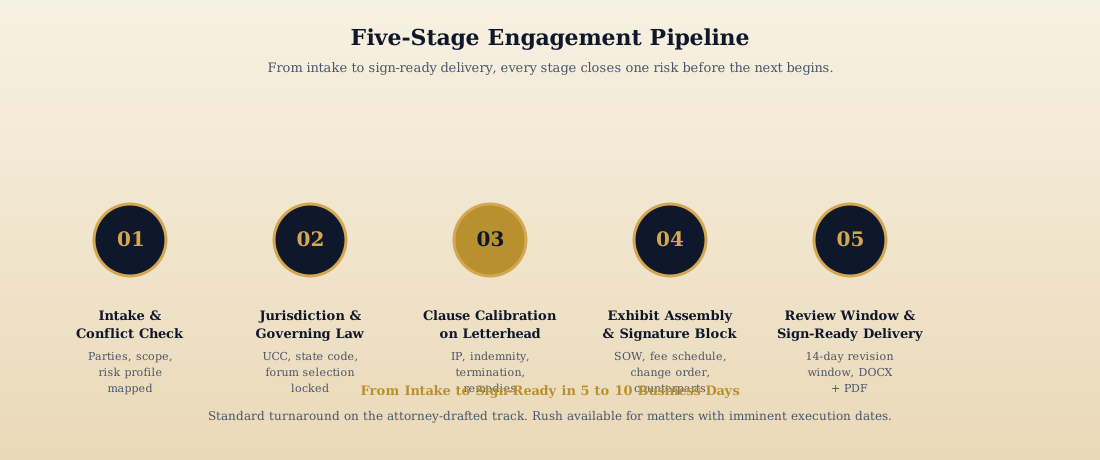
Every commercial contract engagement runs through the same five-stage pipeline, whether the matter is a master services agreement, a vendor supply contract, or a partnership instrument. Each stage closes one risk before the next begins; we do not begin clause calibration until the jurisdiction is locked, and we do not deliver until the fourteen-day review window opens. The same commercial attorney stays on the matter from intake to delivery so the calibration is not re-litigated between hand-offs.
Intake & Conflict Check
We begin with a structured intake: parties' legal names and principal places of business, the deal type and approximate transaction size, the governing law preference, the deliverable schedule, and any pre-existing relationships our roster might have with the counterparty. The conflict check runs across our commercial-attorney roster before a single drafting hour is billed.
Jurisdiction & Governing Law Selection
Our attorneys lock the governing law and forum selection before clause weighting begins. The choice drives the rest of the calibration: New York chooses GOL §5-701 statute of frauds language, California chooses Civil Code §1624, Georgia chooses OCGA §13-5-30. Forum selection chooses the litigation venue, the arbitral seat, or the small-claims fallback; each choice changes how the remedies clause reads.
Clause Calibration on Letterhead
A licensed commercial attorney drafts each clause to the bargained allocation. Scope references the deliverable exhibit; compensation references the milestone schedule; the IP clause sequences the assignment to payment trigger; the indemnity clause pairs the cap with the carve-outs (gross negligence, willful misconduct, IP infringement, confidentiality breach); the termination clause distinguishes for-cause and for-convenience exits with the corresponding fee and IP consequences. Every clause appears on firm letterhead in plain commercial English.
Exhibit Assembly & Signature Block
Exhibit A locks the statement of work with deliverables and acceptance criteria; Exhibit B locks the fee schedule with milestone-payment triggers; Exhibit C, where applicable, locks the change-order form. The signature block names the authorized signatories and includes a counterpart and electronic-signature provision so the parties can execute without a single sit-down meeting.
Review Window & Sign-Ready Delivery
You receive the full draft package and have a fourteen-day review window for revisions. Common revisions tighten the IP assignment trigger, narrow the indemnity carve-outs, modify the termination notice period, or add state-specific dispute-resolution language. The reviewing attorney incorporates revisions and delivers the final sign-ready package as DOCX and PDF, with a counterpart-execution memo that walks both signatories through the order of operations.
How Much Does It Cost to Hire a Contract Attorney?
The cost of a contract law attorney depends on the pricing shape and the document. Local firms typically bill hourly at rates that vary widely by geography, seniority, and overhead, with the meter starting at intake and running through every review round. Legal Tank prices each engagement on a fixed-scope quote tied to the deliverable: the all-in figure is named at intake before any drafting begins, so the buyer knows the total before authorizing work. A two-party service agreement runs substantially less than a multi-party master services agreement with statements of work, complex IP assignment, and indemnity allocation. For a custom commercial contract attorney quote on your specific matter, the intake form returns a fixed-scope figure within twenty-four hours.
When a Contract Engagement Crosses Into Litigation
A calibrated base contract is the strongest evidentiary spine when the relationship breaks down and the file moves into motion practice. Our litigation drafters take the calibrated agreement forward into a contempt motion to enforce a court order, a motion to vacate a default judgment, or a motion to enforce a settlement agreement, with the original drafting attorney available for affidavit support if the matter requires it.
Your Drafting Roster
Four Commercial Attorneys, Eleven Bar Admissions
Your engagement is staffed by a contract drafter from our four-attorney commercial roster, matched to the controlling jurisdiction and the matter type. Senior attorney supervision is included on every standard and complex tier engagement.

Andrew Lawson, Esq.
Senior Contract Attorney
Specializes in NDAs, service agreements, and commercial contracts. Former associate at Sullivan & Cromwell.
Admitted: New York, Connecticut Bar

Lisa Nguyen, Esq.
Employment Law Attorney
Drafts employment contracts, non-competes, severance agreements, and employee handbooks for companies of all sizes.
Admitted: Texas, Illinois Bar

Michelle Park, Esq.
Business Formation Attorney
LLC operating agreements, articles of incorporation, and partnership documents. Helped launch 500+ small businesses.
Admitted: California, Washington Bar

Katherine Brooks, Esq.
Privacy & Compliance Attorney
Privacy policies, terms of service, GDPR/CCPA compliance, and data processing agreements. CIPP/US certified.
Admitted: Virginia, D.C. Bar
What Our Contracts Clients Say
“We needed a master services agreement that worked for our Atlanta engineering office and our New York sales team. Andrew calibrated the governing law clause for the Georgia operating base and then layered the New York forum selection for high-dollar disputes. Both sides of our business signed without a single redline from the counterparty.”
Marcus B.
Verified client
Master Services Agreement
“Our previous vendor template gave the supplier almost unlimited consequential damages exposure. The redrafted contract capped indemnity at fees paid, carved out gross negligence and IP infringement, and added a UCC §2-607 cure notice that we now use across the supplier base. The redraft paid for itself in the first dispute.”
Priya N.
Verified client
Vendor & Supply Contract
“Hiring an executive who lived in California and was joining our Atlanta office required a contract that survived Georgia Restrictive Covenants Act review and accounted for California Business and Professions Code §16600. The contracts attorney built both into the same instrument with a fallback severability clause. The executive started without a single covenant dispute.”
Jordan M.
Atlanta · Verified client
Employment & Restrictive Covenants
“We spun out a joint venture with a Florida partner and needed a partnership instrument under Florida law with deadlock procedures and an exit mechanism. The drafted operating agreement handled the capital contribution structure, the profit allocation, and the buyout valuation method. Two years in we have not had a governance dispute.”
Daniel O.
Verified client
Partnership Agreement
If you are weighing pro se filing as an alternative path while a contract dispute is pending, our roadmap on filing a motion without retained counsel walks through the procedural posture and the documents most pro se filers underestimate.
Frequently Asked Questions
Common questions about the contracts law attorney role, the foundational rules of contract law, and the four stages every commercial agreement runs through.