Professionally Drafted Motion for Contempt of Court Form for Enforcing Court Orders
Direct Answer
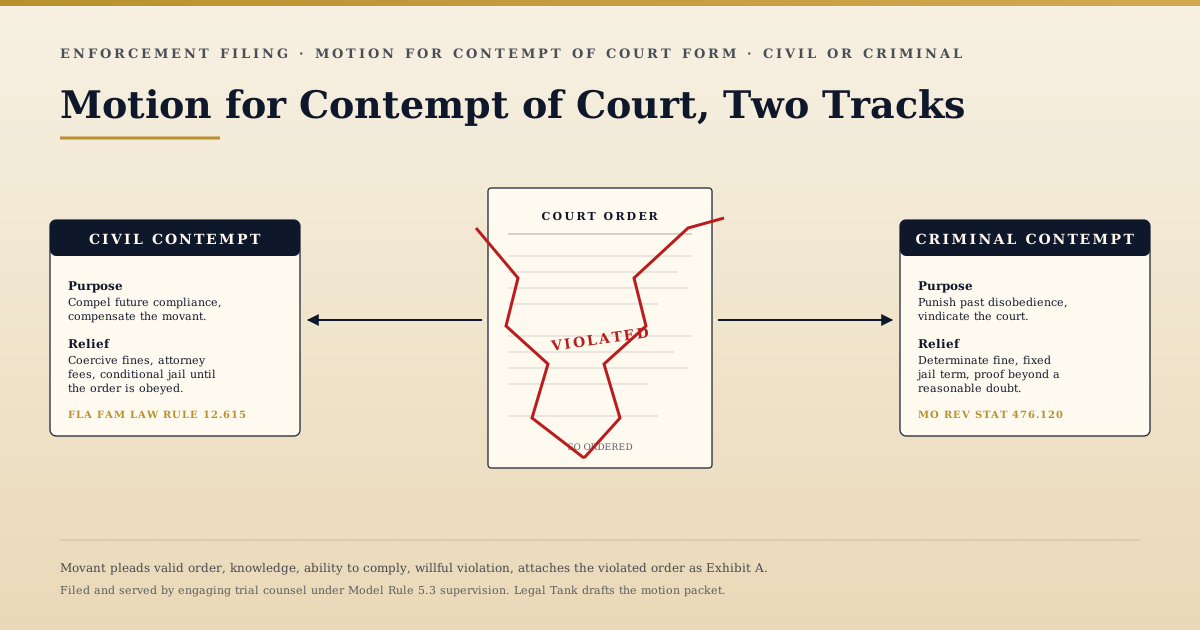
A motion for contempt of court form is the pleading filed in the case that produced the underlying order, asking the court to find the respondent in contempt and impose the relief the rules permit. The full document body is below in attorney-grade form, with the four elements pleaded (valid order, knowledge, ability to comply, willful violation), the prayer for relief mapped to the sanctions tier, and the proposed order to show cause attached. The Texas and Florida family-law variants of the same motion for contempt form use the same scaffold with the rule citation swapped.
Federal · FL · TX · CA · NY
Plead, attach, file
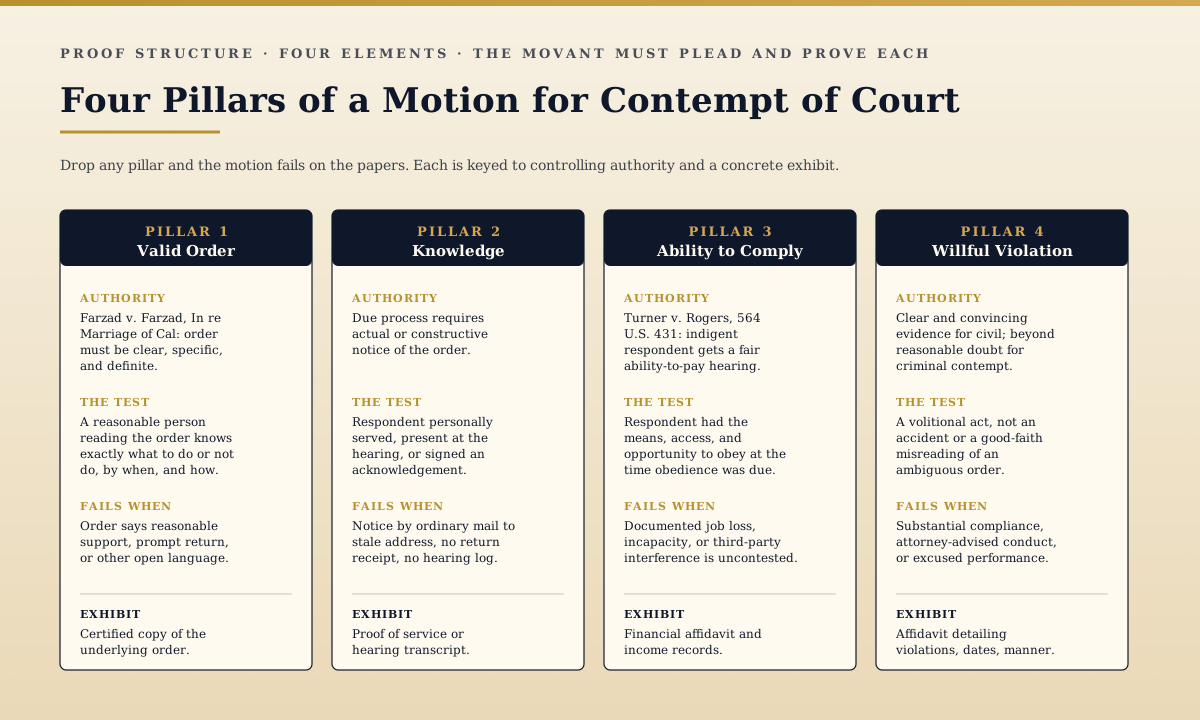
Motions for Contempt of Court We Draft and the Four-Element Showing Each Filing Must Plead
Legal Tank prepares the full enforcement packet for a motion for contempt: the motion itself, the supporting affidavit, the proposed order to show cause, and the certificate of service. The drafting team pleads the four elements (valid order, knowledge, ability to comply, willful violation), maps the prayer for relief to the sanctions tier your factual record supports, and builds the exhibit binder for the show-cause hearing. Every motion for contempt florida family law filing we draft is keyed to Family Law Rule 12.615; every Texas family enforcement filing is keyed to Texas Family Code section 157.166; every California civil contempt motion is keyed to Code of Civil Procedure section 1218.
For the parallel enforcement vehicle that runs alongside contempt practice when the goal is to compel performance of a settlement or an existing court order, see our motion to enforce drafting service for a settlement agreement or court order.
Element 1
Valid order
The underlying order must be clear, specific, and definite. A reasonable person reading it can tell exactly what must be done, by when, and how. Open phrasing like reasonable support or prompt return is grounds to deny. Attach a certified copy of the order as Exhibit A.
Cited as Exhibit A in the motion
Element 2
Knowledge
Due process requires that the respondent had actual or constructive notice of the order. Personal service, presence at the hearing where the order was entered, or a signed acknowledgement satisfy the element. Ordinary mail to a stale address does not.
Cited as Exhibit B (proof of service)
Element 3
Ability to comply
Under Turner v. Rogers, 564 U.S. 431, an indigent respondent in a civil contempt proceeding gets a fair ability-to-pay hearing. The motion must allege the respondent had the means, access, and opportunity to obey at the time obedience was due.
Cited as Exhibit C (financial affidavit)
Element 4
Willful violation
A volitional act, not an accident or a good-faith misreading of an ambiguous order. Civil contempt: clear and convincing evidence. Criminal contempt: beyond a reasonable doubt. Plead the dates, the manner, and the specific provision violated.
Cited in the supporting affidavit
When the drafting workflow runs in parallel with other motions
Contempt practice rarely travels alone. A file motion for contempt request often ships in the same docket as a discovery sanction, an amended pleading, or a reconsideration of the underlying order. For the broader procedural posture, see what a motion in court is and how written requests move a case forward, which walks the filing lifecycle for movants who have not litigated a contempt posture before.
Self-represented filers preparing a file a motion for contempt packet without retained counsel are entering the most procedurally technical track in family and civil practice; a clean pleading is the difference between a granted show-cause order and a denial on the papers.
Texas and Florida Court Rules That Govern Every Motion for Contempt Filed in Family Court
A motion for contempt of court texas form filed in family enforcement runs on Texas Family Code chapter 157, with section 157.166 setting the specificity the motion must meet. A motion for contempt florida family law filing runs on Florida Family Law Rule 12.615. Both rules demand the same four-element factual showing; the procedural shells differ. The on-page form below is drafted in Florida Rule 12.615 language; the Texas variant swaps the citation, the specificity requirement, and the proposed-order paragraph. The other three primary jurisdictions follow the same scaffold.
For the federal posture and the inherent civil contempt power, see the FRCRP 42 row below. Federal courts use their inherent power for civil contempt and the codified Rule 42 procedural shell for criminal contempt. The civil enforcement procedure that backstops a contempt finding is Federal Rule of Civil Procedure 70, which authorizes the court to enforce a judgment for a specific act and hold the disobedient party in contempt.
              IN THE CIRCUIT COURT OF THE [NTH] JUDICIAL CIRCUIT
              IN AND FOR [COUNTY] COUNTY, FLORIDA
                       FAMILY DIVISION


[PETITIONER FULL LEGAL NAME],        )
                                     )
              Petitioner,            )    Case No. [Case Number]
                                     )
v.                                   )    Division: [Letter]
                                     )    Judge [Last Name]
[RESPONDENT FULL LEGAL NAME],        )
                                     )
              Respondent.            )
_____________________________________)


      PETITIONER'S VERIFIED MOTION FOR CONTEMPT
       AND PROPOSED ORDER TO SHOW CAUSE
   (Fla. Fam. Law R. Civ. P. 12.615 / Tex. Fam. Code 157.166)


    Petitioner [Petitioner Full Legal Name] ("Petitioner"),
by and through undersigned counsel and pursuant to Florida
Family Law Rule of Civil Procedure 12.615 (or Texas Family
Code section 157.166 in Texas filings), respectfully moves
this Court to enter an Order to Show Cause and to find
Respondent [Respondent Full Legal Name] in contempt for
willful violation of this Court's [Order Title] entered on
[Order Date]. In support of this motion, Petitioner alleges:


I.   THE UNDERLYING ORDER

     1.  On [Order Date], this Court entered a [Order Title]
         (the "Order"), a certified copy of which is
         attached as Exhibit A.

     2.  The Order required Respondent to [specific
         requirement, quoted verbatim from the Order], by
         [Deadline or condition].


II.  RESPONDENT'S KNOWLEDGE OF THE ORDER

     3.  Respondent had actual knowledge of the Order
         because Respondent was [present in court when the
         Order was entered / personally served with the
         Order on [Service Date] as shown by Exhibit B /
         signed an Acknowledgement of Receipt attached as
         Exhibit B].


III. RESPONDENT'S ABILITY TO COMPLY

     4.  At the times Respondent was required to comply,
         Respondent had the financial means, physical
         capacity, and practical access required to obey
         the Order, as set out in Petitioner's supporting
         Affidavit and the financial records attached as
         Exhibit C.


IV.  WILLFUL VIOLATIONS

     5.  Respondent willfully violated the Order on the
         following dates and in the following manner:

         (a)  On [Date 1], Respondent [specific violation,
              identified by date, manner, and the
              paragraph of the Order violated];

         (b)  On [Date 2], Respondent [specific violation];

         (c)  On [Date 3], Respondent [specific violation].

     6.  Petitioner has been damaged by Respondent's
         violations in the amount of [Damages, if civil
         compensatory contempt is sought], plus reasonable
         attorney fees and costs incurred in bringing this
         enforcement action.


V.   RELIEF SOUGHT

     7.  Petitioner requests that this Court:

         (a)  Issue the proposed Order to Show Cause
              attached as Exhibit D, directing Respondent
              to appear and show cause why Respondent
              should not be held in contempt;

         (b)  Upon hearing, find Respondent in [civil
              contempt / criminal contempt] for the
              violations alleged above;

         (c)  Award Petitioner the relief the Court deems
              appropriate from the sanctions tier
              corresponding to the contempt finding
              (compensatory damages, coercive sanctions, or
              punitive sanctions);

         (d)  Award Petitioner reasonable attorney fees
              and costs incurred in bringing this motion;
              and

         (e)  Grant such other relief as the Court deems
              just and proper.


    WHEREFORE, Petitioner respectfully requests that the
Court enter the Order to Show Cause and, upon hearing, find
Respondent in contempt and award the relief set out above.


Dated: ____________, 20____.


                     Respectfully submitted,


                     _______________________________________
                     [Attorney Name], Esq.
                     [State] Bar No. ______________
                     [Firm Name]
                     [Firm Address]
                     [City, State ZIP]
                     Telephone: (___) ___-____
                     Email: __________________
                     Attorney for Petitioner


================================================================
                          VERIFICATION
================================================================

STATE OF [State]                  )
                                  ) ss.
COUNTY OF [County]                )

    I, [Petitioner Full Legal Name], being first duly
sworn upon oath, depose and state that I have read the
foregoing Motion for Contempt, that the factual allegations
contained in paragraphs 1 through 6 are true and correct of
my own knowledge, and that I make this verification freely
and voluntarily.


                     _______________________________________
                     [Petitioner Full Legal Name]


    Sworn to and subscribed before me this _____ day of
________________, 20____.


                     _______________________________________
                     Notary Public, State of [State]
                     My Commission Expires: _______________


================================================================
                  CERTIFICATE OF SERVICE
================================================================

    I HEREBY CERTIFY that on this _____ day of
________________, 20____, I electronically filed the
foregoing with the Clerk of the Court and served a copy on
Respondent and counsel of record via the e-filing portal or
by [process server / certified mail return receipt
requested]:

    [Respondent Name, Address, Email]
    [Respondent Counsel Name, Firm, Address, Email]


                     _______________________________________
[Attorney Name], Esq.Fla. Fam. Law R. Civ. P. 12.615
Florida Family Law (Rule 12.615)
Florida family contempt for domestic violations of child support, alimony, time-sharing, or other family orders runs on Rule 12.615. The motion pleads the order, knowledge, ability, and willful violation; the proposed order to show cause sets a hearing date; the respondent appears and must show why the court should not enter a contempt finding. The Florida rule is the most-cited family contempt template nationally.
Texas Family Code 157.166
Texas Family Enforcement (TFC 157.166)
A Texas motion for contempt of court form for child support, conservatorship, or possession-and-access enforcement runs on Texas Family Code chapter 157. The motion identifies each provision violated, the date and manner of each violation, and the relief requested. The Texas rule requires unusual specificity: each violation gets its own numbered paragraph or the motion is subject to special exception.
Cal. Code Civ. Proc. 1218
California (CCP 1218)
California civil contempt under Code of Civil Procedure section 1218 authorizes a fine, up to five days of imprisonment per count, and an award of reasonable attorney fees and costs to the movant. Family contempt runs in parallel through Family Code section 290. The motion plus a supporting declaration under penalty of perjury opens the proceeding.
N.Y. Jud. Law 753
New York (Jud. Law 753)
New York civil contempt under Judiciary Law section 753 covers willful disobedience of a lawful court mandate where the offending conduct defeated, impaired, impeded, or prejudiced the movant's rights. Criminal contempt runs on Judiciary Law section 750. Family Court contempt is governed by Family Court Act section 156.
Fed. R. Crim. P. 42 / inherent civil contempt power
Federal (FRCRP 42 / inherent power)
Federal civil contempt rests on the court's inherent power to enforce its own orders. Criminal contempt is governed by Federal Rule of Criminal Procedure 42, which requires notice of the criminal nature of the proceeding, the right to counsel, and prosecution by an appointed attorney or the United States. Federal contempt motions cite the underlying order, the violating conduct, and the relief sought from the issuing district judge.
Inside a Sample Motion for Contempt of Court, Structure, Tone, and Cite Style
A sample motion for contempt of court drafted at attorney standard reads in the third person, names the parties as movant and respondent (or petitioner and respondent in family practice), and pleads each element in a separate numbered paragraph. The tone is factual, not argumentative; the rule cites are short and parenthetical, not stacked. The relief paragraph maps one-to-one to the sanctions tier the movant has elected, and the prayer is specific enough that the judge can grant it without rewriting it.
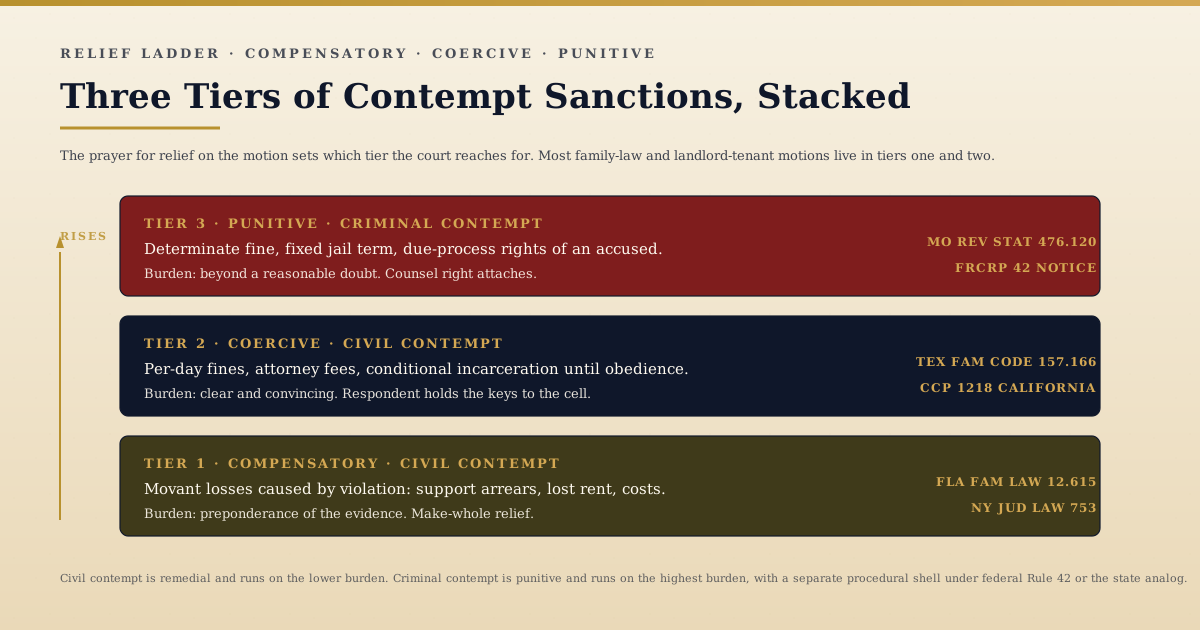
The relief tier matters because the procedural protections track the tier. The ladder below sets out the three tiers, the controlling burden of proof for each, and the citation anchor.
TIER 1
Compensatory civil contempt
Make-whole relief for movant losses caused by the violation: support arrears, lost rent, lost custody time, costs of locating the respondent, and attorney fees authorized by statute. Burden is preponderance of the evidence. Used in the majority of family-law and landlord-tenant enforcement filings.
Burden: Preponderance
TIER 2
Coercive civil contempt
Forward-looking sanctions designed to compel future compliance: per-day fines, conditional incarceration that ends when the respondent obeys, and attorney fees for the enforcement filing. Respondent holds the keys to the cell. Burden is clear and convincing evidence.
Burden: Clear and convincing
TIER 3
Punitive criminal contempt
Determinate fine and fixed jail term to vindicate the court. The respondent gets the procedural protections of an accused: notice of the criminal nature, right to counsel, right against self-incrimination, and prosecution by an appointed attorney. Burden is beyond a reasonable doubt.
Burden: Beyond a reasonable doubt
Six steps from blank form to filed motion
The drafting workflow is the same across jurisdictions. Substitute the controlling rule, the state-specific specificity requirement (Texas Family Code section 157.166 is the strictest), and the local proof-of-service mechanic. Pull the violation timeline and the financial record from the case file; the motion writes itself when the record is clean.
- 1
Copy the on-page template into your working document
Paste the motion body below into a working document. The bracketed fields (caption, case number, judge, order date, violation dates, relief sought) are the only sections that need editing. The rule citation and the four-element scaffold stay intact across jurisdictions.
- 2
Mirror the caption from the violated order
Caption, parties, and case number must match the order being enforced. The judge assignment carries forward. In family-law cases, the division letter matters because contempt motions are heard by the judge that owns the underlying case, not the duty judge.
- 3
Plead the four elements with record cites
Each element gets a record cite. Valid order: attach the certified copy. Knowledge: attach proof of service or the hearing transcript page. Ability to comply: attach the financial affidavit or income records. Willful violation: attach the dated affidavit detailing the violations.
- 4
Set the prayer to the sanctions tier
If you want compensatory damages and fees, plead the figures and the statutory hook. If you want coercive sanctions, plead the per-day fine or the conditional jail relief. If you want criminal contempt, plead the punitive sanction and trigger the Rule 42 procedural shell up front so the show-cause order is issued with the criminal-nature notice.
- 5
Attach the proposed show-cause order
Always attach a proposed order to show cause. The judge signs it on receipt of the motion and sets the return date for the respondent to appear. A motion without a proposed show-cause order will sit on the docket or come back stamped denied without prejudice to refile with a proposed order.
- 6
Have the draft finalized before filing
For criminal contempt or for civil contempt where conditional incarceration is in the prayer, route the draft through /get-quote so the four-element pleading, the sanctions menu, and the procedural posture are reviewed against your state's requirements. The motion is then ready for your engaging trial counsel to sign and file.
Related drafting work
For cases where the underlying order itself needs to be modified before a contempt motion is filed, see what a discovery motion is and how pretrial evidence disclosure is compelled for the predicate discovery moves that often precede contempt practice.
For movants who want to read up before instructing counsel, the legal motions guide sits above this page and surveys the full motion catalog, including the discovery, dispositive, and enforcement tracks that interact with contempt practice in everyday civil and family litigation.
Motion for Contempt of Court Form Questions
Can you file a motion for contempt of court?
How to initiate contempt of court proceedings?
What are the grounds for contempt of court?
Do I need an attorney to file a motion of contempt?
Is contempt hard to prove?
What does motion of contempt mean?
What is the penalty for contempt of court in Missouri?
Have Your Motion for Contempt Professionally Finalized
Legal Tank drafts the motion, the supporting verified affidavit, the proposed order to show cause, and the certificate of service. Your engaging trial counsel signs, files, and appears at the show-cause hearing. The deliverable is a filing-ready packet keyed to your court, your case caption, and your violation record. Send the docket and the violation timeline through intake and the four-element pleading and the sanctions menu are pressure-tested before your engaging counsel files.
Legal Tank prepares filing-ready motion drafts keyed to your court's requirements. We do not appear at the show-cause hearing or file with the court. Your engaged trial counsel signs and files the motion and appears at the hearing.