Defining What Is a Motion in Court and How Written Requests Move a Case Forward
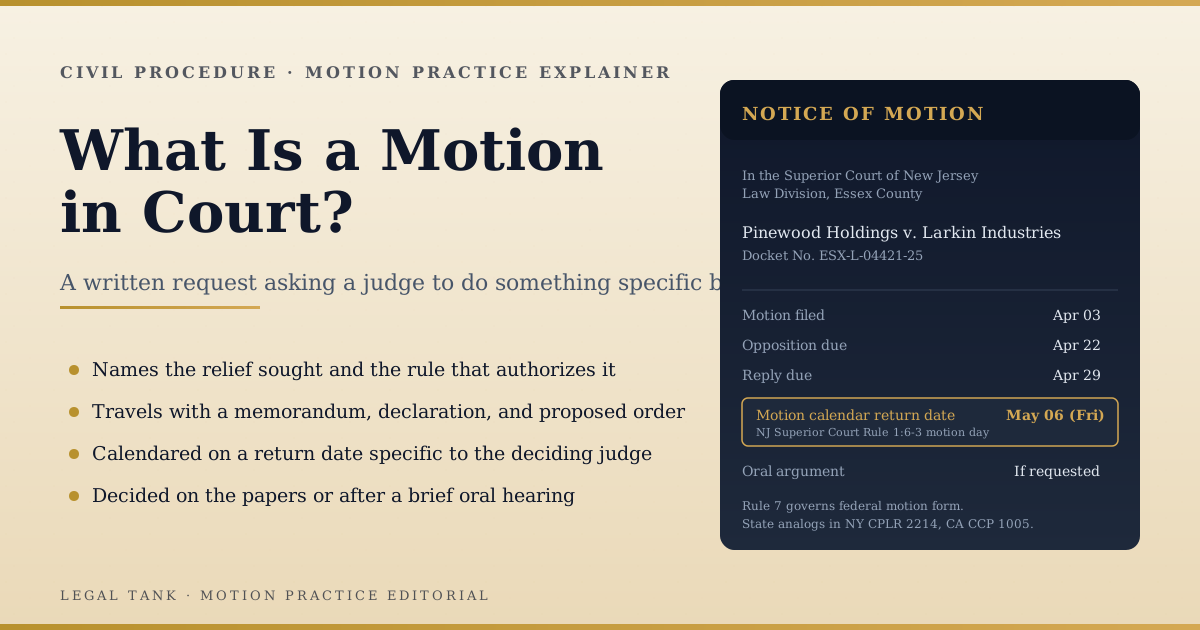
A motion in court is a written request that asks a judge to do something specific in a pending case: dismiss a claim, compel discovery, exclude evidence, enter judgment, or issue an enforcement order. Every court motion names the relief sought, identifies the rule that authorizes the request, attaches a supporting record, and includes a proposed order the judge can sign. The mechanics differ slightly by jurisdiction (federal practice under FRCP Rule 7, New Jersey practice under Rule 1:6-3, New York under CPLR 2214, California under CCP 1005), but the architecture is stable. This guide walks through the legal definition, the motion-calendar quirks that trip up self-represented filers, the purpose motions serve in case management, and the lifecycle of a single motion from drafting through ruling.
What This Term Means in Court: Reading a Motion Court Filing
The plain court motion definition is short: a motion is any application made to a judge in a pending case asking the court to issue a specific order. The movant is the party filing the motion; the responding party is sometimes called the opposing party or the nonmovant. The phrase motion to court shows up in lay searches because non-lawyers reach for it to describe the act of putting a request in front of the judge, but inside the courthouse the preferred phrasing is motion to the court or just motion. When someone says they need to file a motion, they mean preparing and submitting the bundled package that the rules require for the court to act.
The motion court definition sometimes refers to something different from a single filing: in some jurisdictions, "motion court" is a dedicated calendar where pretrial motions are heard, separate from the trial calendar. In New York Supreme Court commercial parts, the assigned justice holds a recurring motion calendar; in New Jersey Superior Court, motion day is fixed by Rule 1:6-3; in federal court, most motions are decided on the papers without a calendar appearance at all. The phrase court motion meaning therefore varies with context: it can name the document, the act of filing, or the day the court hears the application.
Motion in court meaning turns on the underlying rule that authorizes the request. The Federal Rules of Civil Procedure govern federal civil motions, the Federal Rules of Criminal Procedure govern criminal motions, and parallel state codes (the CPLR in New York, the CCP in California, the Texas Rules of Civil Procedure) govern state-court practice. A motion that is not authorized by any rule does not get docketed; clerks reject filings that fail to identify the rule under which the relief is sought.
The Meaning of Motion in Court for a New Filer
For a litigant encountering the term for the first time, the cleanest way to understand a court motion is to picture a written question to the judge that contains its own answer. The motion poses the question (should the case be dismissed? should the witness be excluded? should the defendant be held in contempt?) and supplies the proposed ruling on a separate page the judge can sign as-is. The opposing party then has a fixed window to file written opposition, and the movant may reply. The judge reads the bundle and rules. That four-step pattern (file, oppose, reply, rule) governs essentially every motion regardless of subject matter.
Common Examples of Motions a Court Sees Each Week
The PAA question "what is an example of a motion" has many right answers. The catalog below shows the six most frequent civil and criminal motions a trial court calendars, each with the rule-and-purpose anchor that defines it. Practitioners reading outside their primary practice area will recognize most entries; the rules and standards differ slightly across federal and state court but the names are stable.
- Motion to dismissAsks the court to throw out a claim before any merits proceeding, usually for failure to state a cause of action or lack of jurisdiction. Governed by Federal Rule 12(b) and state analogs.
- Motion for summary judgmentAsks the court to enter judgment without trial because no genuine dispute of material fact exists. Federal Rule 56 governs; state versions follow closely.
- Motion to compel discoveryAsks the court to order an opposing party to answer interrogatories, produce documents, or sit for deposition. Federal Rule 37 is the dominant authority.
- Motion in limineAsks the court to exclude prejudicial evidence before trial begins. Common in criminal practice and in jury trials generally.
- Motion to suppressCriminal-side motion asking the court to exclude evidence obtained in violation of Fourth, Fifth, or Sixth Amendment protections.
- Motion for reconsiderationAsks the court to revisit a prior ruling on the basis of intervening law, new evidence, or clear error. Federal Rule 59(e) sets a 28-day clock.
File a Motion Meaning in Plain English
To file a motion means to deliver the bundled package to the clerk for docketing, to serve the package on every opposing party in the manner the rules require, and to calendar the return date on the court's posted motion calendar (where one exists) or on the docket directly (in federal courts that do not hold calendared hearings). The act of filing starts the clock that governs the opposing party's deadline to respond, and that clock cannot be paused by agreement of counsel except by court order. For the broader pillar-level treatment of motion practice, see the companion piece breaking down what is a legal motion and how written requests shape court decisions, which covers the doctrinal foundations in more depth.
Jurisdictional Quirks Counsel Encounter on the NJ Court Motion Calendar and Beyond
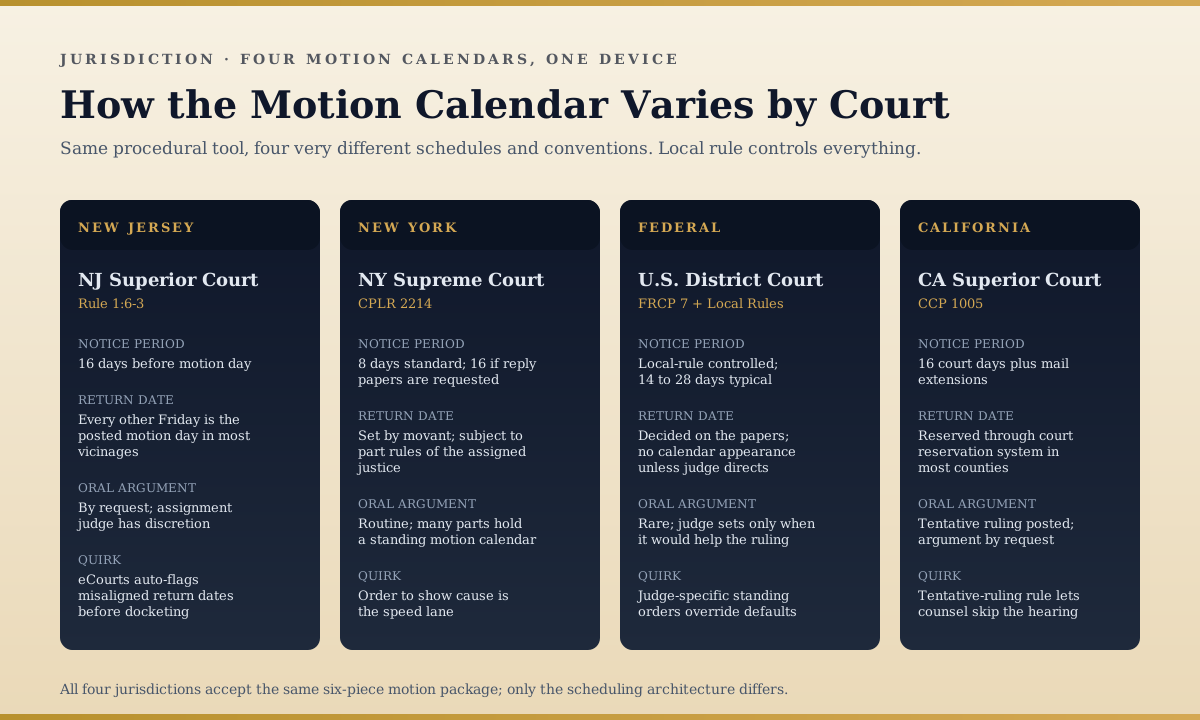
The NJ court motion calendar is the single most searched motion-calendar phrase in the country, and the reason is simple: New Jersey practice runs on a posted motion day rather than on a movant-chosen return date. Under New Jersey Court Rule 1:6-3, motions in the Superior Court are returnable on a posted motion day (typically every other Friday in most vicinages), the moving papers must be filed at least sixteen days before the return date, and opposition is due eight days before. Self-represented filers who pick a Friday at random and walk papers to the clerk learn at intake that the date is not on the posted calendar and the filing is bounced.
The NJ Superior Court motion calendar is published vicinage by vicinage on the judiciary site, and the eCourts system checks the proposed return date against the posted calendar before accepting the filing. Cross-jurisdictional comparison helps: federal practice in the District of New Jersey under Local Civil Rule 7.1 makes motions returnable on a posted motion day (the first and third Monday of each month), with the moving papers filed at least 24 days before that day, opposition 14 days before, and any reply 7 days before, though most federal motions are decided on the papers without a calendar appearance at all. The four-jurisdiction comparison below captures the dominant variations a litigant or counsel will encounter.
New Jersey: Posted Motion Day Under Rule 1:6-3
New Jersey is the most rigid jurisdiction on motion-calendar mechanics. The civil division publishes the posted motion day for each vicinage, the family division uses a separate calendar with tighter deadlines for emergency applications, and the law division sometimes uses a third schedule for special civil part matters. The eCourts platform flags any return date that does not match the posted calendar before docketing, which makes self-represented filings particularly vulnerable to procedural rejection. The sixteen-day notice rule is firm, and short-service motions require a separate order to show cause application to move the matter up. Litigants needing the standard motion to enforce or modify an existing court order outside the posted motion-day calendar can review the procedural framework in our explainer on the procedure for filing a contempt of court motion when an order is violated, a parallel enforcement track that runs on its own calendar.
New York: Part Rules and Movant-Chosen Return Dates
New York Supreme Court practice under CPLR 2214 lets the movant set the return date subject to the eight-day standard notice rule (sixteen days if the movant invites reply papers in the notice of motion). Each justice publishes part rules that overlay the CPLR defaults, often shifting the briefing schedule or imposing word counts on the memorandum. NYSCEF, the state's electronic filing system, docks late filings automatically. The order to show cause is the speed lane when an eight-day notice is too slow; the justice signs the OSC on shortened notice and fixes the return date by hand.
Federal Court: Local Rules and the Submission-on-Papers Default
Federal civil practice under FRCP Rule 7 distinguishes between the form of a motion (it must be in writing, state with particularity the grounds, and state the relief sought) and the schedule for briefing the motion (controlled by the local rule of each district and the standing orders of each judge). The Southern District of New York, the District of New Jersey, the District of Massachusetts, and the Central District of California each post separate local rules, and most federal judges add a personal standing order on top. The dominant default across federal courts is submission on the papers, with oral argument set only when the judge believes it would help the ruling.
California: Tentative Rulings and the Reservation System
California Code of Civil Procedure 1005 sets the notice period at sixteen court days (mail and overnight extensions apply), and most counties run a hearing reservation system that requires counsel to book the calendar slot before filing the motion. The tentative ruling rule under California Rule of Court 3.1308 is the defining quirk: the court posts a draft ruling the day before the hearing, and the parties must give notice to argue against the tentative within the local time window or the tentative becomes final. Pro se filers routinely miss the tentative-ruling window because the posted ruling looks like just another docket entry.
Why Motions Are the Engine of Mid-Case Practice and What a Motion in Court Is Actually Doing for the Litigant
Litigation without motion practice would be unworkable. Every disputed point would have to wait for trial, every discovery standoff would harden into impasse, and every defective claim would consume jury time it does not deserve. Motions exist to push decisions forward in defined increments, giving the parties enforceable mid-case rulings on procedure, evidence, and substantive law. A motion for court attention is rarely a tool of last resort; it is the steering mechanism that lets the case advance at a controlled pace.
Functionally, motions serve four purposes in a civil or criminal case. They dispose of weak claims early (Rule 12(b)(6), Rule 56, and the state analogs). They compel compliance with discovery obligations (Rule 37 motions to compel, motions for sanctions, motions for protective orders). They shape the trial record (motions in limine, motions to suppress, Daubert motions). And they enforce or modify court orders (motions to enforce, motions for contempt, motions to amend or vacate). Most cases live or die not at trial but on a series of motion rulings that narrow the dispute long before a jury is empaneled.
Disposing of Weak Claims Before Discovery Closes
A motion to dismiss under Rule 12(b)(6), a motion for judgment on the pleadings under Rule 12(c), and a motion for summary judgment under Rule 56 are the three vehicles that knock out claims that cannot survive a merits review. The standards differ (Rule 12 motions are decided on the face of the pleadings, Rule 56 motions on the record after discovery), but the goal is the same: remove the claim from the case before trial. For litigants reviewing the related discovery-side dispositive practice, our companion explainer on pretrial discovery and what is a motion of discovery in court for evidence disclosure covers the procedural device that prepares the record those Rule 56 motions depend on.
Compelling Compliance With Discovery and Disclosure
Discovery motions are the highest-volume motion category in civil litigation. The motion to compel under Rule 37 forces a recalcitrant party to answer interrogatories, produce documents, or sit for a deposition. The motion for a protective order under Rule 26(c) shields a party from abusive discovery. The motion for sanctions under Rule 37(b) gives the court enforcement teeth when a party ignores an earlier ruling. Each discovery motion runs on a meet and confer requirement: counsel must certify, on the face of the motion, that the parties tried to resolve the dispute before involving the court.
Shaping the Trial Record Through Pretrial Evidence Rulings
Motions in limine and motions to suppress narrow the universe of evidence the jury will hear. A motion in limine is the civil-side tool, and the criminal-side analog is the motion to suppress. Both move the gatekeeping decisions on admissibility from the middle of trial (where they slow the jury and risk mistrial) to a pretrial hearing where the judge can decide cleanly on the briefed record. Daubert motions on expert witness reliability travel through the same pretrial calendar.
Enforcing and Modifying Court Orders After Entry
Once an order or judgment enters, the moving party still has motion practice available. Motions to enforce, motions for contempt, motions to amend, and motions to vacate (under Rule 60(b)) all operate after the operative order is on the docket. The standards are stricter than for ordinary motions because the law favors finality, but the basic mechanics (notice of motion, memorandum, supporting record, proposed order, return date) hold.
How a Motion to the Court Travels from Drafting Through the Hearing
The lifecycle of a motion is the same across every jurisdiction: draft, file, serve, brief, argue, rule. The schedule varies, but the steps do not. Watching where things break for self-represented filers is the most direct way to understand how the process is supposed to work, because the breakdowns highlight what experienced counsel does almost automatically.
For the document-level companion that breaks down the motion package and the local-form filing mechanics, see the legal motion forms explainer and its step-by-step filing walkthrough. The treatment below focuses on the substantive choices the drafter makes at each stage.
Step 1: Identify the Authorizing Rule Before Drafting Anything
Every motion must point to a specific rule that authorizes the relief. Picking the right rule is the single most consequential drafting decision, because the rule controls the standard, the record the court will consider, and the deadlines that govern the filing. A motion to compel cites Rule 37 in federal practice and the analogous state provision (CPLR 3124, CCP 2030.300, NJ Rule 4:23). A motion to dismiss for failure to state a claim cites Rule 12(b)(6) or the state equivalent. The rule belongs in the first sentence of the notice of motion and again in the opening paragraph of the memorandum.
Step 2: Draft the Notice of Motion, Memorandum, and Declaration as One Package
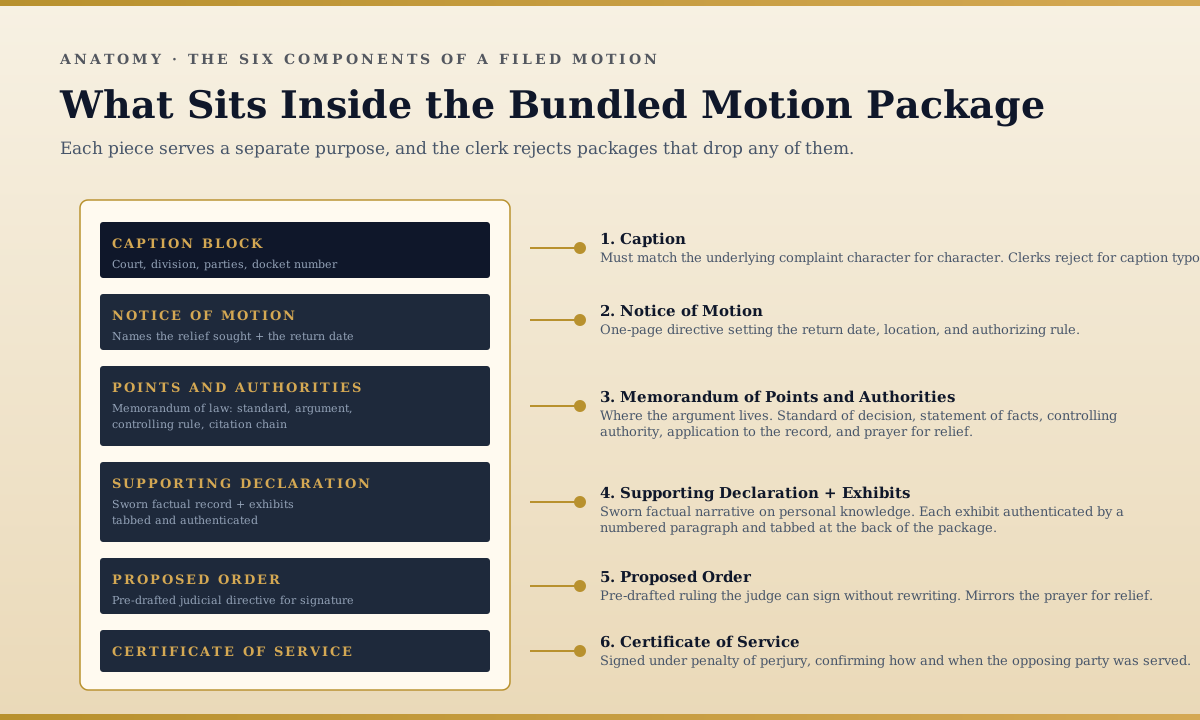
The notice of motion is a single page identifying the deciding court, the parties (in the same caption used in the underlying complaint), the relief sought, the authorizing rule, and the return date (or, in federal court, the deadline by which the motion will be submitted on the papers). The memorandum of law argues the merits: standard of review, statement of facts, the controlling authority, the application to this record, and the prayer for relief. The supporting declaration carries the factual record under penalty of perjury, with exhibits attached as numbered tabs and authenticated paragraph by paragraph.
Step 3: Draft the Proposed Order So the Judge Can Sign It Without Editing
The proposed order is the document the court actually signs. A clean proposed order mirrors the prayer for relief, fits on one page, leaves blanks only for the date and the judge's signature, and avoids overreach. Proposed orders that ask for more than the motion supports get lined through, narrowed, or rejected entirely. Counsel who treat the proposed order as an afterthought lose ground unnecessarily; counsel who treat it as the most important page in the package draw judicial signatures that match what they asked for.
Step 4: File With the Court Clerk and Serve the Opposing Party
Filing with the court clerk may be electronic (most federal courts and many state systems) or in person (smaller state courts and some specialty calendars). Each jurisdiction publishes its filing procedure on the judiciary site. Service of the motion on the opposing party must follow the local rule on service of process, and the certificate of service must be filed with the court to prove the opposing party received the papers. Pro se filers most often fail at this step, either by serving by email when the rule requires personal service or by neglecting to file proof of service before the return date.
Step 5: Brief the Motion (Opposition and Reply)
The opposing party files written opposition by the local deadline, typically eight to fourteen days after service of the moving papers. The movant has a shorter window to file a reply, often three to seven days. Each jurisdiction limits the page or word count for opposition and reply, and judges are unforgiving with over-length filings. The reply should address only the points raised in opposition; new arguments raised for the first time in reply are routinely disregarded.
Step 6: Appear at the Hearing (If There Is One)
The hearing is calendared in New Jersey, New York, and most California superior courts; it is rare in federal court. At the hearing, the judge has already read the papers and uses the time to ask questions, not to hear a full argument from the floor. Counsel for the moving party speaks first, the responding party follows, and the moving party gets a short rebuttal. The judge may rule from the bench, take the matter under advisement and issue a written decision later, or convert the hearing into a tentative ruling track. The most common pro se mistakes at this step are listed below.
Treating the Hearing as a Mini-Trial
Motion hearings argue from the papers. The judge has already read the briefs. Counsel who tries to retry the entire case at the lectern loses the room within the first minute. The strongest argument acknowledges the record, picks the two or three dispositive points, and answers the court's questions directly.
Bringing New Evidence to the Lectern
The record closes when the papers are submitted, subject to narrow rebuttal. Attempting to hand the judge a document at oral argument almost always draws an objection and a refusal to consider. New evidence belongs in a supplemental declaration filed before the hearing or, in some courts, in a motion to reopen briefing.
Missing the Tentative-Ruling Window
California courts and a growing number of state-court parts post a tentative ruling the day before the hearing. The party seeking argument must affirmatively notify the court and opposing counsel within the local window, or the tentative becomes final. Self-represented parties routinely miss this step and learn the case has been decided against them by reading the docket.
Confusing a Motion Hearing With a Trial Date
A motion hearing produces a ruling on the motion. It is not a sentencing, a verdict, or a trial setting. Self-represented criminal defendants sometimes appear at a motion hearing expecting to be sentenced or acquitted; courts redirect them, but the confusion can produce procedural defaults if the appearance was the wrong calendar.
Step 7: Read the Order and Plan the Next Filing
After the ruling, the clerk dockets the signed order. The winning party serves the order on the losing party (in some jurisdictions the court does this automatically; in others it falls on the prevailing party). Appellate rights, motions for reconsideration, and motions to stay all run from the date the order is entered, not from the date of the hearing. Litigants who plan their next filing while the hearing is fresh tend to preserve every available remedy; litigants who set the order aside and revisit it weeks later often discover the appellate clock has expired. For filers proceeding without counsel, the deeper procedural walkthrough in our explainer on a pro se roadmap on how to file a motion in court without an attorney covers the post-ruling housekeeping that protects appellate options.