Filing a Motion for Bond Reduction to Lower Pretrial Release Conditions
A motion for bond reduction is the pretrial filing that asks the same criminal court to lower the bail amount set at arraignment or to soften the conditions of pretrial release. The federal vehicle operates under the Bail Reform Act at 18 U.S.C. 3142, which directs the court to weigh four statutory factors at subsection (g) before setting bond and on review. State courts run analogous frameworks under their own pretrial statutes (California Penal Code 1289, Texas Code of Criminal Procedure article 17.15, North Carolina N.C.G.S. 15A-534, New York CPL 510.30). The initial bond set at arraignment reflects the charging document and the county schedule; the reduction motion gives the defense its first opportunity to put the defendant's full picture on the record. This page lays out the four-factor framework, the section-by-section drafting build, the conditions package that makes reduction politically feasible for the court, and the strategic patterns that drive how bond judges rule.
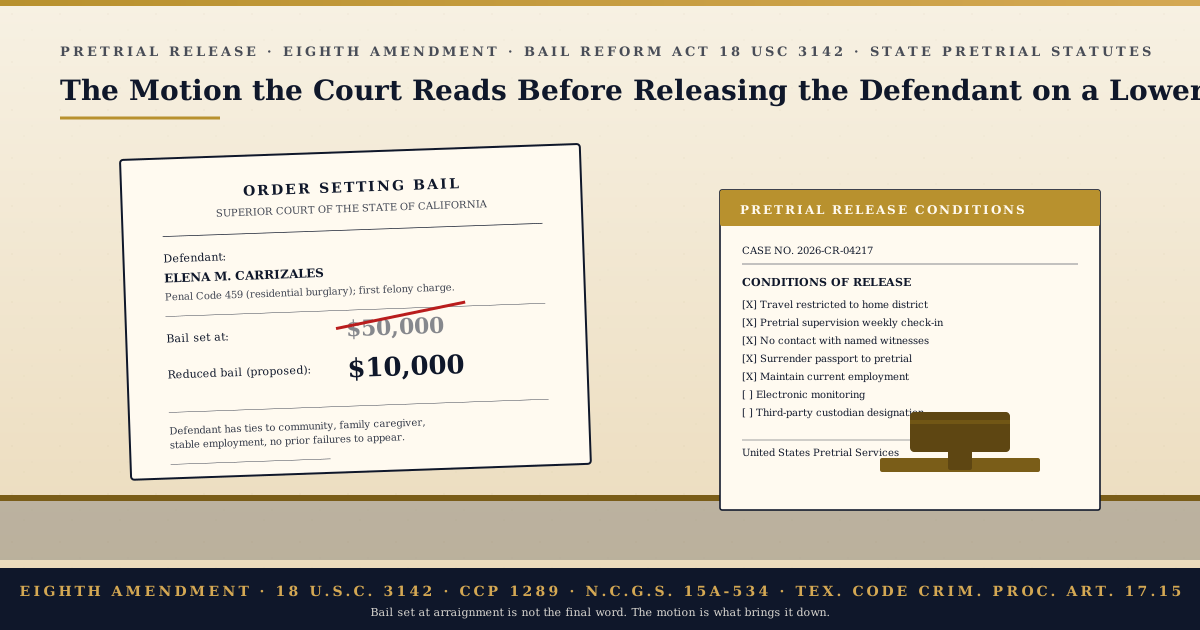
The Motion for Bond as a Pretrial Release Vehicle in Federal and State Criminal Practice
The motion for bond is the criminal-procedure vehicle that opens the formal record on whether the defendant should be released, and on what terms, while the case is pending. The initial bond is set at arraignment or at an initial Bail Reform Act detention hearing. The bond reduction motion is the defense's first structured opportunity to put a complete factor record before the court: pretrial services report, verified affidavits, employer letters, family-tie documentation, and the proposed conditions package. Bond judges read the motion against the four-factor framework of 18 U.S.C. 3142(g) (in federal court) or the state-statutory equivalent.
Federal Bond Reduction Under 18 U.S.C. 3142
The federal vehicle covering motions to reduce or modify a bond set at the initial Bail Reform Act detention hearing. Filed in the same United States district court that set the original bond, decided by the same magistrate judge or detention magistrate, on the four-factor framework of 18 U.S.C. 3142(g) and the conditions of release at 18 U.S.C. 3142(c).
California Bond Reduction Under Penal Code 1289
The California superior-court vehicle covering motions to reduce bail set under the county bail schedule or at arraignment. Operates under Penal Code section 1289, which lets the court reduce bail on good cause after the defendant has been admitted to bail, with the factor analysis codified in Penal Code section 1275 on public safety and flight risk. Filed in the same court that set the original bail.
Texas Bond Reduction Under CCP Article 17.15
The Texas vehicle operating under article 17.15 of the Code of Criminal Procedure, whose bail-setting rules (expanded by Senate Bill 6 in 2021) reach the defendant's ability to make bail, community safety, and criminal history, plus the constitutional excessive-bail prohibition under the Texas Bill of Rights article I section 13. Filed in the district court or county court at law in which the case is pending.
Third-Party Custodian and Conditions Package
The proposed-conditions overlay that supports any reduction motion. Third-party custodian designation, pretrial supervision check-in schedule, electronic monitoring availability, residence and travel restrictions, surrender of passport, mental-health or substance-abuse treatment plan. The conditions package is what makes the reduction politically feasible for the court.
The constitutional floor under the Eighth Amendment prohibits excessive bail. The Supreme Court's decisions in Stack v. Boyle (1951) and United States v. Salerno (1987) frame the constitutional limit: bail set higher than reasonably calculated to ensure the defendant's appearance violates the Eighth Amendment. Bond judges nevertheless retain wide discretion within that floor, and the reduction motion has to give the judge a substantive record to act on. The umbrella explainer on what a legal motion is and how the umbrella catalog covers pretrial criminal vehicles covers the broader motion taxonomy that includes the bond reduction motion alongside suppression, severance, and change-of-venue motions.
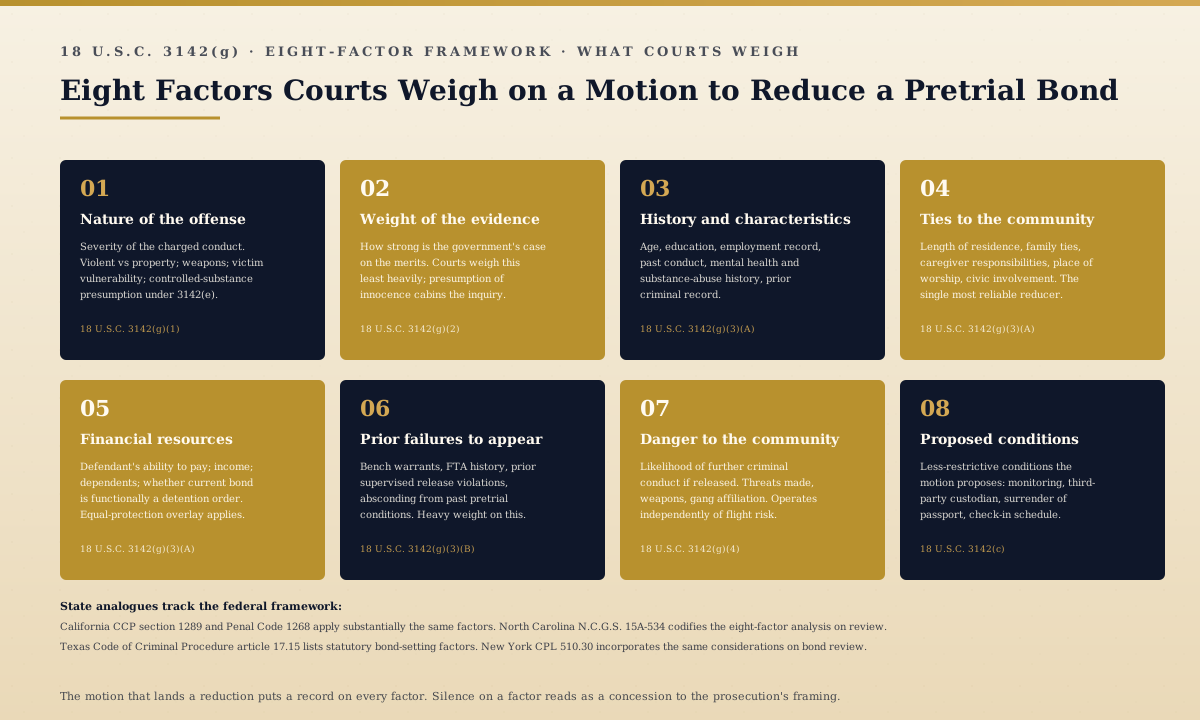
The Federal Detention Presumption Under 18 U.S.C. 3142(e)
For certain federal charges (controlled-substance offenses carrying a maximum sentence of ten years or more, firearms offenses involving controlled substances, certain offenses involving minors), 18 U.S.C. 3142(e) creates a rebuttable presumption that no condition or combination of conditions will reasonably assure the defendant's appearance and the safety of the community. The presumption shifts the burden of production to the defense; on a presumption-case bond reduction motion, the factor record has to be unusually strong to overcome the statutory thumb on the scale. The defense still bears the burden of production but not the ultimate burden of persuasion, which remains with the government.
State-Court Bond Practice Differs From the Federal Framework
State pretrial systems vary in mechanics but converge on the same factor framework. California operates under Penal Code section 1289 (reduction of bail on good cause after admission to bail) with the substantive factor analysis at section 1275. Texas operates under Code of Criminal Procedure article 17.15, whose bail-setting rules were expanded in 2021, plus the constitutional excessive-bail prohibition. New York's CPL 510.30 codifies the same considerations on bond review with a recent shift away from cash bail toward supervised release for most non-violent offenses. North Carolina's N.C.G.S. 15A-534 lists the same factors used in the federal framework. Counsel calendars the controlling state pretrial statute on intake before opening the moving papers.
Common Grounds Defense Lawyers File the Motion for Bond Reduction and the Practical Use of Each Ground
Defense lawyers reach for the bond reduction motion in a recognized set of fact patterns where the initial bond overstates flight risk, overstates community danger, or functions as a de facto detention order because the defendant cannot pay. Each ground maps onto a specific subset of the statutory factors and produces a distinct evidentiary record. The motion that compounds two or three grounds is usually stronger than a motion that rides on a single ground, because the bond judge sees independent support for the same requested reduction.
The most common ground is changed circumstances since arraignment: the defendant has now retained counsel, completed an intake assessment, secured a third-party custodian, started employment, or obtained a residence with a verifiable address. The pretrial services report at the time of arraignment captured none of this; the reduction motion is the procedural mechanism for getting the updated record before the court. A second common ground is a financial-resources mismatch: the initial bond was set by reference to a county schedule that does not account for the defendant's actual ability to post. Bond functionally indistinguishable from detention raises equal-protection concerns under recent federal jurisprudence.
A third common ground is the constitutional excessive-bail argument under the Eighth Amendment, typically paired with a financial-resources factor showing. The argument is most powerful when the requested bond is materially higher than comparable defendants charged with comparable offenses in the same court. A fourth ground is favorable pretrial services evaluation: the federal pretrial officer or state probation interview produced findings supportive of release that the arraignment court had not yet received. A fifth ground is the community-ties development that often happens in the first weeks after arrest as family, employer, and clergy relationships document themselves on the record.
On charges that involve allegations of discovery abuse or obstruction by co-defendants, the parallel posture sometimes calls for a contested motion for sanctions in the same case file. The companion service-firm page on drafting service for a motion for sanctions targeting discovery abuse and bad-faith conduct covers the sanctions vehicle that runs alongside the bond posture when discovery misconduct affects the pretrial calendar. Where new evidence emerges that materially changes the charging picture, the related posture on drafting service for a motion to amend pleadings after discovery reveals new claims covers the amendment vehicle that operates in the civil-companion case (where the criminal-civil parallel applies) on the same underlying factual record.
Drafting Mechanics From Caption to Service on a Motion for Bond Reduction Filing
A filing-ready bond reduction motion compiles six structurally distinct sections into one document. Each section advances the request toward the reduction; skipping any section produces a motion that looks complete on the cover but fails the bond judge's threshold reading. The list below tracks the section sequence Legal Tank delivers on a federal Bail Reform Act engagement, with each section mapped to its evidentiary purpose at the bond hearing.
- 01
Caption and Identification of the Bond Order
The court that set the original bond, the criminal case number, the parties as captioned (United States or the State versus the defendant), the date of the original bond order, the original bond amount, and the conditions imposed. A one-sentence procedural posture orients the bond judge before the argument opens.
- 02
Statement of the Controlling Statute and Standard
A clear statement of the controlling rule (federal Bail Reform Act 18 U.S.C. 3142 for federal cases, the state pretrial statute for state cases), the relief requested (reduction of the bond amount; modification of the conditions; conversion from cash to unsecured), and the burden of proof. The defense bears the burden on a reduction motion in most jurisdictions, with the government carrying the burden on detention in federal practice.
- 03
Factor Analysis Under 18 U.S.C. 3142(g)
The substantive heart of the motion. Section 3142(g) sets four factors: nature of the offense, weight of the evidence, the defendant's history and characteristics, and danger to the community. The drafted motion gives each its own subsection and breaks the history-and-characteristics factor into its statutory components (community ties, financial resources, prior failures to appear), then closes with the proposed conditions package under subsection (c). The factor showings are supported by verified affidavits and documentary exhibits, not lawyer argument alone.
- 04
Defendant's Sworn Declaration
A separately captioned declaration under penalty of perjury establishing the defendant's residence history, employment, family ties, caregiver responsibilities, financial resources, and any rehabilitative steps already taken (substance-abuse intake, mental-health appointments, community service hours). The declaration anchors the factor showing in the defendant's own sworn testimony.
- 05
Third-Party Affidavits and Documentary Exhibits
Employer letters confirming current employment and willingness to maintain the position pending trial, family member declarations confirming residence and caregiver dependency, clergy or community-leader character statements, treatment-provider intake records, school enrollment records for dependent children, and the proposed third-party custodian's declaration accepting the role. Each exhibit corresponds to a specific factor in the statutory analysis.
- 06
Proposed Order and Conditions Package
The proposed order is drafted so the bond judge can sign without redrafting. The order sets the reduced bond amount, specifies the new conditions (pretrial supervision check-in, electronic monitoring, third-party custodian, travel restriction, no-contact provisions, surrender of passport, no firearms), and reserves the court's authority to revoke release on violation. Including the proposed order at filing materially increases the odds of a same-day signing on a strong motion.
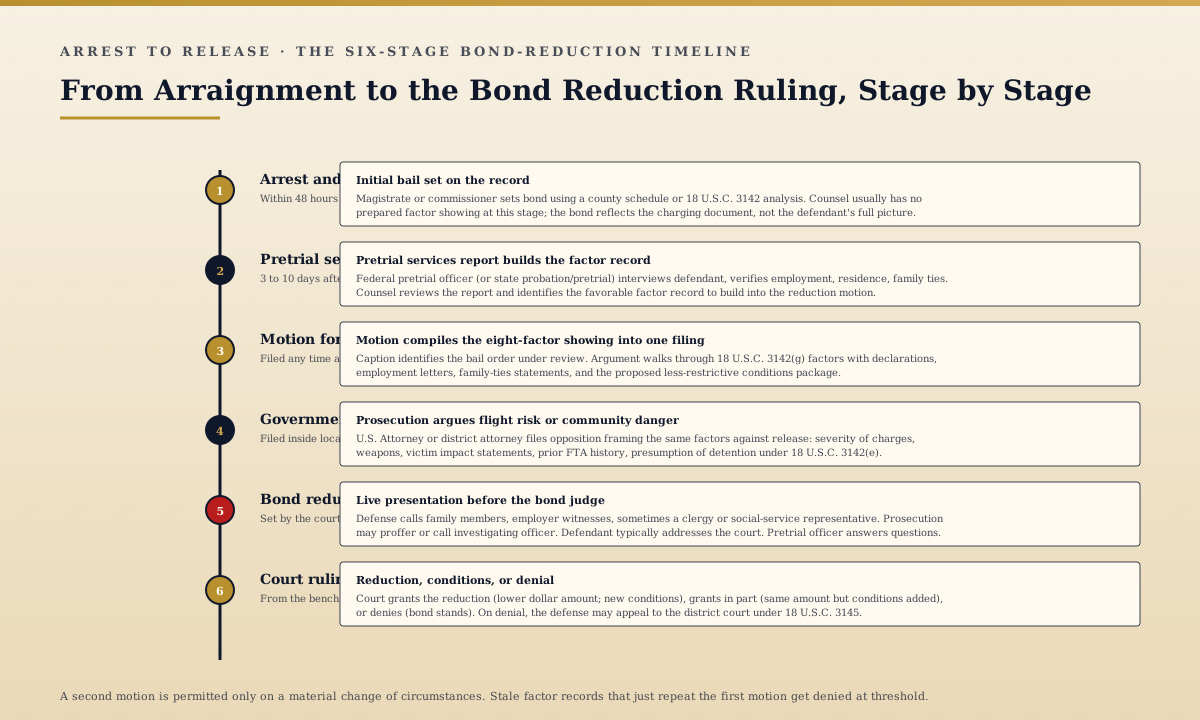
Service on the Government and Pretrial Services
Service is straightforward in most federal districts: the motion is filed on PACER and served on the U.S. Attorney through the electronic-filing system, with a courtesy copy to pretrial services. State practice varies; some counties require physical service on the district attorney's office, while others accept electronic service through the local e-filing portal. Counsel verifies the local service rule before filing; a service defect can delay the hearing by weeks and keep the defendant detained on the original bond.
Requesting an Expedited Hearing on a Detained Defendant
When the defendant is in pretrial custody and unable to post the current bond, the motion includes an expedited-hearing request flagging the detention status. Federal magistrate judges typically set the hearing within seven to fourteen days of filing on an expedited request; state courts vary from same-week to thirty-day calendaring. The expedited request is its own one-page filing or is incorporated as the opening section of the motion itself. Where the underlying posture also implicates a contested civil-companion case (such as a parallel forfeiture or restitution proceeding), the companion service-firm page on attorney-prepared motion for contempt of court enforcing orders against a noncompliant party covers the related civil-enforcement vehicle that sometimes runs alongside the criminal bond posture.
Reconsideration After Denial: The Second Motion Standard
If the bond reduction is denied, a second motion is permitted only on a material change in circumstances since the first ruling. The companion procedural explainer on the motion for reconsideration template and the sections courts expect to see covers the reconsideration-vehicle structure that maps onto the second bond motion. Material changes that support a second motion include: a new third-party custodian designation with verified housing, completion of a substance-abuse intake, a change in the charging document that reduces the maximum sentence, or new pretrial services findings that materially soften the flight-risk picture. A second motion that just repeats the first motion gets denied at threshold.
How Bond Judges Rule and What Tilts the Balance on the Bond Reduction Hearing
Bond reduction motions resolve in one of four outcome buckets, and the post-hearing posture depends on which bucket applies. A grant of the reduction lowers the bond amount, modifies the conditions, or both; the defendant posts the new bond and is released on the new conditions. A partial grant keeps the same bond amount but adds or removes conditions (electronic monitoring becomes optional; third-party custodian is substituted for a residence restriction). A denial preserves the original bond; the defendant either remains in custody or continues on the original release conditions. A conversion order keeps the substantive bond posture but converts between cash, surety, and unsecured forms; this is sometimes the outcome on a presumption case where the court declines a full reduction but allows the defendant to post on different terms.
The single most reliable factor on a reduction motion is the community-ties showing. Bond judges trust verified residence, verified employment, dependent-care responsibilities, and community involvement (clergy reference, civic engagement, extended-family ties) more than any other category of evidence. Motions with a thin community-ties record get denied at higher rates regardless of the other factors. A second strong driver is the proposed-conditions package: a motion that offers a tightly engineered set of less-restrictive conditions (third-party custodian, electronic monitoring, check-in schedule, surrender of passport) makes the reduction politically feasible because the bond judge can grant it without conceding flight risk.
On the federal track, presumption cases under 18 U.S.C. 3142(e) get denied at higher rates than non-presumption cases. The defense response is to push the conditions package aggressively: home incarceration with location monitoring, third-party custodian who is a relative with no criminal history, surrender of all firearms in the household, substance-abuse treatment intake before the hearing. Federal magistrate judges grant presumption-case reductions where the conditions package is structurally tight enough to neutralize the statutory thumb on the scale. Where the underlying posture also implicates a civil-companion default or settlement pressure analysis, the explainer on the motion for default judgment and how it operates in civil litigation covers the civil-companion default mechanics that sometimes run in parallel to the criminal proceeding.
On the state track, outcomes track the same pattern but with geographic variation. California reduction motions in the post-Humphrey era (the California Supreme Court's 2021 decision in In re Humphrey) get granted at higher rates when the defense puts a record on the defendant's ability to pay and the proposed less-restrictive conditions. Texas reduction motions under article 17.15 are particularly responsive to the financial-resources factor and the community-ties factor in combination. New York courts post-bail-reform 2019 default toward release on most non-violent offenses; the reduction motion in New York often functions as a conditions-modification motion rather than an amount-reduction motion. Companion service-firm pages on civil-side dispositive motions can be useful where the criminal-civil parallel applies: the professionally drafted cross-motion for summary judgment briefs and Rule 56 opposition filings page and the the motion for summary judgment template that tracks Rule 56 requirements page cover those parallel civil vehicles in detail.
Appellate review of a bond denial in federal practice is available under 18 U.S.C. 3145, which authorizes a district judge to review a magistrate judge's detention order on the existing record. The companion procedural explainer on anatomy of a motion for default judgment template and how each section functions covers a templating discipline that translates directly to bond-motion drafting: the structural rigor that makes a motion readable section by section produces denial-rate improvements across vehicle types. The underlying procedural architecture across all federal criminal pretrial motions traces back to the Bail Reform Act at 18 U.S.C. 3142.
How a Bond-Reduction Motion Moves Through Court
The movant, typically the defendant or counsel of record, files a written motion supported by a memorandum of law citing the bail statute, the Bail Reform Act where federal, and the factors under Federal Rules of Criminal Procedure Rule 46 (in federal cases) or the equivalent state rule. State-court bond-reduction filings track the analogous procedural framework set out in the local rules of court and, where the matter touches civil procedure (e.g., a contempt bond), the Federal Rules of Civil Procedure.
Before filing in most jurisdictions, defense counsel must confer with the prosecution on whether the motion is opposed. That meet and confer requirement serves two purposes: it forces the parties to surface stipulations (e.g., agreed conditions like GPS monitoring or curfews) that can shorten the hearing, and it forces counsel to identify exactly where the opposing party will push back. Courts in many districts will refuse to hear a bond motion without a meet-and-confer certification attached.
The motion and supporting papers must be served on the plaintiff (in civil-contempt bond contexts) or the prosecuting authority (in criminal bond contexts) under the local rule on service of process. Counsel files a separate certificate of service attesting to the manner and date of delivery. The clerk then dockets the motion to the case docket, the court sets a hearing date, and the bond determination is made on the record after both sides argue from their written submissions.