Written and legally reviewed by our editorial team
DRAFTING SERVICE
Drafting a Motion for a Protective Order to Shield Discovery From Abuse
A motion for a protective order is the written request a court hears when a propounded discovery instrument threatens to expose trade secret matter, compel testimony beyond what the rule allows, or sweep in privileged or non-party records. The drafted motion names the specific prong invoked under FRCP 26(c)(1), pleads the specific harm, attaches the meet-and-confer certification, and asks the court to enter a tailored order so discovery can continue on protected terms.
Civil litigation counsel at Legal Tank prepare the full filing package for the engaging firm to sign and file. We draft to FRCP 26(c) in federal court, plus California CCP 2017.020, New York CPLR 3103, Texas TRCP 192.6, and Illinois Supreme Court Rule 201(c) in the state-court analogs. Legal Tank does not appear in court and does not sign the filed motion.
3-5
Business day turnaround
8
Rule 26(c)(1) prongs
26(c)
Federal anchor rule
5
State-court analogs
WHEN YOU NEED ONE
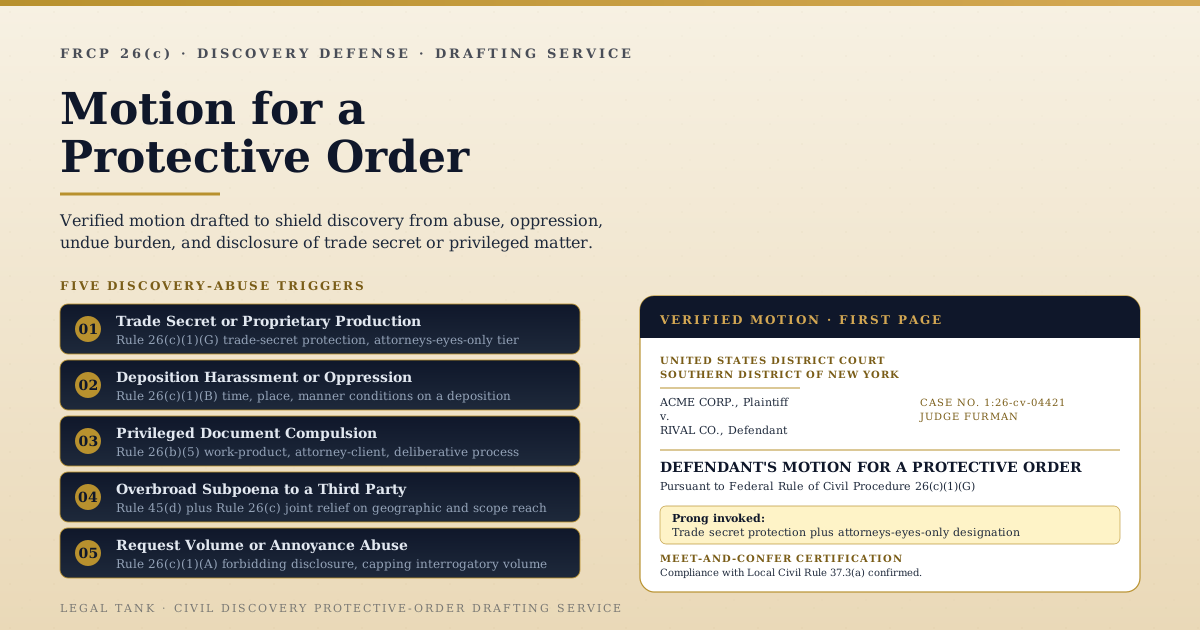
Four Triggers That Send Counsel to the Protective-Order Motion
The instrument is reserved for situations where the propounded discovery is already on the docket and the requested production, deposition, or subpoena reaches material the rule protects. A meet-and-confer letter and a documented impasse are the standard precursors before the verified motion is drafted.
Trade Secret or Proprietary Production
Opposing counsel served a request for source code, customer list, pricing matrix, or manufacturing process documents under FRCP 34 without an attorneys-eyes-only tier in place.
Deposition Harassment or Oppression
Notice of deposition is set in a hostile venue, on an impossible date, or with a duration and scope that crosses from inquiry into harassment. Rule 30 conditions are needed.
Privileged Document Compulsion
Document set sweeps in attorney-client privileged emails, deliberative-process memoranda, or work-product files. The privilege log is challenged on a Rule 26(b)(5) motion.
Overbroad Third-Party Subpoena
Rule 45 subpoena reaches medical, financial, or proprietary records of a non-party custodian, friend, or affiliated entity. Joint Rule 26(c) plus Rule 45(d) relief is needed.
FOUR CATEGORIES
Motions for a Protective Order We Draft
The propounded discovery instrument controls which sub-rule governs and what relief the court can enter. The drafted motion is matched to one of four categories on intake. For a related sibling instrument on the discovery-sanctions side, see drafting service for a motion for sanctions targeting discovery abuse and bad-faith conduct on the same pipeline.
Category 01
Deposition Protective Order
Motion under Rule 30 plus Rule 26(c)(1)(B) and (D) to condition the time, place, manner, and scope of a noticed deposition. Used for FRCP 30(b)(6) designee-deficiency disputes and for oppressive seven-hour examinations.
Category 02
Production and Document Request Protective Order
Motion under Rule 34 plus Rule 26(c) to shield trade secret, proprietary, or privileged document categories. The drafted motion plants the confidentiality tier and attorneys-eyes-only designation on the face of the order.
Category 03
Subpoena Protective Order
Rule 45 plus Rule 26(c) joint motion to limit a third-party subpoena that reaches medical, financial, or proprietary records. The motion may be filed by the party or by the subpoenaed non-party.
Category 04
Stipulated Confidentiality and Sealing Order
Negotiated protective order entered jointly to set confidentiality designations across the entire case. Drafted from the local civil rule sample order with tiered access and sealing under Rule 26(c)(1)(F) and (H).
SAMPLE PACKAGE
Inside the Motion for Protective Order Sample Package
The deliverable is the complete filing package, ready for the engaging firm's signature. Every document is matched to the controlling local civil rule of the issuing court and to the specific prong invoked under FRCP 26(c)(1). The verification rigor tracks the standard of a federal motion for summary judgement template where every factual assertion is paired to a sworn declaration.
Verified Motion for a Protective Order
Caption, identification of the propounded request, prong invoked under FRCP 26(c)(1), prayer for relief, and verification block sworn under penalty of perjury, formatted to the local rule of the issuing court.
Memorandum of Law in Support
Merits brief organized by Rule 26(c) prong, with controlling authority on good cause, specific harm, proportionality under Rule 26(b)(1), and the trade secret protection framework where applicable.
Meet-and-Confer Certification
Sworn declaration narrating the meet-and-confer letter, the live conferral, the response of opposing counsel, and the impasse that justifies filing under the local rule's good-faith requirement.
Exhibits Tabbed and Indexed
Propounded request, objection letter, conferral transcript or summary, privilege log excerpts, sample document set, and any third-party subpoena that is the subject of the motion.
Proposed Order on Protection
Signature-ready order that grants the prong invoked, sets the confidentiality tier where applicable, establishes the attorneys-eyes-only designation, and reserves the court's continuing jurisdiction on disputes.
Notice of Hearing and Stay Request
Notice of hearing keyed to the chambers calendar, request to stay the underlying discovery deadline pending the motion, certificate of service, and any local-rule cover sheet for discovery motions.
RULE 26(c)(1) MENU
Eight Specific Protections the Federal Rule Authorizes
FRCP 26(c)(1) enumerates eight specific orders a court may enter on a granted motion. The drafted motion names the prong by letter. Courts deny protective motions that ask for unspecified protection or that recite the rule without connecting the requested relief to one of the eight prongs.
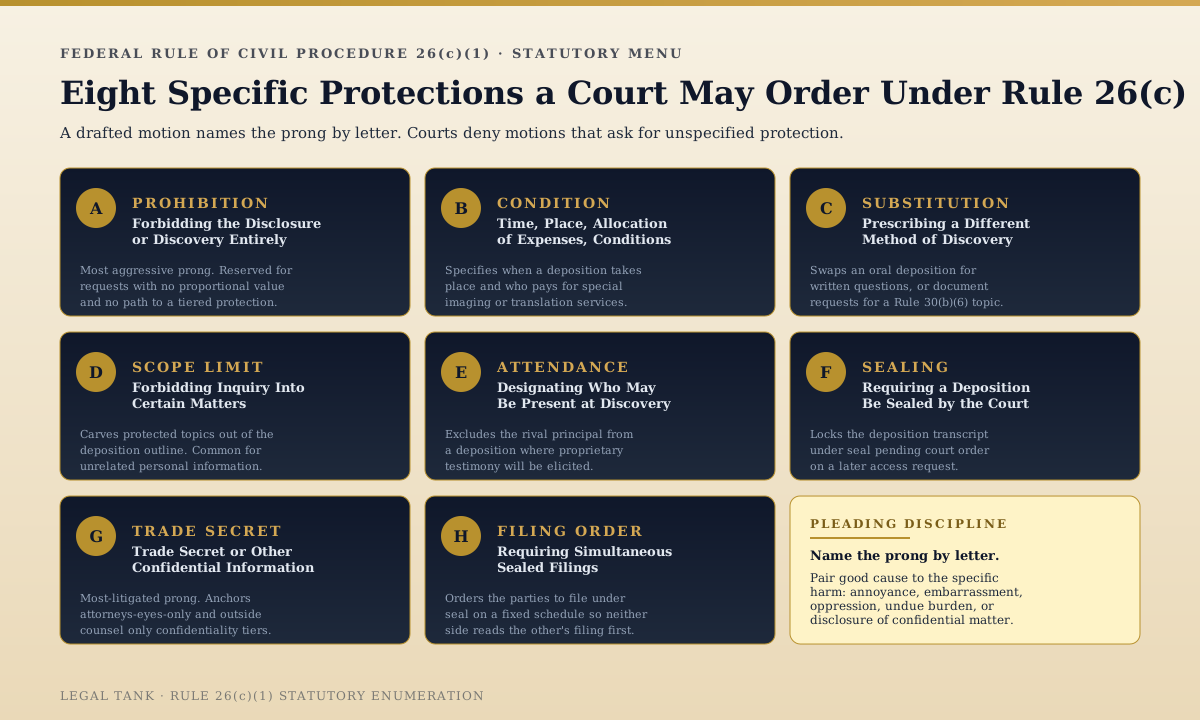
Forbidding the Disclosure or Discovery
Most aggressive prong. Reserved for requests with no proportional value under Rule 26(b)(1) and no path to a tiered protection.
Specifying Time, Place, Allocation of Expenses, Conditions
Pins the deposition date, location, format, and cost allocation. Used for translation, foreign-language interpreters, and special imaging.
Prescribing a Different Discovery Method
Substitutes an oral deposition for written questions under Rule 31, or document requests for a Rule 30(b)(6) topic where the burden is disproportionate.
Forbidding Inquiry Into Certain Matters
Carves protected topics out of the deposition outline. Common for unrelated personal information, sealed criminal records, and protected health information.
Designating Who May Be Present
Excludes the rival principal from a deposition where proprietary testimony will be elicited. Anchors the attorneys-eyes-only tier for live testimony.
Requiring a Deposition Be Sealed
Locks the deposition transcript under seal pending court order on a later access request. Used for source-code walkthrough or financial-projection testimony.
Trade Secret or Other Confidential Information
Most-litigated prong. Anchors attorneys-eyes-only and outside-counsel-only confidentiality tiers across the entire case.
Requiring Simultaneous Sealed Filings
Orders the parties to file under seal on a fixed schedule so neither side reads the other's filing first. Used at the dispositive-motion stage in proprietary cases.
STRATEGIC PURPOSE
Strategic Reasons Counsel Order the Draft
A protective order in discovery is the only instrument the Federal Rules give a responding party to limit otherwise-permissible discovery before the production happens. Without the motion, the production is on a calendar that runs straight through the harm. The drafted motion turns the propounded request into a court-managed exchange.
Preserve the Proprietary Asset
Trade secret value collapses on uncontrolled release. The drafted motion plants the attorneys-eyes-only tier and the outside-counsel-only designation before the file leaves custody.
Manage the Deposition Window
Rule 30 grants seven hours by default. The motion under Rule 26(c)(1)(B) and (D) limits the time, the topics, and the participants where the notice crosses into oppression.
Protect the Privilege Line
Privileged email threads and work-product memoranda are shielded by a coordinated Rule 26(b)(5) and Rule 26(c) motion paired with in-camera review where the privilege is contested.
The motion also coordinates with the upstream pleading. If the engaging firm needs the broader procedural posture, our piece on what is a motion in court and the role of written requests in civil proceedings covers the threshold mechanics that every motion shares, including the verified-motion structure that this protective order package follows.
PROCEDURAL TIMELINE
From Objectionable Request to Order Entered
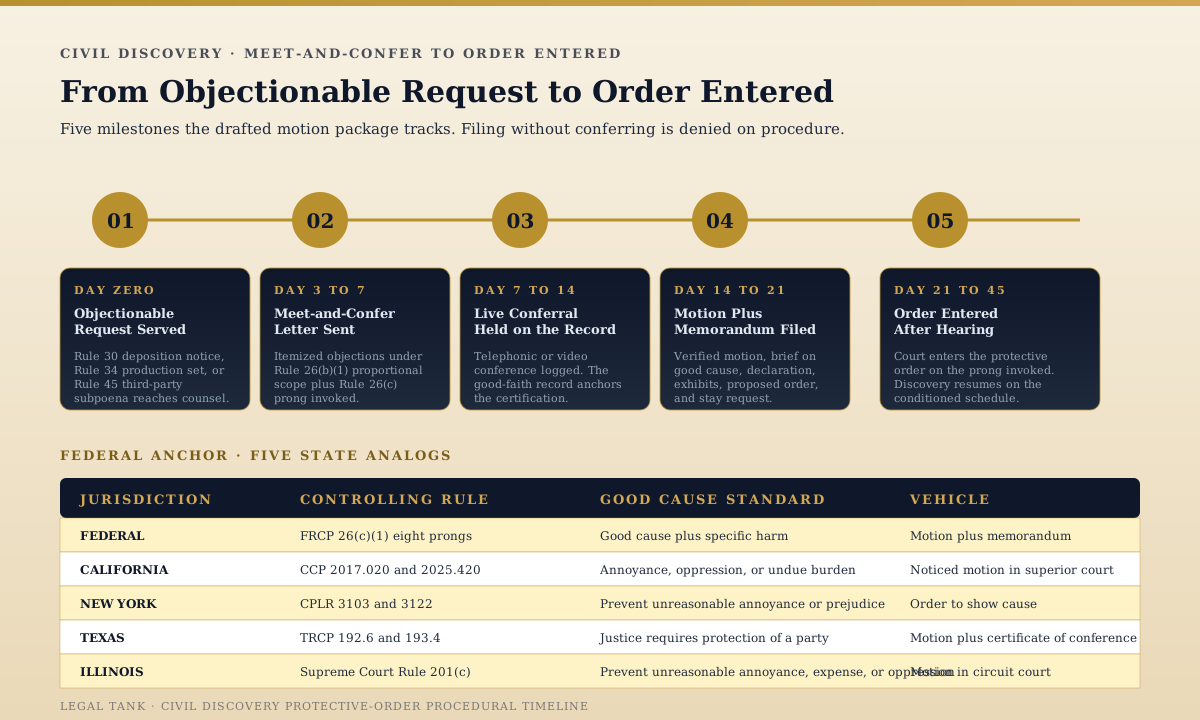
The drafted package tracks five procedural milestones. Counsel who file before the meet-and-confer certification is built draw denials on procedure. The drafted motion is paced to clear the conferral predicate before the verified motion is served.
JURISDICTION MATRIX
Five Jurisdictions, Five Rules That Govern the Protective Motion
The drafted motion is matched to the rule that governs the issuing court. The package format, the good cause standard, and the proposed order shift with the controlling rule. The matrix below maps the federal anchor to four state-court analogs.
FEDERAL
FRCP 26(c)(1)
United States District Court Discovery Protection
CALIFORNIA
CCP 2017.020 + CCP 2025.420
Superior Court Civil Discovery Protective Order
NEW YORK
CPLR 3103 + CPLR 3122
Supreme Court Discovery Protection
TEXAS
TRCP 192.6 + TRCP 193.4
District Court Discovery Protective Order
ILLINOIS
Supreme Court Rule 201(c)
Circuit Court Discovery Protective Order
REPRESENTATIVE DRAFTS
Four Anonymized Engagements That Show the Prong We Plead
Each vignette below traces a real protective-order file from the posture our drafting counsel inherited through the prong the motion pleaded and the outcome the engaging firm reported back. Client identifiers are removed.
S.D.N.Y. Trade-Secret Source Code Production
S.D.N.Y. Apex Officer Deposition Notice
D.N.J. Privileged Email Set Compulsion
S.D. Tex. Third-Party Subpoena to Bank Custodian
PIPELINE
Inside Our Drafting Pipeline for the Protective Motion
From intake to the sign-ready package, the pipeline runs five sequential steps. Our process pairs with attorney drafting for a motion to enforce a settlement agreement or court order on the discovery-defense side of the same drafting pool, and with inside a motion for reconsideration template and the sections courts expect to see when the protective order is denied on a clear-error record.
Step 01
01
Intake of the Propounded Request
You upload the propounded discovery, the meet-and-confer correspondence, the underlying complaint, the scheduling order, and any privilege log already served. The drafting attorney reads the procedural posture before any prose is committed.
Step 02
02
Attorney Maps the Prong and the Harm
A civil litigation attorney maps the objectionable feature of the request to the specific Rule 26(c)(1) prong, identifies the specific harm under the proportionality factors, and confirms in writing which forum and which local civil rule controls the filing.
Step 03
03
Draft the Full Protection Package
The drafting attorney prepares the verified motion, the memorandum of law, the meet-and-confer certification, the indexed exhibits, the proposed order, the notice of hearing, and any stay request keyed to the court's chambers calendar.
Step 04
04
Your Review and One Revision Round
You read the draft and send comments. The drafting attorney incorporates your edits in a single revision pass at no additional cost to your engagement. Additional revisions are scoped before further work begins.
Step 05
05
Sign-Ready Package Delivered for the Engaging Firm
You receive the final PDF and editable Word package, plus a one-page filing checklist matching the controlling local civil rule. Your retained trial counsel signs the package, files, serves, and appears at the noticed hearing. Legal Tank does not appear in court.
TURNAROUND AND ENGAGEMENT
Turnaround and Engagement Process for the Protective Motion
Standard turnaround on the drafted protective motion runs three to five business days from the moment the engaging firm uploads the propounded request and the conferral record. Rush turnaround is available where the deposition or production deadline is inside the next ten business days. Engagement begins after the quote is accepted and the package scope is locked.
Standard Track
Three to five business day delivery. Used when the propounded discovery deadline is at least two weeks out and the conferral predicate is already built.
Rush Track
Forty-eight to seventy-two hour delivery. Used when the deposition is set within ten business days or the production deadline runs through a weekend.
Scope Confirmation
Every engagement is scoped before work begins. The scope memo names the prong invoked, the rule controlling, the deliverable list, and the revision allowance.
Signature Path
The engaging firm signs, files, serves, and appears at the noticed hearing. Legal Tank does not file, does not appear, and does not sign the motion.
Send the propounded request and the conferral record through the secure intake form, and your engagement manager returns a scoped quote before any drafting time is logged.
WHY LEGAL TANK
Four Reasons Trial Counsel Send the Drafting Work to Us
Drafted by Federal Discovery Counsel
Every motion for a protective order is read, framed, and drafted by a bar-admitted civil litigation attorney with federal-court discovery practice. The motion names the prong under FRCP 26(c)(1) on the face of the moving papers rather than asking for unspecified protection.
Built for the Conferral Record
We pull the propounded request, draft the meet-and-confer letter when the engaging firm needs the predicate, then build the certification on the documented conferral. Courts deny protective motions filed without a clean good-faith record.
Drafting Only, No Court Appearance
We deliver a sign-ready package. We do not file, serve, or argue at the hearing. Your retained trial counsel signs the papers under the engaging firm's letterhead and represents the moving party at the noticed hearing.
Statutory Precision, Not Conclusory Pleading
The motion pleads the specific harm under Rule 26(c)(1) and ties each request for relief to a numbered prong. We do not file boilerplate protective motions. The package is built to clear the four most common denial paths before the motion is even served.
DRAFTING COUNSEL
The Civil Litigators Behind the Protective-Order Motion
Our federal discovery drafting pool runs four attorneys with practice across the Southern District of New York, the District of New Jersey, the Southern District of Texas, the District of Massachusetts, and the state-court analogs in California, New York, and Illinois. Each engagement is read and drafted by one bar-admitted civil litigator, then run through an internal review before delivery. For the entry-of- default mechanics that frequently precede the protective motion, see our background on how a motion for default judgment frames the plaintiff's request after the clerk's entry of default.
Marcus Holloway, Esq.
Senior Litigation Attorney
Senior civil litigation attorney with twelve years in the Southern District of New York and the District of New Jersey. Drafts FRCP 26(c) protective-order motions and FRCP 37 motions to compel discovery for federal commercial, trade-secret, and securities matters. Lead drafter on the firm's source-code review-room protocols and on apex-officer deposition limitation motions under the Rule 30(b)(6) substitute framework.
NOTABLE MATTERS
- Source-code attorneys-eyes-only protective order in a software trade-secret action (S.D.N.Y.)
- Apex-officer deposition limitation motion under Rule 26(c)(1)(D) (D.N.J.)
- Joint Rule 45(d) plus Rule 26(c) bank-subpoena narrowing in a commercial-fraud action
Daniel Whitaker, Esq.
Defamation and Commercial Litigation Counsel
Drafts FRCP 26(b)(5)(A) privilege-log challenges, in-camera review motions, and FRCP 34(b) production-deficiency motions for federal commercial litigation in Texas and Colorado. Federal-court motion practice in the Southern District of Texas anchors the privilege-and-production-protection side of the drafting pool.
NOTABLE MATTERS
- FRCP 26(b)(5)(A) privilege-log challenge in a commercial-fraud action (S.D. Tex.)
- In-camera review motion on a deliberative-counsel email set
- FRCP 34(b) production-deficiency motion on a metadata refresh demand
Alexandra Chen-Park, Esq.
Employment, Restrictive Covenants and Civil Litigation Counsel
Drafts state-court protective-order motions across the three-state practice in California, New York, and Illinois. Recent work includes CCP 2017.020 protective-order motions in trade-secret matters, CPLR 3103 order-to-show-cause practice on deposition harassment, and Illinois Supreme Court Rule 201(c) protective-order motions in circuit-court commercial litigation.
NOTABLE MATTERS
- CCP 2017.020 trade-secret protective order on a customer-list production
- CPLR 3103 order-to-show-cause limiting an oppressive deposition notice
- Illinois Rule 201(c) protective order in a Cook County commercial matter
Nathan Brookfield, Esq.
Federal Civil Procedure Counsel
Drafts FRCP 30(b)(6) designee-deficiency motions, cross-designation challenges, and protective-order motions limiting deposition scope across the District of Massachusetts and federal commercial dockets in the First Circuit. Focuses on the deposition-side of discovery protection, where the protective-order motion pairs with a Rule 30(b)(6) topic-limitation request.
NOTABLE MATTERS
- FRCP 30(b)(6) topic-limitation protective order in a federal antitrust matter
- Designee-deficiency motion on a privileged-counsel designation
- Cross-designation protective order in a securities-class-action discovery dispute
CLIENT FEEDBACK
What Engaging Firms Have Said About the Protection Package
"Trade-secret production was sliding toward release of the source code without a confidentiality tier. The drafted motion named Rule 26(c)(1)(G) on the face and the court entered the attorneys-eyes-only protective order in fourteen days."
Theresa W.
New York · Verified client
FRCP 26(c)(1)(G) Trade Secret Protection
"We needed an apex-officer deposition limitation with a Rule 30(b)(6) substitute on enumerated topics. The package included the conferral certification and the proposed order. Plaintiff's counsel accepted the 30(b)(6) on the morning of the hearing."
Rajesh S.
Verified client
Apex Doctrine Plus Rule 30(b)(6) Substitute
"Bank subpoena reached fifteen years of statements on six related entities. The Rule 45(d) plus Rule 26(c) joint motion narrowed the subpoena to a five-year window on three entities, and the bank produced under a separate confidentiality tier."
Lorenzo D.
Verified client
Rule 45(d) and Rule 26(c) Third-Party Subpoena Defense
PROCEDURAL FRAMEWORK
Where FRCP 26(c) Meets the Trial-Court Floor
A motion for protective order is filed under Rule 26(c) of the Federal Rules of Civil Procedure, or the parallel state rule, and pairs the moving papers with a memorandum of law that walks the court through the good-cause showing. The rule treats discovery as presumptively open, so the burden sits squarely on the movant to show that disclosure would create annoyance, embarrassment, oppression, or undue burden. Conclusory affidavits fail; the strongest motions tie each protective request to specific document custodians, ranges of dates, and identified categories of information.
Before the motion is filed, FRCP 26(c)(1) imposes a meet and confer requirement: the movant must certify that counsel conferred (or attempted to confer) with the opposing party in good faith. Most federal districts and many state courts will strike a Rule 26(c) motion that lacks a meet-and-confer certification. The smartest drafting routes the meet-and-confer through a written exchange so the court has a clean record of which protections each side accepted, opposed, or counter-proposed.
Filing requires service of process-style delivery on every party in the case (typically e-filing through CM/ECF for federal courts, or the clerk's state portal). The court clerk dockets the motion, the court sets a hearing or rules on the papers, and decides under a deferential standard of review: abuse of discretion on appeal. The court may issue an order on the written submissions, conduct oral argument, or require an in-camera review of the contested documents. When credibility is contested, the court can take live testimony and create an evidentiary record on which the protective order rises or falls.
FREQUENTLY ASKED
What Counsel Ask Before Engaging the Drafting Pool
The questions below come straight from the People Also Ask results returned for motion for a protective order and motion for protective order. The answers focus on the civil-discovery protective order under FRCP 26(c) and the state-court analogs, not on domestic-violence or criminal protective orders, which run on a separate court track.
How does a protective order work in Virginia?
What is a protective motion?
What happens after a motion is granted?
What is a motion for protective?
Why would a judge dismiss a protection order?
Why do judges deny protective orders?
ADJACENT MOTIONS
Other Motions Our Drafting Counsel Prepare on the Same Pipeline
When the discovery file calls for a parallel filing, drafting service for a motion to amend pleadings after discovery reveals new claims and contempt practice run on the same drafting pool. Each adjacent motion link below opens the dedicated service page.
Motion for Sanctions
When discovery abuse escalates beyond what a protective order can shield, the Rule 37 or Rule 11 sanctions motion is the next instrument on the drafting pool.
Motion to Enforce
When a protective order is entered and the responding party breaches the confidentiality tier, the motion to enforce escalates to civil contempt.
Motion to Amend Pleadings
When discovery surfaces a new claim against the propounding party, the amend motion adds the breach to the live pleading.
Motion to Reconsider (Federal Court)
If the court denied the protective order on a clear factual error or on intervening authority, the federal reconsideration motion under Rule 59(e) or Rule 60(b) is the next instrument to draft.
Authority anchor: Federal Rule of Civil Procedure 26(c) (Cornell LII). Local civil rules in the district where the motion is filed add the meet-and-confer certification requirement.
Propounded Discovery Calling for a Protective Order?
Send us the propounded request and the conferral record. Our drafting counsel maps the objection to the right prong under Rule 26(c)(1) and prepares the verified motion package for the engaging firm to sign and file.
Legal Tank prepares the filing-ready papers. Your retained trial counsel signs the motion, files, serves, and appears at the noticed hearing.