Filing a Motion for Extension of Time and the Showing Courts Expect
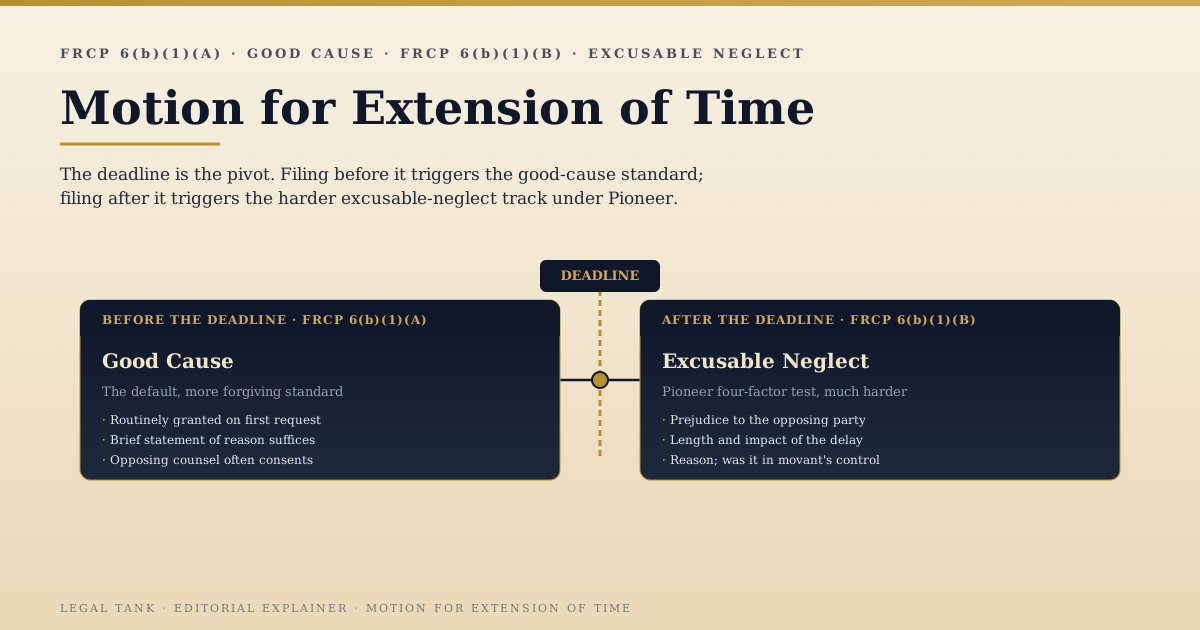
A motion for extension of time is a written request asking the assigned judge to enlarge a deadline that already runs against the movant in a pending case. The governing rule in federal practice is Federal Rules of Civil Procedure 6(b), which splits the analysis on a single hinge: was the motion filed before the deadline (the more forgiving good cause standard of Rule 6(b)(1)(A)) or after (the harder excusable neglect standard of Rule 6(b)(1)(B), measured against the Pioneer four-factor test). The same architecture appears in every state-court system under the local analog rule, and the drafting mechanics are stable across federal and state practice.
What a Motion for Extension of Time Sample Looks Like on the Page
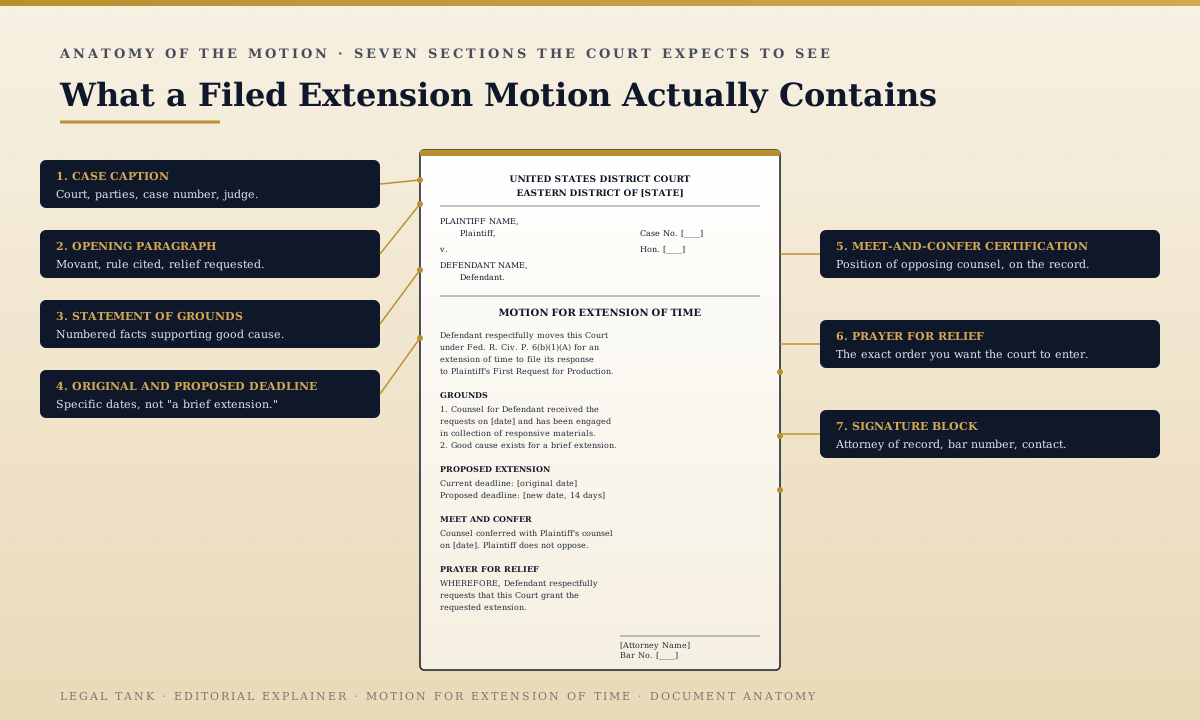
A motion for extension of time sample filed in federal court is a short, plain instrument: typically two to three pages of text, a proposed order on a separate page, and a certificate of service confirming the opposing party was served. The bundle is not long, and it does not need to be. Judges read extension motions quickly, look for the rule cited, the original date, the proposed new date, the position of opposing counsel, and the basic factual reason. If those five elements are present and the motion was filed before the deadline, the court typically grants the request without a hearing.
Reading the Seven Sections of the Sample
Every motion for extension of time sample in federal practice tracks the same seven-section layout. The sections appear in the same order across districts because the ECF docketing conventions, the local rules on motion practice, and the FRCP itself all point at the same outline. The list below walks through each section and what the court is looking for when the bundle hits chambers.
- 1Case CaptionThe court, the parties (using the same names as the underlying complaint), the case number, and the assigned judge. The caption is the first identifier the clerk uses to docket the filing and the first reference the judge sees when picking up the bundle.
- 2Opening ParagraphA one-paragraph statement identifying the movant, citing the rule that authorizes the request (FRCP 6(b)(1)(A) for pre-deadline requests, FRCP 6(b)(1)(B) for post-deadline requests, or the state-court analog), naming the action for which an extension is sought, and stating the relief requested.
- 3Statement of GroundsNumbered factual paragraphs supplying the basis for the request. Common grounds include recently received voluminous discovery, a scheduling conflict with another case, a recent change in counsel, a medical or family circumstance, or coordination with non-party witnesses. The grounds should be specific to this case and this deadline, not generic.
- 4Original and Proposed DeadlineA clean recitation of the date the current deadline expires and the date the movant proposes as the new deadline. Specific dates beat open-ended language. Courts grant extensions defined by calendar dates; they do not grant requests phrased as 'a reasonable extension.'
- 5Meet and Confer CertificationA short paragraph confirming that counsel conferred with opposing counsel before filing and stating the position of the opposing party (consents, does not oppose, opposes). Unopposed motions move faster than contested ones and are often granted on submission without a hearing.
- 6Prayer for ReliefA WHEREFORE paragraph asking the court to enter the proposed order extending the deadline from the original date to the new date. The prayer should match the proposed order word for word so the judge has a clean instrument to sign.
- 7Signature BlockCounsel of record signs the motion under the local-rule format, with bar number, firm address, telephone, and email. A self-represented filer signs in the same block with mailing address and contact information. The signature carries the FRCP 11 representation that the request is non-frivolous and warranted by existing law.
How the Sample Differs in State-Court Practice
A state-court motion for extension of time sample uses the same seven sections, but the caption changes (the court name reflects the state and county or division), the rule citation changes (CPLR 2004 in New York, NJ Rule 1:3-4 in New Jersey, Code of Civil Procedure section 1054(a) in California), and some local-form requirements appear (a notice of motion in New York, a proposed order on the back of the notice in some New Jersey vicinages, a cover sheet in some California Superior Court divisions). The substantive showing the court evaluates is the same: a stated reason, a specific new date, the position of opposing counsel, and a clean proposed order. State-court enforcement work on related instruments is covered in attorney-prepared motion for contempt of court for enforcing orders against a noncompliant party.
How the Federal Rule Frames a Motion for Extension of Time Federal Court Sample
The statutory architecture for a motion for extension of time federal court sample sits in Federal Rule of Civil Procedure 6(b). The rule recognizes only two postures and assigns a different standard to each. Subsection (1)(A) governs motions filed before the original deadline expires and authorizes the court to extend the deadline for good cause. Subsection (1)(B) governs motions filed after the deadline and authorizes the court to extend the deadline only on a showing of excusable neglect. The split is not cosmetic. The Supreme Court's decision in Pioneer Investment Services Co. v. Brunswick Associates Ltd. P'ship, 507 U.S. 380 (1993), defined excusable neglect through a four-factor balancing test that examines prejudice to the opposing party, the length of the delay, the reason for the delay (including whether it was within the movant's control), and whether the movant acted in good faith.
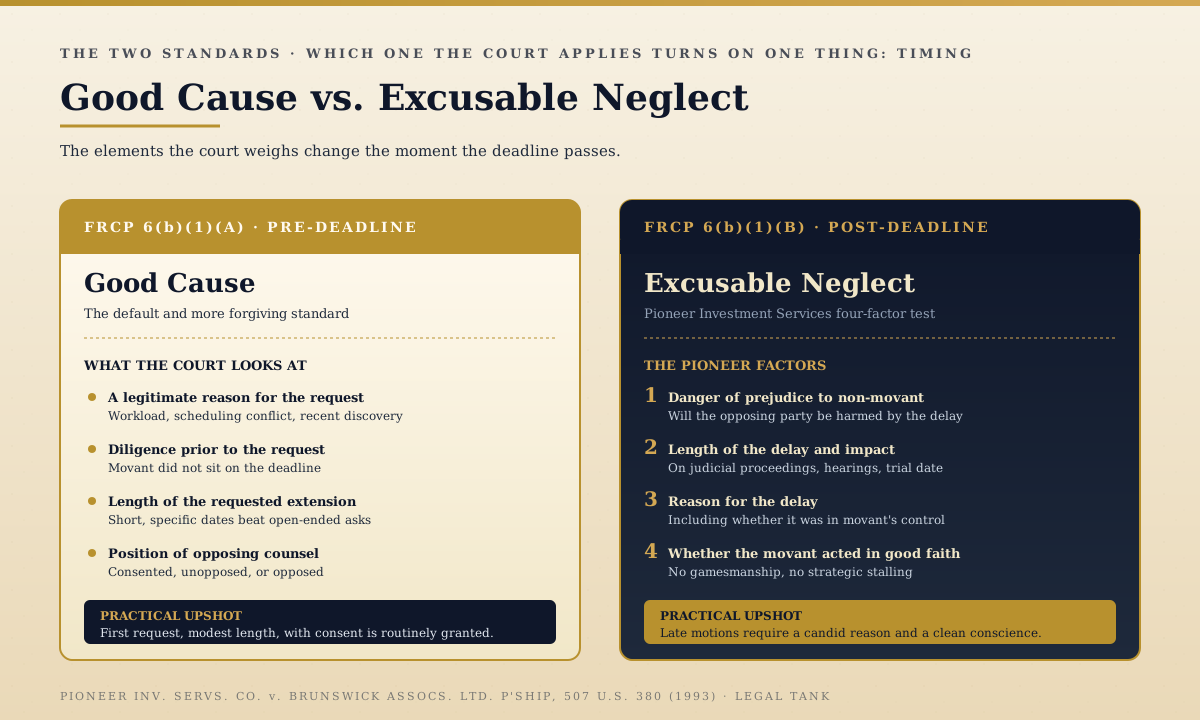
- A legitimate reason for the extension request
- Diligence by the movant before the deadline arrived
- A specific proposed length, not an open-ended ask
- The stated position of opposing counsel
A first request for a brief, specific extension with opposing consent is routinely granted on the papers.
- Danger of prejudice to the non-movant from the delay
- Length of the delay and its impact on the proceedings
- Reason for the delay and whether it was in the movant's control
- Whether the movant acted in good faith throughout
Post-deadline motions are governed by the Pioneer four-factor test and require candor on the reason for the lapse.
Reading Rule 6(b)(1)(A) Good Cause in Practice
The good-cause standard for a pre-deadline motion is deliberately forgiving. Federal courts have read it to mean a colorable, non-frivolous reason offered by counsel in good faith. The Advisory Committee Notes describe the standard as permitting extensions liberally where the request does not disrupt the case schedule and where opposing counsel has not been prejudiced. In practice, a first request for a brief extension (typically seven to fourteen days, occasionally twenty-one) is granted almost as a matter of course in federal district courts when filed in advance of the deadline and unopposed by the other side. Repeated requests draw closer judicial scrutiny, particularly when the case is approaching the dispositive-motion cutoff or the trial date set by the scheduling order.
Reading Rule 6(b)(1)(B) Excusable Neglect Under Pioneer
The excusable-neglect standard for a post-deadline motion is substantially harder, because the deadline has already run against the movant when the motion is filed. The Pioneer balancing test requires the court to weigh prejudice, delay, reason, and good faith, with no single factor dispositive. The Supreme Court emphasized that the reason for the delay is the most important factor in most cases, and that simple inadvertence or counsel's busy schedule is generally not enough unless coupled with circumstances genuinely outside the movant's control. Excusable neglect motions that involve illness, family emergency, recently retained counsel, or a documented calendaring error are more likely to succeed than motions that recite generic workload.
Where the Federal Rules of Civil Procedure Sit in the Architecture
Rule 6(b) is part of the timing chapter of the Federal Rules of Civil Procedure, which also governs how time is counted (Rule 6(a)), how the three-day mail rule applies (Rule 6(d)), and the categories of deadlines that cannot be extended at all (the categorical bar in Rule 6(b)(2)). The deadlines that cannot be extended under Rule 6(b)(2) include the post-trial motion deadlines under Rules 50(b), 50(d), 52(b), 59(b), 59(d), 59(e), and 60(b), and counsel should never plan to seek a Rule 6(b) extension of any of those without first reading the specific carve-out. For an attorney-grade walkthrough of how scheduling motions sit inside the broader motion-practice landscape, see the companion piece on what a legal motion is and how scheduling vehicles fit the broader filing taxonomy.
How the Scheduling Order Changes the Showing
When the deadline being extended was set by the court's scheduling order under FRCP Rule 16, the analysis adds a layer. Rule 16(b)(4) provides that a schedule may be modified only for good cause and with the judge's consent. The federal circuits have applied this slightly more demanding standard to motions that ask to push back discovery cutoffs, dispositive-motion deadlines, or expert-disclosure dates. Counsel filing a Rule 16 modification motion must show diligence, not just good cause in the abstract. The companion service-firm walkthrough at what a motion for summary judgment template includes to satisfy Rule 56 covers how Rule 56 timing intersects with the scheduling-order cutoffs that an extension motion has to navigate.
Common Grounds and Practical Use of the Extension Motion
The purpose of an extension motion is to enlarge a deadline that the case schedule, the federal rule, or the local rule otherwise enforces against the movant. Extensions are routine in federal civil practice because the pace of the rules is faster than the pace at which most cases actually move: the FRCP 12 response window is twenty-one days; the response window for many motions is fourteen days; the reply window is often seven; and the scheduling order cutoffs arrive in months. Counsel and self-represented filers reach for an extension motion when a deadline is in jeopardy for a legitimate, documented reason, and when continuing forward without the extension would either produce a defective filing or skip the chance to file at all.
Recently Received Voluminous Discovery
The most common ground in commercial and employment litigation is recently received voluminous discovery: the plaintiff serves tens of thousands of documents on the eve of the response deadline, and counsel cannot complete review and prepare written responses by the original date. A motion citing the volume produced, the date received, and the time the review reasonably requires is granted in the substantial majority of federal districts under FRCP 6(b)(1)(A). For an attorney-grade walkthrough of how this interacts with downstream discovery enforcement, see the companion piece on drafting service for a motion for sanctions targeting discovery abuse and bad-faith conduct.
Scheduling Conflicts and Coordination With Non-Party Witnesses
A second common ground is a documented scheduling conflict (a previously calendared trial or hearing in another matter, a pre-paid out-of-state deposition, a regulatory filing deadline that competes for the same drafting window). Federal judges generally credit scheduling conflicts when documented with the specific competing calendar entry, and they extend the deadline to the next available business day after the conflict resolves. Coordination with non-party witnesses (treating physicians, expert consultants, regulators) often produces the same kind of immovable scheduling constraint and qualifies for the same treatment.
Recent Substitution of Counsel
When a party retains new counsel close to a deadline, new counsel needs time to read the file, take stock of the record, confer with the client, and prepare the response. Federal courts routinely grant a single brief extension under FRCP 6(b)(1)(A) on this ground when the substitution of counsel is recent and the request is filed before the deadline. The extension motion attaches or references the notice of appearance from the new attorney and states the date of engagement. Pleading-stage work that follows this kind of substitution is covered in the companion service-firm walkthrough at drafting service for a motion to amend pleadings after discovery reveals new claims.
Settlement Posture and the Standstill Extension
Parties who have reached an advanced settlement posture often file a joint motion for extension of time to defer dispositive briefing or discovery deadlines while the settlement papers are negotiated. Federal judges welcome these motions because they conserve judicial resources, and the motions are granted on the papers without a hearing in nearly every case. The standstill extension should state the settlement posture in general terms (an agreement in principle has been reached, a mediation is calendared, settlement papers are circulating) without attaching confidential settlement-discussion content. The closely related plaintiff's request that arises when opposing parties default is covered in how a motion for default judgment lets the plaintiff secure relief after the clerk enters default.
Medical, Family, or Personal Emergency
A documented medical, family, or personal emergency affecting counsel or a party is generally accepted as good cause and, if the emergency arose after the deadline ran, as excusable neglect under Pioneer. The motion should state the general nature of the emergency without disclosing protected health information or sensitive family detail; courts are familiar with these motions and do not require granular disclosure. A short, candid recitation accompanied by a proposed new deadline is what the court is looking for.
The Limits: When a Motion to Extend Cannot Cure the Problem
FRCP 6(b)(2) categorically bars an extension of the post-trial motion deadlines (Rules 50, 52, 59, 60) and a handful of jurisdictional deadlines. Statutes of limitations and statutes of repose are not extended by court order; they expire by operation of law and cannot be saved by a Rule 6(b) motion. The appeal-as-of-right deadlines under Federal Rule of Appellate Procedure 4 are governed by their own rule, not by FRCP 6(b). When the deadline at issue is one of these uncategoreable deadlines, counsel must consider other relief (a motion for reconsideration to reopen the record, a motion to vacate, an FRAP 4(a)(5) extension of the notice of appeal), and an FRCP 6(b) motion will not solve the problem. The template-side treatment is covered in what a motion for reconsideration template contains and the sections courts expect to see and the closely related anatomy of a motion for default judgment template and how each section functions.
How to Write a Motion for Extension of Time: From the Caption to the Certificate of Service
The seven-step walkthrough below covers the drafting choices unique to an extension motion. The lifecycle of a generic motion is stable across every jurisdiction (draft, file, serve, brief, hear, rule), but an extension motion has timing-driven choices that other motions do not. The most important of those choices is whether the motion can be filed before the deadline; the second most important is whether the deadline being extended is set by the federal rule itself or by the Rule 16 scheduling order.
Step 1: File Before the Deadline If at All Possible
The single largest factor controlling whether the court grants the extension is whether the motion is filed before or after the deadline. FRCP 6(b)(1)(A) sets a relatively forgiving good-cause standard for motions filed in advance of the deadline; FRCP 6(b)(1)(B) sets the much stricter excusable-neglect standard for motions filed after the deadline has passed. A movant who realizes a deadline is in jeopardy should file the motion the same day, with as much specificity as the record allows, rather than letting the date slip and then arguing the harder standard.
Step 2: Identify the Authorizing Rule and the Specific Deadline
The opening paragraph cites the rule that authorizes the extension. In federal civil practice the rule is FRCP 6(b)(1)(A) or (B) depending on timing; in federal criminal practice the analog is Fed. R. Crim. P. 45(b); in state practice the rule is the state-code analog (Code of Civil Procedure section 1054(a) in California, CPLR 2004 in New York, NJ Court Rule 1:3-4 in New Jersey, Tex. R. Civ. P. 5 in Texas). The motion also names the specific deadline being extended (response to complaint, response to motion, expert disclosure, discovery cutoff, summary judgment deadline). Conflating two deadlines in one motion produces a muddled order and a confused docket.
Step 3: Conduct and Document the Meet and Confer
Most local rules require counsel to confer with opposing counsel before filing a scheduling motion and to state opposing counsel's position in the motion itself. The conferral should happen by phone or video, not just by email, and the motion should attach or reference the written summary that follows the conferral. If opposing counsel consents, the motion is captioned 'Unopposed Motion for Extension of Time' and is typically granted on the papers without a hearing. If opposing counsel opposes, the motion must address the opposing position substantively, not in conclusory terms.
Step 4: Distinguish an Extension From a Scheduling-Order Modification
If the deadline being extended is set by an individual rule (an answer deadline under FRCP 12(a), a response deadline under a local rule), the motion travels under FRCP 6(b). If the deadline is set by the court's scheduling order (the discovery cutoff, the dispositive motion deadline, the expert-disclosure date), the motion must also satisfy the good-cause standard for modifying a Rule 16 scheduling order. The two standards overlap but are not identical; a motion that asks to push back the Rule 16 cutoffs needs to address scheduling-order good cause separately from the FRCP 6(b) showing.
Step 5: Draft a Proposed Order That Matches the Prayer for Relief
The proposed order is the document the judge actually signs. It should restate the relief requested in the motion with the exact new dates the movant proposed, leave blanks only for the judge's signature and the order date, and fit on a single page where possible. Proposed orders that overreach (asking for additional relief the motion did not request) draw deletions and slow the ruling. Proposed orders that match the prayer for relief word for word produce signed orders that match what the movant asked for.
Step 6: File With the Court Clerk and Effect Service of Process
The motion is filed with the court clerk through the electronic filing system in most federal courts and many state-court systems; smaller state courts may require paper filing. The opposing party must be served the same day under FRCP 5, and a certificate of service must be filed showing the date, method, and recipient. Filings without proof of service of process get bounced. Self-represented filers most often miss this step, either by serving by an unauthorized method or by neglecting to docket the certificate of service before the return date arrives.
Step 7: Track the Ruling and Update the Docket
After the court rules, the granted order replaces the prior deadline on the docket, and counsel updates the internal calendar to match. If the court grants in part (a shorter extension than the movant requested) or denies the motion entirely, the movant complies with the standing deadline. If the motion is denied for failure to confer or some other procedural defect, the movant cures and refiles immediately rather than waiting; a second motion that addresses the prior defect is often granted without further conferral when the original good cause is preserved on the record.
Once the bundle is built, the court clerk dockets the motion, and the docket reflects the pending motion under the assigned judge's name. The judge reviews the motion on the papers in the substantial majority of federal cases (no oral argument), enters the court order granting or denying the request, and the case continues on the new schedule. The cross-cutting dispositive-track work is covered in professionally drafted cross-motion for summary judgment briefs and Rule 56 opposition filings for parties who are simultaneously preparing the substantive dispositive papers under the deadlines the extension motion is asking to push.
Common Drafting Mistakes That Slow the Ruling
Three drafting mistakes recur in extension motions across jurisdictions, and each one delays the ruling or produces a partial grant rather than a clean grant. First, motions that ask for an open-ended extension ("a reasonable extension," "a short extension to be determined later") rather than a specific calendar date force the court to invent the new date from scratch, and the new date the court invents is almost always shorter than what the movant wanted. Second, motions that omit the position of opposing counsel force the court to assume the motion is contested, which slows the ruling and sometimes triggers a meet-and-confer remand before the court will rule. Third, motions that bury the rule citation, the original date, and the proposed new date deep in the body rather than stating them in the first paragraph make it harder for the court to grant the motion on the papers; a clean first paragraph that names all three lets the judge sign the proposed order without further reading. The evidentiary record for the extension motion is not heavy (extensions are not summary judgment motions), but what is there must be specific and verifiable. Pleading-side consequences of mis-drafted extension motions show up later in the case at the pleading stage and at hearings on the merits.