Custom Motion to Modify Divorce Decree Form for Post-Judgment Changes in Support or Custody
Direct Answer
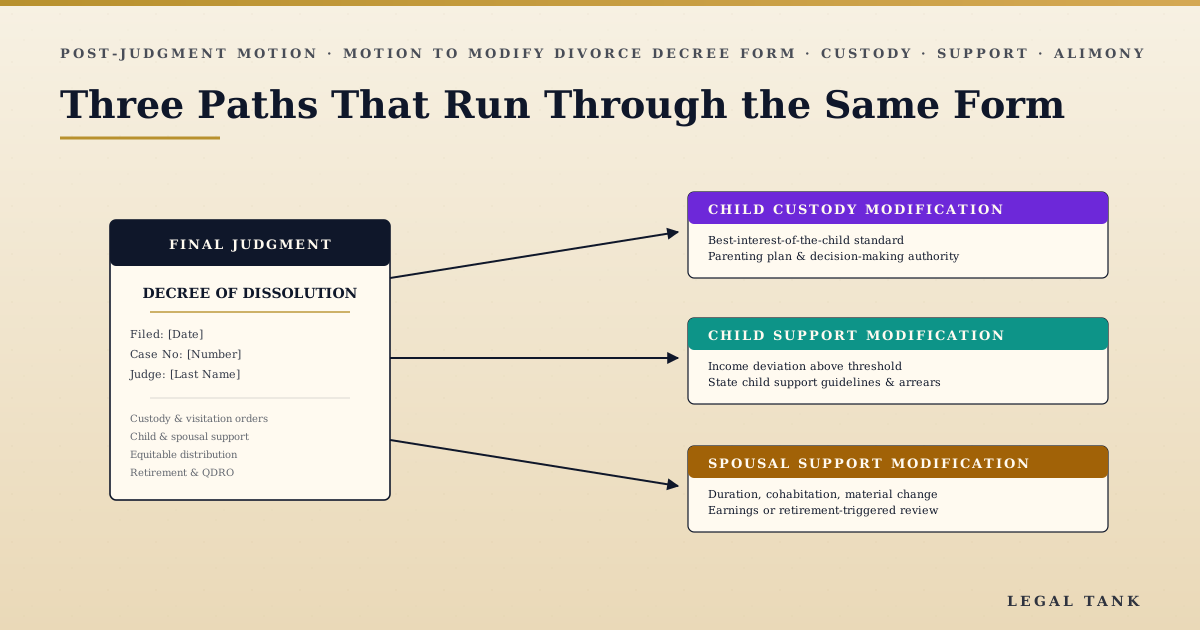
A motion to modify divorce decree form asks the court that issued a final decree of dissolution to change a post-judgment provision of the order: child custody, parenting time, child support, or spousal support. The moving party must show a substantial change in circumstances since the original order, with the threshold set by state statute. The full document body is below in attorney-grade form, with the California Family Code section 3087 custody scaffold, the section 4326 spousal-support scaffold, and a side-by-side state-track matrix covering Texas, Florida, and New York.
CA · TX · FL · NY
Custody, support, alimony
Motions to Modify Divorce Decree Form We Draft, From Motion to Modify Custody to Spousal Support Review
A motion to modify custody is the most frequently filed post-judgment motion in family law practice. Legal Tank drafts the motion as a stand-alone filing or as one of three companion motions inside the same post-judgment packet: custody, support, and alimony. Each track has its own statutory threshold, its own evidentiary load, and its own proposed order shape. The movant decides which tracks to file. The court rules on what is in front of it.
For the dispositive companion when the post-judgment fight also implicates discovery sanctions or a parallel enforcement action, see drafting service for a motion for sanctions targeting discovery abuse and bad-faith conduct for the pretrial misconduct vehicle, and attorney-prepared motion for contempt of court for enforcing orders against a noncompliant party for the enforcement work that often shares a docket with a post-judgment modification.
Track
Child Custody Modification
Legal Tank drafts the post-judgment motion to modify legal custody, physical custody, parenting time, or decision-making authority. The motion identifies the substantial change in circumstances since the existing order, attaches the supporting declaration, and lodges a proposed amended parenting plan that the court can sign.
Fam. Code 3087 / TFC 156.101 / Fla. Stat. 61.13 / DRL 240
Track
Child Support Modification
Legal Tank drafts the post-judgment motion to modify child support, including the updated income and expense statement, the guideline worksheet, and the requested deviation findings. The motion shows the income deviation or guideline shift that crosses the modification threshold in your state.
Fam. Code 4053 / TFC 156.401 / Fla. Stat. 61.14
Track
Spousal Support Modification
Legal Tank drafts the post-judgment motion to modify spousal support, terminate alimony on cohabitation, or step the support down on retirement. The motion plots the material change in need or ability to pay and confronts any non-modification clause inside the marital settlement agreement on the face.
Fam. Code 4326 / TFC 8.057 / Fla. Stat. 61.14 / DRL 236
Inside a Motion to Modify Parenting Plan and the Substantial Change Threshold
A motion to modify parenting plan is the narrowest of the three custody tracks. It targets the weekly schedule, the holiday and vacation rotation, the decision-making allocation on health and education, and the right-of-first-refusal provisions inside the existing parenting plan. The motion does not change legal or physical custody. The court applies the best-interest-of-the-child standard to the requested schedule changes after the substantial-change gate is cleared.
The most common record cite for a parenting plan modification is a documented relocation by either parent, a work-schedule shift that makes the existing parenting time impossible, the child reaching an age where school and activity schedules outgrow the original plan, or a long-standing de facto deviation from the original schedule that the parties want the court to formalize. Each ground attaches different documentary evidence in the supporting declaration.
The deliverable Legal Tank drafts for a parenting plan modification is a four-document packet: the motion to modify with grounds pleaded, the supporting declaration with documents and exhibits, the proposed amended parenting plan laid out week by week, and the proposed order. Your engaging counsel files, serves, and presents the packet at the noticed hearing.
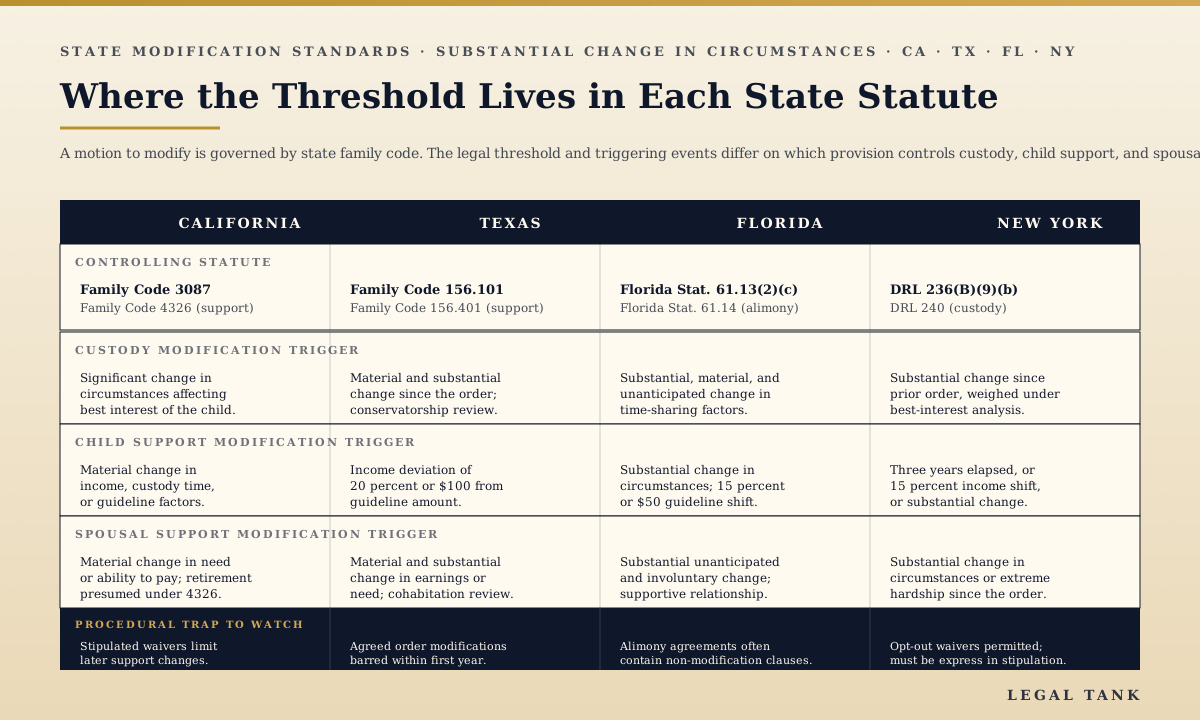
Fam. Code section 3087, 4326
California
- Custody trigger
- Significant change in circumstances affecting the best interest of the child (the changed-circumstances rule of Montenegro v. Diaz), with joint-custody orders modified under Family Code section 3087.
- Child support trigger
- Material change in financial circumstances measured against the statewide guideline (Family Code section 4055); child support is modifiable under section 3651.
- Spousal support trigger
- Material change in need or ability to pay; supportive-relationship cohabitation under section 4323; termination of child support is a statutory change of circumstances under section 4326.
- Procedural trap
- A stipulated non-modification provision or knowing spousal-support waiver in the marital settlement agreement closes the spousal-support door.
Fam. Code section 156.101, 156.401
Texas
- Custody trigger
- Material and substantial change in circumstances since the conservatorship order, evaluated under best interest of the child.
- Child support trigger
- Income deviation of 20 percent or 100 dollars per month from the guideline, three years after the order, under section 156.401(a)(2).
- Spousal support trigger
- Material and substantial change in earnings or need; non-modifiable maintenance possible if so stipulated in the decree.
- Procedural trap
- Agreed-parent conservatorship orders are barred from modification within the first year except on serious-harm findings.
Fla. Stat. 61.13, 61.14, 61.30
Florida
- Custody trigger
- Substantial and material change in circumstances affecting the time-sharing schedule (the unanticipated requirement was removed in 2023).
- Child support trigger
- Substantial change of 15 percent or 50 dollars per month from the guideline amount under section 61.30(1)(b), modified through section 61.14.
- Spousal support trigger
- Substantial unanticipated and involuntary change; supportive relationship under section 61.14(1)(b).
- Procedural trap
- An alimony agreement may include an express non-modification clause that survives the post-decree motion entirely.
DRL section 236, 240
New York
- Custody trigger
- Substantial change in circumstances since the prior order, weighed under best interest of the child analysis.
- Child support trigger
- Three years elapsed since the last order, a 15 percent income shift, or a substantial change in circumstances.
- Spousal support trigger
- Substantial change in circumstances or extreme hardship since the maintenance order under DRL section 236(B)(9)(b).
- Procedural trap
- Express opt-out waivers of the modification right are permitted but must be unambiguous in the divorce stipulation.
How a Motion to Modify Divorce Decree Moves From Substantial-Change Showing to Signed Amended Order
A motion to modify divorce decree rides on three documents: the motion itself, the supporting declaration that sets out the substantial-change facts under penalty of perjury, and the proposed amended order the court can sign at the hearing. The procedural shape is the same across states; only the controlling statute and the timing rule change. The state matrix above maps the specific threshold for California, Texas, Florida, and New York. The on-page form below is the California backbone, with the bracketed jurisdictional fields keyed for cross-state use.
The post-judgment hearing is shorter than the original dissolution trial. The court is not deciding custody or support from scratch. It is deciding whether the moving party met the substantial-change burden, and if so, whether the requested modification serves the best interest of the child or the appropriate post-divorce support standard. Tight motions, complete declarations, and signed-ready proposed orders win these hearings.
                SUPERIOR COURT OF THE STATE OF CALIFORNIA
                       COUNTY OF [DECREE COUNTY]
                       FAMILY LAW DIVISION


In re the Marriage of:               )
                                     )
[PETITIONER FULL LEGAL NAME],        )    Case No. [Original
                                     )                Case Number]
              Petitioner,            )
                                     )    Dept: [Number]
and                                  )    Judge [Last Name]
                                     )
[RESPONDENT FULL LEGAL NAME],        )
                                     )
              Respondent.            )
_____________________________________)


      [PARTY]'S NOTICE OF MOTION AND MOTION TO MODIFY
       JUDGMENT OF DISSOLUTION; MEMORANDUM OF POINTS
        AND AUTHORITIES; DECLARATION OF [DECLARANT];
        PROPOSED AMENDED PARENTING PLAN; PROPOSED ORDER
   (Cal. Fam. Code sections 3087, 4326; Cal. R. Ct. 5.92)


    Hearing Date: [Date]
    Hearing Time: [Time]
    Department:   [Number]
    Reservation:  [Reservation ID]


    TO ALL PARTIES AND THEIR COUNSEL OF RECORD:

    PLEASE TAKE NOTICE that on the above date, time,
and department, [Petitioner / Respondent Full Legal Name]
("Moving Party") will move this Court for an order
modifying the Judgment of Dissolution entered in this
action on [Original Decree Date] as to:

         [ ]  Child custody and parenting time
         [ ]  Child support
         [ ]  Spousal support


I.   STATEMENT OF GROUNDS

     1.  This motion is brought under California Family
         Code section [3087 (custody) / 4326 (spousal
         support) / 3651 (child support)], on the ground
         that a substantial change in circumstances has
         occurred since the entry of the Judgment of
         Dissolution on [Original Decree Date].

     2.  The proposed modification serves the best
         interest of the child / the appropriate
         post-divorce support standard, as set out in
         the supporting Declaration.


II.  SUBSTANTIAL CHANGE IN CIRCUMSTANCES

     3.  The Judgment of Dissolution entered on
         [Original Decree Date] provided that
         [describe relevant existing provision].

     4.  Since entry of the Judgment, the following
         material facts have changed:

         (a)  [Describe change #1, with date and
              supporting exhibit reference.]

         (b)  [Describe change #2, with date and
              supporting exhibit reference.]

         (c)  [Describe change #3, with date and
              supporting exhibit reference.]

     5.  These changes constitute a substantial change
         in circumstances that warrants modification of
         the existing order under Family Code section
         [3087 / 4326 / 3651].


III. RELIEF REQUESTED

     6.  Moving Party requests that the Court enter an
         Amended Order providing:

         (a)  [Custody / parenting time language.]

         (b)  [Child support language with new monthly
              amount, due date, and method of payment.]

         (c)  [Spousal support language with new
              monthly amount or termination date.]

     7.  The Proposed Amended Order is attached as
         Exhibit A. The Proposed Amended Parenting
         Plan, if applicable, is attached as Exhibit B.


IV.  CONCLUSION

    WHEREFORE, Moving Party respectfully requests that
the Court grant this motion, sign the Proposed Amended
Order, and order such further relief as the Court deems
just and proper.


Dated: ____________, 20____.


                     Respectfully submitted,


                     _______________________________________
                     [Attorney Name], Esq.
                     California State Bar No. ______________
                     [Firm Name]
                     [Firm Address]
                     [City, California ZIP]
                     Telephone: (___) ___-____
                     Email: __________________
                     Attorney for [Petitioner / Respondent]


================================================================
                  DECLARATION OF [DECLARANT]
================================================================

    I, [Declarant Full Legal Name], declare:

    1.  I am [the Petitioner / the Respondent in this
        action]. I have personal knowledge of the facts
        stated in this Declaration and, if called as a
        witness, could testify competently to them.

    2.  [Set out the substantial change facts in
        chronological order, with dates and the
        documentary support attached as exhibits.]

    3.  [Identify each material witness by name and
        address and state the substance of the expected
        testimony, if any.]

    4.  [State why the proposed modification serves the
        best interest of the child or the appropriate
        post-divorce support standard.]

    I declare under penalty of perjury under the laws of
the State of California that the foregoing is true and
correct.


    Executed on ____________, 20____, at [City], California.


                     _______________________________________
                     [Declarant Full Legal Name]


================================================================
                  CERTIFICATE OF SERVICE
================================================================

    I HEREBY CERTIFY that on this _____ day of
________________, 20____, I served the foregoing Notice
of Motion and Motion to Modify Judgment of Dissolution,
Memorandum of Points and Authorities, Declaration,
Proposed Amended Parenting Plan, and Proposed Order on
counsel of record by [TrueFiling e-service /
first-class mail with postage prepaid / personal
delivery]:

    [Opposing Counsel Name, Firm, Address, Email]


                     _______________________________________
                     [Attorney Name], Esq.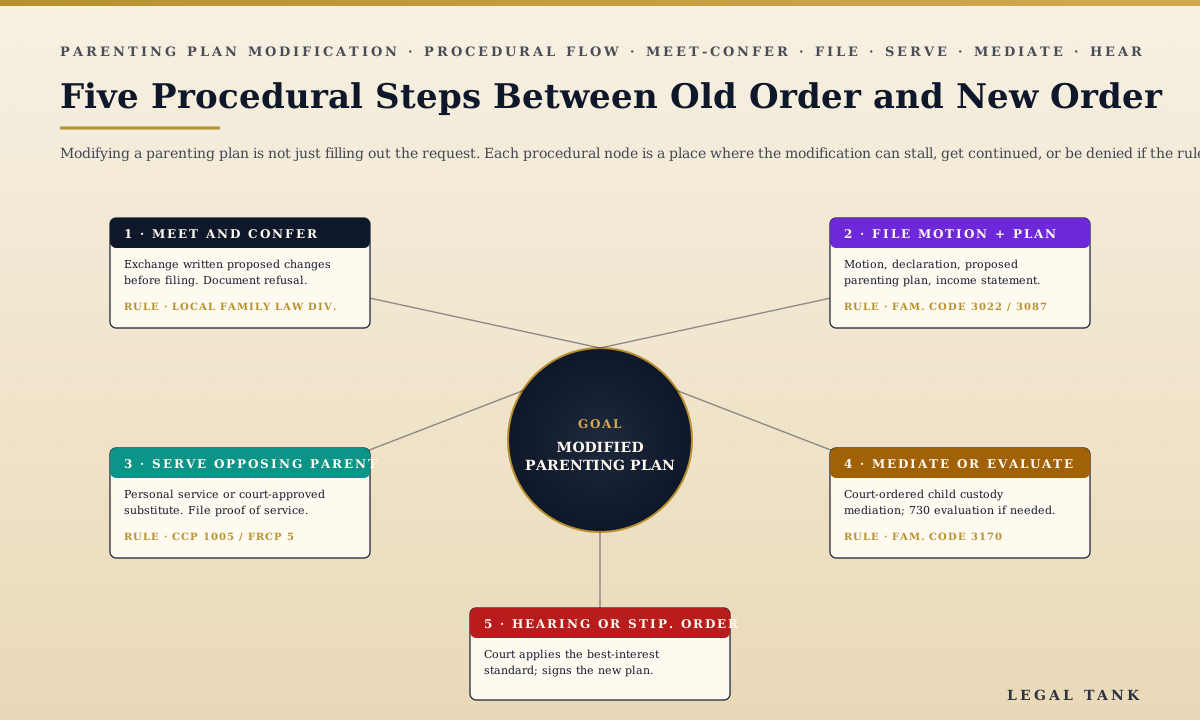
Six steps from blank form to filed motion
Each step corresponds to a section of the on-page form. Caption errors and substantial-change documentation gaps are the two ways a post-judgment motion fails on the papers without ever reaching the merits of the requested modification.
- 1
Copy the on-page form into your working document
Paste the motion body below into a working document. The bracketed fields (caption, case number, judge, decree filing date, the substantial-change paragraph, witness identifications, requested modified order language) are the only sections that need editing. The grounds scaffold and the verification scaffold stay intact across cases in the same state track.
- 2
Mirror the caption from the original divorce decree
Caption, parties, case number, and original judge carry forward from the decree of dissolution. Most state systems route the post-judgment motion back to the original case number rather than opening a new matter. Local rules vary on whether the motion lands on the original judge's calendar or rotates through the post-judgment department.
- 3
Plead the substantial change with record cites
Substantial change in circumstances is the gate. Each fact gets a record cite. Income shift: attach paystubs, tax returns, employment letter, or termination notice. Relocation: attach lease or purchase contract, school enrollment confirmation, employer transfer letter. Health or safety: attach medical records, police reports, CPS findings, or therapist declarations. Generic averments about change without supporting documents draw a tentative ruling to deny.
- 4
Run the meet-and-confer where it is required
California local family law rules in most counties require a documented meet-and-confer attempt on parenting plan modifications before the motion is set for hearing. Texas does not require it pre-motion but the court will route the parties through mediation under Family Code section 153.0071 before trial. Document the meet-and-confer attempt in the supporting declaration. A failed attempt is not a procedural defect; an undocumented attempt is.
- 5
Attach the proposed order or proposed parenting plan
Always attach the proposed amended order. Where parenting time is at issue, attach a proposed parenting plan with weekly, holiday, and summer schedules laid out by week and month. Where support is at issue, attach the updated guideline worksheet and a proposed support order with new monthly amounts, payment dates, and method of payment. The judge signs what is in front of them.
- 6
Have the draft finalized before filing
Post-judgment fights are easier to lose than the original divorce. Send the draft through Legal Tank intake so the substantial-change showing, the declaration, the proposed parenting plan, and the venue choice are pressure-tested against your state's calendaring rules. The motion is then ready for your engaging counsel to sign and file.
Where post-judgment modification intersects other motion work
A motion to modify rarely travels alone. It often accompanies a contempt motion when the opposing party has failed to comply with the existing order, an enforcement motion when arrears need to be reduced to judgment, or a motion to vacate when the original decree was procured by fraud or mutual mistake. For the parallel filings, see a drafted motion to enforce family court orders and judgment provisions and drafted motion to vacate judgment under Rule 60 and Family Code section 2122. The procedural how-to that frames the broader filing posture sits at drafting a motion in court from caption to certificate of service.
The dispositive companions that often share a docket entry with a post-judgment modification include inside a motion for reconsideration template and the sections courts expect to see and anatomy of a motion for default judgment template and how each section functions.
For the procedural umbrella that places post-judgment modification motions inside the broader family-law motion catalog, see what a legal motion is and how modification vehicles fit the broader family-law motion catalog, and the broader umbrella at defining what is a motion in court and how written requests move a case forward. For a drafting-pair service on amended pleadings, see drafting service for a motion to amend pleadings after discovery reveals new claims, and for the parallel dispositive template family, see building a motion to dismiss template that hits Rule 12(b)(6) on the face.
Motion to Modify Divorce Decree Form Questions
Can a divorce decree be renegotiated?
How do you file a motion to modify?
How to amend divorce paperwork?
What is a motion to modify a custody order in NC?
What is the biggest mistake in a divorce?
What are good reasons to file a motion for a custody case?
Have Your Motion to Modify Divorce Decree Professionally Finalized
Legal Tank drafts the post-judgment motion, the supporting declaration, the proposed amended parenting plan, the updated guideline worksheet where support is at issue, and the proposed order. Your engaging family-law counsel signs, files, serves, and argues the motion at the post-judgment hearing. The deliverable is a filing-ready packet keyed to your court, your case caption, and your substantial-change record. Send the decree, the change facts, and the requested modification through intake and the grounds, the declaration, and the proposed order are pressure-tested before your engaging counsel files.
Legal Tank prepares filing-ready post-judgment motion drafts keyed to your court's requirements. We do not appear at the post-judgment hearing or file with the court. Your engaged family-law counsel signs and files the motion and argues it at the hearing.