Sample Motion to Set Aside Judgment Example Showing the Grounds and Relief Courts Require
A motion to set aside judgment example is the filing that asks the same trial court to void the judgment it already entered against the moving party. The federal vehicle runs through Federal Rule of Civil Procedure 60(b), which lists six grounds for relief and applies two different time bars (one year for subsections (1) through (3), reasonable time for (4) through (6)). California adds four separate tracks under Code of Civil Procedure section 473 and 473.5, each with its own deadline and its own evidentiary showing. The English CCJ set-aside under Form N244, the Hawaii Rule 60(b) variant, and the Singapore default-set-aside practice referenced in PAA searches run on parallel but distinct procedural rails. This page lays out the federal six-ground framework, the California four-track timeline, and the section-by-section build of a sample motion to set aside judgment that lands the relief.
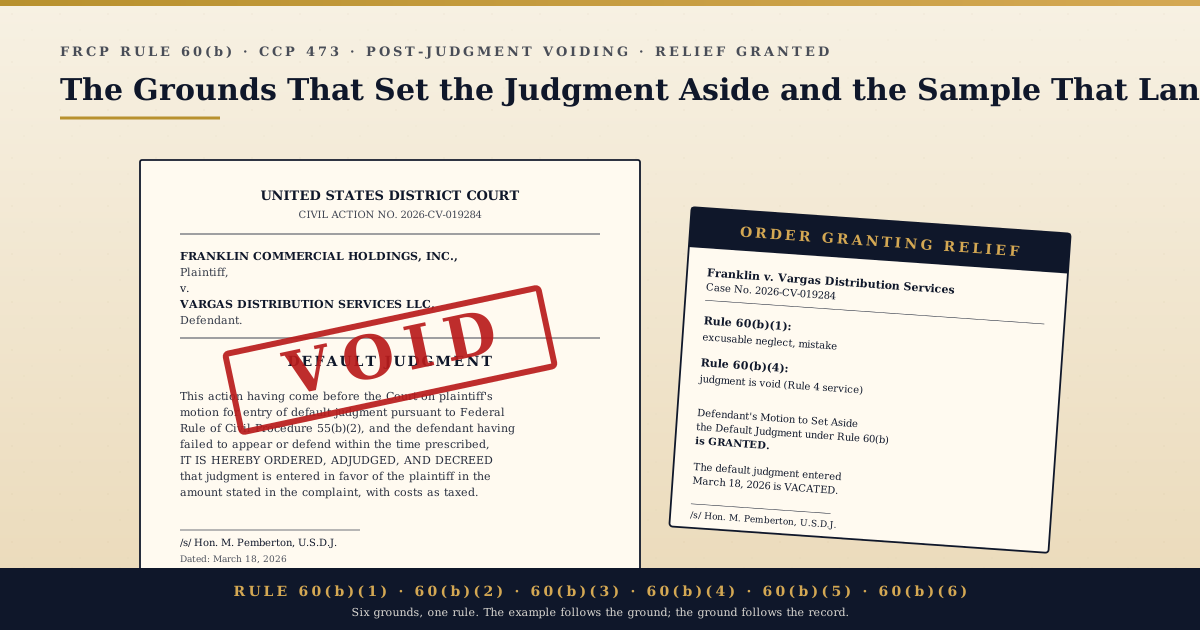
Motion to Set Aside Default Judgment Filings We Draft Across Federal and State Tracks
Legal Tank drafts set-aside motions across four distinct procedural postures. Each posture corresponds to a specific controlling rule (federal Rule 60(b), California CCP 473(b) discretionary, California CCP 473(b) mandatory attorney affidavit, void-judgment under Rule 60(b)(4) or CCP 473(d)). The posture controls the standard the court applies, the evidentiary record the motion has to compile, and the deadline the moving party has to meet. Picking the wrong posture, or filing a generic set-aside form without matching the controlling rule, costs the relief.
Federal Rule 60(b) Set-Aside Motion
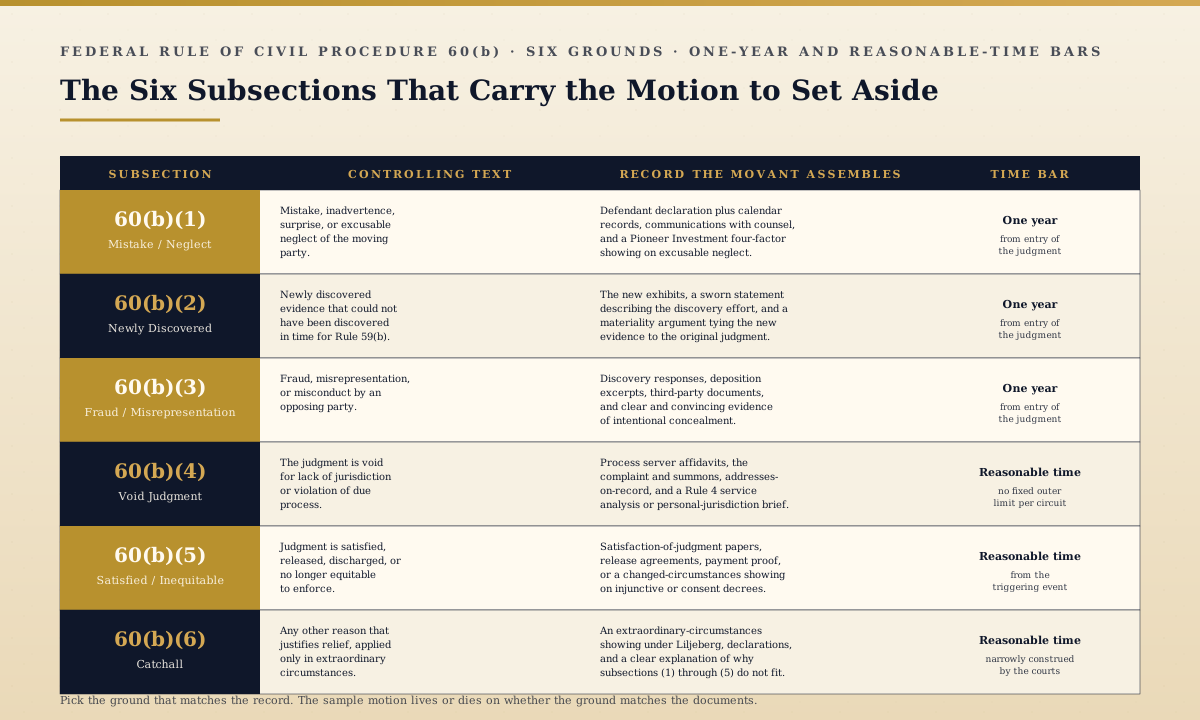
The federal vehicle covering all six subsections from mistake or excusable neglect through the (b)(6) catchall. Filed in the same federal district court that entered the judgment, decided by the same judge, governed by the one-year bar on (b)(1) through (b)(3) and the reasonable-time bar on (b)(4) through (b)(6).
California CCP 473(b) Discretionary Relief
The California superior-court vehicle covering mistake, inadvertence, surprise, and excusable neglect. Filed within six months of entry of the judgment, supported by a sworn declaration of the moving party and the proposed responsive pleading.
California CCP 473(b) Mandatory Attorney Affidavit
The California mandatory-relief track that triggers when retained counsel files a sworn affidavit attributing the default to attorney mistake or neglect. Trial court has no discretion to deny; the relief is mandatory on the affidavit.
Void-Judgment Set-Aside Under Rule 60(b)(4) or CCP 473(d)
The void-judgment vehicle covering lack of personal jurisdiction, lack of subject-matter jurisdiction, defective service of process under Rule 4, and facial invalidity of the judgment itself. Reasonable-time standard with no fixed outer bar.
The federal Rule 60(b) framework is the most heavily litigated of the four tracks. Six subsections cover six distinct procedural pathologies, each with its own evidentiary signature and its own time bar. The matrix below collects the controlling text, the typical record showing, and the time bar for each subsection so counsel can pick the ground that matches the file before opening the brief. The companion explainer on motion to vacate practice and the vacate-vehicle taxonomy courts apply covers the broader vacate-vehicle taxonomy that includes the set-aside motion as one species. The companion service-firm page on drafted motion to set aside default judgment for civil defendants covers the service-side drafting engagement on the same vehicle.
Rule 60(b)(1) Excusable Neglect Drafting Under Pioneer Investment
The most common federal-court set-aside ground is Rule 60(b)(1) excusable neglect. The controlling standard comes from the Supreme Court's decision in Pioneer Investment Services v. Brunswick Associates (1993), which sets a four-factor equitable test: prejudice to the opposing party, length of the delay and impact on judicial proceedings, reason for the delay (including whether it was in the control of the moving party), and good faith of the moving party. The drafting tracks the four factors as four numbered showings in the moving papers. Where the underlying default was entered on the plaintiff side and the defendant now seeks set-aside, the companion explainer on motion for default judgment entry mechanics and the plaintiff-side procedure in civil litigation covers the entry-side mechanics that the set-aside motion now attacks.
Rule 60(b)(4) Void-Judgment Set-Aside on Service or Jurisdiction Defect
Rule 60(b)(4) reaches judgments that are void as a matter of law: void for lack of personal jurisdiction over the defendant (defective service under Federal Rule of Civil Procedure 4, no minimum contacts), void for lack of subject-matter jurisdiction (case outside the federal court's Article III authority), or void for violation of due process. Void-judgment relief is not discretionary: if the moving party proves the judgment is void, the court must set it aside. The reasonable- time standard for filing has no fixed outer limit; the Ninth Circuit has permitted void-judgment set-asides decades after entry. The companion entry-side service-firm page on motion for default judgment template anatomy and the section-by-section build courts review covers the default-entry mechanics that produce the judgments most often attacked under Rule 60(b)(4). Where the parallel posture also implicates a subpoena that should be set aside, the explainer on motion to quash practice and the grounds courts accept to set aside a subpoena covers the subpoena-side set-aside vehicle that uses similar void-for-service doctrine.
The Motion to Set Aside Conviction Branch in Criminal Practice
A motion to set aside conviction is a criminal- procedure vehicle separate from the civil Rule 60(b) framework this page covers. The criminal-set-aside vehicle typically runs through state expungement statutes, post-conviction relief statutes (California Penal Code section 1203.4, Texas Code of Criminal Procedure article 11.07, federal motions under 28 U.S.C. section 2255), or constitutional habeas corpus petitions. The drafting build, the burden of proof, and the relief differ in material respects from the civil Rule 60(b) practice. Legal Tank handles civil set-aside drafting under Rule 60(b) and the state- equivalent rules; criminal set-aside engagements route to specialized post-conviction counsel. Where the parallel civil posture involves summary-judgment opposition that bears on the same factual record, the companion explainer on motion for summary judgment practice under Federal Rule of Civil Procedure 56 covers the dispositive vehicle most often paired with the set-aside motion in commercial-litigation postures.
California Court Rules on the Motion Set Aside and the Four Parallel Tracks
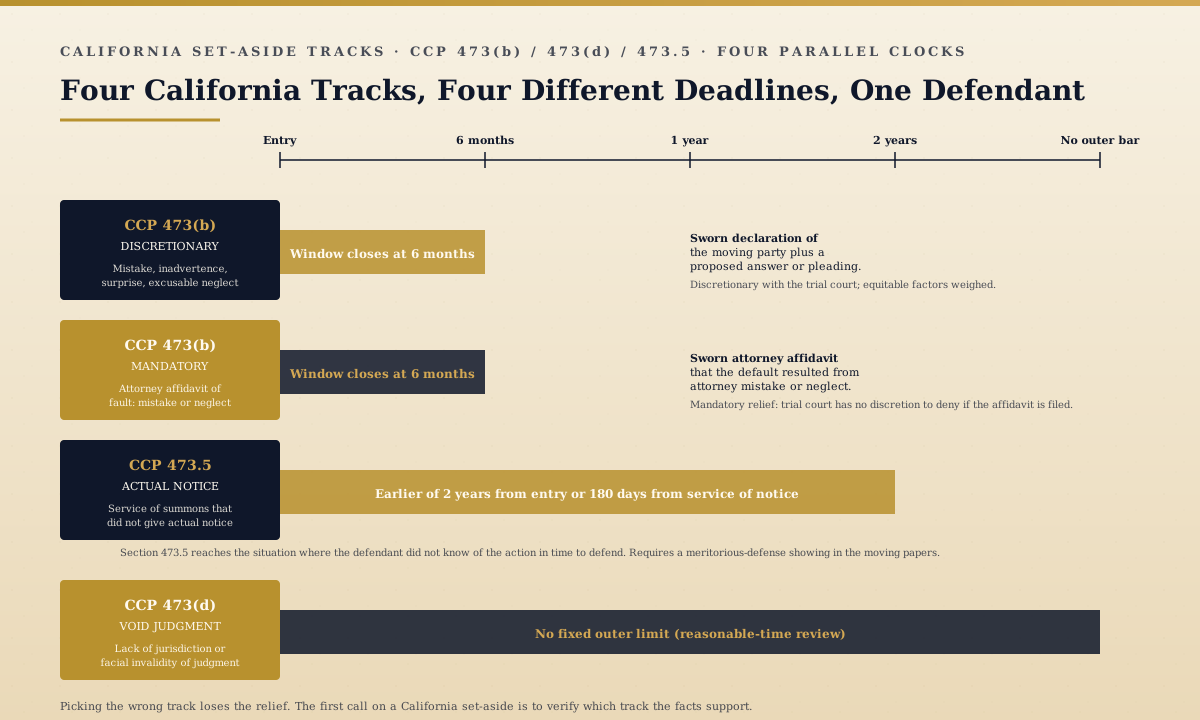
California superior-court practice runs the set-aside vehicle on four parallel tracks, each with its own deadline and its own evidentiary showing. The choice of track is not optional: the facts in the file dictate which track the moving party can use, and filing on the wrong track loses the relief at threshold review. The visual below lays out the four tracks on a single timeline so counsel can pick the track before opening the brief.
CCP 473(b) Discretionary Relief: The Six-Month Window
The most common track. CCP 473(b) allows the trial court to grant discretionary relief from a judgment, order, or proceeding entered against a party through that party's mistake, inadvertence, surprise, or excusable neglect. The motion must be filed within six months of entry of the judgment. The Sacramento County Law Library's published self-help materials on the deadline to file motion to set aside default judgment california describe this track in detail; counsel calendars the six-month deadline from entry, not from notice of entry. The supporting declaration of the moving party is mandatory and has to establish the factual basis for one of the four discretionary grounds.
CCP 473(b) Mandatory Attorney Affidavit: When Counsel's Mistake Caused the Default
The mandatory-relief track triggers when retained counsel files a sworn affidavit attributing the default to attorney mistake, inadvertence, surprise, or neglect. Trial court has no discretion to deny under this track; the relief is mandatory on a properly filed attorney affidavit. The six-month deadline from entry applies. The track is designed to protect the client from the consequences of counsel's procedural mistakes and shifts the burden of any sanction or cost to the attorney who filed the affidavit. The track requires actual fault by counsel; an attorney affidavit that misstates the cause of the default risks bar discipline. The companion explainer on motion to vacate judgment filing procedure and the post-judgment record needed to reopen the case covers the vacate-side procedural mirror that pairs with the attorney-affidavit track on a CCP 473(b) filing.
CCP 473.5 Lack of Actual Notice and CCP 473(d) Void Judgment
CCP 473.5 reaches the situation where the defendant did not receive actual notice of the action in time to defend. The deadline runs to the earlier of two years from entry of the judgment or one hundred eighty days from service of written notice of entry. The moving party has to show both lack of actual notice and a meritorious defense to the underlying claim. CCP 473(d) reaches judgments that are void on their face: judgments entered by a court that lacked jurisdiction, judgments entered against a party who was never served, or judgments that exceeded the relief requested in the complaint. The 473(d) track has no fixed outer deadline; the California courts apply a reasonable-time standard. Where the related posture involves a Rule 56 summary-judgment opposition, the companion service-firm page on motion for summary judgment template build that tracks Rule 56 dispositive-motion requirements covers the dispositive vehicle that often follows a successful CCP 473.5 set-aside on the reopened case.
What a Filing-Ready Motion to Set Aside Default Judgment Template Looks Like Section by Section
A filing-ready set-aside motion compiles six structurally distinct sections into one document. Each section advances the argument toward the relief; skipping any section produces a motion that looks complete on the cover but fails on threshold review. The rendered sample below shows a Federal Rule 60(b)(1) excusable-neglect set-aside motion in attorney-grade form, built around the four-factor Pioneer Investment framework, with the supporting declaration, the proposed order inputs, and the certificate of service in the same document.
            UNITED STATES DISTRICT COURT
            SOUTHERN DISTRICT OF NEW YORK


[PLAINTIFF FULL LEGAL NAME],         )
                                     )
            Plaintiff,               )    Civil Action No.
                                     )    [Case Number]
v.                                   )
                                     )    Judge [Last Name]
[DEFENDANT FULL LEGAL NAME],         )    Mag. Judge [Last Name]
                                     )
            Defendant.               )
_____________________________________)


   DEFENDANT'S MOTION TO SET ASIDE DEFAULT JUDGMENT
        PURSUANT TO FED. R. CIV. P. 60(b)(1)


    Defendant [Defendant Full Legal Name] ("Defendant"), by
and through undersigned counsel, respectfully moves this
Court, pursuant to Federal Rule of Civil Procedure 60(b)(1),
for an Order setting aside the default judgment entered
against Defendant on [Date of Judgment] (ECF No. [Docket
Entry]), on the ground of excusable neglect. In support of
this Motion, Defendant submits the accompanying Declaration
of [Declarant Name], the Memorandum of Points and
Authorities, the proposed Answer attached as Exhibit A, and
the proposed Order attached as Exhibit B, and states:


I.   PROCEDURAL POSTURE

     1.  Plaintiff filed the Complaint on [Date of
         Complaint] (ECF No. 1), alleging [short summary
         of the claims].

     2.  The Clerk entered Defendant's default on [Date of
         Default] (ECF No. [Entry]) for failure to file a
         responsive pleading by [Answer Deadline].

     3.  On [Date of Judgment], the Court entered default
         judgment against Defendant in the amount of
         $[Amount] plus costs and interest (ECF No.
         [Entry]).

     4.  Defendant retained undersigned counsel on [Date
         of Engagement], which is within the one-year
         window prescribed by Fed. R. Civ. P. 60(c)(1) for
         motions under Rule 60(b)(1).


II.  GROUND FOR RELIEF: EXCUSABLE NEGLECT UNDER
     RULE 60(b)(1)

     5.  Federal Rule of Civil Procedure 60(b)(1) permits
         the Court to relieve a party from a final
         judgment for "mistake, inadvertence, surprise, or
         excusable neglect."

     6.  The controlling standard on excusable neglect is
         the four-factor equitable test established by the
         Supreme Court in Pioneer Inv. Servs. Co. v.
         Brunswick Assocs. Ltd. P'ship, 507 U.S. 380, 395
         (1993): (a) the danger of prejudice to the
         non-moving party; (b) the length of the delay and
         its potential impact on judicial proceedings;
         (c) the reason for the delay, including whether
         it was within the reasonable control of the
         movant; and (d) whether the movant acted in good
         faith.


III. THE PIONEER INVESTMENT FOUR-FACTOR ANALYSIS

     A.  No Prejudice to Plaintiff

     7.  Plaintiff has not relied on the default judgment
         in any third-party transaction. Discovery in this
         action has not closed. No writ of execution has
         been issued. Setting aside the judgment returns
         the case to the position it would have occupied
         had Defendant timely answered, with no loss of
         evidence and no third-party reliance interest
         disturbed. See [Declarant Name] Decl. para 4.

     B.  Length of Delay Is Modest

     8.  The default judgment was entered [N] months ago,
         well inside the one-year filing window under Rule
         60(c)(1). Courts in this District routinely grant
         Rule 60(b)(1) relief on delays of comparable
         length. See, e.g., Enron Oil Corp. v. Diakuhara,
         10 F.3d 90, 96 (2d Cir. 1993) (defaults are
         disfavored, doubts resolved in favor of the
         party seeking relief).

     C.  Reason for the Delay: Specific Documented Cause

     9.  The cause of the default was [medical emergency
         of in-house counsel / calendaring error by prior
         counsel / mis-routed service through a former
         registered agent / international travel without
         email access], documented in the Declaration of
         [Declarant Name] and the supporting exhibits.
         The cause was not a strategic decision to default
         and was not within Defendant's reasonable
         control.

     D.  Good Faith of Defendant

    10.  Defendant tenders, with this Motion, a proposed
         Answer (Exhibit A) raising the defenses
         [defenses listed in Section IV below]. The
         tender of the proposed responsive pleading
         demonstrates Defendant's good-faith intent to
         litigate the merits, not to stall the judgment.


IV.  MERITORIOUS DEFENSE

    11.  Defendant's proposed Answer asserts, among other
         defenses: [statute of limitations under N.Y.
         C.P.L.R. section 213 / failure to state a claim
         under Fed. R. Civ. P. 12(b)(6) / accord and
         satisfaction / payment / setoff / lack of
         consideration]. Each defense rests on documents
         in Defendant's possession identified in the
         Declaration of [Declarant Name].

    12.  Under Enron Oil and the Second Circuit
         excusable-neglect line, the moving party need
         only present a defense that is "good at law,"
         not one that will ultimately prevail. The
         defenses tendered here clear that threshold.


V.   CONCLUSION

    WHEREFORE, Defendant respectfully requests that this
Court enter an Order: (a) granting this Motion; (b)
setting aside the default judgment entered on [Date of
Judgment] (ECF No. [Entry]); (c) vacating the underlying
Clerk's entry of default (ECF No. [Entry]); (d) deeming
filed the proposed Answer attached as Exhibit A; (e)
restoring this action to the active docket for further
proceedings consistent with the Court's Civil Case
Management Plan; and (f) granting such other and further
relief as the Court deems just and proper.


Dated: ____________, 20____.
        New York, New York


                     Respectfully submitted,


                     _______________________________________
                     [Attorney Name], Esq.
                     [Bar Admission No.]
                     [Firm Name]
                     [Firm Address]
                     New York, NY [ZIP]
                     Telephone: (___) ___-____
                     Facsimile: (___) ___-____
                     Email: __________________
                     Attorney for Defendant


================================================================
                  CERTIFICATE OF SERVICE
================================================================

    I HEREBY CERTIFY that on this _____ day of
________________, 20____, I caused the foregoing
DEFENDANT'S MOTION TO SET ASIDE DEFAULT JUDGMENT, the
accompanying Declaration of [Declarant Name], the
Memorandum of Points and Authorities, the proposed Answer,
and the proposed Order to be electronically filed with the
Clerk of the Court using the CM/ECF system, which will
serve a notice of electronic filing on all counsel of
record, including:

    [Plaintiff's Counsel Name]
    [Firm Name]
    [Firm Address]
    [Email Address]


                     _______________________________________
                     [Attorney Name], Esq.
Sample federal Rule 60(b)(1) excusable-neglect motion body. California CCP 473(b) discretionary-track and CCP 473(b) mandatory-affidavit variants follow the same structure with the controlling-rule and time-bar paragraphs substituted at Sections I, II, and IV. The draft is calibrated to the controlling rule, the documented cause of the default, and the meritorious defenses available on the record before the motion is signed and filed by retained trial counsel.
Section-by-Section Anatomy of the Sample Above
The rendered motion above compiles into six structurally distinct sections. Each section advances the argument toward the relief; the list below maps the section sequence to its evidentiary purpose at the hearing.
- 01
Caption and Identification of the Judgment
The court that entered the judgment, the case number, the parties as originally captioned, the date the judgment was entered, the docket entry citing the judgment, and a one-sentence description of the disposition (default judgment for sum certain, summary judgment, judgment after trial). The caption block grounds the procedural posture so the judge has the file orientation before reaching the argument.
- 02
Statement of the Ground and the Controlling Subsection
A clear statement of the Rule 60(b) subsection (or CCP 473 subdivision) on which the motion rests, the controlling text quoted in the moving papers, and a short, paragraph-level showing of why the facts in this case satisfy the controlling text. Picking the wrong subsection costs the motion at threshold; pleading two subsections in the alternative is the standard practice when the record could support either.
- 03
Sworn Declaration of the Moving Party
A separately captioned declaration under penalty of perjury that establishes the factual record supporting the ground. The Pioneer Investment four-factor framework on excusable neglect is the standard structure on a (b)(1) motion: length of delay, reason for delay, prejudice to opposing party, and good-faith effort by the moving party. The declaration is the evidentiary spine of the motion; without it, the motion fails on threshold review.
- 04
Proposed Responsive Pleading
California practice under CCP 473 requires the moving party to attach the proposed answer or responsive pleading that will be filed if the set-aside is granted. The attached pleading proves to the court that the moving party is ready to litigate the merits, not just to stall the judgment. The federal practice does not require the attached pleading but practitioners often include it to demonstrate good faith on the motion.
- 05
Memorandum of Points and Authorities
The legal-argument section that walks the court through the controlling rule, the recognized standard (Pioneer Investment for federal excusable neglect, the reasonably-prudent-person excusable-neglect standard for California CCP 473(b), the void-for-lack-of-jurisdiction line of cases for (b)(4)), and the application of the standard to the facts in the declaration. Five to ten pages of focused argument is the typical length.
- 06
Proposed Order Setting Aside the Judgment
The proposed order tracks the moving papers line by line so the trial judge can sign without redrafting. The order vacates the underlying judgment, lifts any related orders (writ of execution, garnishment, lien), and sets the case back on the active docket for further proceedings. Including the proposed order at filing materially increases the odds of a same-day signing on a strong motion.
Recent Engagement: Federal Rule 60(b)(4) Void-Judgment Set-Aside
A typical Legal Tank engagement pattern on the federal track: the defendant (a small LLC) was served at an address it had not occupied for eighteen months. Plaintiff filed proof of service showing personal service on a person who turned out to be a former employee with no current authority to accept process. Default judgment for sum certain entered. Defendant retained new counsel six months after entry. Legal Tank built the moving papers around Rule 60(b)(4) (void judgment for defective service under Rule 4), supported by a process-server deposition transcript, an LLC registered-agent record, and a declaration of the former employee establishing the no-authority point. The motion was granted on the papers without a hearing; the judgment was vacated and the case proceeded to discovery on the merits. The set-aside outcome is procedural; the case then settled on the merits within four months.
Recent Engagement: California CCP 473(b) Mandatory Attorney Affidavit
A typical Legal Tank engagement pattern on the California mandatory track: a commercial defendant retained counsel who calendared the answer deadline incorrectly. Plaintiff entered default and obtained a default judgment. Replacement counsel engaged Legal Tank to build the CCP 473(b) mandatory-affidavit motion. The original counsel signed the sworn affidavit attributing the missed deadline to a calendaring error. Mandatory relief was granted within thirty days of filing; the judgment was vacated; the case resumed; the defendant filed an answer. The track is procedurally efficient where the facts support an attorney-fault affidavit because the trial court has no discretion to deny once the affidavit is on file. Where the parallel posture also implicates a cross-motion on the merits, the companion service-firm page on professionally drafted cross-motion for summary judgment briefs and Rule 56 opposition filings covers the dispositive vehicle that often follows the set-aside on the reopened case.
Recent Engagement: Federal Rule 60(b)(1) Excusable Neglect
A typical Legal Tank engagement pattern on the federal excusable-neglect track: defendant's general counsel was hospitalized during the answer window and the case was mis-routed to a paralegal who did not escalate. Default entered; default judgment for sum certain followed at nine months. Legal Tank built the Rule 60(b)(1) moving papers around the four Pioneer Investment factors: minimal prejudice to plaintiff (no third-party reliance on the judgment), short delay (one-year window not yet elapsed), reason for delay (medical emergency of in-house counsel), and good faith (defendant tendered the proposed answer with the motion). The trial court granted the motion on the papers; the case proceeded to discovery. The procedural foundation runs through the broader Federal Rules of Civil Procedure, which set the procedural floor that state vehicles modify.