Template Motion to Dismiss and the Sections Drafters Adapt for Each Jurisdiction
Direct Answer
A template motion to dismiss is a pre-built civil pleading containing the six required sections a court reads in order: the caption, the title naming the procedural rule, an introductory paragraph, the memorandum of points and authorities (with the Twombly and Iqbal plausibility standard already drafted in), the signature block, and the certificate of service. The sample motion to dismiss below renders the full document in attorney-grade form, with drafting notes alongside each section and state-specific variants for federal court plus California, Texas, Florida, New York, and Illinois.
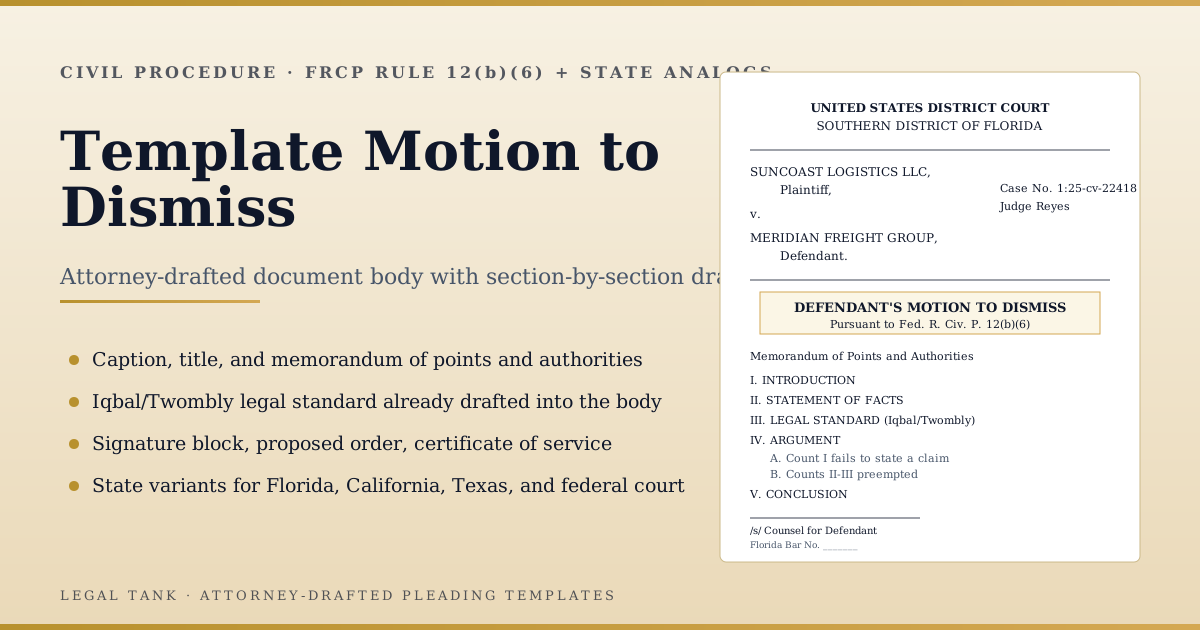
Federal · CA · TX · FL · NY
Copy, adapt, file
Template Motion to Dismiss (Federal Rule 12(b)(6))
The full template motion to dismiss is below in attorney-grade form. The example caption uses a Southern District of Florida federal case; the body works in any federal district with the caption and bar-number fields adjusted. State-court versions of the same motion to dismiss template swap the rule citation (CCP 430.10 demurrer for California, Texas Rule 91a, Florida Rule 1.140(b), New York CPLR 3211, or Illinois 735 ILCS 5/2-615) and the legal-standard paragraph; the remaining sections stay identical.
                  UNITED STATES DISTRICT COURT
                  SOUTHERN DISTRICT OF FLORIDA


[PLAINTIFF FULL LEGAL NAME],         )
                                     )
              Plaintiff,              )    Case No. [Case Number]
                                     )
v.                                   )    Judge [Last Name]
                                     )
[DEFENDANT FULL LEGAL NAME],         )
                                     )
              Defendant.              )
_____________________________________)


    DEFENDANT'S MOTION TO DISMISS PURSUANT TO FED. R. CIV. P. 12(b)(6)


    Defendant [Defendant Full Legal Name] ("Defendant"), by and
through undersigned counsel, respectfully moves this Court to
dismiss the Complaint filed by Plaintiff [Plaintiff Full Legal
Name] ("Plaintiff") in its entirety pursuant to Federal Rule of
Civil Procedure 12(b)(6) for failure to state a claim upon
which relief can be granted. In support of this motion,
Defendant submits the following Memorandum of Points and
Authorities.


             MEMORANDUM OF POINTS AND AUTHORITIES


I.   INTRODUCTION

     [Two to four sentences identifying the core defect. Lead
     with the strongest argument. Example: "Plaintiff's
     breach-of-contract claim fails because the Complaint does
     not plead the existence of a written agreement, an
     essential element of the cause of action under [State]
     law. Counts II and III rely on the same missing element
     and fail for the same reason."]


II.  STATEMENT OF FACTS

     [Recite the well-pleaded facts from the Complaint, in the
     light most favorable to Plaintiff. The motion accepts
     these facts as true for purposes of the motion only. Do
     NOT raise affirmative defenses or extrinsic facts here;
     those belong in a Rule 56 motion for summary judgment.
     Each fact gets a paragraph number that the Argument
     section references back to.]


III. LEGAL STANDARD

     To survive a Rule 12(b)(6) motion, a complaint must
     contain "sufficient factual matter, accepted as true, to
     state a claim to relief that is plausible on its face."
     Ashcroft v. Iqbal, 556 U.S. 662, 678 (2009) (quoting Bell
     Atl. Corp. v. Twombly, 550 U.S. 544, 570 (2007)).
     Threadbare recitals of the elements of a cause of action,
     supported by mere conclusory statements, do not suffice.
     Iqbal, 556 U.S. at 678. The Court must accept all
     well-pleaded factual allegations as true but is not bound
     to accept as true a legal conclusion couched as a factual
     allegation. Id.


IV.  ARGUMENT

     A.   Count I (Breach of Contract) Fails to State a Claim.

          [Element-by-element analysis showing the Complaint
          lacks factual content on each required element under
          the controlling state law. Cite the controlling
          circuit-court authority for each element. Quote the
          Complaint paragraphs that fail to satisfy each
          element so the Court can see the gap on the face of
          the pleading.]


     B.   Count II (Unjust Enrichment) Is Duplicative or
          Otherwise Defective.

          [Explain why this count is duplicative of Count I
          (cannot recover both contract and quasi-contract for
          the same conduct under [State] law) or otherwise
          legally defective.]


     C.   Count III Is Barred by [Statute of Limitations,
          Preemption, Lack of Standing, or Other Doctrine].

          [Each independent ground gets its own subsection. If
          asserting statute of limitations, the bar must appear
          on the face of the Complaint; otherwise the defense
          belongs in an answer.]


V.   CONCLUSION

     For the foregoing reasons, Defendant respectfully requests
that this Court dismiss the Complaint in its entirety, with
prejudice, and grant such other and further relief as the Court
deems just and proper. A proposed order is attached as
Exhibit A.


Dated: ____________, 20____.


                          Respectfully submitted,


                          _______________________________________
                          [Attorney Name], Esq.
                          [State] Bar No. ______________
                          [Firm Name]
                          [Firm Address]
                          [City, State ZIP]
                          Telephone: (___) ___-____
                          Email: __________________
                          Attorney for Defendant


================================================================
                       CERTIFICATE OF SERVICE
================================================================

    I HEREBY CERTIFY that on this _____ day of ________________,
20____, I electronically filed the foregoing with the Clerk of
the Court using the CM/ECF system, which will send a notice of
electronic filing to all counsel of record listed below:

    [Opposing Counsel Name, Firm, Address, Email]


                          _______________________________________
[Attorney Name], Esq.Template Motions to Dismiss We Draft
The federal Rule 12(b)(6) template above is the default civil-litigation vehicle. The eight variants below are the most-requested adaptations, each with a different caption convention, controlling rule citation, and argument structure. The motion to dismiss form for protective orders, eviction defense, and criminal cases departs from the federal template enough that we maintain a separate scaffold for each.
Rule 12(b)(6) Motion to Dismiss
Federal-court motion for failure to state a claim, attacking element-by-element plausibility under Twombly and Iqbal. The default civil-litigation vehicle.
12(b)(1) Subject-Matter Jurisdiction
Motion attacking the court's power to hear the case (federal-question or diversity jurisdiction failure, sovereign immunity, exhaustion). Cannot be waived.
Motion to Dismiss Protection Order
Respondent's motion to dismiss a petition for a protective order on lack of statutory grounds, insufficient evidence, or expired temporary relief.
Motion to Dismiss Protective Order (Texas Form)
Texas Family Code Chapter 85 dismissal motion attacking a protective order petition. Pairs with the Texas Rule 91a baseless-cause-of-action vehicle.
Motion to Dismiss Eviction
Tenant motion attacking a forcible entry and unlawful detainer petition for defective notice, premature filing, retaliation, or habitability defense.
Motion to Dismiss Divorce Petition
Respondent motion attacking a dissolution petition for lack of residency, improper venue, or pending prior action in another state.
Motion to Dismiss Criminal Case
Defense motion under state criminal rules (Florida Rule 3.190(c)(4), New York CPL 210.20) attacking the indictment or information on legal grounds.
Texas Rule 91a Motion (Baseless Cause of Action)
Texas-specific motion to dismiss a cause of action with no basis in law or fact. Operates as the state demurrer analog with mandatory attorney-fee shifting.
Protection Order
A motion to dismiss protection order petition is typically filed in family court or civil court depending on the state. The respondent attacks the petition on lack of statutory grounds (the conduct does not meet the harassment, stalking, or domestic violence definitions in the controlling code), on evidentiary insufficiency at the temporary-relief hearing, or on expiration of the temporary order window. Indiana, Ohio, and Pennsylvania each have distinct procedural rules that govern when the motion can be filed and what evidence is admissible at the dismissal hearing.
Protective Order
A motion to dismiss protective order in Texas family court is governed by Texas Family Code Chapter 85 and pairs with the Texas Rule 91a baseless-cause-of-action vehicle. The dismissal motion must show the petition fails to plead the family-violence or dating-violence statutory elements, or that the parties no longer fall within the statutory relationship categories. Other states label the same relief differently (Texas calls it a protective order, Florida calls it a domestic violence injunction, California calls it a domestic violence restraining order), and the template caption changes accordingly.
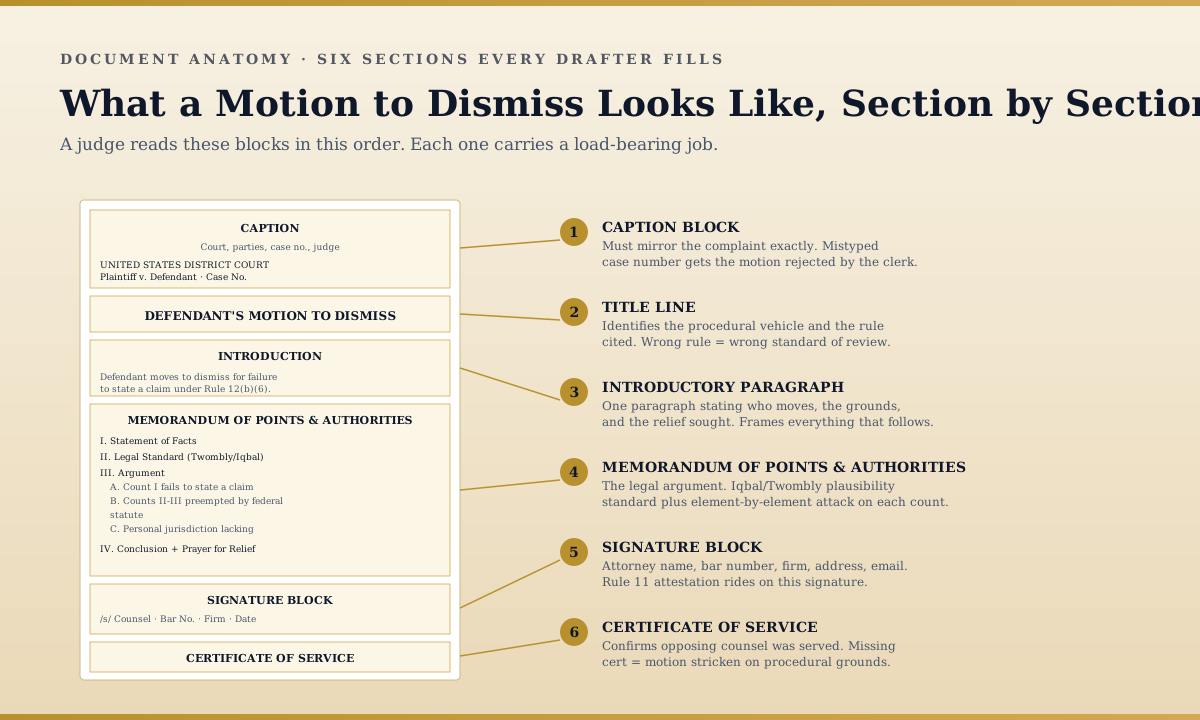
How to Write a Motion to Dismiss a Case Section by Section
Six steps from blank template to a filed motion. Steps two and three are where most homemade motions fail: caption errors that the clerk rejects on intake, and a miscited rule subsection that gives the judge no doctrinal basis to grant relief. The format for motion to dismiss is consistent across federal and state practice; the content of Section III (Legal Standard) is where the jurisdictional swap happens.
Pair this with the procedural walkthrough
The mechanics of filing (e-filing portals, courtesy copies, hearing notice) live in the procedural sibling guide.
Read the procedural walkthrough on how to file a motion to dismiss in civil litigation →- 1
Copy the template into a working document
Copy the Template Motion to Dismiss body below into Word or any text editor. The bracketed fields (case caption, party names, count headings, signature block) are the only spots that need editing.
- 2
Mirror the complaint caption exactly
The motion caption must match the complaint caption character-for-character: court name, party names in the same order, case number, judge assignment. A mistyped case number is a routine ground for the clerk to reject the filing.
- 3
Pick the correct Rule 12(b) subsection
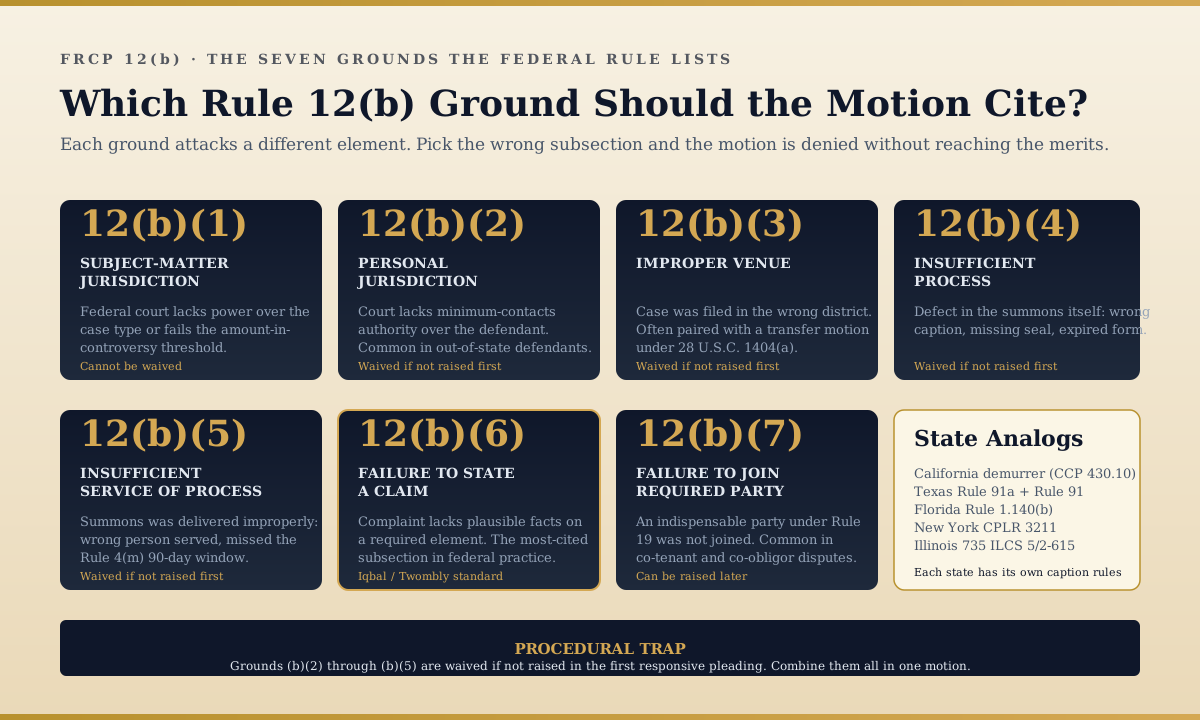
Each subsection from 12(b)(1) through 12(b)(7) attacks a different element. Subsections (b)(2) through (b)(5) are waived if not raised in the first responsive pleading, so combine every available ground into one motion rather than filing separately.
- 4
Have the draft reviewed (recommended for any contested matter)
For cases with fee-shifting statutes, statute-of-limitations defenses, removal posture, or contractual forum-selection clauses, send the draft through /get-quote so the strongest grounds are confirmed before the answer deadline runs.
- 5
File on time and serve opposing counsel
In federal court the motion is generally due within 21 days of service (FRCP 12(a)(1)(A)(i)). State deadlines vary. File via the court e-filing system, serve opposing counsel through the same system or by mail, and dock the certificate of service to the final filing.
- 6
Calendar the opposition and reply windows
Once filed, the plaintiff has the local-rule opposition window (often 14 days in federal court) to respond, and the defendant has a reply window (often 7 days). Some courts schedule oral argument automatically; others rule on the papers alone.
Can You File a Motion to Dismiss Without an Attorney
A pro se defendant has the same right to file under Rule 12(b) as a represented party. The judge reads the motion under the same plausibility standard. The risk is not legal authority; it is procedural execution. The four areas below are where pro se motions most often fail before reaching the merits.
Answer Deadline
FRCP 12(a) sets a 21-day window from service of the summons. State deadlines are tighter in some jurisdictions (20 days in Florida, 30 days in California). A motion filed one day late is denied as untimely and the defendant must file an answer instead. Calendar the deadline the day the summons arrives.
Rule Subsection Selection
Subsections (b)(2) through (b)(5) are waived if not raised in the first responsive pleading. A pro se defendant who files a straight (b)(6) motion and later discovers a personal jurisdiction defect cannot raise it. Combine every available ground in one motion.
Certificate of Service
Every filing requires a certificate of service documenting how opposing counsel was served. Forgetting this attachment is one of the most common reasons a clerk rejects a pro se filing at intake.
Element-by-Element Argument
A motion that says "the case has no merit" without walking through each element of each cause of action is denied. The Argument section must list each element of each count and quote the complaint paragraph that fails to satisfy it.
When attorney drafting pays off
For cases with attorney-fee-shifting statutes (Texas Rule 91a, federal civil-rights claims, FDCPA), statute-of-limitations defenses, removal posture, or forum-selection clauses, the upside of a granted motion (case ended plus fees recovered) makes attorney drafting the higher-value path.
Federal and State Court Rule Variations of the Motion to Dismiss Template
The template above is structured around the federal Rule 12(b)(6) standard. The six state-court variants below cover most filings the drafting team sees. Each note identifies the rule citation, the standard, and the caption-line change that adapts the federal template to the state forum.
Federal Court (FRCP 12)
Federal Rule of Civil Procedure 12(b) lists seven enumerated grounds. The plausibility standard is Twombly and Iqbal. Motions must be filed before the answer is due (Rule 12(a)) and combined under Rule 12(g). Some grounds (subject-matter jurisdiction, failure to state a claim, failure to join a required party) can be raised later; the rest are waived if not raised in the first responsive pleading.
Federal Rule of Civil Procedure 12(b)
California Demurrer (CCP 430.10)
California still uses the historical name demurrer for what other states call a motion to dismiss, governed by Code of Civil Procedure 430.10. A California demurrer template adapts the federal scaffold above by swapping the Section II title to DEMURRER, dropping the Iqbal/Twombly paragraph in favor of the controlling CCP 452 liberal-construction standard, and addressing each ground separately. The grounds parallel FRCP 12(b) but with state-specific labels: lack of jurisdiction, lack of capacity, pending action, defect of parties, failure to state facts. The plaintiff is generally given leave to amend on the first sustained demurrer.
California Code of Civil Procedure 430.10
Texas Rule 91a + Rule 91
Texas Rule of Civil Procedure 91a allows a defendant to move to dismiss any cause of action with no basis in law or fact. The motion must be filed within 60 days of service, and the prevailing party is entitled to attorney fees and costs. Rule 91 handles defects in pleadings via special exception. The Template Motion to Dismiss above can be re-captioned for either vehicle.
Texas Rule of Civil Procedure 91a
Florida Rule 1.140(b)
Florida Rule of Civil Procedure 1.140(b) lists eight grounds for a motion to dismiss, mirroring FRCP 12(b) with two additional state-specific grounds (lack of indispensable parties, pending prior action). A Florida motion to dismiss template uses a Florida circuit-court caption (CIRCUIT COURT OF THE _____ JUDICIAL CIRCUIT) and substitutes the 1.140(b) citation for FRCP 12(b)(6). Florida criminal motions to dismiss are governed by Rule 3.190(c)(4) under a no-disputed-facts standard, and the template adapts to either civil or criminal context with caption and rule citation swaps.
Florida Rule of Civil Procedure 1.140(b)
New York CPLR 3211
New York Civil Practice Law and Rules 3211 lists 13 grounds for a motion to dismiss, the broadest enumerated list in any state. CPLR 3211(a)(7) is the New York analog to FRCP 12(b)(6). Documentary-evidence grounds under CPLR 3211(a)(1) are unique and allow defendants to attach exhibits to attack the complaint, an option not available in federal practice.
New York CPLR 3211
Illinois Section 2-615 + 2-619
Illinois splits the motion to dismiss into two tracks. 735 ILCS 5/2-615 attacks legal sufficiency (the analog to FRCP 12(b)(6)); 735 ILCS 5/2-619 raises affirmative defenses (statute of limitations, res judicata, settlement). Section 2-619.1 allows both grounds in a single combined motion. The Argument section of the template scales to handle both.
735 ILCS 5/2-615 and 735 ILCS 5/2-619
Related Pleading Templates
The motion-to-dismiss template sits alongside three other dispositive and post-judgment pleading templates used in civil practice. Each follows the same six-section anatomy with rule citations swapped to the controlling vehicle.
- Anatomy of a Motion for Default Judgment Template and How Each Section Functions covers the plaintiff-side dispositive motion when a defendant fails to answer.
- Inside a Motion for Reconsideration Template and the Sections Courts Expect to See covers post-ruling motions seeking the court to revisit its order.
- Drafting Service for a Motion for Sanctions Targeting Discovery Abuse and Bad-Faith Conduct is the drafting service for discovery-misconduct motions.
- Drafting Service for a Motion to Amend Pleadings After Discovery Reveals New Claims handles the leave-to-amend motion that often follows a granted motion to dismiss.
Frequently Asked Questions About the Motion to Dismiss Template
Sourced from the People Also Ask box for template motion to dismiss, how to write a motion to dismiss a case, format for motion to dismiss, and motion to dismiss.
Can I file my own motion to dismiss?
How do I write a motion for dismissal?
How to structure a motion to dismiss?
What comes after a motion to dismiss?
Want the Motion to Dismiss Drafted For You
Send the complaint, the answer deadline, and the jurisdiction. The quote request returns the strongest grounds available under the controlling rule, the drafting timeline, and a finalized motion before the answer deadline runs.
Beyond the dismissal motion, the motion drafting bench covers discovery, post-trial, enforcement, and injunction practice as complete packages.