Defendants Asking What Is Motion to Suppress and How It Excludes Unlawfully Obtained Evidence
A motion to suppress is the pretrial filing that asks a trial court to exclude evidence the prosecution intends to use because that evidence was obtained in violation of the Fourth Amendment, the Fifth Amendment, the Sixth Amendment, or a parallel state statutory protection like California Penal Code section 1538.5. The filing identifies the unlawful police conduct, names the constitutional theory, attaches the supporting record, and asks the judge to order that the challenged item, the derivative evidence, or the custodial statement may not be introduced at trial. When the motion succeeds the prosecution's case frequently collapses; when it fails the issue is preserved for appellate review. This guide walks through the doctrine, the hearing mechanics, the drafting build, and the post-hearing path for defendants and pro se litigants alike.
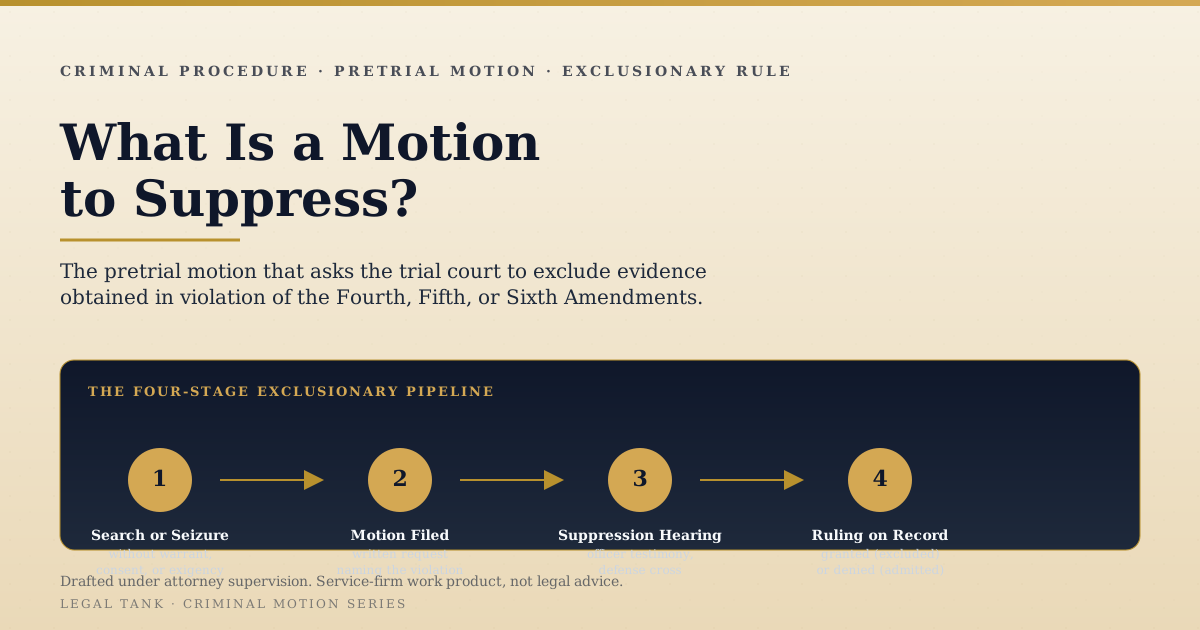
Plain-English Definition: What Is Motion to Suppress Evidence
In plain English, a motion to suppress evidence is a written request that asks the trial court to keep certain evidence out of the prosecution's case at trial because the police obtained it in violation of a constitutional right or a state statutory protection. The motion to suppress definition in most state criminal-procedure treatises tracks the same federal framework: a written request, filed before trial, naming the evidence to be excluded, identifying the recognized ground, and asking for an evidentiary hearing where the trial judge sits as the fact-finder. The motion to suppress meaning in courtroom usage captures the same procedural device whether the filing happens in federal court under Federal Rule of Criminal Procedure 12, in California state court under 1538.5 motion to suppress practice, or in New York state court under CPL 710.20.
What Does a Motion to Suppress Mean for the Prosecution's Case
When a defendant asks what does motion to suppress mean for the trial timeline, the answer turns on whether the suppressed item is essential to the prosecution. If the only physical evidence of a controlled substance is excluded as the product of an unlawful search, the prosecution generally cannot proceed. If a confession is excluded under the Miranda framework but other independent evidence exists, the prosecution may continue on the surviving record. The trial judge's ruling at the suppression hearing therefore frequently functions as the case-deciding moment, even though it happens months before opening statements. Courts sometimes describe this dynamic as the "case-altering ruling" because a granted motion can produce a dismissal on the same day, while a denied motion narrows what the defense can contest at trial.
Where the Motion Fits in the Pretrial Calendar
The motion to suppress is one of the canonical pretrial motions, sitting alongside the motion in limine, the motion to dismiss, and the motion to compel discovery in the standard pretrial sequence. For a broader framing of the pretrial motion family and how the suppression vehicle fits within the trial-record-shaping toolkit, the companion explainer on what a legal motion is and how the catalog frames pretrial vehicles like suppression walks through the procedural sequence in detail. The motion to suppress is procedurally distinctive because it functions as a full evidentiary hearing rather than a paper-only argument.
The Five Recognized Grounds for Suppression
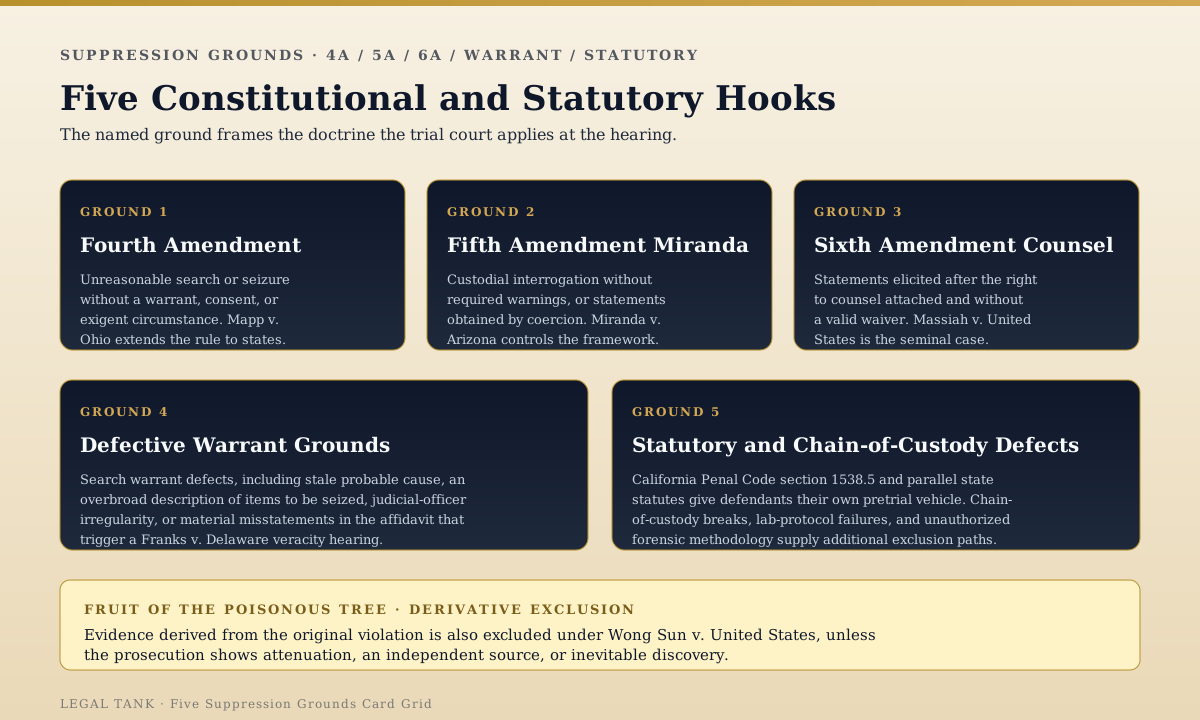
The trial court reaches the merits only after the motion identifies a recognized ground. The four foundational grounds are constitutional (Fourth, Fifth, and Sixth Amendment violations plus defective warrant grounds); the fifth runs through state statutory and chain-of-custody defects. The card grid below summarizes the four constitutional and warrant-based pressure points; the section after the image addresses the fifth, statutory hook.
Fourth Amendment Unreasonable Search or Seizure
The most-cited ground. The search or seizure was conducted without a warrant, the defendant did not consent, and no exigent circumstance justified the bypass. Mapp v. Ohio extends the federal exclusionary rule to state prosecutions, so the same framework runs in every trial court in the country.
Fifth Amendment Miranda Violation
Statements made during custodial interrogation without proper Miranda warnings, or statements obtained by coercion, threats, or psychological pressure that overrides voluntariness under the totality of the circumstances. The Miranda framework controls the analysis.
Sixth Amendment Right to Counsel Breach
Statements elicited after the right to counsel has attached (typically at the first formal proceeding) and without a valid waiver. Massiah v. United States is the seminal case; the framework runs separately from the Fifth Amendment Miranda track and reaches statements that would survive Miranda scrutiny.
Defective Warrant Grounds
Stale probable cause, an overbroad description of items to be seized, judicial-officer irregularity, or material misstatements or omissions in the affidavit that trigger a Franks v. Delaware veracity hearing. A facially valid warrant is presumptively reasonable; defects move the analysis back into warrantless-search territory.
The Fifth Ground: Statutory and Chain-of-Custody Defects
Beyond the four constitutional and warrant-based grounds, every state recognizes its own statutory exclusion vehicle. California Penal Code section 1538.5 (the canonical 1538.5 motion to suppress) supplies the procedural mechanism for raising Fourth Amendment challenges in California state prosecutions and has its own pretrial timing rules. New York CPL 710 provides the parallel state vehicle in New York. Illinois Code of Criminal Procedure 725 ILCS 5/114-12 supplies the Illinois analog. State statutory vehicles often supply additional grounds beyond the federal floor, such as chain-of-custody defects in forensic-evidence cases, lab-protocol failures in blood-alcohol testing, or unauthorized forensic methodology in handwriting and fingerprint analysis.
Working Samples from Recent Dockets and the Motion to Suppress Evidence Template Structure
A working motion to suppress evidence template has seven structural components that appear in nearly every filed motion regardless of jurisdiction. The caption identifies the court, the case number, and the parties. The introduction names the evidence to be suppressed and the constitutional or statutory ground. The statement of facts walks the court through the police conduct in chronological order, anchored to specific exhibits (body-camera timestamps, dispatch logs, warrant affidavits). The legal argument applies controlling precedent to the facts. The proposed order tells the court what relief is requested in plain language. The certificate of service confirms the prosecution received the motion. And the exhibit list catalogs the supporting record.
Sample 1: Prolonged Traffic Stop and the Resulting K-9 Sniff
A defendant is stopped for an alleged equipment violation. The officer issues a citation in eight minutes, but instead of releasing the driver waits an additional fourteen minutes for a K-9 unit to arrive. The dog alerts, the officer searches the vehicle, and a controlled substance is recovered. The motion to suppress argues that the extension of the stop beyond the time reasonably required to issue the citation violated Rodriguez v. United States, and the evidence recovered during the unconstitutional extension must be excluded. The supporting exhibits are the body-camera footage with the eight-minute citation-completion timestamp, the dispatch log confirming the K-9 unit was not summoned until after the citation was issued, and the officer's report.
Sample 2: Custodial Interrogation After Invocation of Counsel
A defendant in custody at a station-house unambiguously invokes the right to counsel during a recorded interview. Two hours later, a second detective reinitiates questioning and obtains an incriminating statement. The motion to suppress argues that Edwards v. Arizona barred reinitiation of interrogation in the absence of counsel and without an affirmative request by the defendant to reopen the interview. The supporting exhibits are the audio recording of the first invocation, the booking record showing continuous custody, and the transcript of the second interview.
Sample 3: Warrant Affidavit With Material Omissions
A search warrant is issued for the defendant's residence based on a confidential informant's tip. The motion to suppress argues that the affidavit omitted material facts about the informant's credibility (a prior demonstrated falsehood, an unresolved pending charge offering a motive to fabricate) that, if disclosed, would have defeated probable cause. The motion requests a Franks v. Delaware veracity hearing. The supporting exhibits are the warrant affidavit, the omitted impeachment material obtained through discovery, and a declaration from the defense investigator. The motion to suppress evidence template for this scenario specifically invokes the affiant's duty of candor and asks the court to set the matter for a separate evidentiary hearing before reaching the suppression question.
Why the Exclusionary Rule Drives Every Filed Motion to Suppress Evidence
The exclusionary rule is the judicially-created remedy that gives constitutional protections their teeth in everyday criminal adjudication. Without exclusion, the Fourth, Fifth, and Sixth Amendments would protect rights on paper while leaving the prosecution free to use unlawfully obtained evidence at trial. The Supreme Court has framed exclusion as a deterrent: police forces are far less likely to conduct warrantless rummaging through a citizen's home, to ignore a Miranda invocation, or to question a represented defendant when the predictable consequence is that the evidence cannot reach the jury. Every filed motion to suppress evidence implements that deterrence framework on the facts of a single case.
The exclusionary rule reaches further than the immediate item seized. Under Wong Sun v. United States, 371 U.S. 471 (1963), evidence derived from the original violation (the fruit of the poisonous tree) is also excluded, unless the prosecution proves attenuation, an independent source, or inevitable discovery. A confession that follows an unlawful arrest, a witness identified through unlawfully obtained information, and a search that was the downstream product of an earlier illegality are all candidates for derivative exclusion. This derivative reach is one of the most consequential features of modern suppression practice.
The Movant Carries the Initial Burden
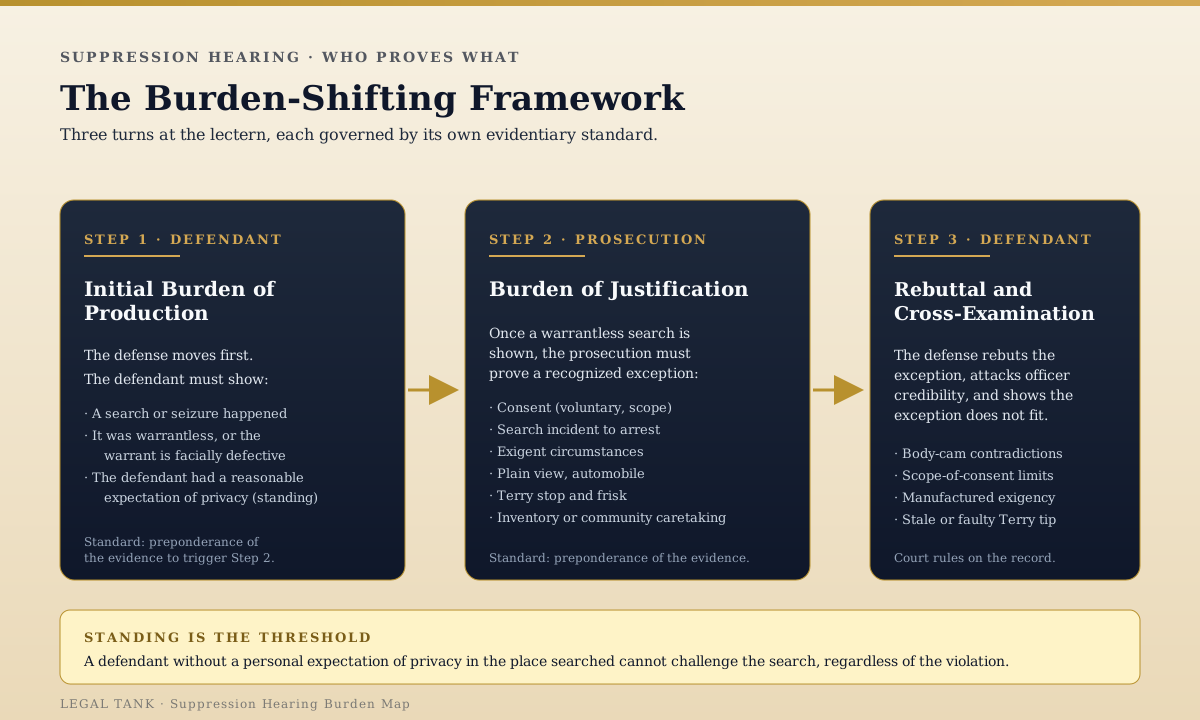
The defendant is the movant at the suppression hearing. The defense files first, opens the hearing, and bears the motion to suppress burden of proof at the production stage: showing a search or seizure happened, showing it was warrantless or the warrant is facially defective, and showing the defendant had a reasonable expectation of privacy in the place searched (standing). Standing is the threshold that disqualifies many otherwise-meritorious motions. A passenger in a borrowed vehicle, a guest in a non-leased residence, or a co-occupant of a common area may not have standing to challenge the search even when the police conduct was unconstitutional.
The Opposing Party Then Carries the Burden of Justification
Once the defendant has carried the initial burden, the burden shifts to the opposing party (the prosecution) to prove by a preponderance of the evidence that a recognized exception to the warrant requirement applies. The recognized exceptions are: consent (voluntary, scope-limited), search incident to a lawful arrest, exigent circumstances (hot pursuit, destruction of evidence, emergency aid), the plain-view doctrine, the automobile exception, Terry stop-and-frisk for officer safety, inventory searches following lawful impoundment, and the community-caretaking doctrine.
Rebuttal, Cross-Examination, and the Court's Ruling
The defense then has a final opportunity to rebut the asserted exception. The most effective rebuttals attack the documentary record: body-camera footage that contradicts the officer's narrative on consent, dispatch transcripts that undercut the asserted Terry-stop tip, manufactured-exigency timelines that show officers created the emergency they then relied on. The trial judge sits as the fact-finder, weighs the testimony and the documentary record, and rules on the record at the close of the hearing or in a written decision issued shortly after. When the ruling denies suppression, the issue is preserved for direct appeal under the applicable state rule.
How to File a Motion to Suppress: A Step-by-Step Build for What Is a Motion to Suppress in Practice
The drafting build for a motion to suppress has seven steps. The order matters: each step depends on the documentary record assembled in the prior step. Skipping ahead (drafting before fixing the constitutional theory, or fixing the theory before checking standing) produces motions that look complete on paper but fail at threshold review.
Step 1: Pull the Discovery and Identify the Constitutional Hook
Get the complete discovery file: arrest report, body-camera and dash-camera footage, dispatch transcripts, search-warrant affidavit and return, lab reports, witness statements, and any 911 audio. Read the discovery in chronological order and identify the moment police conduct crossed a constitutional line. The hook frames the entire motion, so the identification has to be specific (not just "the search was unconstitutional," but "the K-9 sniff occurred fourteen minutes after the citation was issued, in violation of Rodriguez v. United States").
Step 2: Confirm Standing and Frame the Threshold Showing
Confirm the defendant has a personal expectation of privacy in the place searched. A passenger challenging a vehicle search faces a standing problem that a driver does not. A guest in a third party's residence faces a standing problem that a co-leaseholder does not. The motion must establish standing on its face, with citation to controlling Supreme Court and state-court authority, because a court that finds no standing never reaches the merits.
Step 3: Build the Statement of Facts From the Documentary Record
The statement of facts is the most persuasive section of any suppression motion. Walk the court through the police conduct in chronological order, anchored to specific timestamps from the body-camera footage, specific page numbers from the police report, and specific entries in the dispatch log. The factual narrative should let the judge see the unlawful conduct unfold without having to consult the exhibits independently. Every factual assertion needs a citation to the underlying exhibit, indexed by tab number, page, and timestamp where applicable.
Step 4: Draft the Legal Argument Around Controlling Precedent
Apply controlling precedent to the facts already established. The argument should be organized around the elements of the doctrinal test the constitutional theory implicates: for a Rodriguez claim, the duration of the stop and whether the extension was justified by independent reasonable suspicion; for a Miranda claim, custody, interrogation, and the adequacy of the warnings; for a Franks claim, the specific affidavit statements and the specific omitted facts. Cite federal precedent first, then the controlling state authority, then any state intermediate-appellate cases that have applied the doctrine on closely analogous facts.
Step 5: Prepare the Proposed Order and Memorandum of Law
Attach a proposed order that names the specific evidence to be suppressed in plain language a judge can sign as drafted. A memorandum of law accompanies the motion when local rules require it (most federal courts and many state courts), running through the constitutional argument in fuller doctrinal depth. The memorandum is also where derivative-exclusion arguments under Wong Sun typically appear, mapping the original violation to each item of evidence that flowed from it.
Step 6: Serve the Prosecution and File the Certificate
Serve the complete motion package on the prosecutor of record, attach a certificate of service signed under penalty of perjury, and file with the court clerk within the local pretrial motion deadline. Most jurisdictions require the motion to be filed a fixed number of days before the scheduled trial date (often thirty to sixty days), and late filings are denied as untimely absent a showing of good cause. The procedural mechanics across motion practice are framed in the companion explainer on what a motion in court is and how a written request moves a case forward through the docket.
Step 7: Prepare for the Hearing and the Post-Denial Path
The hearing is where most suppression motions are won or lost. The defense must be ready to cross-examine the officer on the documentary record, to introduce body-camera footage with the relevant timestamps cued, and to argue the controlling precedent from the lectern. If the ruling denies suppression, the defense preserves the issue for direct appeal under the controlling state rule, and may also file a motion for reconsideration when intervening authority or a newly-disclosed fact warrants it. The drafting template for that follow-on filing is set out in the explainer on inside a motion for reconsideration template and the sections courts expect to see. If the ruling instead grants suppression and the prosecution can still proceed on the surviving record, the case moves toward trial with a narrowed evidentiary picture. The procedural framework for attacking a final judgment after conviction is set out separately in the service-firm guide on drafting a motion to vacate judgment after the criminal trial record closes. The doctrinal underpinnings of the federal exclusionary rule sit in the body of constitutional criminal procedure rather than the Federal Rules of Civil Procedure, though state pretrial motion practice frequently borrows the written-motion architecture set out in the civil rules under FRCP Rule 7.