Written and legally reviewed by our editorial team
DRAFTING SERVICE
Drafting Service for a Motion to Amend Pleadings After Discovery Reveals New Claims
A motion to amend pleadings is the written request a civil litigant files when the operative complaint, answer, counterclaim, judgment, or court order needs to change after the document is already on the docket. The drafted motion identifies the rule that controls (FRCP 15 for pleadings, FRCP 59(e) for an alter-or-amend within twenty-eight days, FRCP 60(b) for extraordinary relief, or the controlling state family code for a decree), explains why justice requires the change, and asks the court to enter a tailored order on the amendment.
Civil litigation counsel at Legal Tank prepare the full filing package for the engaging firm to sign and file. We draft to FRCP 15(a)(2) in federal court, plus FRCP 59(e), FRCP 60(b), and the family code provisions in California, Texas, Florida, and New York. Legal Tank does not appear in court and does not sign the filed motion.
3-5
Business day turnaround
28d
Rule 59(e) window
15
Federal anchor rule
4
Procedural vehicles
WHEN YOU NEED ONE
Four Triggers That Send Counsel to a Motion to Amend
The instrument is reserved for situations where the original document is already on the docket and the case has moved past the point where the filing reflects reality. The trigger determines the rule, the clock, and the standard. Each of the four common triggers below maps to a different procedural vehicle.
Discovery Reveals a New Claim
Deposition testimony, interrogatory answers, or produced documents surface a violation the original complaint did not plead. The amended pleading must arise out of the same conduct to relate back under FRCP 15(c).
Misnamed or Substituted Defendant
The right corporate entity, individual officer, or affiliated company was not named in the original. Rule 15(c)(1)(C) relation back applies if the substituted party had notice within the Rule 4(m) service window.
Judgment Contains Manifest Error
The court misapplied a controlling authority or rested on a record fact that the docket contradicts. Rule 59(e) opens a twenty-eight day window to ask the trial court to alter or amend a judgment before appeal.
Decree or Order Needs Post-Judgment Change
A divorce decree, custody order, or support order is no longer workable after a substantial change in circumstances. State family code provisions authorize the post-judgment motion to amend a court order.
FOUR VEHICLES
Motions to Amend Pleadings We Draft, From a Motion to Amend the Complaint to a Post-Judgment Court Order Change
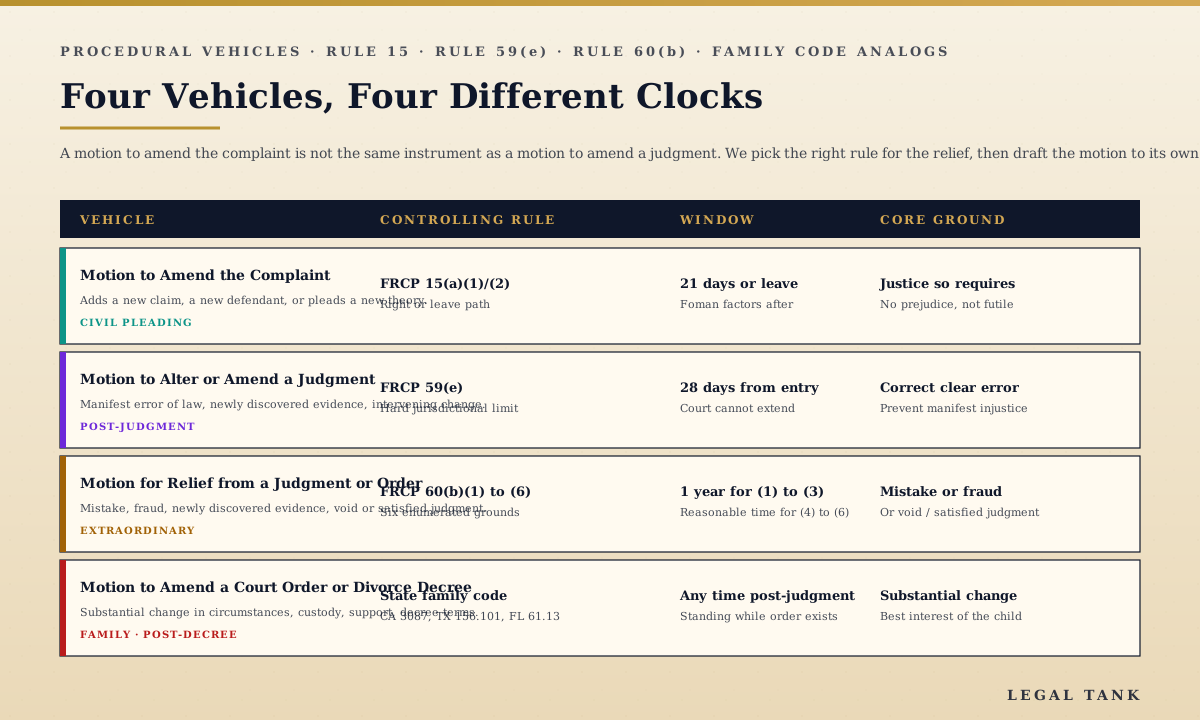
The instrument that controls the relief depends on what is being amended. A motion to amend the complaint runs on FRCP 15. A motion to alter or amend a judgment runs on FRCP 59(e). A motion for relief from a judgment runs on FRCP 60(b). A motion to amend a divorce decree or family court order runs on the state family code. The drafted motion is matched to one of these four vehicles at intake.
Vehicle 01
Motion to Amend the Complaint
Adds a new claim, a new defendant, or a new theory to the operative pleading. Drafted with a redlined proposed amended complaint, the Foman v. Davis factor brief, and the Rule 15(c) relation-back analysis where limitations are at issue.
Vehicle 02
Motion to Alter or Amend a Judgment
Asks the trial court to alter or amend a judgment for manifest legal error, newly discovered evidence, intervening change in controlling law, or to prevent manifest injustice. Drafted on the FRCP 59(e) clock.
Vehicle 03
Motion for Relief From a Judgment or Order
Extraordinary relief from a final judgment on grounds enumerated in Rule 60(b)(1) through (6). Used for mistake, fraud, newly discovered evidence, a void judgment, or a satisfied judgment. Drafted with the specific subsection grounded in the record.
Vehicle 04
Motion to Amend a Court Order or Divorce Decree
Family-court motion to modify support, custody, parenting time, or decree property terms. Drafted on the controlling state code (California Family Code section 3087 and 4326, Texas Family Code section 156.101, Florida Statute 61.13, New York Domestic Relations Law section 236).
Divorce Decree
A motion to amend divorce decree terms runs outside the federal civil rules entirely. The motion to amend divorce support, spousal maintenance, or property allocation sits inside the family court that entered the original decree. California Family Code section 3087 authorizes a custody modification on a showing of changed circumstances. Family Code section 4326 authorizes a spousal-support modification on a retirement or material change in earning capacity. Texas Family Code section 156.101 requires a material and substantial change in circumstances of the child or a conservator. Florida Statute 61.13(3) governs decree modifications on a substantial-change showing. The drafted package addresses the controlling statute, the changed-circumstances narrative, and the proposed amended decree.
Court Order
A motion to amend court order terms applies to a broader set of post-judgment instruments: custody orders outside a divorce decree, supervised-visitation orders, paternity orders, child support administrative orders, and state-equivalent injunctions. The motion to amend court instructions runs on the same substantial-change showing the divorce decree path uses, but the controlling statute may be different. The drafted motion names the controlling provision, attaches the operative court order, and explains the substantial change with documentary support. For federal post-judgment orders the analog is Rule 60(b), with the (5) prong (the judgment has been satisfied, released, or discharged) or (6) catch-all prong as the framework.
For an example of a parallel federal vehicle that disposes of a case on the pleadings rather than amending them, attorney-drafted motion for judgement on pleadings for civil litigants seeking early resolution runs on Rule 12(c) and is the next instrument when the amended pleading itself establishes a right to judgment on its face. Counsel asking how to retain attorney-drafted pleadings for filing a motion in court in civil and family matters use that engagement when the amendment is part of a broader filing package.
PURPOSE OF THE INSTRUMENT
Why a Motion to Amend a Judgment Is a Different Instrument From a Motion to Amend the Pleading
The phrase "motion to amend" covers two procedural worlds. One world is pre-judgment, where the goal is to update the pleading so the case proceeds on what is actually in dispute. The other world is post-judgment, where the goal is to change the adjudicated outcome itself before the appellate clock matters. The purpose of each motion drives the rule, the standard, and the deadline.
PRE-JUDGMENT PURPOSE
Update the Operative Pleading
Before a judgment is entered the operative pleading still drives discovery, the scheduling order, and the eventual trial. The purpose of a Rule 15 amendment is to align the pleading with the case as discovery reveals it. New facts surface in depositions. New defendants emerge from produced documents. A successor-liability theory becomes viable after a corporate-records request returns. The amendment moves the pleading from where it was to where the evidence is. Without the amendment the trial proof drifts away from the pleadings, and the court limits the proof to what was pleaded.
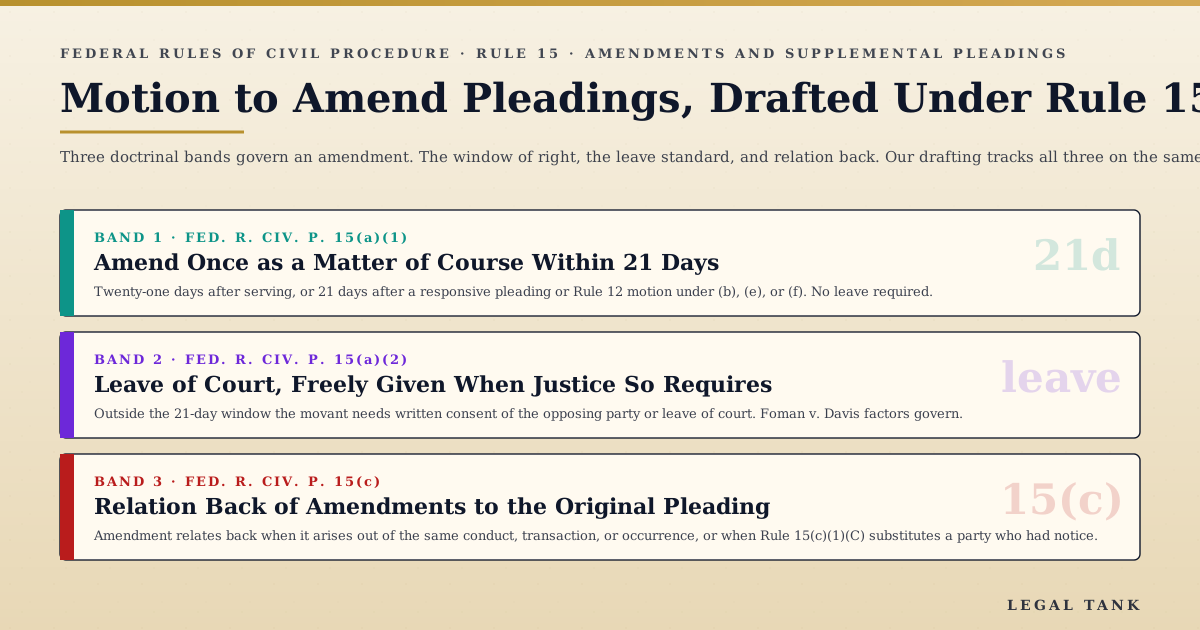
Rule 15 makes amendment easy by design. Inside the twenty-one day right-of-course window no leave is required. Outside it, leave shall be freely given when justice so requires. The drafted motion uses that default but addresses the Foman factors so the court does not search for a reason to deny.
POST-JUDGMENT PURPOSE
Change the Adjudicated Outcome
After the court enters judgment the purpose shifts entirely. The pleading no longer matters; the entered judgment does. A motion to amend a judgment under Rule 59(e) asks the trial court to correct a manifest legal error inside a twenty-eight day jurisdictional window. The relief is alteration of the judgment, not amendment of the complaint. The supporting memorandum identifies the manifest error, the newly discovered evidence, the intervening change in controlling law, or the manifest injustice. The court reviewing a Rule 59(e) motion to amend a judgment is the same judge who entered the judgment.
Rule 60(b) opens a wider relief lane on extraordinary grounds. Mistake, newly discovered evidence, fraud, a void judgment, a satisfied or discharged judgment, or any other reason that justifies relief. The one-year limit applies only to (1), (2), and (3). The Rule 60(b)(4) void-judgment ground and the Rule 60(b)(6) catch-all run on a reasonable time, which courts measure case by case.
Picking the Right Post-Judgment Vehicle
The same record can support more than one vehicle. A manifest legal error filed inside twenty-eight days runs best on Rule 59(e). The same error filed outside that window runs on Rule 60(b)(1) on a mistake theory, with the one-year outer limit. A void judgment is always Rule 60(b)(4) regardless of the date. The drafted one-page intake memo identifies the right vehicle before the brief is written so the motion is not denied on the wrong rule.
When the post-judgment motion fails and the engaging firm needs to reset before the appellate clock, the motion for reconsideration template and the sections courts expect to see walks through the in-court reset. Counsel asking what defines the plaintiff's request and what is a motion for default judgment in civil litigation use that explainer when the amendment work follows a default- judgment entry, where Rule 60(b) is the natural next vehicle.
HOW THE COURT REVIEWS
How the Court Reviews a Motion to Amend Judgement and the Foman Factors That Decide Leave
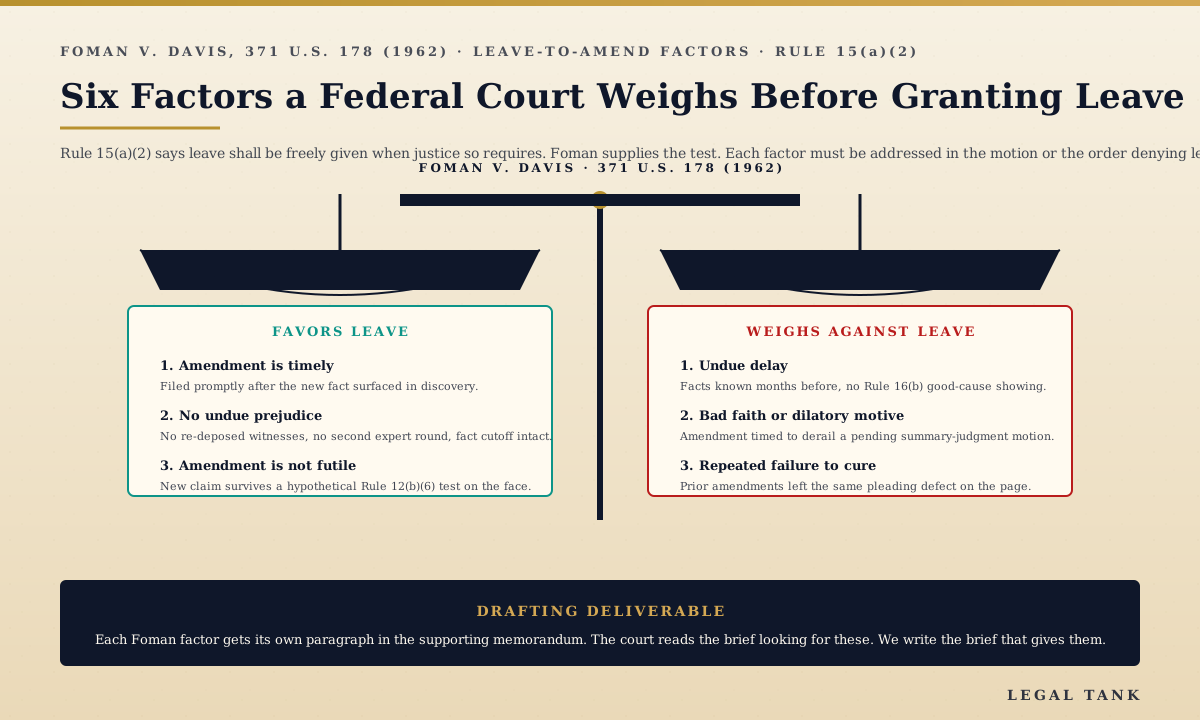
Once the motion is on file, the court runs a known analysis. For pre-judgment Rule 15 amendments the analysis is the Foman v. Davis six-factor test. For a motion to amend judgement under Rule 59(e) the analysis is the manifest-error standard. For Rule 60(b) it is the subsection-specific ground. The British spelling (to amend judgement) appears in older U.S. cases and in Commonwealth-influenced practice; the standard is the same. We draft the brief to whichever standard the court will apply.
WEIGHS AGAINST LEAVE
Undue Delay
The court asks whether the movant knew the underlying facts months ago. Late amendments after the Rule 16(b) scheduling order has closed require a good-cause showing on top of the Rule 15 standard.
WEIGHS AGAINST LEAVE
Bad Faith or Dilatory Motive
Amendments timed to derail a pending summary judgment, to inject a defendant after the discovery cutoff, or to manufacture diversity destruction draw skepticism. The drafted brief explains the timing.
WEIGHS AGAINST LEAVE
Repeated Failure to Cure
If the court has already granted leave once or twice and the same pleading defect persists, the fourth amendment is the one that gets denied. We do not file successive amendments without diagnosing the prior defect.
WEIGHS AGAINST LEAVE
Undue Prejudice to Opposing Party
Re-deposed witnesses, re-opened expert reports, or a continued trial date raise prejudice. The brief addresses prejudice head-on with the proposed discovery cure: a defined re-deposition window or a narrow expert refresh.
WEIGHS AGAINST LEAVE
Futility of Amendment
The court may deny leave when the proposed amended pleading would not survive a hypothetical Rule 12(b)(6) motion. The drafted brief plead-checks the new count against the elements before filing.
FAVORS LEAVE
Justice So Requires (Default Toward Leave)
Rule 15(a)(2) commands that leave shall be freely given when justice so requires. The default in federal civil practice tilts toward granting leave. The five factors above are the recognized exceptions that overcome the tilt.
Five-Step Drafting Pipeline From Intake to Sign-Ready Package
Step 01
Intake of the Record
You upload the operative complaint, the scheduling order, the discovery record fragments that surfaced the new claim or fact, the judgment or order to be amended, and the opposing party's prior correspondence. The drafting attorney reads the posture before any prose is committed.
Step 02
Attorney Picks the Right Rule and Vehicle
A civil litigation attorney maps the relief to FRCP 15, FRCP 59(e), FRCP 60(b), or the controlling state family code. The vehicle pick is documented in a one-page memo confirming the deadline, the standard, and the local-rule filing format.
Step 03
Draft the Full Amendment Package
The drafting attorney prepares the motion, the memorandum of law organized to the Foman factors or the rule-specific standard, the redlined proposed amended pleading, the meet-and-confer certification, the proposed order, and the notice of hearing keyed to chambers.
Step 04
Your Review and One Revision Pass
You read the draft and send comments. The drafting attorney incorporates your edits in a single revision pass within the engagement scope. Additional revisions or a new theory beyond the redline are scoped separately before further work begins.
Step 05
Sign-Ready Package Delivered to the Engaging Firm
You receive the final PDF and editable Word package, plus a one-page filing checklist matching the controlling local civil rule. Your retained trial counsel signs, files, serves, and appears at the noticed hearing. Legal Tank does not appear in court.
Counsel preparing a Rule 56 motion after the amended pleading clears discovery use building a motion for summary judgment template that tracks Rule 56 requirements as the next instrument in the file. For amendments that follow a default-judgment posture, anatomy of a motion for default judgment template and how each section functions walks through the upstream filing that often precedes the Rule 60(b) amend-the-judgment instrument.
DRAFTED PACKAGE
Six Documents the Drafting Pool Delivers in Every Engagement
The motion does not file alone. Every amendment engagement delivers six documents organized to the local civil rule of the court where the motion will be filed. Engaging trial counsel receives the complete package, reviews, signs, and files.
Motion to Amend or Motion to Alter or Amend
Caption, identification of the document to be amended, rule invoked under FRCP 15, 59(e), 60(b), or state family code, prayer for the relief requested, and signature block formatted to the local rule of the issuing court.
Memorandum of Law in Support
Merits brief organized by Foman factor for Rule 15(a)(2) motions, by manifest-error theory for Rule 59(e), by subsection-(1)-through-(6) ground for Rule 60(b), or by substantial-change-in-circumstances showing for the family code path.
Proposed Amended Pleading (Redlined Exhibit)
Clean and redlined copies of the proposed amended complaint, answer, or counterclaim. Local civil rules typically require both versions as exhibits to the motion so the court sees exactly what changes.
Meet-and-Confer Certification
Sworn declaration narrating the conferral letter, the live discussion, the response of opposing counsel, and the impasse or stipulation that produced the motion. Required under most local civil rules before a leave motion is filed.
Proposed Order Granting Leave to Amend
Signature-ready order that grants the rule-specific relief: leave under Rule 15, alteration under Rule 59(e), relief under Rule 60(b), or modification under the state family code, with the operative amended document deemed filed on entry.
Notice of Hearing and Certificate of Service
Notice keyed to the chambers calendar, the certificate of service for the motion package, and any local-rule cover sheet. Service on the opposing party is mandatory before the court will reach the merits.
ENGAGEMENT
Turnaround and Engagement Process for the Amendment Drafting Pool
Engagement starts with a custom quote at intake, sized to the scope of the amendment and the controlling deadline. The four tracks below describe how the work moves from upload to delivery. No standardized fee table is published on this page; quotes are confirmed per matter via the custom quote request.
Standard Track
Three to Five Business Day Turnaround
Used when the deadline is at least two weeks out. Includes intake, attorney review of the discovery record or judgment docket, full drafting of the motion package, one revision pass, and delivery of the sign-ready PDF and editable Word files.
Rush Track
Forty-Eight to Seventy-Two Hour Turnaround
Reserved for Rule 59(e) twenty-eight day windows that close inside a week and emergency leave motions tied to a scheduling-order deadline. Drafting moves to the front of the queue. Scope and timeline confirmed at intake.
Scope of Drafting
Single Motion Package or Companion Filings
Standard scope is one motion to amend plus the supporting memorandum, proposed amended pleading exhibit, meet-and-confer certification, proposed order, and notice of hearing. Companion filings (related joint case management report) are scoped separately at intake.
Signature and Filing
Engaging Trial Counsel Signs and Files
Legal Tank delivers the sign-ready package. The engaging firm reviews, signs the moving papers under its own letterhead, files through the court's electronic filing system, serves the opposing party, and argues the motion at the noticed hearing.
When the post-amendment posture calls for parallel sanctions practice, drafting service for a motion for sanctions targeting discovery abuse and bad-faith conduct runs on the same drafting pool. Counsel asking how the legal-motion umbrella catalogs amendment vehicles alongside other pretrial filings use that umbrella to frame the amendment as a pretrial filing in the larger civil-procedure context, and attorney-drafted cross-motion for summary judgment briefs and Rule 56 opposition filings is the next vehicle when the amended pleading triggers a dispositive motion exchange.
WHY LEGAL TANK
Four Reasons Counsel Send Amend-Pleading Work to This Drafting Pool
Drafted by Federal Civil Counsel
Every motion to amend is read, framed, and drafted by a bar-admitted civil litigation attorney with federal-court motion practice. The brief addresses each Foman factor by name rather than asking the court to grant leave on conclusory grounds.
Built for the Rule 59(e) Clock
The twenty-eight day FRCP 59(e) window does not extend. Our intake confirms the deadline on day one, schedules the drafting to the actual entry date of the judgment, and delivers the package with margin for the engaging firm to review and file.
Drafting Only, No Court Appearance
We deliver a sign-ready package. We do not file, serve, or argue at the hearing. Your retained trial counsel signs the papers under the engaging firm's letterhead and represents the moving party at the noticed hearing under Rule 5.3 supervision.
Vehicle Picked at Intake
The first deliverable is a one-page memo confirming which rule controls (15(a), 59(e), 60(b), or state family code), the deadline that governs, and the local-rule filing format. The brief is drafted to the picked vehicle, not to a generic amend template.
REPRESENTATIVE DRAFTS
Four Anonymized Engagements From the Amendment Drafting Pool
S.D. Tex. Motion to Amend the Complaint After Deposition
POSTURE
Plaintiff in a commercial-fraud action deposed the defendant's chief operating officer and uncovered a separate side-arrangement with a third-party affiliate that supported an unjust-enrichment count not pleaded in the original.
RULE INVOKED
FRCP 15(a)(2) leave standard plus FRCP 15(c)(1)(B) relation back, with the redlined proposed amended complaint and a Foman factor brief.
OUTCOME
Court granted leave to amend, plaintiff filed the amended complaint adding the unjust-enrichment count and the affiliate as a defendant, the affiliate appeared and the case proceeded on the amended pleading.
N.D. Cal. Motion to Alter or Amend a Judgment
POSTURE
District court entered summary judgment for the defendant on a state-law unfair-competition count, applying a federal preemption theory the Ninth Circuit had rejected in an opinion published the prior week.
RULE INVOKED
FRCP 59(e) motion to alter or amend a judgment, filed within the twenty-eight day window on an intervening-change-in-controlling-law theory.
OUTCOME
Court granted the Rule 59(e) motion, vacated the preemption ruling, and reinstated the state-law count. Case continued on the merits without an appeal record on the preemption question.
S.D.N.Y. Motion for Relief From a Default Judgment
POSTURE
Defendant in a commercial-collection action discovered a default judgment had been entered after a process server filed a defective affidavit. The defendant moved to vacate on a Rule 60(b)(4) void-judgment theory.
RULE INVOKED
FRCP 60(b)(4) motion for relief from a void judgment, paired with a Rule 60(b)(1) excusable-neglect argument in the alternative.
OUTCOME
Court granted the Rule 60(b)(4) motion, vacated the default, and reopened the action. Defendant appeared, answered, and the case proceeded to merits discovery.
Travis County Motion to Amend a Divorce Decree
POSTURE
Movant sought a modification of the parenting plan and child support obligations under the divorce decree after a job relocation triggered a substantial change in circumstances under Texas Family Code section 156.101.
RULE INVOKED
Texas Family Code section 156.101 motion to modify a parenting plan, with the supporting affidavit, proposed amended parenting plan, and updated income statement.
OUTCOME
Court entered the amended decree on a stipulated basis after mediation. New parenting schedule and revised support amount took effect on the order's signature date.
DRAFTING COUNSEL
Four Attorneys on the Amendment Drafting Bench
Every motion is drafted by a bar-admitted civil litigation attorney whose practice anchors one corner of the amendment world: federal Rule 15 leave practice, Rule 59(e) and Rule 60(b) post-judgment work, state-court pleading amendments, and family-decree modifications.
Daniel Whitaker, Esq.
Federal Commercial Litigation Counsel
Senior federal-civil drafting attorney with ten years in the Southern District of Texas and the District of Colorado. Drafts FRCP 15(a)(2) motions to amend the complaint after deposition discovery surfaces a new theory, FRCP 59(e) motions to alter or amend a judgment within the twenty-eight day window, and FRCP 60(b) motions for relief from judgment on the (1) mistake and (4) void-judgment grounds. Anchors the amendment-side practice on the federal commercial drafting pool.
NOTABLE MATTERS
- FRCP 15(a)(2) motion to amend the complaint adding an unjust-enrichment count after a chief-operating-officer deposition (S.D. Tex.)
- FRCP 59(e) motion to alter or amend a judgment on an intervening-change-in-controlling-law theory
- FRCP 60(b)(4) motion to vacate a default judgment on a defective-service theory
Marcus Holloway, Esq.
Senior Litigation Attorney
Twelve years in the Southern District of New York and the District of New Jersey. Drafts FRCP 15(a)(2) motions to amend the complaint with an emphasis on late-stage leave motions filed after the Rule 16(b) scheduling-order deadline, where the good-cause showing and the Foman analysis run in parallel. Also drafts FRCP 15(c) relation-back motions on John Doe defendant substitutions in personal-injury and securities matters.
NOTABLE MATTERS
- Late-stage FRCP 15(a)(2) leave motion after the Rule 16(b) deadline in a securities matter (S.D.N.Y.)
- FRCP 15(c)(1)(C) relation-back motion substituting a properly named corporate defendant
- Diversity-preserving amendment opposition in a removal posture
Alexandra Chen-Park, Esq.
Civil and Family Litigation Counsel
Fifteen years of state-court motion practice across California, New York, and Illinois. Drafts state-court motions to amend pleadings under CCP section 473, CPLR 3025, and Illinois Code of Civil Procedure section 2-616, plus motions to amend a divorce decree under California Family Code section 3087 and 4326 and New York Domestic Relations Law section 236. Anchors the state-court amendment side and the family-decree-modification side of the drafting pool.
NOTABLE MATTERS
- Los Angeles Superior Court CCP 473 amendment motion after deposition discovery
- Family Code section 3087 motion to amend a custody court order on a job relocation
- CPLR 3025 motion to amend the complaint adding a successor-liability theory
Nathan Brookfield, Esq.
Federal Civil Procedure Counsel
Eleven years in the District of Massachusetts and on federal commercial dockets in the First Circuit. Drafts FRCP 60(b) motions for relief from judgment on the (1) excusable neglect, (3) fraud, (4) void judgment, and (6) catch-all grounds. Pairs Rule 60(b) practice with statutory definitions work for consumer and contractor matters in the First Circuit district courts.
NOTABLE MATTERS
- FRCP 60(b)(1) motion to vacate a default judgment on a misservice theory (D. Mass.)
- FRCP 60(b)(3) motion to amend a judgment on a fraud-on-the-court theory
- FRCP 60(b)(4) motion to vacate a void judgment in a consumer action
CLIENT FEEDBACK
What Engaging Firms Have Said About the Amendment Package
"Deposition uncovered a side-arrangement we never knew existed. The drafted Rule 15(a)(2) motion plus the redlined proposed amended complaint cleared the Foman analysis on the face of the brief. Court granted leave and the affiliate appeared."
Hector V.
Verified client
FRCP 15(a)(2) Motion to Amend the Complaint
"Our twenty-eight day Rule 59(e) window was closing in nine days and the intervening Ninth Circuit opinion was directly on point. The drafted motion landed the manifest-error theory cleanly. Court vacated the preemption ruling and reinstated the state-law count."
Priya R.
Verified client
FRCP 59(e) Motion to Alter or Amend a Judgment
"The default judgment was entered on a defective-service affidavit. The drafted Rule 60(b)(4) motion landed the void-judgment ground and the Rule 60(b)(1) excusable-neglect ground in the alternative. Court vacated the default and reopened the case."
Daniel T.
New York · Verified client
FRCP 60(b)(4) Relief From a Void Judgment
FREQUENTLY ASKED
What Counsel Ask Before Engaging the Amendment Drafting Pool
The questions below come straight from the People Also Ask results returned for motion to amend pleadings and motion to amend the complaint. The answers are framed around the four amendment vehicles we draft: Rule 15 pleading amendments, Rule 59(e) alter-or-amend, Rule 60(b) relief, and the state family code path.
What is the purpose of a motion to amend?
What is the Rule 59 motion to amend?
How do you amend a pleading?
What does motion to amend a complaint mean?
What does motion to amend mean in court?
What is a motion to amend used for?
ADJACENT MOTIONS
Other Motions Our Drafting Counsel Prepare on the Same Pipeline
When the amendment is part of a broader filing sequence, our drafting pool handles the adjacent instruments without an attorney-handoff. Each adjacent motion link below opens the dedicated service or template page.
Motion for Judgement on the Pleadings
When the amended pleading establishes the moving party's right to judgment on the face of the record, the Rule 12(c) motion converts the amendment into an early resolution vehicle.
Motion for Sanctions
When discovery abuse delayed the amendment or surfaced the new claim only through obstructive conduct, the Rule 37 or Rule 11 sanctions motion runs alongside the leave motion.
Motion to Reconsider (Federal Court)
If the trial court denied leave to amend on a clear factual misreading, the federal reconsideration motion is the inside-the-court route before the alter-or-amend or interlocutory appeal track.
Authority anchor: Federal Rule of Civil Procedure 15 (Cornell LII) for the leave-to-amend standard and the relation-back rule. Local civil rules in the district where the motion is filed add the meet-and-confer certification requirement and any chambers-specific formatting for the proposed amended pleading.
Discovery Just Revealed a New Claim? Send Us the Record.
Send the operative pleading, the discovery record fragment that surfaced the new claim, and the scheduling order. Our drafting counsel picks the right rule (Rule 15, Rule 59(e), Rule 60(b), or the state family code), confirms the deadline, and prepares the verified motion package for the engaging firm to sign and file.
Legal Tank prepares the filing-ready papers. Your retained trial counsel signs the motion, files, serves, and appears at the noticed hearing under Rule 5.3 supervision. Legal Tank does not appear in court.