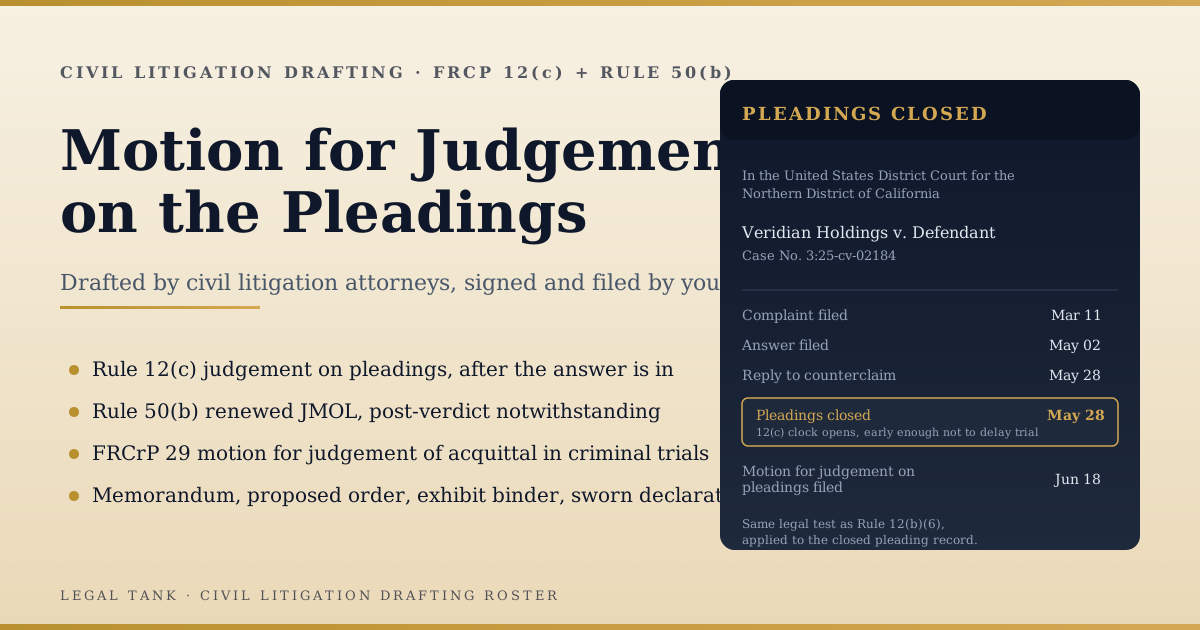
When the Closed Record Decides the Case
Four buyer scenarios account for most of the motions our drafting attorneys prepare. The common thread is a litigation posture where the closed pleading record, the trial evidence on the verdict, or the prosecution's case-in-chief is legally sufficient on its face to enter judgement for the moving party without further proceedings.
The Answer Concedes the Defect on the Face of the Complaint
The complaint fails to plead a required element, attaches a contract whose plain terms defeat the claim, or relies on a theory the opposing party has already conceded in the answer. The closed pleading record is enough to decide the case, and there is no point taking discovery to confirm what the papers already say.
The Answer Asserts No Viable Defense to a Valid Claim
Plaintiff-side Rule 12(c). The complaint pleads a clean prima facie case, and the answer asserts only conclusory denials, immaterial defenses, or admissions that close the proof gap. Rather than pay for discovery, the plaintiff moves for judgement on the pleadings and asks the court to enter judgement on the closed record.
Post-Verdict, the Jury Reached a Result No Reasonable Jury Could Reach
A jury returned a verdict that the evidentiary record cannot support. Within 28 days of entry of judgement on the verdict, FRCP 50(b) allows a renewed motion for judgement as a matter of law, the modern federal vehicle for what older practitioners still call a motion for judgement notwithstanding the verdict.
Criminal Trial, the Prosecution's Evidence Is Legally Insufficient
After the close of the government's case or within 14 days of a guilty verdict, a criminal defendant may move under FRCrP 29 for a judgement of acquittal. The motion asks the trial court to decide that no rational trier of fact could have found the essential elements proven beyond a reasonable doubt on the evidence presented.
If the closed record is not yet enough and discovery is still open, the right vehicle is usually a Rule 56 summary-judgement motion, not a Rule 12(c). Our summary judgement template suits matters where depositions or expert affidavits are needed to reach the standard. We will tell you which vehicle fits before drafting begins.
Motions for Judgement on Pleadings We Draft
Three different rules sit under the same drafting roster, each calibrated to a different stage of the case. The motion for judgment on pleadings under Rule 12(c) targets the closed pleading record; the motion for judgement notwithstanding the verdict, now formalized as a Rule 50(b) renewed JMOL, targets the trial record; and the criminal-trial counterpart, the motion for judgement of acquittal under FRCrP 29, targets the sufficiency of the prosecution evidence.
Motion for Judgement on the Pleadings
The bread-and-butter vehicle. Either party may move after the answer is in. The court takes the non-movant's well-pleaded factual allegations as true and asks whether the moving party is entitled to judgement as a matter of law. Documents referenced and central to the claims are part of the record by incorporation.
After pleadings close, before trial delay
StandardSame legal test as Rule 12(b)(6), applied to the closed pleading record
Renewed Motion for Judgement as a Matter of Law (JNOV)
The modern federal vehicle for what practitioners formerly called a motion for judgement notwithstanding the verdict. The motion preserves the Rule 50(a) record made before submission, asks the court to set aside the verdict, and seeks judgement for the moving party on the trial record.
Within 28 days of entry of judgement on the verdict
StandardNo reasonable jury could have found for the non-movant on the evidence at trial
Motion for Judgement of Acquittal
Criminal-trial counterpart, viewing the evidence in the light most favorable to the prosecution and asking whether any rational trier of fact could have found the essential elements proven beyond a reasonable doubt. Available pre-verdict at the close of the prosecution case, and post-verdict on a renewed motion within 14 days.
After government rests, or within 14 days of guilty verdict
StandardEvidence insufficient to sustain a conviction beyond a reasonable doubt
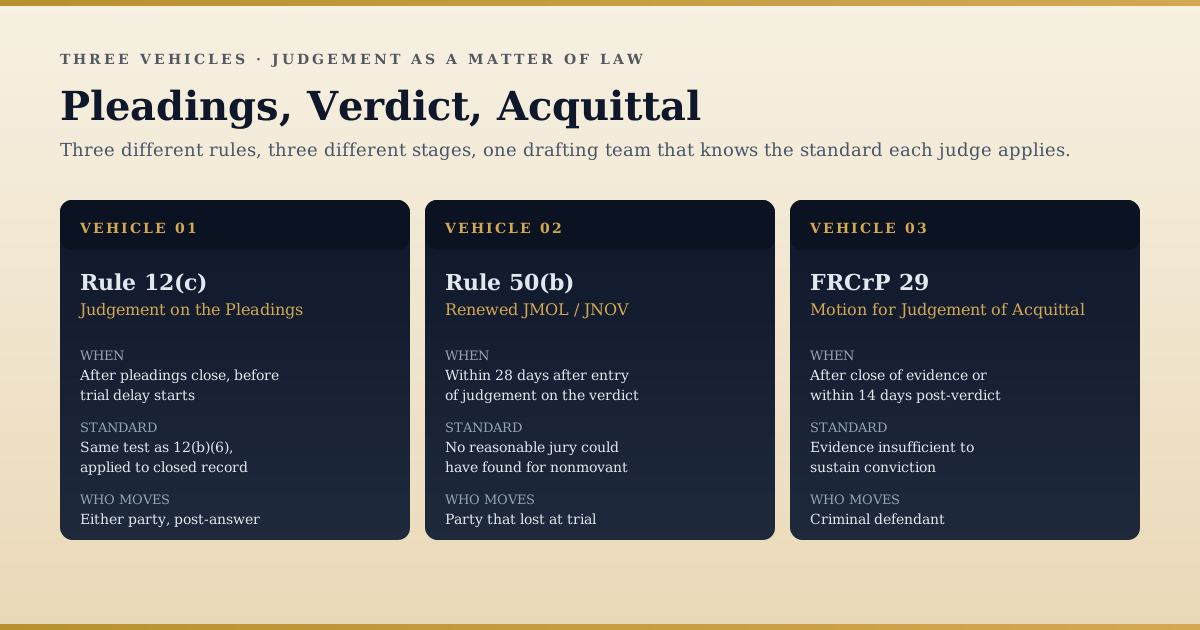
Buyers most often commission the Rule 12(c) vehicle. The renewed JMOL and FRCrP 29 acquittal motions are drafted on rush when the post-verdict windows are days out. If you need to confirm the right vehicle before commissioning, the amend-pleadings drafting service is often the better intermediate step where the operative pleading needs to be revised first.
What Lands in Your Inbox
The deliverable is a complete, sign-ready filing package. Every component below is drafted, formatted to the local rule of the court hearing the motion, and delivered in PDF and editable Word so the engaging firm can sign and file without rework.
Notice of Motion and the Motion Itself
Caption, parties, hearing-date placeholder, and the operative request for relief, formatted to the local rule of the trial court hearing the matter.
Memorandum of Law in Support
The merits brief, organized around the controlling standard (Rule 12(c) plausibility, Rule 50(b) reasonable-jury, or FRCrP 29 sufficiency), with circuit-specific case law for the court hearing the motion.
Pleading-by-Pleading Cross-Reference Appendix
Tabbed cite map showing exactly which paragraph of the complaint, answer, counterclaim, or reply supports each ground in the motion. Federal judges read this first.
Supporting Declaration
Sworn declaration from counsel or party attesting to the closed pleading record, authenticating the integrated documents the court may consider without converting to summary judgement.
Proposed Order Granting the Motion
Signature-ready order entering judgement on the pleadings, dismissing the claims with or without prejudice as the record supports, and reserving any fee-shifting issue for a separate motion.
Filing Checklist for the Engaging Firm
One-page checklist matching local rule, page limits, font size, hearing notice, service requirement, and chambers copy obligations. The engaging firm files and serves; we draft.
The package is structured so a granted motion ends or substantially reshapes the case on a single order. The proposed order enters judgement on the pleadings, dismisses the relevant counts with prejudice where the record supports it, and reserves any fee-shifting issue for a separate motion. Your retained trial counsel files, serves, and argues; we draft.
How the Court Reads a Motion for Judgement
A federal trial court hearing a Rule 12(c) motion for judgment on pleadings applies the same legal test it would apply on a Rule 12(b)(6) motion to dismiss: it accepts the well-pleaded factual allegations of the non-moving party as true, draws all reasonable inferences in that party's favor, and asks whether the moving party is entitled to judgement as a matter of law on the closed pleading record.
Plausibility, Not Possibility
The non-moving party's allegations must be plausible on their face, not merely consistent with liability. Conclusory legal labels are stripped from the record before the court asks whether the factual content remaining supports a reasonable inference of liability. The drafted memorandum applies this framework count by count.
Factual Grounding Required
Allegations must rest on factual grounding, not threadbare recitals of the elements. Rule 12(c) motions are won where the answer reveals that the only factual content advancing the complaint is conclusory and the rest of the record affirmatively shows the opposite. The brief draws this contrast paragraph by paragraph.
The same framework controls the related motion for judgement of acquittal in criminal trials under FRCrP 29, viewed through the sufficiency lens of Jackson v. Virginia, 443 U.S. 307 (1979), and the renewed JMOL under Rule 50(b), viewed through the no-reasonable-jury standard of Reeves v. Sanderson Plumbing, 530 U.S. 133 (2000). Three rules, one organizing question: does the closed record, on the law, allow only one outcome.
How Our Attorneys Draft Your Pleadings Motion
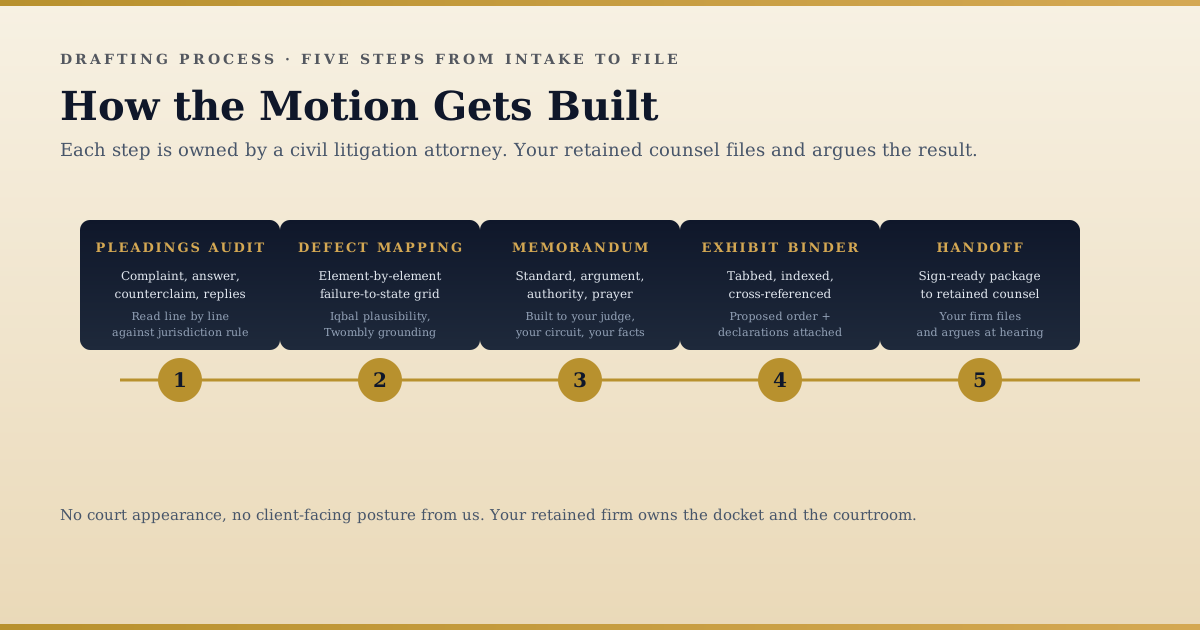
Five steps separate intake from a sign-ready motion package. The drafting attorney audits the closed record first, maps the element-by-element defect grid, and only then commits prose to the memorandum.
Pleadings Audit, Line by Line
Submit the complaint, the answer, any counterclaim, the reply, and any integrated document. The drafting attorney reads the entire closed record before any prose is committed and confirms the pleadings are in fact closed for Rule 12(c) purposes or the verdict has entered for Rule 50(b) purposes.
Defect Mapping, Element by Element
The drafting attorney builds a grid mapping each pleaded element of each claim against the closed record. Iqbal plausibility and Twombly grounding are applied where the motion turns on the complaint. The result is the element-by-element memo that anchors the brief.
Memorandum Drafted to the Court Hearing the Motion
The memorandum is built to your judge, your circuit, and your facts. Circuit-specific authority is preferred over generalist treatise citation, and the standard section quotes the controlling case verbatim with the pinpoint cite.
Exhibit Binder and Proposed Order Prepared
The integrated documents are tabbed, indexed, and cross-referenced against the memorandum. The proposed order is drafted to enter judgement on the pleadings, dismissing the relevant claims or counterclaims with prejudice where the record supports it.
Sign-Ready Package Delivered to the Engaging Firm
You receive the final PDF and editable Word package, plus the filing checklist matching the local rule. Your retained trial counsel signs, files, serves, and argues at the noticed hearing. Legal Tank does not appear in court.
Why Legal Tank for the Pleadings-Motion Drafting
You can write the motion in-house, hire local counsel at billable rates to draft it, or commission Legal Tank for the drafting. The trade-off is straightforward: Legal Tank is faster, ships a complete pleadings-motion package, and never appears in court. Four reasons buyers commission us specifically.
Drafted by a Civil Litigation Attorney, Not a Forms Engine
Every motion is read, framed, and prepared by a bar-admitted civil litigation attorney with Rule 12(c), Rule 50(b), or FRCrP 29 motion practice. The motion picks the strongest single vehicle rather than papering the file with overlapping requests.
The Court's Standard Is Quoted, Not Paraphrased
Iqbal plausibility, Twombly grounding, and circuit-specific Rule 12(c) authority are quoted verbatim with pinpoint cites. The standard section reads as if it were written by a chambers clerk, because the brief is built to make the clerk's job easy.
Drafting Only, No Court Appearance, No Surprises
We deliver a sign-ready package. We do not file, serve, or argue at the hearing. Your retained trial counsel handles the courthouse work, signs the papers, and represents you at the noticed hearing.
Standard Three-to-Five Business Days, Rush Available
Standard turnaround is three to five business days from intake to delivery. Rush is available when a Rule 50(b) 28-day window or a FRCrP 29 14-day window is days out and the engaging firm needs the package now.
Legal Tank vs. DIY vs. Local Counsel for the Pleadings Motion
The three realistic ways to get the motion drafted, side by side.
| Question | Write It Yourself | Hire Local Counsel | Legal Tank |
|---|---|---|---|
| Who drafts it | You and your paralegal, after-hours, working from generic forms | A junior associate at the local firm, billed against the matter | A bar-admitted civil litigation attorney with Rule 12(c) motion practice, ready for your retained counsel to sign and file |
| Turnaround | Whatever your bandwidth allows; deadlines often missed | Two to four weeks, depending on firm workload | Three to five business days standard, rush available for Rule 50(b) and FRCrP 29 windows |
| Standard mapping | Form-driven, plausibility test often confused with summary-judgement standard | Sound on federal Rule 12(c), less reliable on state analogs | Iqbal and Twombly quoted verbatim, circuit-specific authority pinpoint-cited, state-rule analogs framed before drafting begins |
| Pleading cross-reference | Conclusory, no cite-to-pleading appendix | Drafted, depth varies by associate | Tabbed cite map showing exactly which paragraph supports each ground, prepared for the chambers clerk |
| Files and argues | You and your retained counsel | Yes, full representation if you keep them on the matter | No, your retained trial counsel handles the courthouse work |
Buyers come to us when the answer is in, the closed record looks decisive, and the engaging firm needs the motion drafted now without losing two associates to a sixty-hour brief. Submit the pleadings and a drafting attorney returns the framing memo within one business day.
Representative Drafts We Have Produced
Four anonymized vignettes from the drafting roster, each tracking how the procedural posture mapped to a controlling vehicle and what the resulting order produced. Matter details have been altered to preserve client confidentiality; the rule citations and procedural framing reflect the actual filings.
Commercial Defendant Wins on Closed Pleadings in S.D.N.Y.
Posture
Vendor sued for breach of an integrated master services agreement; the answer attached the executed agreement showing the disputed obligation belonged to a non-party affiliate.
Vehicle
FRCP 12(c) motion built on the integrated contract incorporated by reference into the complaint.
Outcome
Court entered judgement on the pleadings dismissing the breach count with prejudice; remaining counts dropped on stipulation within thirty days.
Renewed JMOL Vacated a Federal Patent Verdict
Posture
Jury returned an infringement verdict after a four-day trial; the trial evidence on the doctrine of equivalents was thin and the Rule 50(a) record was preserved.
Vehicle
FRCP 50(b) renewed motion for judgement as a matter of law, filed inside the 28-day window.
Outcome
District court granted the motion, set aside the verdict, and entered judgement of non-infringement. Federal Circuit affirmed.
FRCrP 29 Acquittal Following Insufficient Government Proof
Posture
Federal prosecution on wire-fraud counts where the government's case-in-chief omitted any proof connecting the defendant to the interstate-wire element.
Vehicle
FRCrP 29 motion for judgement of acquittal at the close of the prosecution case, renewed within 14 days of the verdict.
Outcome
Trial court granted the renewed motion; judgement of acquittal entered on the wire-fraud counts and the indictment dismissed.
Plaintiff-Side Rule 12(c) on a Defective Answer
Posture
Commercial promissory-note plaintiff filed a clean complaint; the defendant's answer admitted the underlying signature and consideration and asserted only a non-viable usury defense.
Vehicle
Plaintiff-side FRCP 12(c) motion on the answer's failure to state a viable defense.
Outcome
Court entered judgement on the pleadings for the plaintiff, ordered interest and fees, and closed the case without discovery.
The Civil Litigation Attorneys Drafting Pleadings Motions
Our drafting roster is built around civil litigation practitioners with Rule 12(c), Rule 50(b), and FRCrP 29 motion experience, calibrated for the most common buyer scenarios in federal commercial defense, plaintiff-side pleadings practice, post-verdict JMOL work, and federal criminal trial defense. The drafting attorney prepares the motion and supporting papers; your retained trial counsel signs, files, and argues at the hearing.

Daniel Whitaker, Esq.
Civil Litigation and Federal Practice Counsel
J.D., University of Texas School of Law · 10 years
FRCP 12(c) Judgement on the Pleadings, Federal Commercial Defense, Iqbal/Twombly Framework
Civil litigation attorney with ten years of federal commercial practice in the Southern District of Texas and the District of Colorado. Drafts Rule 12(c) motions for commercial defendants and plaintiffs where the closed pleading record, including any integrated contract or referenced document, decides the case as a matter of law. Reviewer of record on the firm's Rule 12(c) drafting roster.
Notable Drafted Matters
- •FRCP 12(c) motion produced full pleadings-judgement dismissal in a 2025 S.D. Tex. commercial vendor matter

Marcus Holloway, Esq.
Senior Litigation Attorney
J.D., Fordham University School of Law · 12 years
FRCP 50(b) Renewed JMOL, Federal Jury Trial Post-Verdict Practice
Senior civil litigation attorney with twelve years in S.D.N.Y. and D.N.J. federal jury trial practice. Drafts Rule 50(b) renewed motions for judgement as a matter of law for defendants and plaintiffs who preserved the Rule 50(a) record at trial and need the renewed brief inside the 28-day post-verdict window.
Notable Drafted Matters
- •Rule 50(b) renewed JMOL vacated a patent verdict in a 2024 federal jury trial; affirmed on Federal Circuit appeal

Sofia Reyes, Esq.
Federal Criminal Trial Counsel
J.D., Stanford Law School · 10 years
FRCrP 29 Motion for Judgement of Acquittal, Federal Trial-Court Practice
Federal criminal trial attorney with ten years of practice in the C.D. Cal., E.D.N.Y., and D.D.C. district courts. Drafts FRCrP 29 motions for judgement of acquittal at the close of the prosecution case and on the renewed post-verdict track within the 14-day window, with concentration on wire fraud, healthcare fraud, and securities-fraud trial postures where the indictment fails to meet the sufficiency standard.
Notable Drafted Matters
- •FRCrP 29 renewed motion produced judgement of acquittal on the wire-fraud counts in a 2025 C.D. Cal. federal trial

Christopher Davis, Esq.
State-Court Pleadings Practice Counsel
J.D., University of Texas School of Law · 10 years
California CCP 438 Judgment on Pleadings, Florida Rule 1.140(c), Texas State-Court Pleadings
Drafts state-court motions for judgment on the pleadings under CCP 438 in California superior court, Rule 1.140(c) in Florida circuit court, and the parallel Texas pleadings-stage standard. Handles the cases where the closed state-court pleading record settles the matter without resort to summary judgement.
Notable Drafted Matters
- •CCP 438 motion produced full pleadings-judgement dismissal in a 2024 Los Angeles Superior Court commercial matter
What Litigants and Their Counsel Say
“The integrated contract in our case clearly defeated the breach count, but our trial counsel did not want to spend two associates on a Rule 12(c) brief. Their drafting attorney built it in four business days, the chambers clerk's first question at oral argument quoted the brief, and the court entered judgement on the pleadings.”
Augustin M.
New York · Verified client
FRCP 12(c) Judgement on the Pleadings
“Twenty-eight days post-verdict and we needed the renewed JMOL brief drafted in under a week. The drafting attorney pulled the Rule 50(a) record we had preserved, framed the no-reasonable-jury argument on the trial evidence, and the district court vacated the verdict on the papers.”
Priya V.
Verified client
FRCP 50(b) Renewed JMOL
“Federal wire-fraud prosecution where the government's case-in-chief never connected our client to the interstate-wire element. The drafting attorney prepared the FRCrP 29 brief at the close of the prosecution case and the renewed version within the fourteen-day window. The court granted the renewed motion and entered judgement of acquittal.”
Atticus H.
Verified client
FRCrP 29 Renewed Acquittal
Frequently Asked Questions
The six questions buyers ask most before commissioning a motion for judgement on the pleadings, drawn from the live People Also Ask panels for the controlling motion for judgement on pleadings and motion for judgment on pleadings queries.
What is a motion for Judgement on the pleadings 12 C?
What does judgement on the pleadings mean?
What is a motion for judgment on the pleadings in California?
What is a motion for judgment on the pleadings in Florida?
What's the difference between a motion to dismiss and a motion for judgment on the pleadings?
What does judgment on the pleadings mean?
Related Civil Motion Drafting Services
Pleadings motions often run alongside other early-stage and post-judgment filings. Litigants commissioning a Rule 12(c) motion also commission summary-judgement briefs when discovery is needed, amendment motions when the operative pleading must be revised, and vacate motions when an adverse pleadings-judgement needs to be reopened.
Motion to Amend Pleadings Attorney
Rule 15 amendment service when discovery reveals new claims or new parties and the operative pleading needs to be revised before further motion practice.
Motion to Vacate a Judgment Attorney
Post-judgment relief under Rule 60(b) when a Rule 12(c) loss needs to be reopened on mistake, fraud, newly discovered evidence, or void-judgement grounds.
Motion to Compel Discovery Attorney
Mid-case discovery escalation drafted under Rule 37 when a Rule 12(c) loss puts the case into full discovery and the opposing party will not produce.
Commission a Motion for Judgement on Pleadings
A civil litigation attorney drafts the motion, the supporting memorandum, the pleading cross-reference appendix, and the proposed order, calibrated to FRCP 12(c) in federal court or the controlling state-court rule. We draft the filing package; your retained trial counsel signs, files, and argues at the noticed hearing.