Motion to Reopen Immigration Court Cases After a Removal Order or Missed Hearing
A motion to reopen immigration court is the written request that asks the immigration judge (the IJ) or the Board of Immigration Appeals (the BIA) to revisit a final order of removal on the basis of new evidence, changed country conditions, defective notice, exceptional circumstances, or ineffective assistance of prior counsel. The filing window runs ninety days from the date the final administrative order issued, anchored in 8 CFR 1003.23(b)(1) for motions filed with the immigration judge and 8 CFR 1003.2(c)(2) for motions filed with the Board. The architecture is specific: the motion identifies the procedural posture, attaches the new evidentiary record, names the ground recognized by regulation, and asks the adjudicator to vacate the prior order so the underlying claim can be heard again. This guide walks through the filing sequence, the EOIR-versus-BIA forum split, the drafting steps, and the realistic post-denial path.
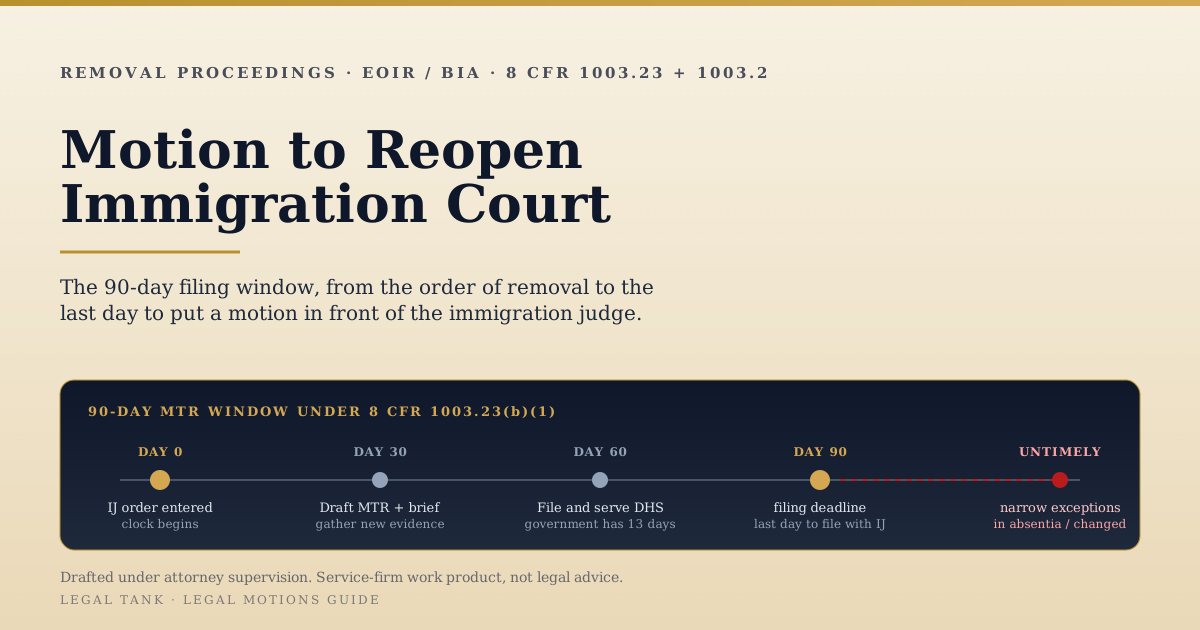
Stages of the Filing and Hearing Sequence, and What Happens If Motion to Reopen Is Denied
The lifecycle of a motion to reopen in removal proceedings has four visible stages and one shadow stage. The visible stages are filing, service on DHS, the government response period, and the adjudicator's ruling. The shadow stage is the parallel stay-of-removal track that runs behind the merits motion because the order of removal remains executable until a stay issues. Respondents who treat the four-stage motion as the whole story sometimes find themselves removed while the favorable ruling is still pending. The stages described below assume an in-country respondent with a final order of removal and an active charging document on the EOIR docket.
For a broader procedural framing of motion practice generally, the companion explainer defining what is a motion in court and how written requests move a case forward covers the bundled-package architecture that all motions share, of which the immigration motion to reopen is a procedurally distinct variant filed before an administrative adjudicator rather than an Article III court.
DHS Has Thirteen Days to Oppose
Once the motion is filed and served on the Department of Homeland Security counsel of record, DHS has thirteen days under 8 CFR 1003.23(b)(1)(iv) to file a written response. DHS may oppose the motion, concede the relief sought, or join in a stipulated motion when the equities favor reopening. Stipulated motions are not bound by the one-motion numerical limit and the agency adjudicates them on a faster track.
IJ or BIA Rules on the Papers
The immigration judge or the Board of Immigration Appeals adjudicates the motion on the written record without a separate hearing in the ordinary course. Live testimony is rare at the reopening stage because the threshold question is whether the new evidence, the changed country conditions, or the procedural defect warrants a fresh merits proceeding, not whether the respondent ultimately prevails on the underlying claim.
If Granted: Back to Master Calendar
An order granting the motion vacates the prior order of removal (in whole or in part), reopens the proceeding on the underlying claim, and returns the matter to the Master Calendar before the immigration judge. The respondent then proceeds with the relief sought (asylum, withholding, cancellation, adjustment, voluntary departure, or other forms) on the rebuilt record.
If Denied: Thirty Days to Appeal or Stay
A denial does not pause removal. The respondent has thirty days to file a notice of appeal with the BIA (when the IJ denied) or a petition for review with the U.S. Circuit Court of Appeals (when the BIA denied). The respondent should pair the appellate filing with a stay-of-removal request because the underlying order remains executable while the appeal is pending.
The Stay-of-Removal Track That Runs Alongside the Motion
Filing a motion to reopen does not, by itself, stop ICE from executing the removal order. The respondent must request a discretionary stay of removal from the immigration judge under 8 CFR 1003.23(b)(1)(v), from the BIA under 8 CFR 1003.2(f), or from DHS on Form I-246. Without a granted stay, the merits motion can be granted on paper while the respondent has already been removed, which destroys most of the available relief. Counsel who file the stay request as a separate document at the same time as the motion to reopen preserve the respondent's physical presence for the duration of the adjudication. The stay petition explains the likelihood of success on the underlying motion, the irreparable harm of removal during pendency, and the public-interest factors that tilt against execution while the merits are open.
Service Requirements That Self-Represented Filers Most Often Miss
Every motion to reopen must be served on the DHS Office of the Chief Counsel that appeared in the original proceeding. The accepted methods of service are personal delivery, certified mail with return receipt, or first-class mail with a proof-of-service certificate signed under penalty of perjury. The proof of service must be filed with the motion itself, not after. EOIR rejects filings without a proof of service at the intake window, and the rejection does not toll the ninety-day clock. Pro se respondents who serve by ordinary email or who skip the proof of service often discover the defect only after the filing window has closed.
Appellate Path After a Denial
A denial of the motion is not the end. The respondent has thirty days to file a notice of appeal with the BIA on Form EOIR-26 (when the immigration judge denied) or a petition for review with the appropriate U.S. Circuit Court of Appeals (when the BIA denied) under 8 USC 1252(b)(1). Petitions for review reach an Article III court for the first time at the circuit-court stage, which is the only judicial review available for most removal-related decisions. A separate doctrinal device, the motion for reconsideration, asks the same body that issued the denial to correct a legal error rather than reopen on new evidence. The standards and timing differ; the procedural framework for that alternative is laid out in the explainer on Rule 59(e) and Rule 60(b) standards for a motion to reconsider in federal court, which is the Article III analog of the immigration-court motion for reconsideration under 8 CFR 1003.23(b)(2).
When the Immigration Judge Hears the Motion: The EOIR Motion to Reopen Posture
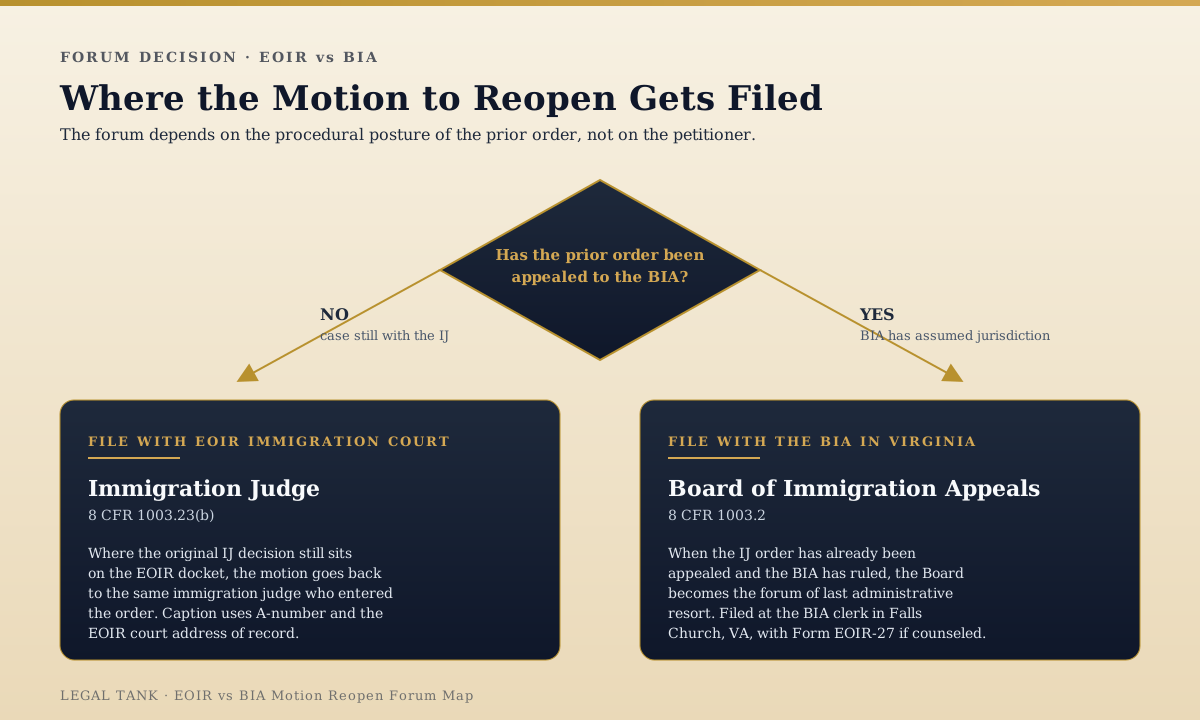
An EOIR motion to reopen is filed with the Executive Office for Immigration Review, the Department of Justice component that runs the immigration courts, when the original order of removal still sits on the immigration-judge docket and has not been appealed to the Board. The motion goes back to the same immigration judge who entered the order, captioned with the respondent's A-number and the EOIR court address of record. The statutory and regulatory anchors are 8 USC 1229a(c)(7) for the underlying right to move to reopen and 8 CFR 1003.23(b) for the procedural mechanics.
Two procedural postures put the case before the IJ rather than the Board. The first is when the prior order has not been appealed at all and the appeal window has closed. The second is when DHS previously moved to dismiss without prejudice and the respondent later seeks to reopen on new grounds. The forum decision is binding: a motion filed with the wrong adjudicator gets dismissed for lack of jurisdiction, and the ninety-day clock continues to run during the misfiled pendency. The diagram below shows the forum split in a single decision diamond.
What the IJ Looks for at Threshold
The immigration judge screens the motion against four threshold requirements before reaching the merits. First, timeliness: was the motion filed within the ninety-day window, or does a statutory exception apply (in absentia rescission, changed country conditions, or sua sponte reopening). Second, the numerical bar: is this the respondent's first motion to reopen, or does a recognized exception allow a successive filing. Third, the evidentiary threshold: does the new evidence appear material and was it unavailable at the original hearing. Fourth, the procedural integrity: was DHS properly served and was the proof of service filed.
Motion Hearings Are Rare at the IJ Stage
The immigration judge typically rules on the written record without an oral-argument hearing. Live testimony at the reopening stage is uncommon because the threshold question is whether the new evidence, the changed country conditions, or the procedural defect warrants a fresh merits proceeding, not whether the underlying claim ultimately prevails. When the IJ grants the motion, the matter returns to the Master Calendar for a substantive hearing on the underlying claim; when the IJ denies, the respondent's appellate window opens.
Sister Pretrial Motions That Travel With the Reopening Motion
A motion to reopen sometimes travels alongside a pretrial motion asking the immigration judge to pretermit removal proceedings on jurisdictional grounds, particularly where the underlying Notice to Appear was defective. The pretermit theory rests on the Supreme Court's decisions in Pereira v. Sessions, 138 S. Ct. 2105 (2018) and Niz-Chavez v. Garland, 141 S. Ct. 1474 (2021), which held that an NTA missing the time and place of the hearing does not trigger the stop-time rule for cancellation of removal and may render the entire proceeding jurisdictionally infirm. Filing a pretermit motion in tandem with a motion to reopen can sometimes resolve the case before the reopening merits are reached.
When the BIA Decides the Motion on Appellate Posture: The BIA Motion to Reopen
A BIA motion to reopen is filed with the Board of Immigration Appeals in Falls Church, Virginia, when the IJ's prior order has already been appealed to the Board and the Board has issued its own decision. At that point, the BIA has assumed jurisdiction over the matter under 8 CFR 1003.2, and the Board, not the immigration judge, is the body that must vacate or modify the order to allow renewed merits proceedings. The mechanics mirror the IJ-level motion (ninety-day window, evidentiary attachments, proof of service, one-motion limit with statutory exceptions), but the adjudicator and the standard of review differ.
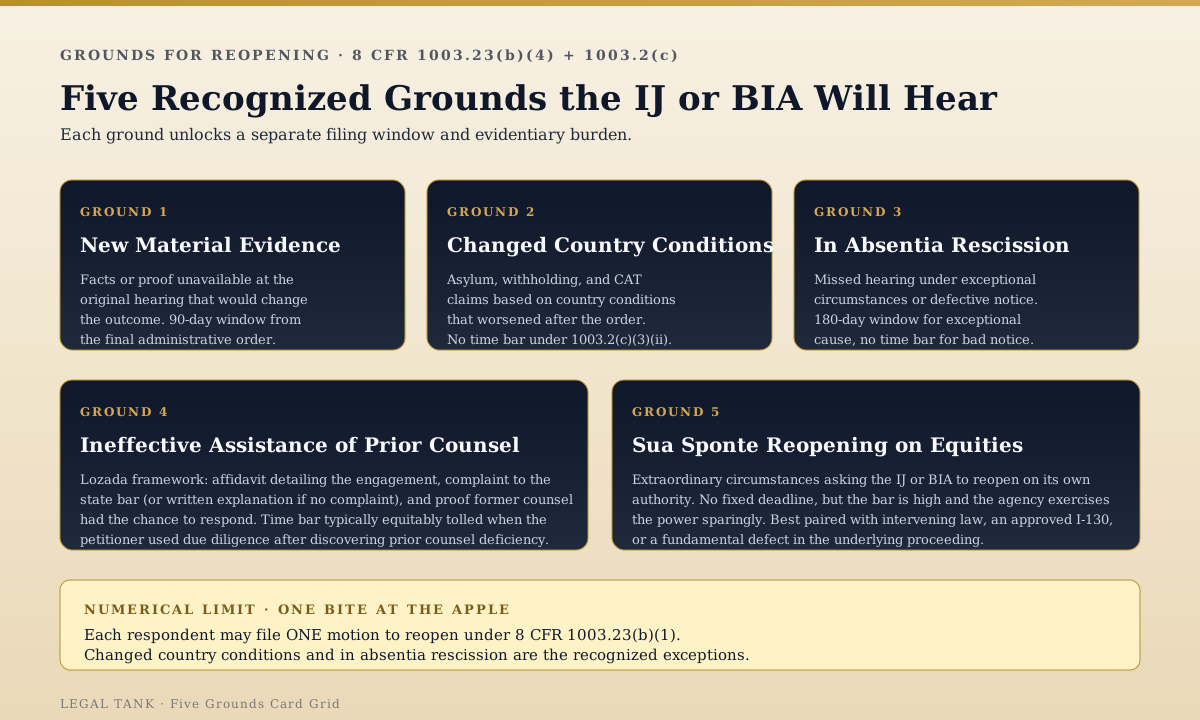
The BIA reviews its own prior decision deferentially. To reopen at the Board, the respondent must show new evidence material to the outcome that was previously unavailable, changed country conditions for asylum-track claims, an in absentia rescission ground, ineffective assistance under the Lozada framework, or extraordinary circumstances supporting sua sponte reopening. The five recognized grounds are laid out in the card grid below, each tied to its regulatory anchor and evidentiary burden.
The Lozada Framework for the Ineffective-Assistance Ground
Of the five recognized grounds, ineffective assistance is the most procedurally demanding. Under the framework first laid out by the BIA in Matter of Lozada, a respondent claiming ineffective assistance of prior counsel must satisfy three corroboration requirements before the Board will reach the prejudice question. The three requirements appear in the checklist below and are typically referenced as the Lozada prongs.
- Sworn Statement Describing Prior Counsel EngagementAffidavit detailing what former counsel was hired to do, what was actually done, the date range of the engagement, and the specific deficient acts or omissions that prejudiced the original proceeding. The affidavit must be specific enough that the IJ or BIA can evaluate prejudice on the face of the filing.
- Bar Complaint or Written ExplanationEither a copy of the disciplinary complaint filed against prior counsel with the state bar in the jurisdiction of admission, or a written explanation of why a bar complaint was not filed. Most circuits accept the written explanation when the petitioner can show a reasonable basis for not pursuing formal discipline.
- Proof Prior Counsel Had Notice and a Chance to RespondDocumentation that the petitioner served prior counsel with the ineffective-assistance allegations and gave former counsel the opportunity to respond. A certified-mail return receipt, an email read-receipt, or a sworn-service affidavit satisfies this prong of the Lozada framework.
Sua Sponte Reopening at the Board
The BIA retains discretionary authority to reopen any case on its own initiative under 8 CFR 1003.2(a) without regard to the ninety-day filing window or the one-motion numerical limit. The standard is high: the petitioner must show extraordinary circumstances, an intervening change in law or fact, or a fundamental procedural defect in the original proceeding. The Board exercises sua sponte authority sparingly. Most successful sua sponte motions pair a precedent decision changing the legal landscape with an approved I-130 or another concrete equity that puts the case in a posture justifying renewed adjudication.
How the BIA Differs from an Article III Appellate Court
The BIA is not an Article III court; it is an administrative adjudicator within the Department of Justice. A motion to reopen at the BIA travels through a single docket-paper process, decided by a single Board member in most cases and a three-member panel on review. The Board does not hold oral argument on reopening motions in the ordinary course, and the record is closed once briefing ends. Article III review becomes available only after a BIA decision, by petition for review under 8 USC 1252 filed with the U.S. Circuit Court of Appeals for the circuit covering the respondent's last EOIR court of record.
How to File a Motion to Reopen Immigration Court, Step by Step: the Motion Reopen Immigration Filing
The drafting build for a motion to reopen immigration removal proceedings has seven discrete steps. The order matters, because each step depends on the documentary record assembled in the prior step. Skipping ahead (drafting the motion before fixing the ground, or fixing the ground before checking the numerical limit) produces filings that look complete on paper but get bounced on threshold review.
Step 1: Confirm the Procedural Posture and Identify the Forum
Pull the EOIR record and identify the last administrative ruling. If the prior order was issued by the immigration judge and the appeal window has closed without an appeal, the IJ remains the forum. If the prior order was appealed to the BIA and the Board issued its own decision, the BIA is the forum. Misfiling at this stage costs ninety days; the ninety-day clock keeps running while the misfiled motion sits at the wrong adjudicator.
Step 2: Pick the Recognized Ground and Anchor the Regulation
Identify which of the five recognized grounds applies (new evidence, changed country conditions, in absentia rescission, ineffective assistance, or sua sponte reopening). Each ground has its own regulatory anchor and its own evidentiary burden. A motion that invokes the wrong ground does not get repaired through subsequent briefing; the Board treats the named ground as dispositive of the framework the adjudicator applies. The recognized regulatory anchors are 8 CFR 1003.23(b)(4) for IJ-level motions and 8 CFR 1003.2(c) for BIA-level motions, with the specific subsection varying by ground.
Step 3: Assemble the New Evidentiary Record
Gather the documentary proof that supports the named ground. Country-conditions motions need updated State Department reports, news articles, expert declarations, and individualized affidavits tying the country-wide developments to the respondent's personal circumstances. New-evidence motions need an explanation of why the evidence was unavailable at the original hearing and a sworn statement from the proposed witness or the records custodian. Ineffective-assistance motions need the Lozada package described above. The record must be tabbed, paginated, and indexed.
Step 4: Draft the Motion, the Brief, and the Proposed Order
The motion is a short procedural document identifying the respondent, the A-number, the prior order, the ground, the relief sought, and the regulatory anchor. The brief in support argues why the ground is satisfied, walks the adjudicator through the new evidentiary record, and addresses the threshold gates (timeliness, numerical limit, materiality). The proposed order vacates the prior order, reopens the proceeding, and returns the matter to the Master Calendar in plain language the adjudicator can sign as drafted. The architecture mirrors a federal-court motion package in form, but the applicable rules are administrative, not the Federal Rules of Civil Procedure that govern civil motion practice under FRCP Rule 7.
Step 5: Pay the Filing Fee or Submit a Fee-Waiver Request
The Department of Justice fee for a motion to reopen at EOIR or the BIA is set by the published EOIR fee schedule. Respondents who cannot afford the filing fee must attach Form EOIR-26A (Fee Waiver Request) with corroborating financial documentation: most recent tax return, current pay stubs, household-income breakdown, and a sworn statement of inability to pay. A waiver granted at filing applies to the underlying motion; a waiver denied requires the fee to be paid before the motion is adjudicated, and the ninety-day clock does not toll during the waiver-review period.
Step 6: Serve DHS and File the Proof of Service
Serve the complete motion package on the DHS Office of the Chief Counsel that appeared in the original proceeding, by personal delivery, certified mail, or first-class mail with a signed proof-of-service certificate. Attach the proof of service to the motion at filing, not after. Filings without proof of service attached are rejected at intake without tolling the filing window. For the parallel civil-court doctrine that reopens a closed matter on grounds analogous to the immigration motion to reopen, the companion explainer on what a motion to vacate is and when courts set aside a judgment describes the Rule 60(b) framework that tracks similar threshold gates in Article III practice.
Step 7: File the Stay-of-Removal Request as a Separate Document
File a discretionary stay-of-removal request alongside the motion to reopen, either with the same adjudicator or with DHS on Form I-246, so the order of removal does not get executed during the adjudication. The stay petition is a separate filing that explains the likelihood of success on the underlying motion, the irreparable harm of removal during pendency, the balance of equities, and the public-interest factors. Practitioners and respondents alike treat the stay request as inseparable from the motion to reopen, because a granted motion is worthless if the respondent has already been removed.