Motion for Change of Venue Form and the Grounds Courts Require to Transfer a Case
Direct Answer
A motion for change of venue form asks the court to move the case from the county or district where it was filed to a different court that is proper or more appropriate under the venue rules. The full document body is below in filing-ready form, with the four California Code of Civil Procedure section 397 grounds scaffold (not the proper court, impartial trial impossible, convenience of witnesses, no qualified judge) and the federal 28 USC section 1404(a) Gulf Oil factor balance. The Texas motion to transfer venue variant swaps the rule citation and tightens the timing trigger.
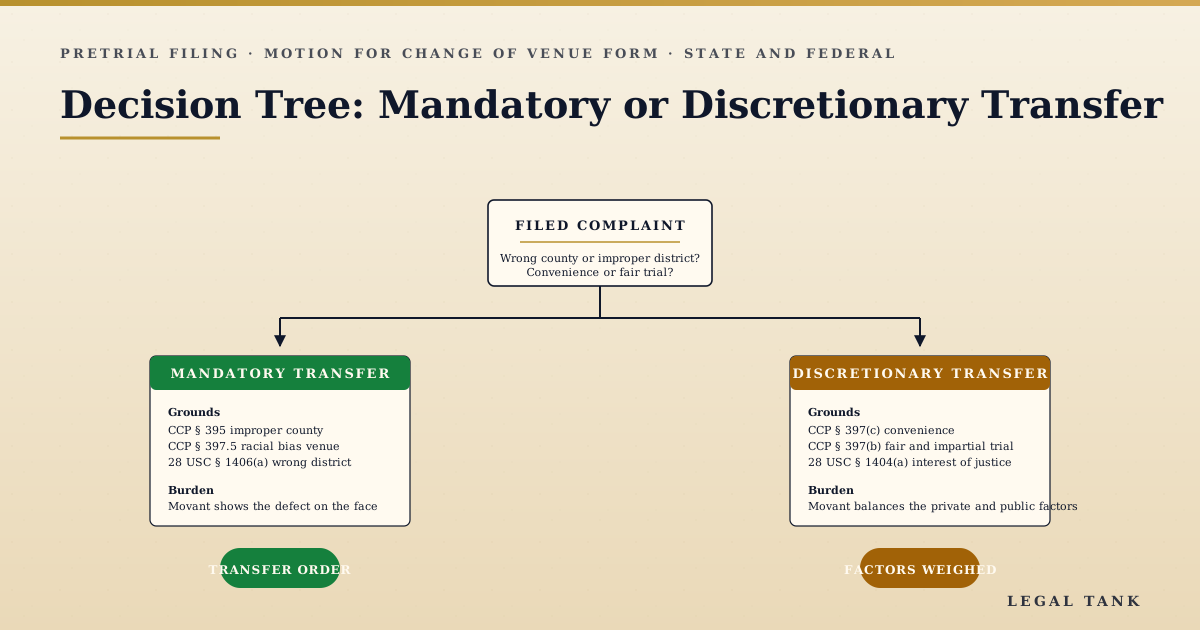
Federal · CA · TX · NY · FL
Ground, transfer, file
California Court Rules That Govern Every Motion for Change of Venue California Family Law Filing
A motion for change of venue california family law filing runs on two interlocking authorities: California Family Code section 2320, which sets the six-month-state and three-month-county residency requirements for a marital dissolution, and California Code of Civil Procedure section 397, which lists the four discretionary grounds a superior court may use to transfer a civil action to another county. A petitioner who satisfies the section 2320 residency requirement in a different county than the filing county will frequently couple a Family Code venue fact with a CCP section 397(c) convenience-of-witnesses showing to move the case to a court closer to the parties, the children, and the supporting witnesses.
For the broader procedural posture and the pretrial motion menu that runs alongside venue practice, see the legal-motion umbrella catalog that includes pretrial vehicles like venue, suppression, and dismissal for the umbrella, and attorney-prepared motion of contempt of court for enforcing orders against a noncompliant party for the enforcement work that often shares a docket with a venue change in a long-running family-law matter.
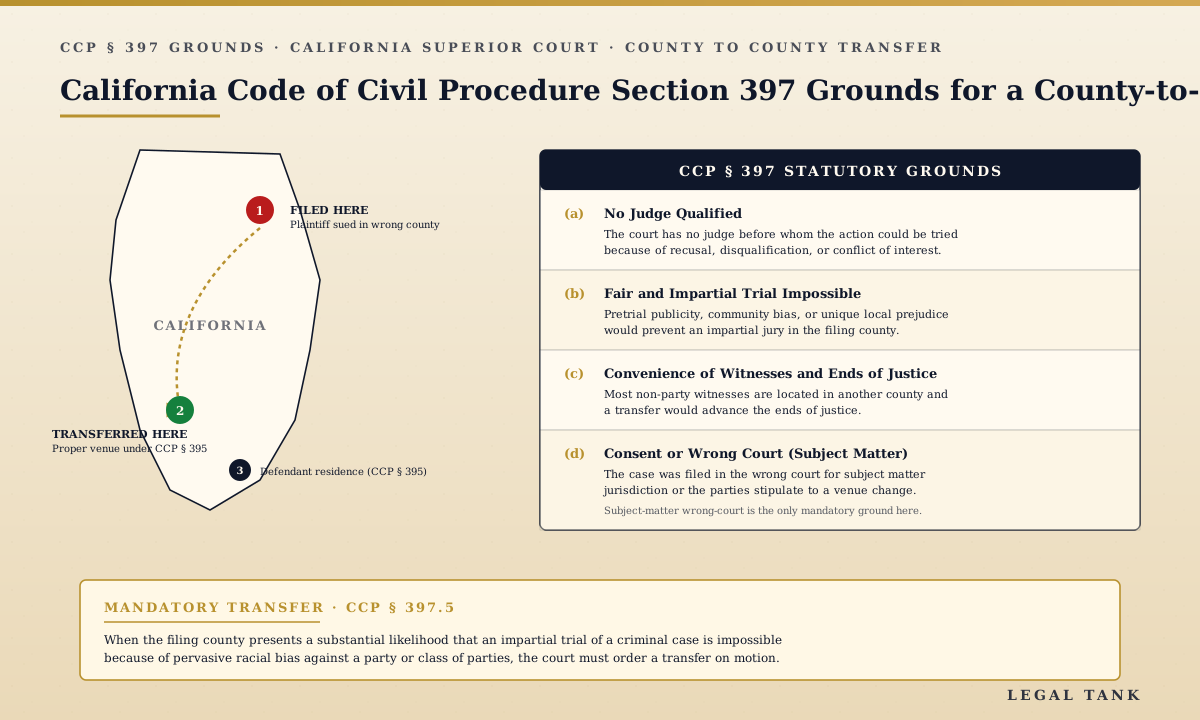
Ground a
Not the proper court
CCP section 397(a). The court designated in the complaint is not the proper court for the action under the venue statute (CCP section 395 sets the defendant's residence as the default proper county for most civil actions). The motion shows why venue is improper in the filing county and asks for transfer to the proper county.
CCP section 397(a)
Ground b
Impartial trial impossible
CCP section 397(b). Pretrial publicity, community bias, or a unique local prejudice would prevent an impartial jury in the filing county. The motion attaches the media archive, the polling data if available, and the witness declarations that document the local atmosphere.
CCP section 397(b)
Ground c
Convenience and ends of justice
CCP section 397(c). The convenience of non-party material witnesses and the ends of justice favor a different county. The motion identifies each witness by name and address, the substance of the expected testimony, and why personal appearance in the transferee county matters.
CCP section 397(c)
Ground d
No qualified judge
CCP section 397(d). From some cause there is no judge of the court qualified to act, because of recusal, disqualification, or a chambers-wide conflict of interest. The motion identifies the disqualifying conflict and asks for transfer to the nearest superior court of equivalent jurisdiction.
CCP section 397(d)
The Penal Code section 1033 mandatory criminal transfer
CCP section 397 governs civil venue. Criminal change of venue is governed instead by Penal Code section 1033, which operates as a mandatory transfer remedy: where the court determines there is a reasonable likelihood that a fair and impartial trial cannot be had in the filing county (because of pervasive pretrial publicity or local bias against a party), the court must order a transfer on the defendant's motion. The Penal Code section 1033 motion is the criminal analog to the civil CCP section 397(b) showing, but the standard and the appellate posture differ.
The state-court practice runs on the regular law-and-motion calendar under CCP section 1005, with sixteen court days of notice and five additional days for mail service. The motion must be filed before the answer in a wrong-county posture under CCP section 396b, or the venue challenge is waived. Companion work: building a motion to dismiss template that hits Rule 12(b)(6) on the face for the dispositive companion when the venue challenge survives but the underlying complaint also fails.
Legal Meaning of a Motion for Change of Venue, Without the Jargon
Venue is the geographic location where a case is heard. It is not the same as jurisdiction, which is the court's legal power to decide the case. A court may have full subject-matter and personal jurisdiction over the parties and still sit in the wrong venue because the case belongs in a different county or district under the venue statute. The motion to change venue is the procedural vehicle for asking the court to fix the geography without disturbing its underlying authority to hear the dispute.
In California state practice the venue statute is CCP section 395, which sets the residence of the defendant as the default proper county for most civil actions, with specialized rules for real-property actions (county where the property sits), contract actions (county of contract performance), and tort actions (county of injury). The defendant's residence rule means the movant on a wrong-county motion is typically the defendant, and the relief is transfer to the county of the defendant's residence under CCP section 397(a). The opposing party may try to defeat the motion by pointing to a specialized venue rule that keeps the case in the filing county.
In federal practice the venue statute is 28 USC section 1391. A federal court that sits in a proper venue may still transfer the case under 28 USC section 1404(a) for the convenience of parties and witnesses and in the interest of justice, to any other district where the case could have been brought originally. A federal court that sits in an improper venue must either dismiss or transfer under 28 USC section 1406(a). The two tools work in parallel: section 1404(a) for discretionary transfers from a proper forum, section 1406(a) for corrective transfers from a wrong forum.
                SUPERIOR COURT OF THE STATE OF CALIFORNIA
                       COUNTY OF [FILING COUNTY]
                          [DIVISION/DEPARTMENT]


[PLAINTIFF FULL LEGAL NAME],         )
                                     )
              Plaintiff,             )    Case No. [Case Number]
                                     )
v.                                   )    Dept: [Number]
                                     )    Judge [Last Name]
[DEFENDANT FULL LEGAL NAME],         )
                                     )
              Defendant.             )
_____________________________________)


      DEFENDANT'S NOTICE OF MOTION AND MOTION FOR
       CHANGE OF VENUE; MEMORANDUM OF POINTS AND
        AUTHORITIES; DECLARATION OF [DECLARANT];
                  PROPOSED ORDER
   (Cal. Code Civ. Proc. sections 396b, 397, 399)


    Hearing Date: [Date]
    Hearing Time: [Time]
    Department:   [Number]
    Reservation:  [Reservation ID]


    TO ALL PARTIES AND THEIR COUNSEL OF RECORD:

    PLEASE TAKE NOTICE that on the above date, time,
and department, [Defendant Full Legal Name] ("Defendant")
will move this Court for an order transferring this
action from [Filing County] County Superior Court to
[Transferee County] County Superior Court pursuant to
California Code of Civil Procedure sections 396b, 397,
and 399.


I.   STATEMENT OF GROUNDS

     1.  Defendant brings this motion under Code of Civil
         Procedure section 397, subdivision [(a) / (b) /
         (c) / (d)], on the ground that [the court
         designated in the Complaint is not the proper
         court / an impartial trial cannot be had in
         [Filing County] / the convenience of witnesses and
         the ends of justice would be promoted by the
         change / from some cause there is no judge of the
         court qualified to act].

     2.  The proposed transferee court, [Transferee County]
         County Superior Court, is a court in which this
         action could have been filed originally under
         Code of Civil Procedure section 395.


II.  STATEMENT OF FACTS

     3.  This action was filed on [Filing Date] in
         [Filing County] County Superior Court. A copy of
         the Complaint is attached as Exhibit A.

     4.  At the time the Complaint was filed, Defendant
         resided in [Transferee County] County and has
         continuously resided there ever since, as set
         out in the Declaration of [Declarant] attached
         as Exhibit B.

     5.  The material non-party witnesses identified in
         the case file, [Witness 1], [Witness 2], and
         [Witness 3], reside and work in [Transferee
         County] County, as set out in the Declaration
         attached as Exhibit B.

     6.  The documentary evidence relevant to the claims
         and defenses, including [describe], is located
         at [address] in [Transferee County] County.


III. ARGUMENT

     7.  California Code of Civil Procedure section 397
         authorizes a transfer of an action from one
         county to another on any of four enumerated
         grounds. The factual record set out in paragraphs
         3 through 6 above and the attached Declaration
         establish ground [(a) / (b) / (c) / (d)] by a
         preponderance of the evidence.

     8.  The convenience of non-party witnesses is the
         single most weighted factor under CCP section
         397(c). The transferee county is the home of
         every non-party witness identified in this
         action, and trial in [Filing County] would
         impose travel and lost-work costs on each.

     9.  The plaintiff's choice of forum is entitled to
         deference, but that deference is overcome where
         the moving party shows that the convenience
         factors and the ends of justice favor the
         transferee county. The facts here meet that
         showing.


IV.  RELIEF SOUGHT

     10. Defendant requests that this Court:

         (a)  Grant this motion and order the action
              transferred from [Filing County] County
              Superior Court to [Transferee County]
              County Superior Court;

         (b)  Order the transferring party to pay the
              costs and fees of transfer within thirty
              days under CCP section 399;

         (c)  Order the clerk of [Filing County] County
              Superior Court to transmit the case file
              to the clerk of [Transferee County] County
              Superior Court within fourteen days; and

         (d)  Grant such other relief as the Court deems
              just and proper.


    WHEREFORE, Defendant respectfully requests that the
Court grant the motion and transfer this action to
[Transferee County] County Superior Court.


Dated: ____________, 20____.


                     Respectfully submitted,


                     _______________________________________
                     [Attorney Name], Esq.
                     California State Bar No. ______________
                     [Firm Name]
                     [Firm Address]
                     [City, California ZIP]
                     Telephone: (___) ___-____
                     Email: __________________
                     Attorney for Defendant


================================================================
                  DECLARATION OF [DECLARANT]
================================================================

    I, [Declarant Full Legal Name], declare:

    1.  I am [the Defendant in this action / counsel of
        record for Defendant]. I have personal knowledge
        of the facts stated in this Declaration and, if
        called as a witness, could testify competently to
        them.

    2.  [Set out the residence facts under penalty of
        perjury.]

    3.  [Identify each non-party material witness by name
        and address, and state the substance of the
        expected testimony.]

    4.  [Identify the location of documentary and
        physical evidence relevant to the claims and
        defenses.]

    I declare under penalty of perjury under the laws of
the State of California that the foregoing is true and
correct.


    Executed on ____________, 20____, at [City], California.


                     _______________________________________
                     [Declarant Full Legal Name]


================================================================
                  CERTIFICATE OF SERVICE
================================================================

    I HEREBY CERTIFY that on this _____ day of
________________, 20____, I served the foregoing Notice
of Motion and Motion for Change of Venue, Memorandum of
Points and Authorities, Declaration, and Proposed Order
on counsel of record by [TrueFiling e-service / first-class
mail with postage prepaid / personal delivery]:

    [Opposing Counsel Name, Firm, Address, Email]


                     _______________________________________
[Attorney Name], Esq.Cal. Fam. Code section 2320; CCP section 397
California Family Law (Family Code section 2320)
A California marital dissolution requires six months of state residence and three months of county residence before the petition is filed. Where the residency requirement is met in a different county than the filing county, the motion proceeds under CCP section 397(c) for convenience of witnesses, often coupled with Family Code section 2320 venue facts. The supporting declaration walks the court through residency dates, witness locations, and the requested transferee county.
Cal. Code Civ. Proc. section 397
California Civil (CCP section 397)
California civil change of venue runs through CCP section 397 and is heard on the regular law-and-motion calendar under CCP section 1005, which requires sixteen court days of notice with five additional days for mail service. The motion must be filed before the answer where wrong-county venue is the ground, or the right to challenge venue is waived under CCP section 396b.
Tex. Civ. Prac. & Rem. Code section 15.063
Texas Civil (TCPRC section 15.063)
A Texas motion to transfer venue must be filed prior to or concurrently with any other plea, pleading, or motion except a special appearance. Failure to file at this point waives the venue challenge. The Texas motion is governed by Texas Rule of Civil Procedure 87 and requires the moving party to specifically deny the venue facts pleaded in the petition and to identify a county of proper venue.
28 U.S.C. section 1404(a)
Federal Civil (28 USC section 1404(a))
A federal motion to transfer venue for convenience travels under 28 USC section 1404(a) and is granted only to a district where the case could have been brought originally. The motion balances the Gulf Oil v Gilbert private-interest and public-interest factors. The 2013 Atlantic Marine decision reframed the analysis where a valid forum-selection clause is in play, reducing the plaintiff's choice-of-forum weight to zero.
28 U.S.C. section 1406(a)
Federal Wrong-Venue Cure (28 USC section 1406(a))
Where venue is improper because the case lies outside the section 1391 venue statute, the court must either dismiss or, in the interest of justice, transfer the case to any district in which it could have been brought. Section 1406(a) is the wrong-venue cure tool and is functionally the federal counterpart to CCP section 397(a). A motion under section 1406(a) faces a lower bar because the venue defect is on the face of the record.
Common Grounds and Practical Use of a Motion for Change of Venue in Civil and Criminal Practice
The most common grounds for a civil change of venue, ranked by frequency in the case file: wrong county under CCP section 395 with the case belonging at the defendant's residence; convenience of non-party witnesses where the witnesses, the records, and the physical evidence sit in a different county; and impartial-trial-impossible where media coverage or local prejudice in the filing county would taint the jury pool. The most common ground in criminal practice is pretrial publicity under the constitutional fair-trial right and Penal Code section 1033 for criminal venue, which makes transfer mandatory once the court finds a reasonable likelihood that a fair and impartial trial cannot be had in the county.
The federal track sees a different mix. Most federal motions to transfer venue run under 28 USC section 1404(a) as discretionary convenience transfers. Wrong-venue motions under section 1406(a) are less common because federal plaintiffs tend to clear the section 1391 venue statute at the complaint stage. The 2013 Supreme Court decision in Atlantic Marine changed the landscape by holding that a valid forum-selection clause shifts the balance: the plaintiff's choice of forum receives no weight, and the private factors collapse into the contractual choice. Public factors alone rarely defeat a forum-selection clause.
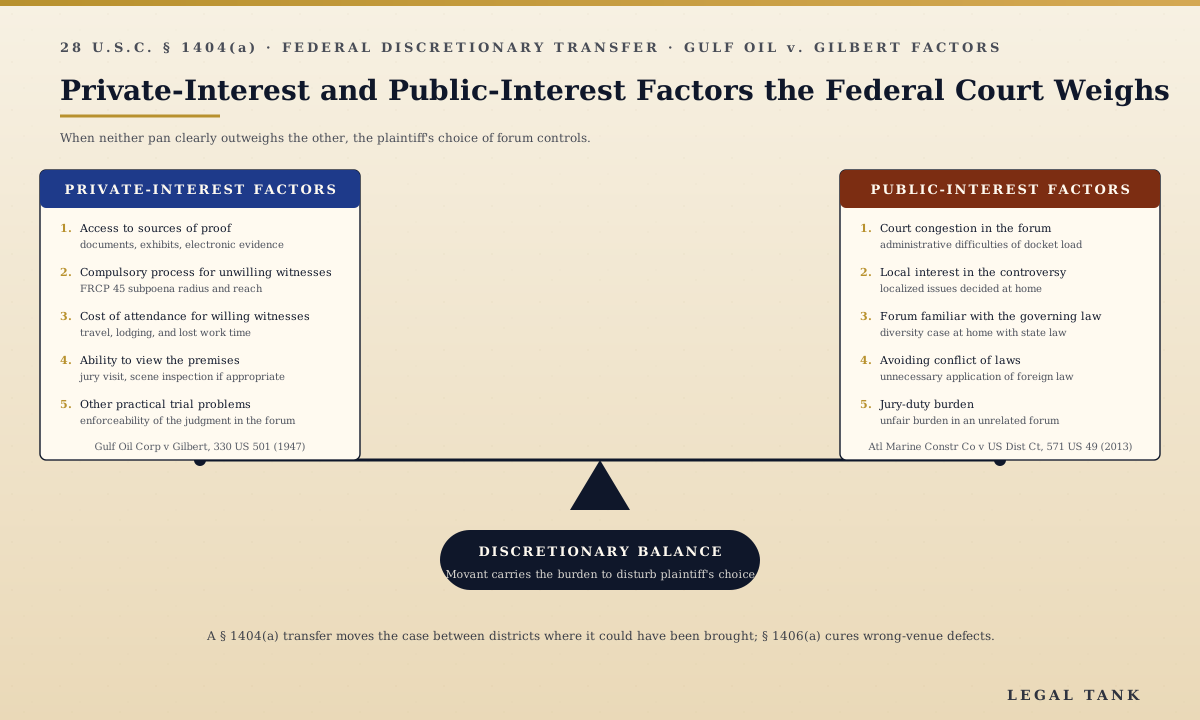
PRIVATE-INTEREST
Convenience to the parties
Relative ease of access to sources of proof; availability of compulsory process for unwilling witnesses under FRCP 45; cost of attendance for willing witnesses; ability to view the premises if a site inspection is appropriate; and other practical problems that make trial easy, expeditious, and inexpensive.
Gulf Oil Corp v Gilbert, 330 US 501 (1947)
PUBLIC-INTEREST
Forum interest and administration
Administrative difficulties from court congestion; the local interest in deciding localized controversies at home; the interest in having a diversity case tried in a forum at home with the state law; avoidance of unnecessary conflict-of-laws problems; and the unfairness of burdening citizens of an unrelated forum with jury duty.
Atl Marine Constr Co v US Dist Ct, 571 US 49 (2013)
MOVANT'S BURDEN
Disturbing plaintiff's choice
The plaintiff's choice of forum is entitled to substantial deference and is rarely disturbed when the chosen forum is the plaintiff's home. The movant must show that the private and public factors weigh clearly in favor of the transferee district. A neutral balance means the motion fails and the case stays.
Piper Aircraft Co v Reyno, 454 US 235 (1981)
Where venue practice intersects other motion work
A change-of-venue motion rarely travels alone. It often accompanies a Rule 12(b)(3) motion to dismiss for improper venue in federal court, a special appearance to challenge personal jurisdiction, or an early Rule 12(c) motion on the pleadings where the venue and substantive defects are visible on the face of the complaint. The motion can also follow a discovery exchange that reveals new location-specific facts. For the dispositive companion filing, see anatomy of a motion for default judgment template and how each section functions.
For the broader procedural umbrella that places venue motions inside the pretrial motion family, see defining what is a motion in court and how written requests move a case forward.
Drafting Mechanics for a Motion for Change of Venue From Caption Through Service
The drafting workflow is the same across jurisdictions. Substitute the controlling rule, the state-specific timing trigger (California CCP section 396b before the answer; Texas TCPRC section 15.063 before or concurrent with the first pleading), and the local proof-of-service mechanic. Pull the residence facts, the witness list, and the evidence inventory from the case file; the motion writes itself when the record is clean.
A motion that is technically correct but factually thin still loses. Judges read the supporting declaration before they read the points and authorities. The declaration is where the case is won. Specific witness names with addresses, specific document locations, and specific residence dates do the work that broad averments about convenience cannot.
Six steps from blank form to filed motion
Each step below corresponds to a section of the on-page form. Work the steps in order. Caption errors and timing errors are the two ways a venue motion fails on the papers without ever reaching the substantive grounds.
- 1
Copy the on-page form into your working document
Paste the motion body below into a working document. The bracketed fields (caption, case number, judge, filing county, transferee county, venue facts, witness identifications, requested transfer date) are the only sections that need editing. The CCP section 397 grounds scaffold and the federal section 1404(a) factor scaffold stay intact across cases in the same track.
- 2
Mirror the caption from the complaint
Caption, parties, case number, and judge assignment carry forward from the complaint. The motion must be filed before the answer on a wrong-county ground in California, or the venue challenge is waived under CCP section 396b. In Texas, file the motion to transfer concurrently with or before any other pleading or the right is waived under TCPRC section 15.063.
- 3
Plead the grounds with record cites
Each ground gets a record cite. Wrong-county venue: attach the operative pleadings and the residence affidavits. Impartial-trial-impossible: attach the press archive, the polling data, and the witness declarations. Convenience: attach witness lists with names, addresses, and expected testimony. No-judge: attach the recusal orders or conflict declarations.
- 4
Identify the transferee court and confirm jurisdiction
The transferee court must be a court where the case could have been filed originally. In California civil practice this means a superior court of the proposed transferee county; in federal practice this means a district that satisfies the section 1391 venue statute and that has personal jurisdiction over the defendants. The motion names the transferee court in the caption of the proposed order.
- 5
Attach the proposed order granting the motion
Always attach a proposed order. The judge signs it on receipt of a ruling. In California, the proposed order under CCP section 399 specifies that the transferring party pay transfer costs within thirty days. In federal court, the proposed section 1404(a) transfer order directs the clerk to transmit the record to the transferee district under the appropriate local rule.
- 6
Have the draft finalized before filing
For high-stakes venue fights or for motions that turn on the Gulf Oil factors, route the draft through /get-quote so a senior drafter reviews the grounds, the declarations, and the procedural posture. The motion is then ready for your engaging trial counsel to sign and file.
Service, hearing, and post-ruling logistics
California civil service under CCP section 1005 requires sixteen court days of notice before the hearing, with five additional days when the motion is served by mail and two additional days for overnight delivery. Federal civil service runs on FRCP 5 and the local civil rules of the issuing district; most districts require notice under their motion-day calendaring rule, with response and reply windows set by local rule. Reserve the hearing date on the law-and-motion calendar before serving the papers; an unreserved motion may be stricken sua sponte.
At the hearing, the court typically rules from the bench after argument. A granted motion triggers the transfer mechanics under CCP section 399: the moving party pays transfer costs within thirty days, the clerk transmits the file to the transferee court, and the case picks up in the new court at the procedural posture it held at transfer. A denied motion preserves the underlying venue and leaves the case on its original calendar; appellate review of a venue denial in California runs through writ practice rather than direct appeal.
For parallel pretrial work that fits in the same docket entry as a venue motion, see drafting service for a motion for sanctions targeting discovery abuse and bad-faith conduct and drafting service for a motion to amend pleadings after discovery reveals new claims. For the dispositive companion in a Rule 56 posture, see professionally drafted cross-motion for summary judgment briefs and Rule 56 opposition filings. For the procedural how-to that frames the broader filing posture, see steps for how to file a court motion from drafting through the hearing.
How a Change-of-Venue Motion Moves Through Federal and State Court
In the United States District Court, transfer is governed by 28 U.S.C. § 1404(a) (convenience-of-parties) and § 1406(a) (improper venue), with the procedural mechanics drawn from the Federal Rules of Civil Procedure. The motion is supported by a memorandum of law that walks each statutory factor (the location of witnesses, the relative ease of access to sources of proof, plaintiff's choice of forum, and the interest of justice) against the record. State-court venue rules track the local civil procedure code, but the public-and-private-interest factor framework is nearly identical.
Most federal districts impose a meet and confer requirement before any non-dispositive motion: the movant must contact the opposing party, attempt resolution, and certify the conference in the moving papers. The motion is then e-filed through CM/ECF (or the state-equivalent portal), service of process-style delivery is completed to every party of record, and the court clerk dockets the filing. The court enters a scheduling order setting the response date (usually 14 to 21 days), the reply date (7 to 14 days), and either a hearing date or notice that the matter will be decided on the papers.
At the hearing, the court may hear oral argument, or rule from the bench based on the moving papers and the evidentiary record. A transfer order is interlocutory but practically dispositive: once entered, the case file is electronically transferred to the receiving court within a typical deadline of 14 days. Counsel should treat the final court order as the operative document: the receiving court's local rules, not the original forum's, govern the case from the moment the transfer is docketed.
Motion for Change of Venue Form Questions
What does motion for change of venue mean?
Which of these facts would a judge consider in deciding a motion to change venue?
Can a plaintiff file a motion to transfer venue?
Is it hard to get a change of venue?
How to file a change of venue in California family law?
What are the grounds for change of venue in California?
Have a Litigator Finalize Your Motion for Change of Venue
Legal Tank drafts the motion, the supporting declaration, the points and authorities, and the proposed order under Model Rule 5.3 supervision. Your engaging trial counsel signs, files, serves, and argues the venue motion at hearing. The deliverable is a filing-ready packet keyed to your court, your case caption, and your venue facts. Send the docket and the residence record through intake and a litigator pressure-tests the grounds, the declaration, and the transfer mechanics before your engaging counsel files.
Legal Tank prepares attorney-grade motion drafts under Model Rule 5.3 supervision. We do not appear at the venue hearing or file with the court. Your engaged trial counsel signs and files the motion and argues it at the hearing.