Order to Show Cause and the Burden It Places on the Responding Party
An order to show cause is a court directive compelling a named party to appear at a fixed return date and explain, on the record, why the relief the moving party requests should not be granted. The order shortens notice, attaches an enforceable deadline to the responding party, and frequently carries interim relief on the face of the document itself. This page explains the procedural mechanics across civil litigation, family court, and criminal proceedings, the standards judges apply at signing and at the hearing, and the deadline structure that controls every OSC track.
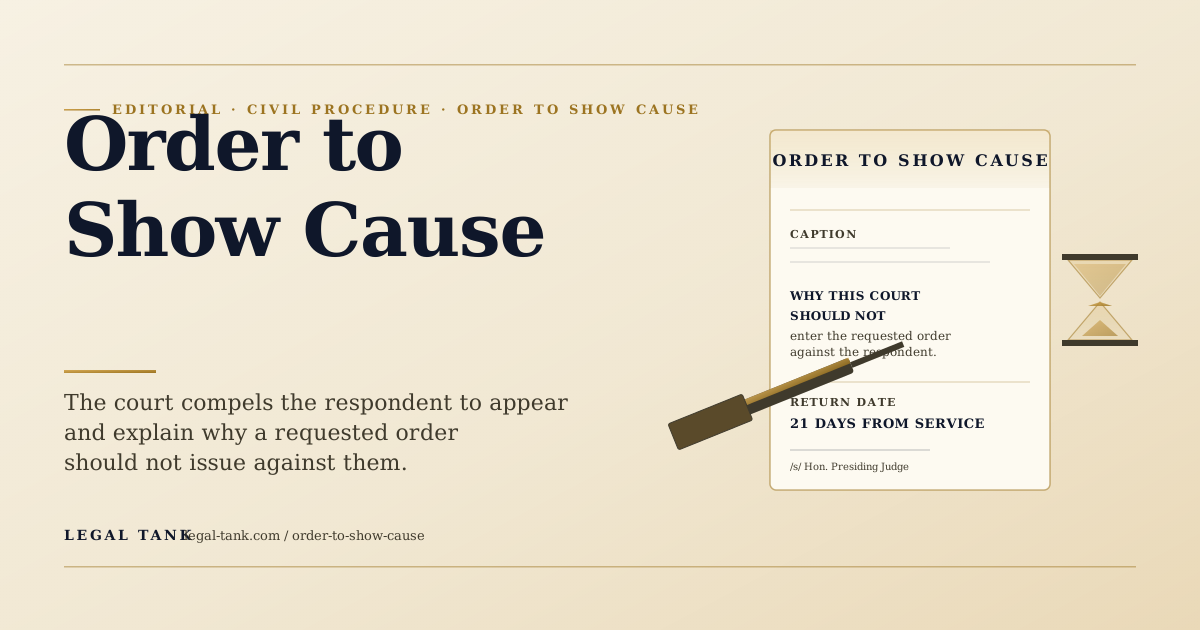
The defining feature of the OSC is the burden flip. Where an ordinary noticed motion makes the moving party prove the right to relief on a leisurely calendar, the order to show cause makes the responding party prove, on a shortened clock, why the relief should not enter against them.
What Is an Order to Show Cause? The Motion and Order as One Bundled Filing
Lawyers and clerks treat the phrase motion and order to show cause as a single bundled filing rather than two separate documents. The motion is the substantive request for relief: an injunction, a contempt finding, an emergency custody change, a turnover. The order is the proposed judicial directive that, once signed, compels the responding party to appear and contest the relief. Filing them together is what distinguishes the OSC track from the ordinary noticed-motion track, because the judge can sign the order, set the return date, and fix interim relief in a single sitting before the responding party even knows the matter has been filed.
The bundled package usually contains five components: the proposed order itself, the supporting affidavit or declaration, the moving papers laying out the legal argument, a memorandum of law (in jurisdictions that require one), and a proposed final order granting the underlying relief. The judge reviews the bundle, signs the proposed order to show cause, fixes the return date, prescribes service, and sets any interim relief in motion. The plaintiff or movant then serves the signed order along with the supporting papers on the responding party. From that moment on, the responding party carries the procedural burden of going forward.
Federal practice authorizes ex parte signing of a motion and order to show cause whenever it accompanies an application for a temporary restraining order or preliminary injunction, governed by Federal Rule of Civil Procedure 65. State courts have parallel devices: New York CPLR 2214(d), Texas Rule of Civil Procedure 680, and California Code of Civil Procedure 527, under which a temporary restraining order is made returnable on an order to show cause why a preliminary injunction should not issue. The local form differs, but the underlying mechanics are stable across jurisdictions.
What the Order Itself Contains
A signed order to show cause names the deciding court, the parties in the same caption used in the underlying complaint, the relief the moving party is seeking, the return date, the time of the hearing, the location of the appearance, and the manner in which the respondent must be served. When the moving party sought interim relief and the judge granted it, the body of the order includes the interim directive, often introduced by the formula "pending the hearing and determination of this motion, it is hereby ORDERED that." The judge dates and signs at the bottom, and the court clerk enters the order on the docket.
What Does a Show Cause Order Mean? Why It Is Called "to Show Cause"
The procedure descends from the common-law rule nisi, from the Latin nisi, meaning "unless": a provisional order that becomes absolute unless the named party appears and shows cause why it should not. The point is not academic. By directing the responding party to show cause, the court reverses the ordinary procedural posture: the respondent must come forward at the hearing, not the movant. The movant carries the substantive merits burden, but the procedural obligation to appear and to file written opposition lands on the responding party first.
Reading Across to Adjacent Procedural Tools
Practitioners often confuse the OSC with related devices. The OSC sits alongside the ordinary noticed motion, the ex parte application, and the petition for a writ. The broader landscape of pretrial filings and how written requests shape civil and criminal proceedings places the OSC inside the family of motions a litigant may need at different stages of a case. For the related learning track on assembling a motion from scratch, our guide on writing a court motion from caption through proposed order covers the document-by-document anatomy.
Why Courts Use a Motion for Rule to Show Cause Across Civil, Family, and Criminal Dockets
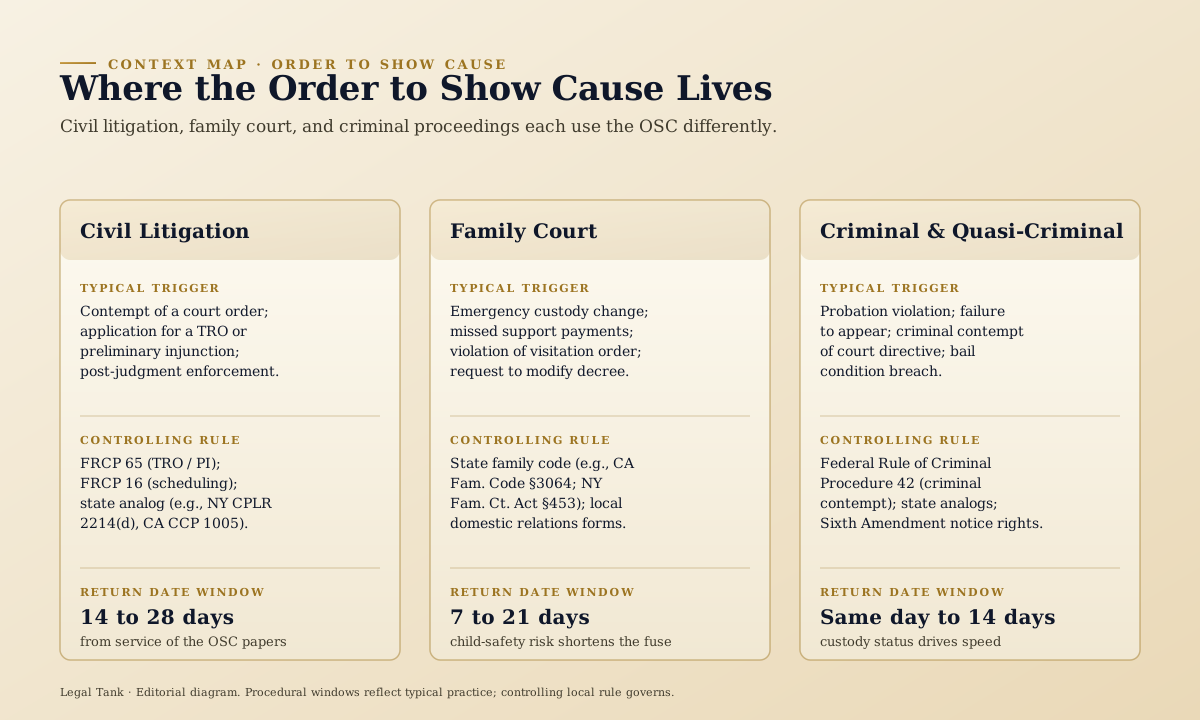
A motion for rule to show cause serves a single functional purpose across docket types: it forces a responding party to appear and account for conduct, on a clock the moving party did not have to set through ordinary calendar mechanics. The applications differ by context. In civil litigation the OSC most commonly accompanies a request for a temporary restraining order or for civil contempt enforcement. In family court the OSC is the standard vehicle for emergency custody motions, support modification, and enforcement of visitation orders. In criminal and quasi-criminal settings the OSC issues to bring a probationer, a contemnor, or a defendant under suspended sentence back before the court for an explanation that may carry liberty consequences.
What unifies the three contexts is the asymmetry of the procedural posture. The judge has, by signing the order, already concluded that the moving party has presented enough on the face of the papers to put the responding party to an answer. The remaining question at the return-date hearing is not whether the matter deserves judicial attention, but whether the responding party can articulate a sufficient reason for the requested order to be denied or modified.
Civil Litigation: TRO, Preliminary Injunction, and Contempt
Civil litigators reach for the OSC when a noticed motion will not answer the timing problem. Applications for a temporary restraining order or preliminary injunction under Federal Rule of Civil Procedure 65 are the dominant federal use case. Civil contempt enforcement against a party who has ignored a discovery order or a payment directive is the second-largest category. In both categories, the moving party files the motion and order to show cause together, and the judge fixes the return-date hearing during the same review.
Family Court: Custody Emergencies and Order Enforcement
Family court OSCs handle situations where a child is at immediate risk, where one parent has violated a custody or visitation order, or where a support obligation has gone unpaid long enough to warrant judicial intervention. The supporting affidavit must describe the triggering conduct in concrete terms with dates, corroborating exhibits where they exist, and a clear linkage to the underlying decree or stipulation. Counsel familiar with applying for an order modifying an existing decree may also draw on the framework discussed in our explainer on drafting a motion to enforce a settlement agreement or court order, because the operative directive language overlaps.
Eviction and Landlord-Tenant Settings
Housing courts in many jurisdictions use the OSC to schedule expedited hearings on emergency landlord-tenant disputes, particularly when a tenant has filed a motion to vacate a default judgment or when a landlord seeks to enforce a stipulation of settlement. The OSC compresses the hearing calendar and signals to the parties that the matter requires immediate attention. The local housing court rule typically prescribes a tight return-date window because tenancy status is at stake.
Criminal and Quasi-Criminal Proceedings
In criminal practice the OSC issues most often as a probation violation order, a criminal contempt directive under Federal Rule of Criminal Procedure 42, or a citation to a defendant whose suspended sentence may be revoked. The constitutional notice protections under the Sixth Amendment apply with full force, because the responding party's liberty is potentially at stake. The administrative analog appears in immigration practice, where reopening an immigration court case after a removal order or missed hearing follows a parallel show-cause procedure governed by the Executive Office for Immigration Review rather than by Article III rules.
Pleading-Stage Show-Cause Variants
Courts also issue OSCs sua sponte when a complaint appears to suffer from a defect that will not survive a motion to dismiss. New York practitioners encounter this when a court directs a plaintiff to show cause why a complaint should not be dismissed for failure to state a cause of action under CPLR 3211(a)(7). The mechanics are identical to a movant-initiated OSC, with the court substituting for the moving party at the threshold step.
Drafting Mechanics: Caption to Service for an Order to Show Cause
The drafting work on an OSC is more demanding than on an ordinary noticed motion because the moving party must produce two completed documents (the motion and the proposed order itself) plus a supporting affidavit detailed enough to carry the burden at signing. Court clerks reject OSC packages for clerical reasons at far higher rates than ordinary motions, because the proposed order travels straight to the judge for signature and any error becomes visible immediately. The mechanics below reflect the dominant cross-jurisdictional pattern; local rule controls.
Anatomy of the Proposed Order, Part by Part
The proposed order itself runs three to five pages in most jurisdictions. Each named section serves a specific drafting purpose, and missing or malformed sections are the leading cause of clerk rejection at intake. Drafters who treat the proposed order as boilerplate produce filings that get bounced; drafters who treat each block as a discrete drafting target produce filings that move through intake without friction.
- Court blockIdentifies the deciding court at the top of the page, including jurisdiction, division, and county. Errors in the court block draw clerk rejection at intake.
- CaptionNames the parties exactly as they appear on the underlying complaint or petition. Index number or docket goes on the right margin. The case style must match the existing record character for character.
- Title of paperStates the document type in capital letters: ORDER TO SHOW CAUSE WITH TEMPORARY RESTRAINING ORDER, or ORDER TO SHOW CAUSE FOR CIVIL CONTEMPT. The descriptor signals the relief sought and triggers the clerk's routing.
- Order to show cause languageUses the directive verb structure required by the local rule. Most jurisdictions accept the formula "ORDERED that the respondent show cause before this Court at the courthouse located at, on the date and time below, why an order should not be entered." The dates and times are blanks the judge fills in by hand or by stamp.
- Interim relief paragraphIf the moving party seeks a temporary restraining order or other interim relief, this paragraph spells out exactly what the responding party may not do, or must do, between filing and the return date. The paragraph is often the most contested portion at signing and is frequently lined through or modified by the judge.
- Service directivesDescribes how the responding party must be served, the deadline for service, and the deadline for opposition papers. Courts vary widely here, so the moving party must check the local rule before drafting. Personal service on the named respondent is the dominant requirement; substituted service requires explicit court permission.
- Signature and date linesReserves space for the judge's signature, the date the order is signed, and (in many jurisdictions) the time of day the order was signed. In some courts, the law clerk fills in the return date before the order goes to the judge for signature.
The Supporting Affidavit Carries the Record
The supporting affidavit or declaration is where the evidentiary work happens. It must be made under penalty of perjury, must rest on personal knowledge, and must walk the judge through the timeline of the underlying conduct in concrete factual terms. Argument belongs in the moving papers, not in the affidavit. Exhibits attach as numbered tabs, with a paragraph of the affidavit authenticating each exhibit and explaining its relevance. The first paragraph of the affidavit identifies the affiant, the affiant's relationship to the matter, and the basis for the affiant's knowledge of each fact recited.
Service of the Signed Order on the Responding Party
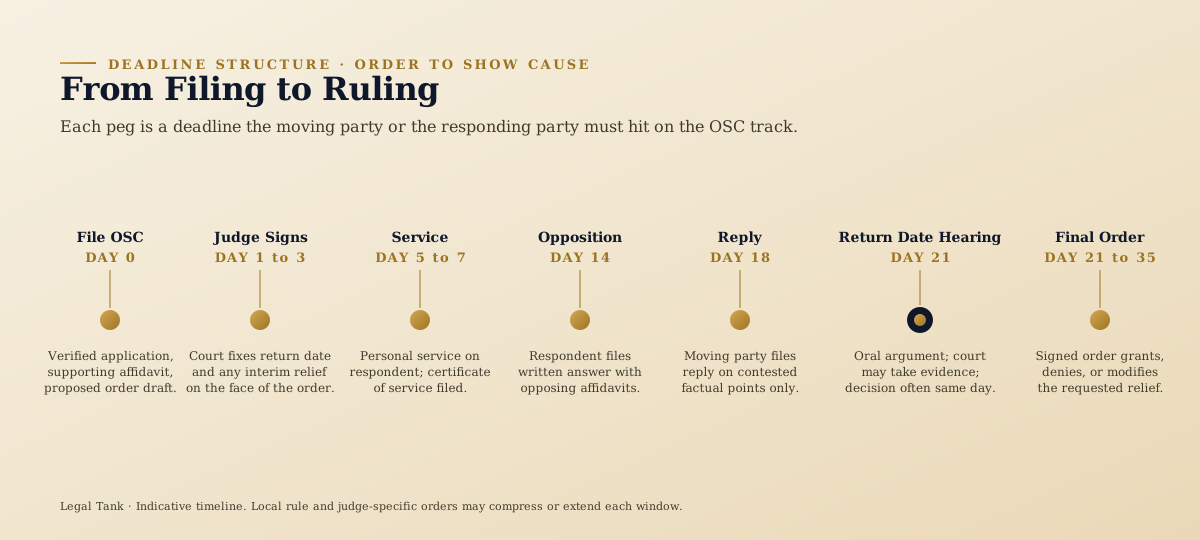
After the judge signs, the moving party must serve the responding party in the manner prescribed on the face of the order. Personal service on the respondent is the dominant requirement; substituted service on a person of suitable age and discretion is sometimes permitted on a separate showing. Service of process must be completed by the deadline the order itself specifies, typically three to seven days after signing, and the certificate of service must be filed with the court before the return date. The court clerk dockets the proof of service, and the judge confirms service at the start of the hearing.
Filing the OSC With the Court Clerk
Filing varies by jurisdiction. Many state courts require the moving party to walk the package to a designated ex parte clerk, who routes it to the duty judge for signature. Federal courts generally accept electronic filing, with the judge reviewing the package on the docket. Either way, the moving party should be ready to answer questions at signing about the timeline, the nature of the harm, and the proposed return date. The judge often modifies the proposed order during signing, and counsel should bring a clean redraft on a thumb drive for chambers signing sessions.
Coordinating With Adjacent Motion Practice
An OSC frequently runs in parallel with other pretrial filings. When the moving party also seeks to shield discovery from misuse, our explainer on drafting a motion for a protective order to shield discovery from abuse covers the related procedural device. When a calendar-protection issue is the real driver behind the OSC application, our companion guide on the motion to continue template with the good-cause language judges expect describes the gentler procedural alternative for litigants whose timing pressure does not rise to the level of an OSC.
Order to Show Cause Hearing: How Courts Rule and What Tilts the Balance
At the return-date hearing the judge has the affidavits, the moving papers, the responding party's opposition, any reply, and whatever oral argument and live testimony local practice allows. The judge then signs a final order granting, denying, or modifying the relief originally requested. Predicting the ruling comes down to a manageable set of factors, weighted by how much each one moves the judge in practice.
For litigants enforcing a court order through an OSC for civil contempt, the procedural posture and burden allocation are described in detail in our explainer covering the procedure for filing a contempt of court motion when an order is violated, which works in tandem with the OSC analysis here.
- Weight: Heavy
Specificity of the Affidavit Record
The single biggest predictor of how the court rules is whether the supporting affidavit reads like a witness statement or like a brief. Witness statements with dates, dollar amounts, attached exhibits, and first-person observation carry the day. Affidavits that string adjectives together and conclude with legal labels lose. The judge wants a record that will survive cross-examination at the return-date hearing.
- Weight: Heavy
Timeliness of the Filing Relative to the Trigger
Courts respond to OSC applications based on when the moving party first learned of the underlying conduct. A two-day gap between the trigger event and the OSC filing reads as genuine emergency. A two-month gap reads as an attempt to weaponize the calendar against the responding party, and judges deny those applications even when the underlying merits are strong.
- Weight: Medium
Quality of the Notice and Service Showing
Even when the OSC is presented for signature ex parte, the court evaluates whether the moving party has explained how the responding party will be served and how the responding party will have a meaningful opportunity to oppose. Sloppy service plans get the OSC denied outright or signed with shortened interim relief and a cooler hearing date than the moving party requested.
- Weight: Medium
Compliance with Local Form Requirements
Local rules govern font size, page limits, exhibit tabbing, paragraph numbering, and the order in which the supporting papers are presented. Judges who reject for non-compliance do not preview the merits, so a meritorious application loses procedurally. The moving party must read the controlling local rule the morning of filing, not from memory.
- Weight: Medium
Cleanliness of the Underlying Record
If the moving party has missed deadlines, ignored court orders, or filed incomplete papers earlier in the case, that history follows the OSC into chambers. The clerk pulls the docket before the judge signs, and any pattern of moving-party non-compliance reduces the credibility of the emergency claim. Conversely, a clean record signals that the OSC is a measured response, not a tactical maneuver.
- Weight: Light
Adequacy of the Proposed Order
A proposed order that mirrors the relief paragraphs in the moving papers, leaves blanks only for the date and the return time, and avoids overreach gets signed. Proposed orders that include grant language broader than the affidavit supports get lined through, narrowed, or rejected. The moving party should draft the proposed order assuming the judge will sign it as written.
When the Court Grants the Underlying Relief
A grant looks the way the moving party hoped. The signed final order incorporates the relief paragraph from the proposed order, with whatever modifications the judge made on the record at the hearing. The order is enforceable by contempt the moment it is signed and entered. The responding party has whatever appellate rights the controlling rule preserves, with appellate stays available only on a separate showing in most jurisdictions.
When the Court Denies or Modifies the Requested Order
Denials usually trace to one of the heavy-weight factors above: a thin affidavit, a stale trigger, or a defective service showing. Modification is more common than outright denial; a judge who sees genuine harm but believes the requested remedy sweeps too broadly will narrow the relief paragraph by hand, shorten the duration of any injunctive directive, and condition ongoing relief on bond or further motion practice.
Post-Hearing Enforcement and Appeal Tracks
After the final order issues, the moving party serves it on the responding party and can move to enforce by contempt or by further OSC if the responding party defies the directive. The responding party's appellate options depend on whether the order is final or interlocutory; most OSC orders carrying interim injunctive relief are immediately appealable as injunctions, while orders disposing of post-judgment enforcement motions are final orders subject to ordinary appellate review.
The Procedural Standards Behind Every Order to Show Cause
An OSC is a procedural vehicle, so the substantive standard depends on the relief it seeks. When the OSC accompanies a request for injunctive relief in the United States District Court or a state court of general jurisdiction, it is measured by the four-factor preliminary-injunction test of Winter v. Natural Resources Defense Council, 555 U.S. 7 (2008): likelihood of success on the merits, a showing that irreparable harm is likely (not merely possible) absent relief, the balance of equities, and the public interest. The moving party must make a clear showing on each factor and carries the burden of proof throughout. When the OSC instead seeks a civil contempt finding, the standard is clear and convincing evidence that the respondent violated a clear and unambiguous court order. Conclusory affidavits about "loss of business goodwill" fail; a properly drafted OSC supports each element with declarations citing specific facts, dates, and dollar amounts.
Before filing, counsel checks three jurisdictional gates. First, venue: federal venue is set by 28 U.S.C. § 1391 and lies where any defendant resides or where a substantial part of the events occurred; state venue follows the local code. Second, governing law: an OSC seeking to enforce a contract is read under the law named in the contract's choice-of-law clause, while one seeking injunctive relief on a statutory claim is read under the law of the forum. Third, the statute of limitations: an OSC filed after the underlying claim is time-barred fails at the threshold even if every other element is met.
Caption, parties, and pro se filings
The case caption at the top of every OSC must match the operative complaint exactly: same court, same case number, same party order. A mismatched caption is the most common reason a clerk rejects an emergency filing. A pro se litigant may file an OSC without counsel; courts apply a more forgiving construction to pro se papers under Haines v. Kerner, but the procedural rules still control. Pro se filers must serve the OSC and underlying complaint together if the OSC issues before service is complete.
Available remedies
The remedies available through an OSC depend on the underlying claim. In contract enforcement, the court can compel specific performance, order accounting, or freeze contested funds. In civil contempt, the court can order daily fines, coercive incarceration, or attorneys' fees. In family law, the court can compel child-support arrears, transfer custody, or modify visitation. The OSC itself does not create the remedy; it accelerates the procedural posture so the court can rule on the merits before irreparable harm is locked in.