Motion to Continue Template With the Good-Cause Language Judges Expect to See
Direct Answer
A motion to continue template is a pre-built pleading asking the court to reset a hearing or trial date already on calendar. The full document body is below in attorney-grade form, keyed to Florida Rule 1.460 with the good-cause grounds, meet-and-confer certification, proposed continued trial date, and certificate of service drafted in. The federal version under FRCP 16(b)(4) and the Oregon motion to continue under UTCR 6.030 use the same scaffold with the rule citation and caption swapped.
Federal · FL · OR · CA · TX
Copy, adapt, file
What a Motion to Continue Is and the Two Things It Actually Asks the Court to Do
A motion to continue is a written request, filed by the movant and served on the opposing party, asking the court to reset a date already on calendar. The relief is narrow: vacate the existing date, set a new date, and enter an order reflecting both. The motion does not pause the case, does not toll any deadline tied to the original date, and does not vacate the date by itself. The previously set date stays controlling until the judge signs the order continuing it.
The to continue template below is drafted in two layers. The outer layer is the document scaffold: caption, title, procedural background, grounds, meet-and-confer, prayer for relief, signature, certificate of service. The inner layer is the substantive content that varies by case: the specific good-cause showing, the diligence record, and the prejudice that would result if the motion is denied. The continue template handles the outer layer with placeholders so the drafter only edits the inner layer.
Courts treat a continuance request as a request to modify a scheduling order under the Federal Rules of Civil Procedure or the state analog. That framing matters because the controlling standard is good cause measured by diligence, not the more forgiving liberal-amendment standard from Rule 15. The drafter who treats a continuance like a routine extension misses the operative test and writes a motion that will not clear it.
Florida Court Rules That Govern Every Motion to Continue Filed in Florida State Court
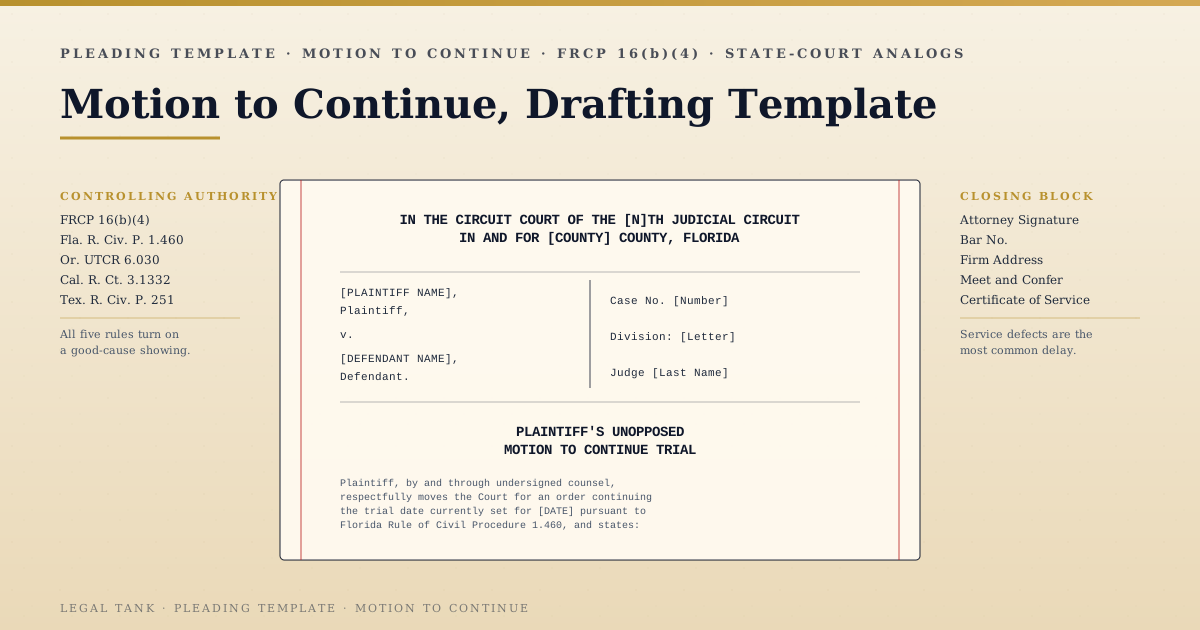
The on-page document below is a Florida Rule 1.460 Unopposed Motion to Continue Trial in attorney-grade form. The example caption uses a Florida circuit-court civil action; the body works in county court with the caption and division references adjusted. State-court versions of the same motion to continue template swap the rule citation (FRCP 16(b)(4) for federal, Oregon UTCR 6.030, California Rule of Court 3.1332, or Texas Rule of Civil Procedure 251) and the standard paragraph; the rest of the document stays nearly identical.
For an annotated, section-by-section walkthrough of the federal Rule 16(b)(4) version and the reasons courts accept a reset, see the companion annotated motion for continuance sample.
For enforcement work that runs parallel to a continuance request, attorney-prepared motion for contempt of court for enforcing orders against a noncompliant party pairs naturally with a continuance because both ride the same docket and often the same factual record.
              IN THE CIRCUIT COURT OF THE [NTH] JUDICIAL CIRCUIT
              IN AND FOR [COUNTY] COUNTY, FLORIDA


[PLAINTIFF FULL LEGAL NAME],         )
                                     )
              Plaintiff,             )    Case No. [Case Number]
                                     )
v.                                   )    Division: [Letter]
                                     )    Judge [Last Name]
[DEFENDANT FULL LEGAL NAME],         )
                                     )
              Defendant.             )
_____________________________________)


      PLAINTIFF'S UNOPPOSED MOTION TO CONTINUE TRIAL


    Plaintiff [Plaintiff Full Legal Name] ("Plaintiff"), by
and through undersigned counsel and pursuant to Florida Rule
of Civil Procedure 1.460, respectfully moves the Court for
an Order continuing the trial currently set for [Original
Trial Period] and resetting the matter to the Court's next
available trial docket no earlier than [Proposed Trial
Period]. In support of this motion, Plaintiff states:


I.   PROCEDURAL BACKGROUND

     1.  This action was filed on [Date of Complaint] and
         is set for trial on the Court's [Original Trial
         Period] docket, with calendar call on [Calendar
         Call Date], pursuant to the Order Setting Trial
         dated [Date].

     2.  The parties have completed [percentage] of the
         discovery contemplated by the Case Management
         Order entered [Date], including the depositions
         of [Witness Names].


II.  GROUNDS FOR CONTINUANCE

     3.  Good cause exists to continue the trial for the
         following reasons:

         (a)  Material witness [Witness Name], whose
              testimony is central to [Issue], is
              unavailable for the current trial period
              due to [medical condition, military
              deployment, prepaid international travel]
              documented in Exhibit A.

         (b)  Late-produced discovery: Defendant produced
              [Volume] pages of responsive documents on
              [Date], which is [N] days before the
              discovery cutoff. Plaintiff requires
              additional time to review the production
              and complete the deposition of [Custodian].

         (c)  Trial conflict: undersigned counsel is set
              for trial in [Case Caption, Court, Case
              Number] beginning [Date], which conflicts
              with this trial period. A copy of the
              conflicting Order Setting Trial is attached
              as Exhibit B.

     4.  The requested continuance is not for purposes of
         delay, but to permit the parties to complete
         trial preparation and present the matter to the
         Court on a developed evidentiary record.


III. MEET AND CONFER CERTIFICATION

     5.  Pursuant to Fla. R. Civ. P. 1.202, undersigned
         counsel certifies that prior to filing, on
         [Date], undersigned conferred with opposing
         counsel [Counsel Name] regarding the relief
         requested in this motion. Opposing counsel does
         not oppose the motion.


IV.  PROPOSED CONTINUED TRIAL DATE

     6.  Counsel for the parties have conferred regarding
         the Court's next available trial docket and have
         identified [Proposed Trial Period] as a date
         that works for all counsel, the parties, and the
         known witnesses.

     7.  A proposed Order continuing the trial and
         resetting the case to the [Proposed Trial Period]
         docket is attached as Exhibit C.


V.   CONCLUSION

    WHEREFORE, Plaintiff respectfully requests that the
Court enter an Order: (a) granting this Motion; (b)
continuing the trial currently set for [Original Trial
Period]; (c) resetting the trial to [Proposed Trial
Period]; and (d) granting such other and further relief
as the Court deems just and proper.


Dated: ____________, 20____.


                     Respectfully submitted,


                     _______________________________________
                     [Attorney Name], Esq.
                     Florida Bar No. ______________
                     [Firm Name]
                     [Firm Address]
                     [City, State ZIP]
                     Telephone: (___) ___-____
                     Email: __________________
                     Attorney for Plaintiff


================================================================
                  CERTIFICATE OF SERVICE
================================================================

    I HEREBY CERTIFY that on this _____ day of
________________, 20____, I electronically filed the
foregoing with the Clerk of the Court using the Florida
Courts E-Filing Portal, which will serve a copy on all
counsel of record listed below:

    [Opposing Counsel Name, Firm, Address, Email]


                     _______________________________________
[Attorney Name], Esq.Why a Movant Files a Motion to Continue Hearing Instead of Letting the Date Stand
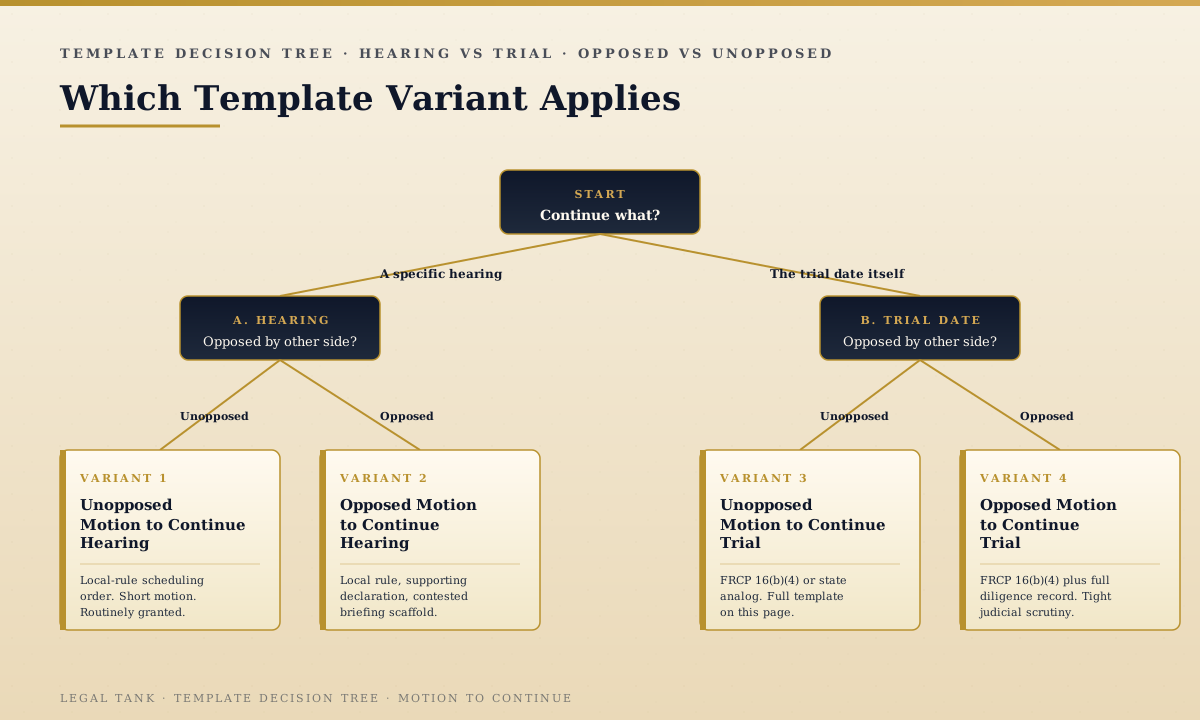
The phrase motion to continue hearing narrows the relief to one specific date on the docket: a motion-calendar appearance, a status conference, an evidentiary hearing, or a calendar call. The trial date is not in play. That narrower scope changes the template factor: shorter document, lighter good-cause showing, often a one-paragraph statement and a proposed reset date. The full trial-continuance template above scales down by removing the procedural background and proposed-trial-date sections and pointing the prayer at the specific hearing.
Unopposed Motion to Continue Hearing
Used when the movant only wants to reset a specific hearing (motion calendar, status conference, evidentiary hearing) and the opposing party has agreed. Shortest form factor: caption, one good-cause paragraph, meet-and-confer certification, proposed reset date, signature block.
Opposed Motion to Continue Hearing
Same scope as above (a specific hearing, not the trial) but the other side opposes. Requires a supporting declaration laying out the diligence record and the prejudice from proceeding on the existing date. Often paired with a request for shortened-notice briefing.
Unopposed Motion to Continue Trial
Most common variant. Used when both sides have agreed to reset the trial. Even with consent, the court will not move a Rule 1.440 trial order on stipulation alone in most jurisdictions: the motion must still satisfy good cause under FRCP 16(b)(4) or the state analog.
Opposed Motion to Continue Trial
Highest stakes. The Court will hold a hearing, review the diligence record, and apply the strictest version of the good-cause standard. The motion must document the specific event that requires the continuance, the date the movant first learned of it, and the date by which the movant could have flagged the problem to the court.
When to file the hearing version, not the trial version
If the goal is to reset only a specific hearing, the hearing variant is the right document. The court reads a motion to continue hearing differently than a motion to continue trial because the downstream effects are limited: the trial schedule survives, no scheduling order is modified, and no discovery cutoff moves.
For dispositive-motion practice tied to the same docket, the supporting briefing patterns in what a motion for summary judgment template includes to satisfy Rule 56 and the anatomy of a motion for default judgment template and how each section functions show how a calendar reset interacts with the substantive motion already on file.
How to Draft an Oregon Motion to Continue Under UTCR 6.030 and the State Rule Variants
An Oregon motion to continue is governed by Uniform Trial Court Rule 6.030. The Oregon rule has features the Florida rule does not: the motion must be signed by the attorney of record and carry a certificate that the attorney has advised the client of the request, and it must set forth the trial date, the reason, any dates previously set for trial and each prior postponement, and whether any party objects. The template body above adapts for Oregon by swapping the Florida Rule 1.460 citation in the opening paragraph for UTCR 6.030, replacing the Florida e-filing certificate with the Oregon eCourt service language, and adding the attorney certificate the Oregon rule requires.
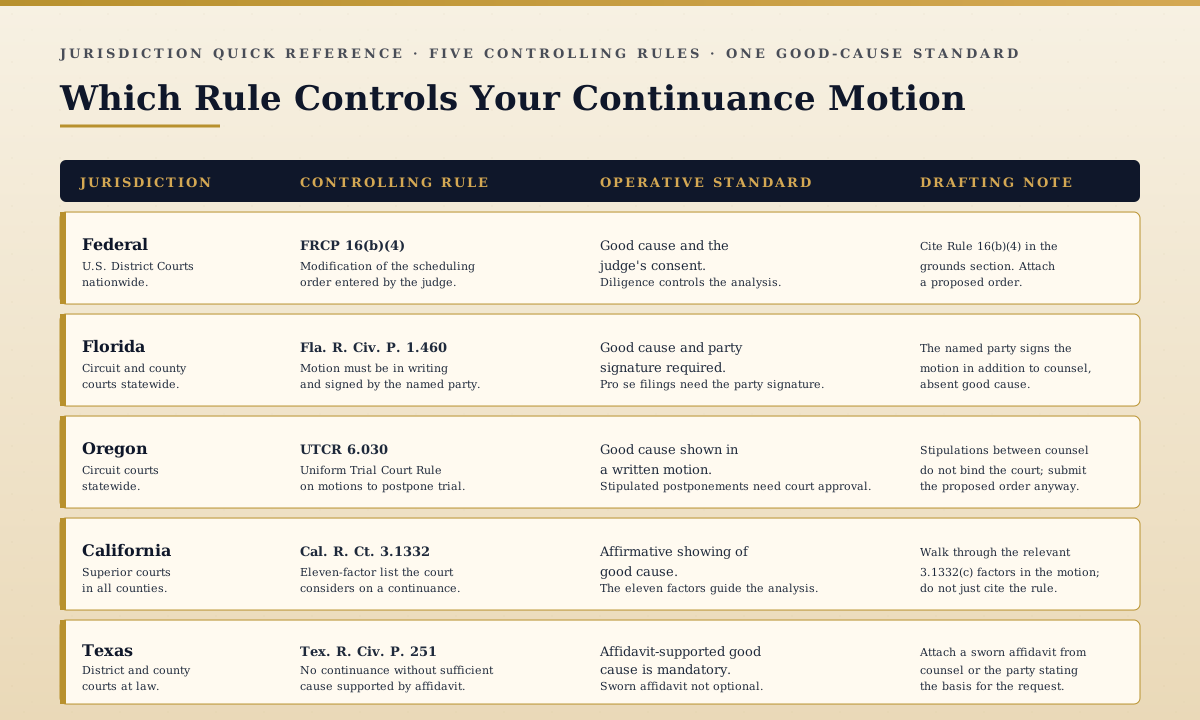
The same scaffold runs in four other primary jurisdictions, with the rule citation and a small number of state-specific paragraphs adjusted. The table below summarizes the swaps.
Federal Rule of Civil Procedure 16(b)(4)
Federal Court (FRCP 16(b)(4))
Federal trial dates are set by a scheduling order under Rule 16(b). Once set, the schedule may be modified only for good cause and with the judge's consent. The good-cause analysis turns on diligence, the same lens that controls amended pleadings out of time. Drafters cite Johnson v. Mammoth Recreations, 975 F.2d 604, 609 (9th Cir. 1992), or the controlling circuit equivalent.
Florida Rule of Civil Procedure 1.460
Florida (Fla. R. Civ. P. 1.460)
The Florida rule requires the motion in writing, signed by the named party absent good cause for an attorney-only signature, and supported by a record-based showing. A motion to continue Florida trial must clear an abuse-of-discretion appellate standard if the trial court denies it, so the prejudice and diligence findings need to be on the face of the motion.
Oregon Uniform Trial Court Rule 6.030
Oregon (UTCR 6.030)
An Oregon motion to continue must be signed by the attorney of record and carry a certificate that the attorney has advised the client of the request. It must set forth the trial date, the reason for the postponement, any dates previously set for trial and each prior postponement, and whether any party objects. The court may decide the motion by summary determination without a hearing.
California Rule of Court 3.1332
California (Cal. R. Ct. 3.1332)
California Rule of Court 3.1332 lists circumstances that may indicate good cause (unavailability of witness or counsel, addition of a new party, undiscovered material evidence) and circumstances that do not (general congestion of counsel calendar). The rule disfavors continuances absent affirmative proof and requires a declaration supporting the motion.
Texas Rule of Civil Procedure 251
Texas (Tex. R. Civ. P. 251)
Texas requires the motion supported by affidavit, with the sufficiency of the showing measured against Rule 252 (want of testimony) or the common-law continuance for absent counsel or witness. Trial courts have broad discretion, but the Texas Supreme Court has reversed denials where the moving party documented diligence and the witness testimony was central.
Six steps from blank template to filed motion
The drafting workflow is the same across all five jurisdictions. Substitute the controlling rule, the state-specific service mechanic, and the local meet-and-confer rule, then run the six steps below. The memorandum of law in support is optional in most jurisdictions; attach one when the good-cause showing turns on a contested legal issue (for example, whether late discovery satisfies diligence under the controlling circuit authority).
- 1
Copy the template into a working document
Paste the full Motion to Continue Template body below into Word or any text editor. The bracketed fields (caption, case number, judge, original and proposed trial dates, grounds) are the only spots that need editing.
- 2
Mirror the Order Setting Trial caption exactly
The motion caption must match the Order Setting Trial caption: court, parties, case number, division letter, judge assignment. Even a one-character mismatch in the case number can route the filing to the wrong docket.
- 3
Document the good-cause showing with record cites
Each ground gets a record cite. Witness unavailable: attach the affidavit. Late discovery: cite the production date and Bates range. Counsel trial conflict: include the conflicting case caption and the order setting that trial. Generalized busy-counsel statements do not clear the FRCP 16(b)(4) bar.
- 4
Confer with opposing counsel and certify the result
Many courts require conferral before a continuance motion. Florida Rule of Civil Procedure 1.202 is one example, requiring a certificate of conferral above the signature block (it exempts pro se parties). Document the date and method of the conference and state whether the motion is unopposed, opposed, or partially opposed.
- 5
Have the draft finalized before filing
For trial continuances in cases with statute-of-limitations issues, fee-shifting exposure, or pending motions in limine, send the draft through /get-quote so the diligence record and prejudice showing are confirmed before filing.
- 6
File on the e-portal and serve all counsel
File on the Florida Courts E-Filing Portal (or the equivalent state or federal e-filing system) and serve opposing counsel through the same mechanism. Calendar the proposed continued trial date as if the motion will be granted, and calendar the original date as if it will be denied.
Related drafting work
When the continuance is paired with substantive motions, the same Legal Tank drafting team builds the companion documents. See drafting service for a motion to amend pleadings after discovery reveals new claims for amended-pleading work that often triggers a parallel continuance, drafting service for a motion for sanctions targeting discovery abuse and bad-faith conduct for the discovery-abuse posture that justifies the continuance, and professionally drafted cross-motion for summary judgment briefs and Rule 56 opposition filings for the dispositive-motion track that runs alongside trial-date practice.
For threshold defense motions in the same case, see how a motion for default judgment lets the plaintiff secure relief after the clerk enters default and what a legal motion is and how continuance requests fit the procedural calendar.
Motion to Continue Template Questions
What are the rules for motion to continue in Florida?
What does it mean motion to continue?
Have Your Motion to Continue Professionally Finalized
Legal Tank drafts the motion, the supporting declaration, the meet-and-confer certification, and the proposed order. Your engaging trial counsel signs, files, and appears at the hearing. The deliverable is a filing-ready packet keyed to your court, your case caption, and your record. Send the existing case docket through intake and the diligence and prejudice showing are reviewed before the answer or opposition deadline runs.
Legal Tank prepares filing-ready motion drafts keyed to your court's requirements. We do not appear at the hearing or file with the court. Your engaged trial counsel signs and files the motion.