Annotated Motion for Continuance Sample Showing How Lawyers Justify a Trial Date Reset
A motion for continuance sample walks section by section through the document a litigator files when something has happened in the case that prevents fair preparation for the current trial date. The motion cites FRCP 16(b)(4) or its state-court analog, identifies the precise event that disturbs the schedule (illness, witness unavailability, late-produced discovery, substitution of counsel, a conflicting trial setting), records the meet-and-confer with opposing counsel, and asks the court to enter an order resetting the trial to a specific new date with the pretrial schedule recalculated accordingly. Continuance motions filed by counsel acting with diligence are routinely granted on the papers.
What Counts as a Valid Motion for Continuance Reasons and Why Diligence Is the Keystone
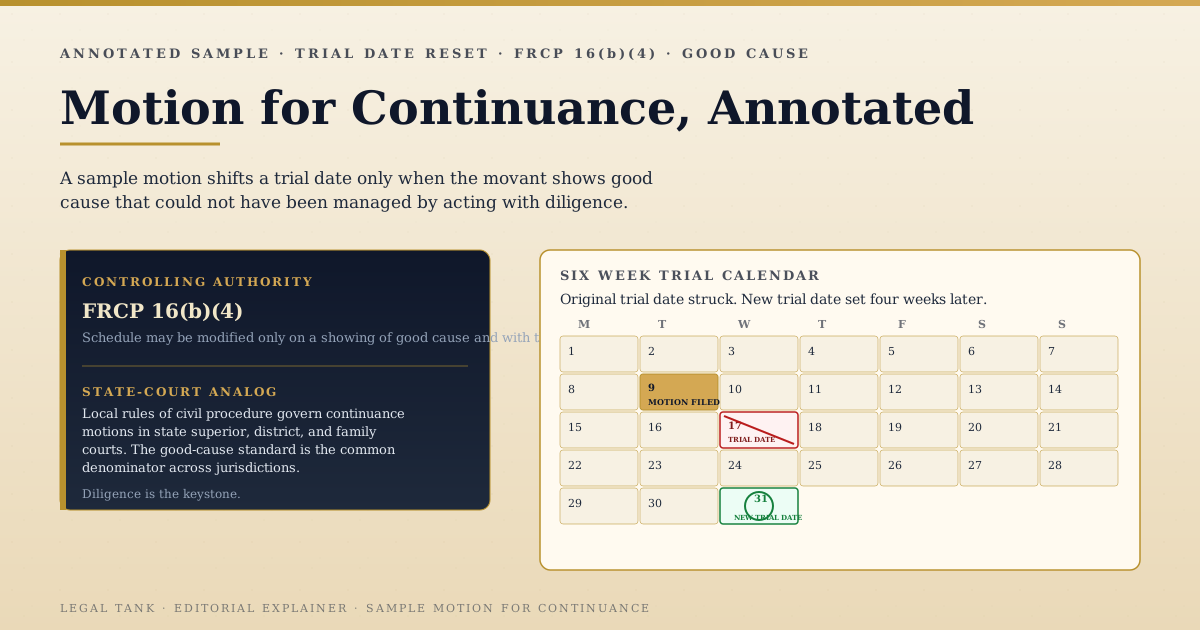
Federal civil practice does not give a party a right to reset the trial date. The trial date sits in the scheduling order entered under FRCP 16(b), and the rule says that order may be modified only on a showing of good cause and with the assigned judge's consent. The same architecture governs state-court continuance practice: the calendar belongs to the court, and a litigant who wants to move the calendar must persuade the judge that a specific event makes the current date untenable despite counsel having acted with reasonable diligence throughout the case.
Five categories of facts account for nearly every continuance motion filed in civil litigation. The first is the illness or incapacity of counsel or a party; the second is the unavailability of a material witness who cannot be reached on the trial date; the third is the production of significant discovery on the eve of trial; the fourth is the recent substitution of counsel; and the fifth is an irreconcilable conflict with another active trial in another court. Each of these categories produces a distinct showing the moving papers must make, and each category travels with its own list of documents the court expects to see attached.
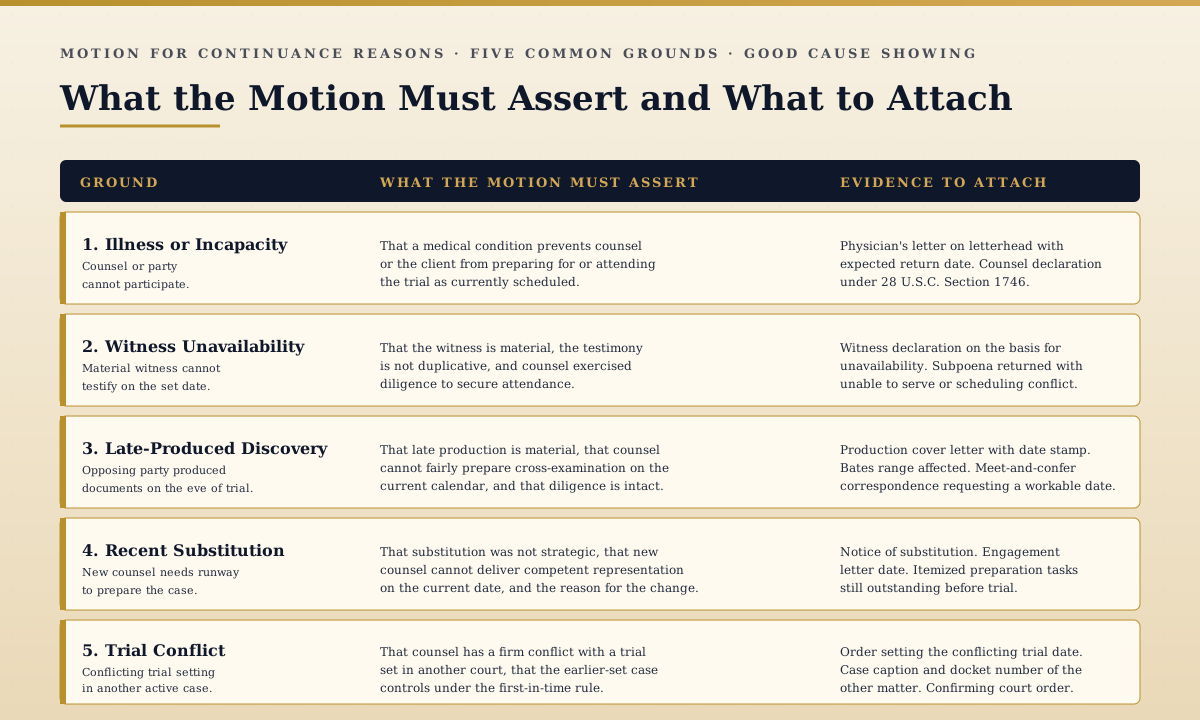
The single most common defect in continuance motions filed by inexperienced counsel is the missing diligence story. A motion that names the triggering event but never explains what counsel did before that event arose looks like a request for a courtesy rather than a request for relief on a showing of good cause. Judges who routinely deny continuance motions are not denying the reason; they are denying the absence of a record showing the movant could not have reasonably anticipated the problem. The reasons table on this page lists the diligence record each category requires.
A related drafting decision is whether to file the motion as opposed or unopposed. The meet-and-confer requirement in most federal districts and many state-court systems pushes the parties to negotiate the continuance posture before filing. Where opposing counsel agrees not to oppose, the motion is captioned "Unopposed Motion for Continuance," the opposing position is stated in the meet-and-confer paragraph, and the court typically grants the request the same week without a hearing. Where opposing counsel opposes, the motion shifts into contested briefing and the court evaluates the diligence record on the papers. Counsel should remember that an amended-pleadings drafting service or a contested non-dispositive motion both run on the same meet-and-confer architecture, and the certificate of conferral controls how the judge reads the procedural posture.
When Lawyers File a Continuance Motion and Why the Trial Calendar Sets the Stakes
The continuance motion is the standard procedural tool for telling the court that something the parties did not control has disturbed the schedule. The Federal Rules of Civil Procedure do not list "continuance" as a separate motion; the relief travels through the modification-of-scheduling-order mechanism in FRCP 16(b)(4) and through the inherent authority every trial court possesses to manage its own calendar. In state court, continuance practice is typically named explicitly in the local rule of civil procedure, and the rule numbers vary jurisdiction by jurisdiction.
Lawyers file continuance motions for one of three structural reasons. The first is a discovery event that affects what counsel can prepare; the second is an unavailability event that affects who can appear on the trial date; the third is a calendar conflict that affects whether counsel can ethically be in court at all. Each of these maps cleanly to the five categories in the reasons matrix, and the motion's persuasive weight depends on naming the structural reason in the opening paragraph and tying it to the diligence record. Continuance motions that read like calendar negotiations rather than requests for relief rarely persuade a court that has already invested clerk time and judicial time in the existing date.
The procedural posture matters too. A continuance motion filed ninety days before trial is treated very differently from a continuance motion filed seven days before trial. Early motions are usually granted on the papers without a hearing; late motions draw judicial scrutiny, sometimes a hearing, and sometimes a partial grant that resets only the disputed deadline rather than the entire trial schedule. Continuance practice runs adjacent to dispositive briefing under Rule 56 and to how a motion for default judgment lets the plaintiff secure relief after the clerk enters default; each of these motions interacts with the trial calendar in ways the continuance motion has to anticipate.
A continuance motion is also the right vehicle for resetting individual pretrial deadlines rather than the trial date itself. Where the deadline at risk is the dispositive motion cutoff, the expert disclosure date, or the pretrial order submission date, the motion should ask for the specific deadline to be reset and should explain how the rest of the schedule cascades. Courts grant deadline-specific continuance motions more readily than they grant motions to move the trial itself, and a clean sample motion shows both options as a primary prayer and an alternative prayer.
Continuance practice intersects with what a motion for reconsideration template contains and the sections courts expect to see in one common posture: when the court denies a continuance and the trial is set for the following week, a quick motion for reconsideration with new evidence can salvage the date. Counsel should not treat a denial as final without checking whether there is fresh material that supports reconsideration.
How to Build the Sample Motion, Section by Section
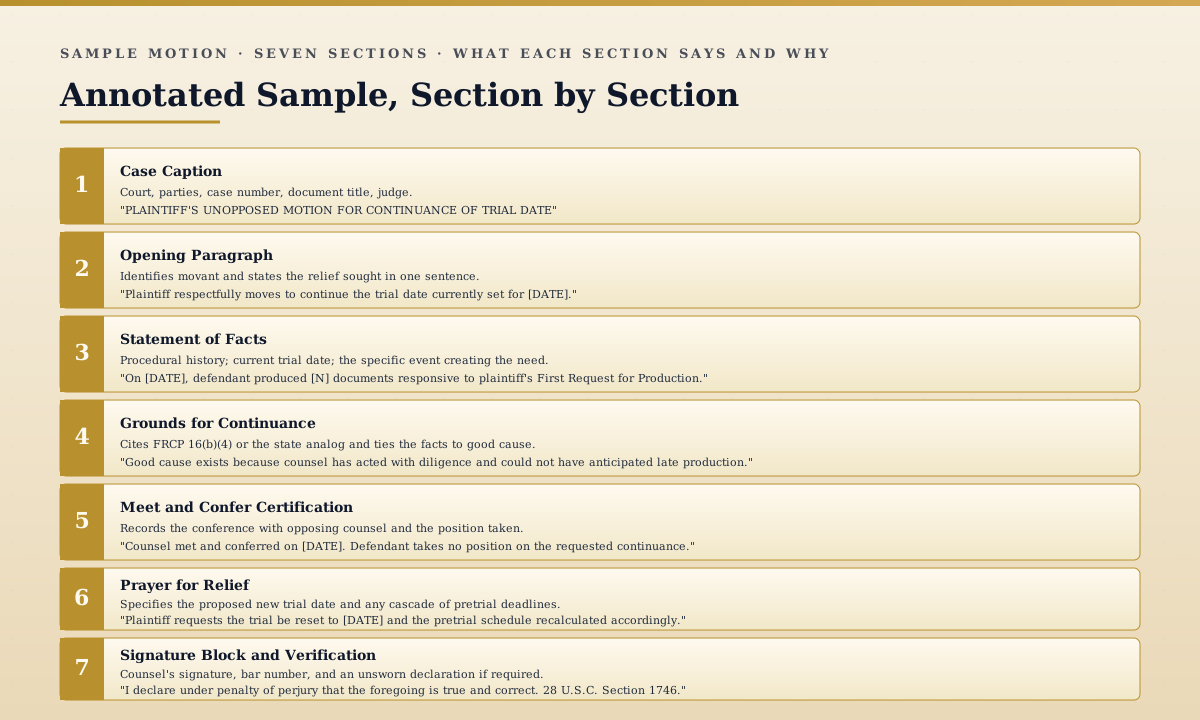
A sample motion for continuance contains seven discrete sections. Each section answers a question the court will ask before signing the proposed order, and each section has its own drafting discipline. The rendered sample below shows a Federal Rule 16(b)(4) good-cause continuance motion in attorney-grade form, with the seven sections fully populated. The annotated walkthrough that follows breaks the same document into its component parts so a drafter can see how each section maps onto the corresponding paragraph in the rendered motion.
            UNITED STATES DISTRICT COURT
            NORTHERN DISTRICT OF CALIFORNIA


[PLAINTIFF FULL LEGAL NAME],         )
                                     )
            Plaintiff,               )    Case No.
                                     )    [Case Number]
v.                                   )
                                     )    Judge [Last Name]
[DEFENDANT FULL LEGAL NAME],         )
                                     )
            Defendant.               )
_____________________________________)


PLAINTIFF'S UNOPPOSED MOTION FOR CONTINUANCE OF TRIAL DATE
       PURSUANT TO FED. R. CIV. P. 16(b)(4)


    Plaintiff [Plaintiff Full Legal Name] ("Plaintiff"),
by and through undersigned counsel, respectfully moves
this Court, pursuant to Federal Rule of Civil Procedure
16(b)(4) and Civil Local Rule 6-2, for an Order continuing
the trial currently set for [Original Trial Date] and
resetting the matter to the Court's next available trial
calendar no earlier than [Proposed Trial Date], together
with a corresponding adjustment of the remaining pretrial
deadlines under the Civil Case Management Order entered
[Date]. In support of this Motion, Plaintiff states:


I.   PROCEDURAL POSTURE

     1.  This action was filed on [Date of Complaint] and
         is set for jury trial on the Court's [Original
         Trial Date] calendar, with the Pretrial
         Conference set for [PTC Date], pursuant to the
         Civil Case Management Order entered [Date]
         (ECF No. [Entry]).

     2.  The parties have substantially completed fact
         discovery and are in the final phase of expert
         depositions. No prior continuance of the trial
         date has been requested.


II.  GROUNDS FOR CONTINUANCE UNDER RULE 16(b)(4)

     3.  A scheduling order may be modified only for good
         cause and with the judge's consent. Fed. R. Civ.
         P. 16(b)(4). The "good cause" inquiry turns
         principally on the diligence of the party
         seeking modification. Johnson v. Mammoth
         Recreations, Inc., 975 F.2d 604, 609 (9th Cir.
         1992). Good cause exists here for the reasons
         set out below:

         (a)  Material witness [Witness Name], whose
              testimony is central to the issue of
              [Issue], is unavailable for the current
              trial period due to [documented medical
              condition / military deployment under
              orders dated [Date] / prepaid international
              travel booked before the trial date was
              set]. Supporting documentation is attached
              as Exhibit A.

         (b)  On [Date of Production], Defendant produced
              [Volume] pages of responsive documents,
              which is [N] days before the original
              discovery cutoff. The late production
              requires Plaintiff to re-take the
              deposition of [Custodian] and to amend the
              expert report of [Expert Name]. The cover
              letter and Bates range are attached as
              Exhibit B.

         (c)  Undersigned counsel has been set for trial
              in [Conflicting Case Caption, Court, Case
              Number] beginning [Conflict Date], which
              under the first-in-time rule controls over
              this matter's current trial period. A copy
              of the conflicting Order Setting Trial is
              attached as Exhibit C.

     4.  Plaintiff has acted with diligence throughout
         the discovery period. The need for continuance
         arises from events outside Plaintiff's
         reasonable control and could not have been
         anticipated when the original schedule was
         entered.


III. MEET AND CONFER CERTIFICATION

     5.  Pursuant to Civil Local Rule 6-2,
         undersigned counsel certifies that on [Date],
         undersigned conferred by telephone with
         opposing counsel [Opposing Counsel Name]
         regarding the relief requested in this Motion.
         Defendant does not oppose the continuance and
         joins in the request for a coordinated
         pretrial-deadline adjustment.


IV.  PROPOSED RESCHEDULED DATES

     6.  Counsel for the parties have conferred and
         identified [Proposed Trial Date] as a date that
         works for the Court's calendar, all counsel,
         the named witnesses, and the experts of record.

     7.  Counsel have further agreed to the following
         coordinated pretrial-deadline adjustments:

         Expert Discovery Cutoff:    [New Date]
         Dispositive Motion Hearing: [New Date]
         Pretrial Conference:        [New Date]
         Jury Trial:                 [New Date]

     8.  A proposed Order continuing the trial and
         resetting the pretrial deadlines is attached as
         Exhibit D.


V.   CONCLUSION

    WHEREFORE, Plaintiff respectfully requests that this
Court enter an Order: (a) granting this Motion;
(b) continuing the trial currently set for [Original
Trial Date]; (c) resetting the trial to [Proposed Trial
Date]; (d) entering the coordinated pretrial-deadline
adjustments set forth in Paragraph 7 above; and
(e) granting such other and further relief as the Court
deems just and proper.


Dated: ____________, 20____.
        San Francisco, California


                     Respectfully submitted,


                     _______________________________________
                     [Attorney Name], Esq.
                     California Bar No. ______________
                     [Firm Name]
                     [Firm Address]
                     San Francisco, CA [ZIP]
                     Telephone: (___) ___-____
                     Email: __________________
                     Attorney for Plaintiff


    I declare under penalty of perjury under the laws of
the United States that the foregoing is true and correct.
Executed on _____________, 20____, at San Francisco,
California. 28 U.S.C. Section 1746.


                     _______________________________________
                     [Attorney Name], Esq.


================================================================
                  CERTIFICATE OF SERVICE
================================================================

    I HEREBY CERTIFY that on this _____ day of
________________, 20____, I caused the foregoing
PLAINTIFF'S UNOPPOSED MOTION FOR CONTINUANCE OF TRIAL
DATE and the accompanying Exhibits A through D and
proposed Order to be electronically filed with the Clerk
of the Court using the CM/ECF system, which will serve a
notice of electronic filing on all counsel of record,
including:

    [Opposing Counsel Name]
    [Firm Name]
    [Firm Address]
    [Email Address]


                     _______________________________________
                     [Attorney Name], Esq.
Sample federal Rule 16(b)(4) good-cause continuance motion body. The Florida Circuit Court 1.460 state-court variant on the companion blank fillable motion-to-continue template follows the same seven-section structure with the controlling rule paragraph substituted at Section II. The motion is calibrated to the controlling rule for the forum, the documented cause of the conflict, and the corroborating exhibits available on the record before retained trial counsel signs and files.
- 1
Case Caption
The court, the parties, the case number, the document title, and the assigned judge sit at the top of the first page.
"PLAINTIFF'S UNOPPOSED MOTION FOR CONTINUANCE OF TRIAL DATE"
- 2
Opening Paragraph
One sentence identifying the movant and stating the specific relief sought sets the table for the rest of the motion.
"Plaintiff respectfully moves the Court to continue the trial date currently set for [DATE]."
- 3
Statement of Facts
Procedural history, the current trial date, and the specific event creating the need for a reset belong in this section.
"On [DATE], defendant produced [N] documents responsive to plaintiff's First Request for Production."
- 4
Grounds for Continuance
Cite FRCP 16(b)(4) or the state-court analog and tie the recited facts to the good-cause standard the court applies.
"Good cause exists because counsel has acted with diligence and could not have anticipated late production of these documents."
- 5
Meet and Confer Certification
Record the conference with opposing counsel and the position taken; unopposed motions clear the docket fastest.
"Counsel met and conferred on [DATE]. Defendant takes no position on the requested continuance."
- 6
Prayer for Relief
Specify the proposed new trial date and request that the pretrial schedule be recalculated to match.
"Plaintiff requests the trial be reset to [DATE] and the pretrial schedule recalculated accordingly."
- 7
Signature Block and Verification
Counsel's signature, bar number, and an unsworn declaration under penalty of perjury where the local rule requires it.
"I declare under penalty of perjury that the foregoing is true and correct. 28 U.S.C. Section 1746."
Two drafting details deserve special attention. The proposed order attached to the motion should match the prayer for relief word for word; a proposed order that adds collateral relief or that asks for vague language often draws a hand-edited order back from chambers, which wastes time the movant rarely has. The certificate of service at the end of the bundle must state the date, the method, and every recipient by name; service defects are the most common procedural reason a well-drafted continuance motion gets delayed at the clerk's office.
Counsel who handle continuance motions alongside other non-dispositive motion practice often draw on the same drafting routines used for sanctions and discovery requests. The drafting service for a motion for sanctions targeting discovery abuse and bad-faith conduct relies on the same meet-and-confer scaffold and the same evidentiary attachment discipline a continuance motion does; litigators who write one well tend to write the other well. For further procedural background, the Cornell Legal Information Institute publishes the full text of the Federal Rules of Civil Procedure and the FRCP Rule 16 scheduling and management framework both of which control continuance practice in federal court.
How Courts Rule on the Request and Why the Outcome Depends on Diligence
A well-drafted, unopposed continuance motion that names the triggering event, attaches corroborating evidence, and reflects a documented meet-and-confer is granted in the great majority of cases on the papers within a week of filing. The court enters the proposed order, the docket reflects the new trial date, and the case proceeds on the revised schedule. This is the dominant outcome for continuance motions filed in sufficient time and supported by a clean diligence record.
Three outcomes account for the remaining minority of motions. The court may grant in part, resetting one specific deadline (the dispositive motion cutoff or the expert disclosure date) while leaving the trial date intact. The court may deny without prejudice, telling the movant the record is too thin and inviting a renewed motion with stronger supporting evidence. The court may deny outright, especially where the motion is filed close to trial without a diligence explanation or where the opposing party shows that an earlier motion on the same facts already cleared the calendar. Each of these outcomes is reviewable on appeal only for abuse of discretion, which is a stringent appellate standard.
Settlement is the dark horse of continuance practice. A substantial percentage of cases that reach the eve of trial settle in the window the continuance motion creates; the parties use the additional time to negotiate without the calendar pressure of an immediate trial date. Counsel who request a continuance should anticipate that the granted motion may shift the case toward settlement rather than toward a delayed trial, and the case strategy should adjust accordingly. The motion-for-default-judgment template is the adjacent procedural tool most likely to shape the negotiating posture during the continuance window.