Writing an Opposition to Motion That Persuades the Court to Deny the Relief Sought
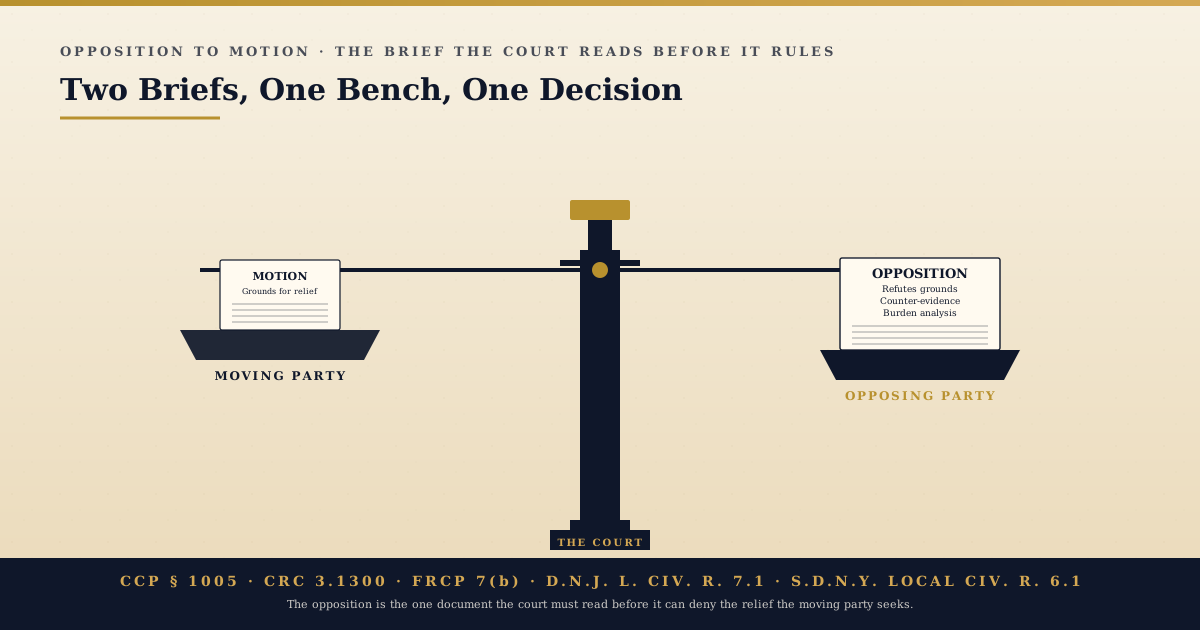
An opposition to motion is the written response the opposing party files asking the court to deny the relief the moving party seeks. The opposition is the one document the court must read before it can deny the motion. A strong opposition addresses the moving papers paragraph by paragraph, identifies the controlling burden of proof, marshals counter-evidence on the record, refutes the legal authority cited by the moving party, and proposes an alternative order denying the motion. This page walks the opposition to motion deadline california filers run on, the federal local-rule analogs, and a five-step drafting framework Legal Tank uses on every opposition brief regardless of the underlying motion.
Where the opposing party is filing a counter-motion alongside the opposition, see Professionally Drafted Cross-Motion for Summary Judgment Briefs and Rule 56 Opposition Filings for the parallel build, which combines the opposition memo with a cross-motion in a single set of papers.
When to File: Opposition to Motion Deadline California Filers Run On
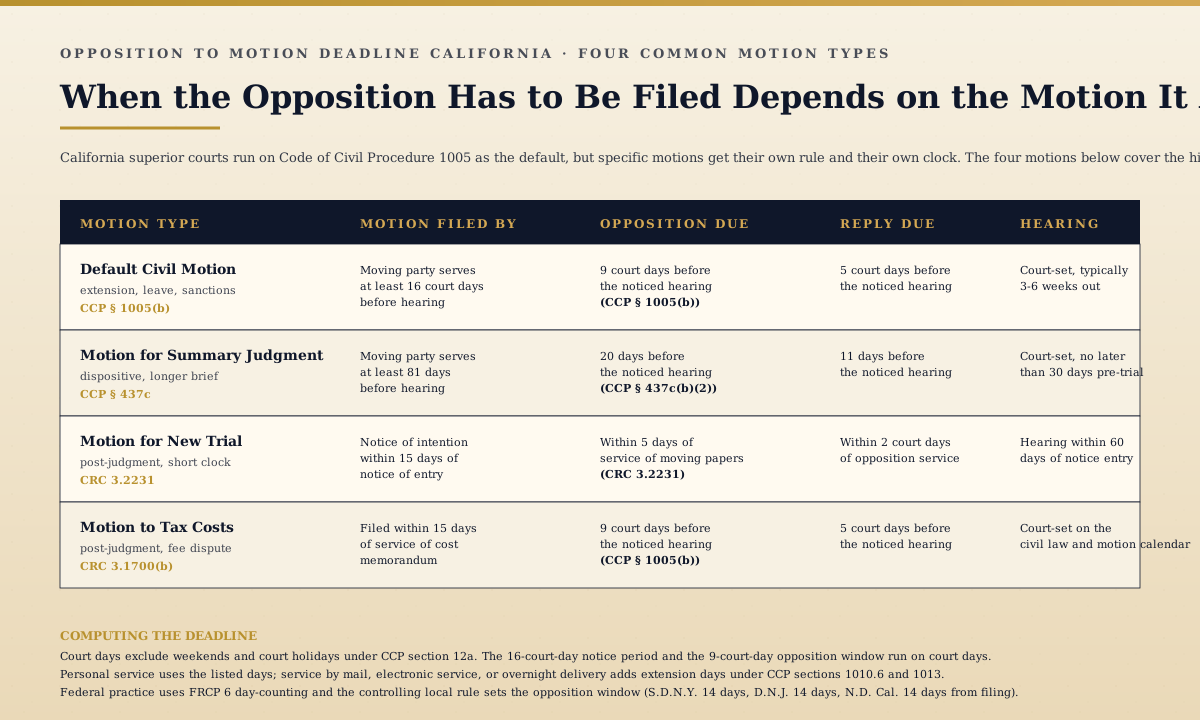
The opposition to motion deadline california filers face depends on which motion the opposition answers. California superior courts run on Code of Civil Procedure section 1005 as the default for civil law-and-motion practice, but specific motions have their own rules and their own clocks. The four motions below cover the highest-volume opposition windows in state-court practice.
The Default Clock Under CCP 1005
Under CCP 1005(b), the moving party serves and files the motion at least 16 court days before the noticed hearing. The opposition must be served and filed at least nine court days before the hearing. The reply must be served and filed at least five court days before the hearing. These windows are counted backward from the hearing date under CCP section 12c, excluding weekends and court holidays. Service by mail adds five calendar days to the moving party's notice period; electronic service adds two court days; overnight delivery adds two court days. The official text sits on Cornell LII at the Federal Rules of Civil Procedure root and the Rule 7 page.
Summary Judgment: The 81-Day Clock
CCP 437c(b)(2) sets the summary-judgment clock longer than the default. Moving papers serve at least 81 days before the hearing. The opposition must be served and filed at least 20 days before the hearing. The reply must be filed at least 11 days before the hearing. The 20-day window is jurisdictional in practice because most California superior courts will not consider a late-filed opposition on a dispositive motion. The opposition includes a separate statement of disputed material facts under CCP 437c(b)(3) addressing each undisputed fact the moving party asserted.
Motion for New Trial: The CRC 3.2231 Compressed Clock
California Rule of Court 3.2231 compresses the post-trial opposition clock significantly. The opposition must be served and filed within five days of service of the moving papers and may be no longer than 15 pages. The reply must be served and filed within two court days of service of the opposition and may be no longer than five pages. The hearing must be held within 60 days of the notice of entry of judgment because trial-court plenary power ends at that 60-day mark under CCP 660.
Federal Practice: Local-Rule Variations
The United States District Court sets the opposition deadline by local rule, with significant variation district to district. The S.D.N.Y. and the D.N.J. both default to 14 days from service of the moving papers. The Northern District of California defaults to 14 days from filing under N.D. Cal. L.R. 7-3(a). Massachusetts uses 14 days under D. Mass. L.R. 7.1(b)(2). Federal motion practice does not use court-day counting on the opposition window; the day count runs on calendar days with the FRCP 6(a) carry-over for weekends and holidays.
How Courts Read and Apply the Opposition to Motion
The court reads the opposition as the second paper in a defined briefing sequence (motion, opposition, reply, hearing), giving it the same record-weight as the motion it answers. Because the opposition is a response rather than a new claim, the trial judge evaluates it inside the four corners of the relief the moving party requested: every argument the opposing party raises has to track the legal theory and the factual record the motion put on the docket. Arguments outside that frame (separate causes of action, requests for affirmative relief, new claims) belong in a cross-motion or a counter-complaint and are routinely ignored when raised inside an opposition brief.
The movant (the moving party) bears the burden of proof on most motions. The opposition's first task is to identify the controlling burden and show the moving party has not satisfied it. On a motion to dismiss under FRCP 12(b)(6), the moving party has to show that the pleading fails to state a claim under the Twombly/Iqbal standard. On a motion for summary judgment under FRCP 56, the moving party has to show no genuine dispute of material fact on every element. On a motion for sanctions under FRCP 11, the moving party has to show specific bad-faith conduct or a frivolous pleading. The opposition tracks the controlling burden and refutes each prong.
The plaintiff and the defendant both write oppositions in the ordinary course. The plaintiff writes oppositions to motions to dismiss, motions for summary judgment, motions for sanctions, and motions in limine that the defendant files. The defendant writes oppositions to motions for leave, motions for summary judgment (where the plaintiff moves first), motions for sanctions, and motions to amend the complaint. The procedural slot is the same either direction.
Related anatomy. The opposition tracks the underlying motion. See Inside a Motion for Reconsideration Template and the Sections Courts Expect to See for the structure of the underlying motion the opposition answers, and the Anatomy of a Motion for Summary Judgment Template That Tracks Rule 56 Requirements explainer for the dispositive-motion variant.
What the Opposition Has to Contain
A complete opposition brief contains: (1) a caption identifying the court, parties, case number, and the hearing date; (2) a title naming the motion the opposition answers; (3) a statement of the controlling standard of review; (4) a factual statement on the record with citations; (5) a legal argument addressing each point the moving party raised; (6) a request for relief (denial of the motion plus, where local rule permits, fees and costs on the motion); and (7) a signature block under Rule 11 or its state analog. The memorandum of law attached to the opposition carries the legal argument and the supporting authority.
On summary-judgment oppositions in California, the opposition includes a separate statement of disputed material facts under CCP 437c(b)(3). On opposition briefs in New Jersey, the supporting certification under N.J. Court Rule 1:4-4(b) carries the contested facts. On opposition briefs in federal court, the supporting affidavit or declaration carries the same evidentiary role. The form varies; the substantive load on the opposition is the same.
When Litigators File an Opposition Motion and Why
Litigators file an opposition for three converging reasons. First, the opposition is the brief that defeats the underlying motion on the merits. A well-drafted opposition prevents the relief the moving party requested from issuing. Second, even when the underlying motion is likely to be granted on some grounds, the opposition narrows the scope of the order and preserves the opposing party's positions on the remaining issues. Third, the opposition is the procedural record the appellate court will read on later review; failure to oppose typically forfeits the issue on appeal.
On procedural motions (extensions of time, leave to file, motions to compel, motions for protective orders), the opposition usually negotiates rather than defeats: the opposition lays out a counter-proposal (a shorter extension, a narrower discovery scope, a tailored protective order) that the court adopts in place of the moving party's request. On dispositive motions (motion to dismiss, motion for summary judgment, motion for judgment on the pleadings), the opposition has to defeat the motion on its terms because granting the motion ends the case or a claim.
On post-judgment motions (motion for new trial, motion to vacate, motion for reconsideration), the opposition defends the judgment already entered. The opposing party in this posture is the party that won at trial or won the original ruling; the opposition asks the court to preserve the judgment against the post-judgment challenge. See also the related service-firm anatomy in Attorney-Prepared Motion of Contempt of Court for Enforcing Orders Against a Noncompliant Party for the enforcement variant where opposition briefing is common.
On New Jersey motions specifically, the opposing party files a certification rather than an affidavit under N.J. Court Rule 1:4-4(b). The certification carries the same evidentiary weight but does not require a notary. In the District of New Jersey, the opposition runs on D.N.J. Local Civil Rule 7.1 and is typically filed within 14 days of service of the moving papers. The certification attaches to the opposition brief as the sworn factual support for the contested facts.
Preserving the Record for Appellate Review
The opposition serves a second function the moving party rarely considers: it preserves the opposing party's position for the appellate docket if the motion is granted. A granted motion that was not opposed presents an undeveloped record on appeal and most circuits treat the unraised arguments as forfeited. A granted motion that was opposed on the record gives the appellate court the full developed posture, the burden-of-proof framework, the counter-evidence, and the controlling authority.
The meet and confer requirement imposed by many local rules also shapes the opposition. Where the moving party satisfied the meet-and-confer obligation but the parties could not agree, the opposition documents the meet-and-confer and explains why the opposing party rejected the proposed compromise. The court reads this section to evaluate whether the dispute was genuine before reaching the merits.
Related procedural framing. What a Legal Motion Is and the Vehicle Family That Opposition Briefs Respond To covers the broader motion-vehicle taxonomy that opposition briefs answer to across pretrial and post-judgment dockets.
How to Prepare an Opposition Motion, Step by Step
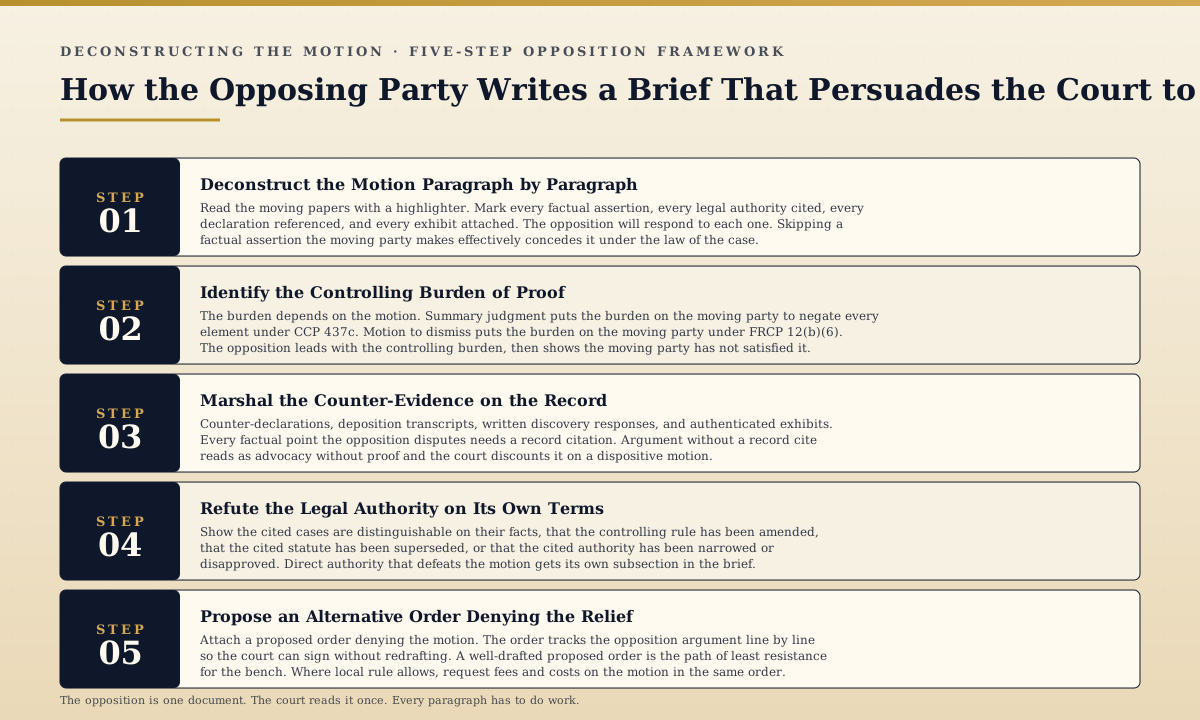
The opposition is one document. The court reads it once. Every paragraph has to do work. The five-step framework below is the way Legal Tank deconstructs the moving papers and builds an opposition that survives the reply and persuades the court to deny the relief.
- 01
Deconstruct the Motion Paragraph by Paragraph
Read the moving papers with a highlighter. Mark every factual assertion, every legal authority cited, every declaration referenced, and every exhibit attached. The opposition will respond to each one. Skipping a factual assertion the moving party makes effectively concedes it for purposes of the motion under the law of the case.
- 02
Identify the Controlling Burden of Proof
The burden depends on the underlying motion. Summary judgment puts the burden on the moving party to negate every element under CCP section 437c (or FRCP 56 in federal court). A motion to dismiss puts the burden on the moving party to show the pleading is deficient under FRCP 12(b)(6). A motion for sanctions under FRCP 11 puts the burden on the moving party. The opposition leads with the controlling burden and then shows the moving party has not satisfied it.
- 03
Marshal the Counter-Evidence on the Record
Counter-declarations, deposition transcripts, written discovery responses, authenticated exhibits, and any judicially noticeable material. Every factual point the opposition disputes needs a record citation. Argument without a record cite reads as advocacy without proof, and the court discounts it on a dispositive motion. Build a separate statement of disputed material facts where the local rule requires one (CCP 437c(b)(3) in California; equivalent federal local rules in many districts).
- 04
Refute the Legal Authority on Its Own Terms
Show that the cited cases are distinguishable on their facts, that the controlling rule has been amended, that the cited statute has been superseded, or that the cited authority has been narrowed or disapproved by later decision. Direct authority that defeats the motion gets its own subsection in the opposition brief. Authority cited by the moving party that the opposing party does not address is taken as conceded.
- 05
Propose an Alternative Order Denying the Relief
Attach a proposed order denying the motion. The order tracks the opposition argument line by line so the court can sign without redrafting. A well-drafted proposed order is the path of least resistance for the bench. Where the local rule allows fees and costs on the motion (FRCP 11(c)(2) inverse, CCP 128.5, or D.N.J. L. Civ. R. 11.1 in New Jersey practice), include the request in the order.
Common Drafting Failures the Court Reads as Concession
Defective oppositions cluster on a small number of failure modes. The opposition ignores a key factual assertion the moving party made; the court treats the silence as concession. The opposition argues the legal merits without addressing the controlling burden of proof; the court reads this as wandering off the rule. The opposition cites authority the moving party already distinguished in the reply; the court treats the issue as resolved on the moving party's side. The opposition asks for relief in the conclusion that the body of the brief did not develop; the court ignores the unsupported request. A complete opposition lands every argument it opens, with record citation and authority.
Service, Filing, and Calendar Mechanics
Serve the opposition on every party that has appeared in the action. File the opposition with the clerk by the deadline that controls the motion type (CCP 1005, CCP 437c, CRC 3.2231, or the federal local rule). E-file where the court requires it; pay any additional fee the local rule imposes on the opposition (most courts do not, but a handful do). Calendar the hearing date that the moving party noticed; the court rules on the motion at that hearing unless the motion is decided on the papers.
Service-firm oppositions. See Motion for Sanctions Drafting Service Targeting Discovery Abuse and Bad-Faith Conduct, Drafting Service for a Motion to Amend Pleadings After Discovery Reveals New Claims, and Motion for Judgment on the Pleadings Drafting for Civil Litigants Seeking Early Resolution for variant oppositions Legal Tank prepares on parallel motions. Anatomy of a Motion for Default Judgment and the Plaintiff's Burden Under FRCP Rule 55 covers the default-judgment posture an opposing party defends against.
Opposition to Motion Questions Filers Search For
Questions pulled from real Google People Also Ask data on opposition-brief searches. Answers framed to the way Legal Tank drafts and the way courts read these briefs in practice.