
By the Legal Tank editorial team
Six Professional Services Contracts We Draft
Our commercial attorneys draft the full range of legal services contract instruments that govern professional engagements: master services agreements, consulting contracts, independent contractor agreements, statements of work, software development agreements, and creative services contracts. Each instrument shares the same architecture (governing law, deliverables, fees, acceptance, IP, indemnity, remedies) but the clause weight shifts based on the engagement. A management consulting contract loads the methodology and deliverable-acceptance clauses; a software development agreement loads the IP and security-incident clauses; a creative services contract loads the moral-rights and portfolio-display carve-outs. Pairing the right base instrument with the right clause weighting is what keeps the contract enforceable rather than aspirational.
Under the Restatement (Second) of Contracts § 1, the contract is a promise for the breach of which the law gives a remedy, supported by mutual consideration: the client pays the fees, the provider furnishes the services. The clauses we draft turn that promise into an enforceable instrument by specifying performance, fixing the price, and pre-bargaining the consequences of non-performance. Generic contract templates rarely carry that calibration; reviewing a draft another party submitted is a different exercise covered by our contract review attorney work.
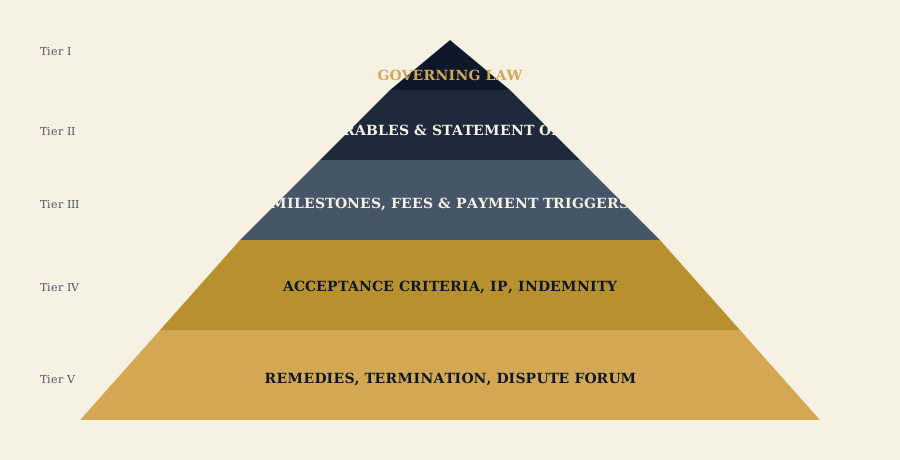
Master Services Agreement
The umbrella commercial framework that governs an open-ended provider relationship across multiple statements of work. Master services agreements set the universal terms (IP, indemnity, cap, dispute forum) once, then incorporate each engagement by exhibit. Used by clients who anticipate multiple engagements with the same provider and want to negotiate the heavy clauses one time.
Consulting Services Contract
Tailored for management consultants, marketing strategists, financial advisors, and similar engagements where the deliverable is the analysis, the report, or the implemented recommendation. Includes a methodology clause, deliverable acceptance criteria, and an IP assignment that captures the work product without overreaching into the consultant's pre-existing methodology.
Independent Contractor Agreement
Drafted to preserve independent-contractor classification under the IRS common-law test, which weighs behavioral control, financial control, and the relationship of the parties, and under the controlling state worker-classification framework (the economic-reality or ABC test, depending on the state). Addresses the right of control, the method of payment, the supply of materials, and the worker-classification representations the client needs to defend the engagement against a misclassification audit.
Statement of Work (Exhibit A)
The deliverable-level instrument that sits beneath a master services agreement or stand-alone professional services contract. Defines the in-scope work with specificity, the acceptance criteria each deliverable must meet, the milestone schedule, and the change-order mechanics that prevent scope creep from being absorbed without compensation.
Software Development Agreement
A specialized professional services contract covering custom code, integration work, and SaaS implementation. Sequences IP assignment around source code, addresses open-source attribution, allocates security-incident liability, and frames acceptance criteria with concrete pass-fail tests rather than subjective satisfaction language.
Creative Services Contract
Drafted for design firms, video producers, and content agencies. Splits ownership cleanly between the deliverable (assigned to the client on payment) and the agency's underlying tools, frameworks, and templates (retained by the agency under a perpetual license). Addresses moral rights, attribution, and the portfolio-display carve-out that creative providers require.
For ongoing or partnership engagements, the right instrument may be a partnership agreement rather than a services contract. For real-estate brokerage and listing engagements, our real estate contract counsel drafts the engagement on the appropriate state-specific framework. We can also pair the new agreement with a sample-driven walkthrough; see our annotated professional service contract sample for a clause-by-clause breakdown of a typical engagement.
What a Professional Services Contract Looks Like, Clause by Clause
Below is an annotated skeleton of the core clauses every professional services contract carries, with a short drafting note on what each clause is doing and where generic templates go wrong. The bracketed terms are the variables we calibrate to your engagement. This is an illustrative professional services contract sample for orientation, not legal advice; the operative language in your draft is tailored to the matter.
- 1.
Parties and Recitals
This Professional Services Agreement (the "Agreement") is entered into as of [Effective Date] by and between [Client Legal Name], a [State] [entity type] (the "Client"), and [Provider Legal Name], a [State] [entity type] (the "Provider"). The Client wishes to engage the Provider to perform the professional services described in Exhibit A, and the Provider wishes to perform those services on the terms set out below.
Drafting note: Identify each party by exact registered legal name and entity type; the recitals frame the consideration without creating standalone obligations.
- 2.
Scope of Services
The Provider shall perform the services described in the statement of work attached as Exhibit A (the "Services"). Any work outside the scope of Exhibit A shall be authorized only through a written change order signed by both parties.
Drafting note: Anchor scope to Exhibit A and route everything else through a change-order mechanism, the primary defense against uncompensated scope creep.
- 3.
Compensation and Payment
In consideration of the Services, the Client shall pay the fees set out in Exhibit B. Payment is tied to the milestones in Exhibit B and is due within [30] days of the Client's acceptance of each deliverable. A deliverable not rejected in writing within [10] business days of delivery is deemed accepted.
Drafting note: Milestone triggers plus a deemed-acceptance fallback convert delivery into a cash event and stop indefinite client review from stranding the Provider's revenue.
- 4.
Intellectual Property
Upon the Provider's receipt of full payment for a deliverable, the Provider assigns to the Client all right, title, and interest in the work product created specifically for the Client under this Agreement. The Provider retains ownership of its pre-existing materials, tools, and methodologies and grants the Client a non-exclusive license to use them solely as incorporated in the deliverables.
Drafting note: Sequence the assignment to full payment and carve out the Provider's pre-existing methodology so neither side over- nor under-transfers.
- 5.
Indemnification and Limitation of Liability
Each party shall indemnify the other against third-party claims arising from its breach of this Agreement. Except for claims arising from gross negligence, willful misconduct, breach of confidentiality, or infringement of third-party intellectual property, each party's aggregate liability shall not exceed the total fees paid under this Agreement.
Drafting note: Pair the liability cap (often the fees paid) with the carve-outs that punch through it; a balanced indemnity is what makes the rest of the risk allocation enforceable.
- 6.
Term and Termination
This Agreement begins on the Effective Date and continues until the Services are complete unless terminated earlier. Either party may terminate for material breach on [15] days' written notice if the breach is not cured within that period. The Client may terminate for convenience on [30] days' notice, in which case the Provider is paid for Services performed through the termination date.
Drafting note: Distinguish for-cause from for-convenience exits, each with its own notice period and corresponding fee and IP consequences.
- 7.
Governing Law and Dispute Resolution
This Agreement is governed by the laws of the State of [State], without regard to its conflict-of-laws rules. The parties shall attempt to resolve any dispute through good-faith negotiation, and failing that, through binding arbitration administered in [Venue], reserving the right to seek injunctive relief in court.
Drafting note: Fix the governing law and the escalation path at formation; an unspecified forum is litigated later at far greater cost.
- 8.
Insurance
Throughout the term, the Provider shall maintain, at its own expense, professional liability (errors and omissions) insurance with limits of not less than [$1,000,000] per claim covering the Services, and commercial general liability insurance with limits of not less than [$1,000,000] per occurrence. The Provider shall name the Client as an additional insured on the commercial general liability policy and shall furnish certificates of insurance on request.
Drafting note: Name the coverage the engagement actually needs: professional liability (E&O) responds to negligent performance of the Services, while commercial general liability with additional-insured status covers third-party bodily-injury and property-damage claims. Generic templates that say only insurance requirements leave both gaps open.
- 9.
Confidentiality and Survival
Each party shall protect the other's Confidential Information with at least reasonable care and shall use it solely to perform this Agreement. On termination or expiration, the receiving party shall, at the disclosing party's election, return or destroy the Confidential Information and certify that it has done so, except for archival copies and copies required to be retained by law. The confidentiality obligations, the intellectual property assignment, indemnification, the limitation of liability, and dispute resolution survive termination or expiration of this Agreement.
Drafting note: Confidentiality is meant to outlast the engagement, so pair the duty with a return-or-destroy-and-certify obligation and an express survival clause; trade-secret protection can run as long as the information stays secret.
- 10.
Force Majeure
Neither party is liable for a failure or delay in performance (other than a payment obligation) caused by an event beyond its reasonable control, including natural disaster, fire, flood, war, terrorism, epidemic, governmental action, or utility or telecommunications failure, provided the affected party gives prompt notice and uses commercially reasonable efforts to resume performance. If the event continues beyond [30] days, either party may terminate the affected portion of the Services.
Drafting note: Excuse non-performance for genuinely uncontrollable events, but carve out payment obligations and cap the excuse with a notice duty and a right to terminate if the disruption drags on.
- 11.
Non-Solicitation
During the term and for [12] months after termination, neither party shall knowingly solicit for employment any employee or contractor of the other who was directly involved in the Services, provided that general advertising and hiring of a person who responds to it independently are not a breach of this clause.
Drafting note: Protect each side's personnel investment with a reciprocal, time-bounded restriction while preserving ordinary-course hiring; keep the duration reasonable so the clause stays enforceable.
- 12.
Assignment and Subcontracting
Neither party may assign this Agreement without the other's prior written consent, except that either party may assign to a successor in a merger or a sale of substantially all of its assets on notice. The Provider may engage subcontractors to perform portions of the Services but remains responsible for their performance and for their compliance with the confidentiality and intellectual property obligations of this Agreement.
Drafting note: Control who may step into the contract and permit subcontracting while keeping the Provider primarily liable and binding any subcontractor to the same confidentiality and IP terms.
- 13.
General Provisions
If any provision of this Agreement is held unenforceable, the remaining provisions continue in full force and the unenforceable provision is modified to the minimum extent necessary to make it enforceable. This Agreement, together with its exhibits, is the entire agreement between the parties on its subject matter and supersedes all prior discussions and writings. Notices under this Agreement must be in writing and are effective when delivered to the address set out in the signature block or as later updated in writing.
Drafting note: The boilerplate that decides real disputes: severability preserves the deal if one clause fails, the entire-agreement (integration) clause bars stray side promises, and the notices clause fixes how and when formal communications count.
A complete professionally drafted agreement also adds representations and warranties, a compliance-with-laws clause, and a counterpart-execution block, each calibrated to the engagement. The clause skeleton above is the spine; the calibration is the work.
PSA vs MSA (and Where the SOW Fits)
A professional services agreement (PSA) governs a single, defined engagement: one scope, one fee arrangement, one set of deliverables. A master services agreement (MSA) is an umbrella contract that fixes the recurring commercial terms once (intellectual property, confidentiality, indemnity, liability cap, insurance, dispute forum) and then lets each new project attach as a separate statement of work (SOW) that defines only that project's scope, deliverables, timeline, and fees. The SOW is the deliverable-level instrument; the MSA is the framework that governs every SOW signed under it.
Use a stand-alone PSA when
The relationship is a one-off, or the parties do not expect repeat work. A single agreement carries both the framework terms and the project-specific scope, so there is nothing to reconcile against a separate umbrella. This is the cleaner instrument when there will be one engagement and one invoice cycle.
Use an MSA plus SOWs when
The same client and provider anticipate multiple engagements and want to negotiate the heavy clauses a single time. New projects then spin up quickly on a short SOW rather than a fresh full contract, which shortens the time from handshake to signature on each engagement.
In an MSA structure, the SOW controls the project-specific details and the MSA controls everything else. When the two conflict, an order-of-precedence clause in the MSA decides which document wins, and that clause is worth drafting deliberately: it is the single provision that determines whether a negotiated SOW term can override the umbrella. For clients scoping an ongoing relationship, we structure the contract drafting as an MSA with a reusable SOW form; for a single engagement, the stand-alone PSA above is the right instrument.
Service Legal Agreements: What Makes the Contract Actually Binding
People search for service legal agreements when what they mean is a services contract that will hold up: one a court will enforce and a counterparty cannot shrug off. Enforceability does not come from legal-sounding vocabulary. It comes from five elements every binding agreement needs: an offer, acceptance of that offer, consideration flowing both ways (fees for services), parties with capacity to contract, and a lawful purpose. A services agreement can satisfy all five in plain English on two pages, and a ten-page template stuffed with hereinafters can still fail on definiteness if nobody can say what performance was promised.
The practical additions that make a binding agreement useful in a dispute are specificity and signatures: a scope described concretely enough that breach is measurable, a price and payment schedule with no gaps, a governing-law clause so everyone knows which state's rules apply, and an execution block signed by someone with authority on each side. Most service contracts do not legally require notarization or a written form to bind, though certain categories (long-term deals under the statute of frauds, for one) must be in writing. When the stakes justify it, this is exactly the calibration a professionally drafted agreement delivers over a downloaded form.
Why Commercial Counsel Order a Fresh Drafting Engagement
In-house counsel and outside commercial attorneys order a freshly drafted professional services contract for the same reason every time: the existing template was written for a different engagement and is now misallocating risk on a matter that has grown beyond it. The most common drivers are scope creep without a change-order discipline, payment timing that leaves the provider exposed, ambiguous IP assignment that leaves the client paying without ownership, and an indemnity clause that either swallows the contract or evaporates on the facts that actually matter. Our drafts are calibrated against each of these failure modes from the first clause onward.
The other strategic driver is negotiating posture. A contract drafted on firm letterhead by a licensed commercial attorney signals to the counterparty that the matter is serious, that the calibration is intentional, and that any redline pushed back across the table will be evaluated against an attorney-grade standard rather than a template. That signaling materially affects how counterparties treat the negotiation. A weak base contract becomes the floor; a strong base contract becomes the ceiling. For in-house counsel and outside general counsel routing the matter, the engagement typically lands with a professional services contract attorney rather than a generalist; solo founders without dedicated in-house support route the same call to a professional services contract lawyer with commercial drafting experience. Either path delivers a contract for professional services on firm letterhead with the commercial services contract clause weighting matched to the engagement.
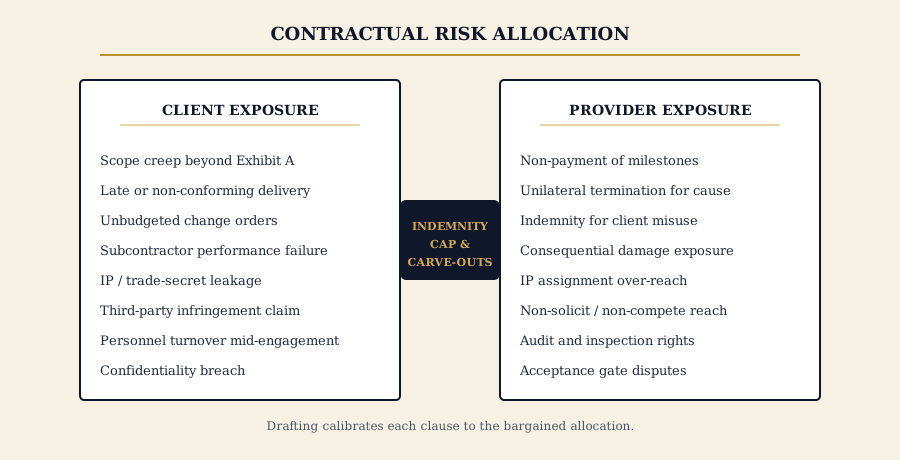
Scope Creep Containment
Without a written scope tied to acceptance criteria, every conversation becomes a candidate change request. The contract anchors the in-scope work to Exhibit A and routes anything outside through a change-order mechanism that ties new work to new fees.
Payment Discipline
Milestone-based payment triggers convert deliverable acceptance into a cash event. The contract pairs each deliverable with a payment percentage, a defined acceptance window, and a deemed-acceptance fallback that prevents indefinite client review from stranding the provider's revenue.
Intellectual Property Allocation
The IP clause sequences three transfers: pre-existing IP stays with each party, work product is assigned to the client on full payment, and the provider retains a license to use generic methodology and frameworks. Without that sequencing, providers either over-assign or clients pay without owning what they paid for.
Indemnity Cap & Carve-Outs
The indemnity clause identifies which claims each party covers, then pairs the cap (often the fees paid) with the carve-outs (gross negligence, willful misconduct, IP infringement, confidentiality breach) that punch through the cap. A balanced indemnity beam is what makes the rest of the risk allocation enforceable.
Ready to put your engagement on a calibrated contract?
Start Your Professional Services ContractInside Our Drafting Pipeline
Our drafting pipeline runs in four structured stages, each closing one risk before the next begins. We do not begin drafting until the engagement scope is mapped; we do not finalize until the exhibits are built; we do not deliver until you have a fourteen-day review window to surface anything that would otherwise be missed. The same drafter stays on the matter from intake to delivery so the calibration the engagement requires is not re-litigated between hand-offs.
Engagement Intake & Scope Mapping
We begin by mapping the engagement: who is performing the work, what deliverables are due, what milestones gate payment, and what conduct each side cannot accept. Our intake covers the parties' legal names, the principal place of business, the deliverable schedule, the fee structure, the renewal posture, and any pre-existing IP each side will bring to the engagement. The intake doubles as the data model for Exhibit A, which our drafters incorporate by reference rather than restating in the body.
Clause Calibration
Each clause is drafted to the bargained allocation. The scope clause references Exhibit A; the compensation clause references Exhibit B with milestone-payment triggers; the IP clause sequences the assignment so work product transfers only on full payment; the indemnity clause identifies covered claims and pairs the cap with the carve-outs; the termination clause distinguishes for-cause and for-convenience exits with the corresponding fee and IP consequences. Every clause is written in plain commercial English calibrated to the matter.
Exhibit Build & Signature Block
The exhibits are built next: Exhibit A as the statement of work with deliverables, acceptance criteria, and turnaround windows; Exhibit B as the fee schedule with payment milestones and any rush-rate language; Exhibit C, where applicable, as the change-order form. The signature block names the authorized signatories, recites the date of execution, and includes a counterpart and electronic-signature provision so the parties can execute without a single sit-down.
Review Window & Sign-Ready Delivery
You receive the full draft package and have a fourteen-day review window to request revisions. Common revision requests include adjusting the IP assignment trigger, narrowing the indemnity carve-outs, modifying the termination notice period, or adding state-specific dispute-resolution language. The reviewing attorney incorporates revisions and delivers the final sign-ready package as DOCX and PDF, with a counterpart-execution memo that walks both signatories through the order of operations.
For prospective clients still scoping the engagement, the right starting point is the calibration intake itself: identifying the parties, the deliverables, and the milestone-based payment triggers that the contract will codify. If you are starting from a base instrument and need definitional grounding, our contract for services explainer and the deeper services agreement template walkthrough cover the framework your provider or client is most likely to send across the table.
Engagement Paths, Turnaround, and Client Outcomes
A professional services contract engagement runs on one of two paths depending on the matter. An AI-assisted draft works for single-matter engagements with standard scope where a verified template structure and a same-day turnaround are the priority. A custom-drafted engagement is the right path when the indemnity cap, the IP-assignment trigger, the carve-outs, and the change-order mechanics need to be calibrated to the actual matter. The quote for either path is set at the free quote request, where complexity, party count, and any industry-specific clause work (software escrow, medical-data handling, regulated-industry reps and warranties) are mapped before the engagement begins.
Single matter, standard turnaround
- AI-generated professional services contract
- Scope, fees, IP, indemnity, and termination clauses
- Verified template structure
- Exhibit A statement of work skeleton
- DOCX and PDF delivery within 24 hours
Scope and quote set at intake
- Every clause drafted to your engagement
- Calibrated indemnity cap and carve-outs
- IP assignment sequenced to payment trigger
- Exhibits A through C built to your engagement
- Counterpart and electronic-signature provision
- Revisions included within 14-day review window
Rush Turnaround on Imminent-Execution Matters
For matters with imminent execution dates or board-meeting deadlines, rush turnaround is available on the custom-drafted track. Scope, urgency, and the corresponding quote are confirmed at intake. Drafting begins after the engagement is confirmed. If a downstream contract dispute develops, the calibrated base contract gives counsel a stronger position to litigate from.
Frequently Asked Questions
Common questions about the professional services contract framework, the Restatement basis, and the bargained allocation between client and provider.