By the Legal Tank editorial team
When Clients Hire Us for a Contract Lease
Most clients arrive after a generic template has failed them. The eviction took eight months instead of three because the notice provision did not match state statute. The commercial tenant exploited an ambiguous operating-expense definition. The lease-to-own buyer disappeared and the option-forfeiture clause turned out to be unenforceable. A properly drafted contract lease prevents each of those outcomes by sequencing the obligations correctly at formation rather than relying on judicial reformation later. Under the Restatement (Second) of Contracts § 1, the lease is a contract supported by mutual consideration; under state real-property statute, it is also a conveyance of a leasehold estate. Federal overlays attach at signing for residential matters: the lead-based paint disclosure rule (42 U.S.C. § 4852d) and the Fair Housing Act. Both layers must hold for the instrument to survive a material breach dispute.
We work three primary lease use cases. Each is distinct in clause weight and in the failure modes that drive disputes. For background reading on the legal framework, the related guide on what is a lease contract walks through the doctrine. For sample language and structure, see the annotated contract lease sample below. For the underlying fillable form, our lease template walkthrough covers the form-fillable layer.
Residential Lease Drafting
Single-family rentals, multi-unit apartment leases, and condo or co-op rentals where the tenant is occupying the property as a primary or secondary residence. Our drafters address state-specific security-deposit caps, statutorily required disclosures (HUD lead-based paint, mold, bedbug history, flood zone), Fair Housing Act tenant-screening compliance, and the notice-to-cure periods that govern eviction in your jurisdiction. Drafted to survive an eviction proceeding rather than merely look good at signing.
Commercial Lease Drafting
Office, retail, industrial, and mixed-use commercial leases for tenants ranging from a single storefront to a multi-floor headquarters. Commercial leases turn on the rent escalators, the operating-expense pass-through methodology, the use clause and exclusives, the tenant-improvement allowance, and the assignment-and-subletting provisions. We draft each provision to the actual deal terms rather than to a generic form, with attention to the CAM reconciliation and the surrender condition at expiration.
Lease-to-Own and Option Contracts
Lease-to-own and lease-with-option-to-purchase instruments where the tenant pays rent toward an eventual purchase. The drafting risk is the option clause itself: how the option is exercised, what portion of paid rent applies to the purchase price, what happens if the option is not exercised, and how the tenant-buyer is protected against the landlord's intervening transfer or financing. We address each option-mechanic in plain commercial English and route the title-transfer steps through the closing instructions.
How We Draft and Deliver Your Contract Lease
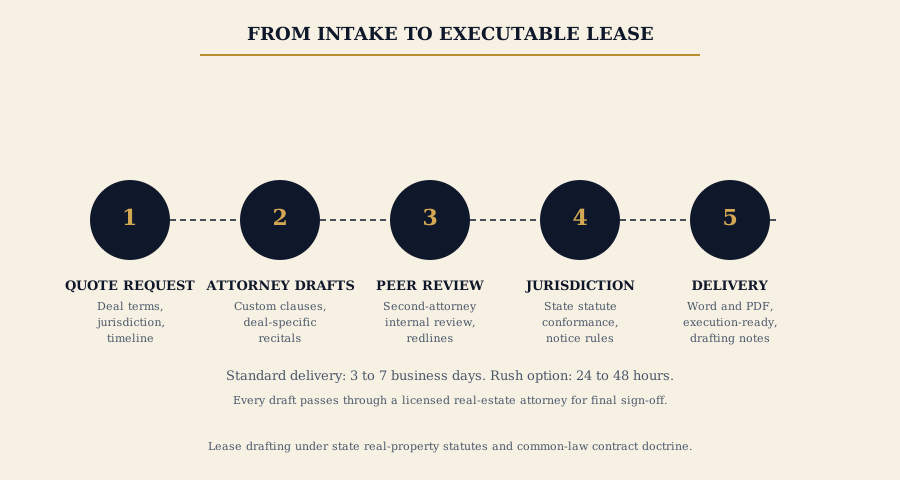
Our drafting pipeline runs five stages. Each stage produces a checkpoint deliverable and each checkpoint reduces the chance of a clause failure surfacing later. The pipeline is the same whether the matter is a $1,800-per-month residential lease or a multi-million-dollar commercial buildout, with the document weight scaling to the engagement.
- 01
Quote Request (Same-Day)
We capture the deal terms at intake: parties, premises, term, rent, security deposit, special covenants. The intake doubles as the data model for the draft, so the drafter is not chasing missing facts during drafting. For commercial deals we also capture the use clause, exclusives, escalators, and operating-expense methodology. Most intakes complete in 30 minutes.
- 02
Provision-by-Provision Drafting
Each provision is drafted to the bargained allocation. The premises clause references the recorded legal description; the term clause sets commencement, expiration, and renewal mechanics; the rent clause includes any escalators and late-fee schedule; the default and remedies clause sequences notice, cure, and termination consistent with state statute; the indemnity and insurance clause sets the certificate-of-insurance floor and the mutual-indemnity beam.
- 03
Internal Peer Review
A second reviewer checks the draft against our checklist of 47 lease-specific failure modes: missing notice address, mismatched commencement and rent-start dates, security-deposit cap overflows, prohibited assignment-restraint language, ambiguous holdover provisions, and the dozens of other issues that surface only on the second read. Peer review is built into our delivery timeline at no additional cost.
- 04
Jurisdictional Conformance Check
Real-estate law is state-specific. We conform the draft to the controlling state's lease statute (Florida Chapter 83, California Civil Code 1940 et seq., New York RPL Article 7, and so forth) and to local ordinances where they bite (rent control, source-of-income protections, just-cause eviction overlays). Cross-referencing local rules during drafting prevents the common error of a generic form running into a state-specific tenant protection at enforcement.
- 05
Sign-Ready Delivery
You receive the final draft as DOCX and PDF, with a counterpart-execution memo, an addenda packet (security deposit receipt, lead-based paint disclosure where applicable, move-in inspection form), and a brief drafting note that highlights the three or four provisions worth reading once before execution. Standard turnaround is 3 to 7 business days; rush option closes in 24 to 48 hours.
For matters that involve adjacent commercial relationships, our real estate contract drafting team handles purchase agreements, deeds, and closing instruments alongside the lease drafting. For complex deal stacks involving multiple parties, our partnership agreement walkthrough covers the joint-venture overlay.
What the Finished Contract Lease Contains
Every lease of contract we deliver follows the same twelve-section spine. The spine does not vary; the clause weight does. A residential lease front-loads the security-deposit, statutory-disclosure, and habitability provisions; a commercial lease front-loads the operating-expense, tenant-improvement, and assignment provisions; a lease-to-own front-loads the option mechanics and forfeiture schedule. The drafter calibrates which sections do the heavy lifting, but the spine guarantees nothing important is dropped.
The anatomy below covers each section briefly. For a longer practice-oriented walkthrough, the related explainer on how to write a contract pairs each contract concept with sample drafting language; if the negotiation has already broken down, our contract dispute drafting service addresses enforcement and remedies.
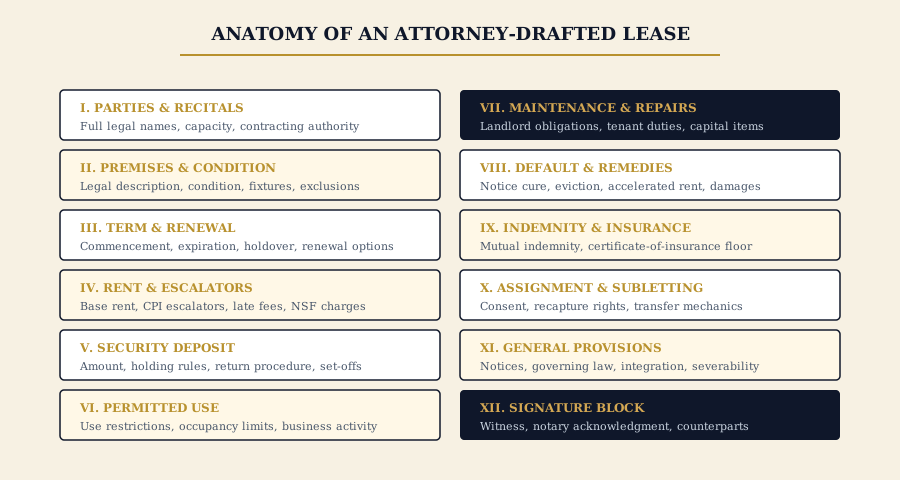
Parties and Recitals
Full legal names of landlord and tenant, contracting capacity, the recital that grounds the bargain, and any guarantor or co-tenant signature blocks.
Premises and Condition
Legal description, fixtures included or excluded, condition at commencement, and the move-in inspection protocol that documents the baseline.
Term and Renewal
Commencement date, expiration date, holdover mechanics (often elevated rent), and renewal options where the parties have bargained for them.
Rent and Escalators
Base rent, payment timing, late-fee schedule, NSF charges, and any consumer-price-index or fixed-percentage escalator that changes rent over time.
Security Deposit
Amount, holding requirements (separate account, interest accrual where required), itemized return procedure, and the set-off rules for damages beyond ordinary wear.
Permitted Use
Use restrictions, occupancy limits, business-activity provisions for commercial leases, and the prohibited-use schedule that protects landlord interests.
Maintenance and Repairs
Landlord obligations (structural, code-compliance, capital systems), tenant duties (interior maintenance, ordinary repairs), and the line that splits capital from operating items.
Default and Remedies
Notice of default, cure window, eviction process consistent with state statute, accelerated rent provisions, and the remedies architecture for breach.
Indemnity and Insurance
Mutual indemnity for third-party claims, certificate-of-insurance floor, additional-insured status, and the waiver-of-subrogation language for subrogation control.
Assignment and Subletting
Consent standards, recapture rights for landlord, transfer mechanics, and the underlying lease retention question that distinguishes assignment from sublet.
General Provisions
Notices to address, governing law, entire-agreement and no-oral-modification clauses, severability, and the attorneys-fees provision for prevailing-party recovery.
Signature Block
Authorized signatories named, witness or notary acknowledgment where the state requires it, counterparts provision, and the date of execution.
What a Professionally Drafted Lease Looks Like, Clause by Clause
The anatomy above lists what each section does; below is the actual language, annotated. The bracketed terms are the variables our lease drafter calibrates to your property, parties, and jurisdiction. This is an illustrative contract lease sample for orientation, not legal advice; the operative language in your draft is conformed to your controlling state statute.
- 1.
Parties and Premises
This Lease is entered into on [Date] between [Landlord Legal Name] ("Landlord") and [Tenant Legal Name] ("Tenant"). Landlord leases to Tenant the premises at [Property Address], together with [parking/storage/fixtures], for residential use only.
Drafting note: Name the parties by full legal name and describe the premises precisely; an imprecise premises description is a recurring source of disputes over what was actually leased.
- 2.
Term and Holdover
The term begins on [Commencement Date] and ends on [Expiration Date]. If Tenant remains in possession after expiration without a renewal, the tenancy converts to month-to-month, terminable on [30] days' written notice, and holdover rent accrues at [amount or percentage of base rent].
Drafting note: Set commencement, expiration, and holdover mechanics explicitly; silence on holdover is what lets a tenant overstay at the old rate.
- 3.
Rent and Late Fees
Tenant shall pay rent of $[Amount] per month, due on the [1st] of each month at [payment address or method]. Rent received after the [5th] incurs a late fee of [amount permitted by state law]. Rent is payable without setoff except as the law allows.
Drafting note: Tie the late fee to what state law permits; an excessive late fee is unenforceable and can taint the rent clause.
- 4.
Security Deposit
Tenant shall deposit $[Amount] as a security deposit, held [in a separate account / as state law requires]. Landlord shall return the deposit, less lawful deductions itemized in writing, within [the period set by state statute] after Tenant surrenders the premises.
Drafting note: Security-deposit handling and the itemized-return deadline are heavily regulated and vary by state; missing the statutory deadline can forfeit the landlord's deductions and trigger penalties.
- 5.
Use, Maintenance, and Condition
Tenant shall use the premises solely as a private residence, keep them clean, and comply with applicable law. Landlord shall maintain the structure, common areas, and code-required systems; Tenant shall promptly report needed repairs and is responsible for damage beyond ordinary wear.
Drafting note: Split landlord and tenant repair duties on the capital-versus-ordinary line, and preserve the implied warranty of habitability most states impose on residential landlords.
- 6.
Default and Remedies
If Tenant fails to pay rent or breaches any term, Landlord shall give written notice and [the cure period required by state law] before pursuing eviction and other remedies available at law. Notice shall be delivered to the address in the General Provisions section by the method the controlling statute requires.
Drafting note: The notice-and-cure sequence must track the controlling state eviction statute exactly; a defective notice is the single most common reason an eviction is dismissed and has to restart.
Prefer to start from a fillable form? Our residential lease template and free rental agreement template give you the form-fillable layer. Bring the result here when you want it calibrated to your jurisdiction and made enforceable in an eviction or deposit dispute.
Pricing Tiers and Same-Week Delivery
Flat-fee pricing across our contract lease drafting service: a fixed quote on every residential contract for lease, custom quotes on commercial and lease-to-own where the deal economics drive the drafting weight. Standard turnaround is 3 to 7 business days for residential, 5 to 10 for commercial and lease-to-own. A 24 to 48 hour rush option is available for residential matters at a documented surcharge, and we never bill hourly during drafting; the price you see at intake is the price we deliver to.
Residential Lease
- Professionally drafted to your state's requirements
- State-specific statutory disclosures
- Move-in inspection form included
- Counterpart and e-signature ready
Commercial Lease
- Office, retail, or industrial use cases
- Operating-expense and CAM provisions
- Tenant-improvement allowance language
- Use clause, exclusives, and assignment
Lease-to-Own
- Option clause with exercise mechanics
- Rent-credit-toward-purchase ledger
- Title transfer and closing path
- Default and forfeiture sequencing
Pricing covers the drafting, peer review, jurisdictional conformance check, and one round of revisions. Additional revision rounds, addenda built after delivery, and post-execution amendments are billed at a documented hourly or flat-fee rate quoted at the time of request. We do not double-bill against the original drafting fee.
Frequently Asked Questions
Common questions about the contract to lease, the drafting process, and pricing.