How a Preferential Trade Agreement Is Structured
The legal structure of a preferential trade agreement tracks one of three patterns recognized under WTO regional-trade-agreement rules: the customs union, the free trade area, and the partial-scope agreement. Each tier offers a different bargain between depth of integration and political flexibility, and each is governed by a different combination of GATT Article XXIV, the Enabling Clause, and the agreement's own internal procedures.
The Anti-Counterfeiting Trade Agreement illustrates a fourth, less common form: a plurilateral enforcement instrument narrowly focused on intellectual-property protection. Although ACTA was signed by several developed economies in 2011, the European Parliament rejected it in 2012, and the agreement never reached the threshold for entry into force. The structure remains a useful comparator because it shows what a preferential trade agreement looks like when narrowed to a single subject matter.
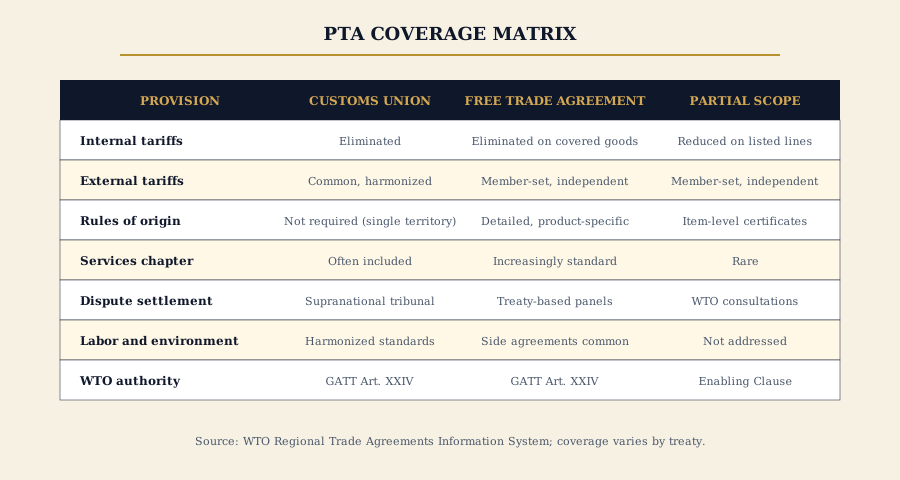
Customs Union
- Common external tariff schedule
- Internal duty-free trade across all members
- Single trade-policy voice in WTO negotiations
- Supranational dispute mechanism in mature unions
European Union, Mercosur, East African Community, Andean Community
Free Trade Agreement
- Tariff elimination on covered goods between members
- Each member retains its own external tariff schedule
- Detailed product-specific rules of origin
- Treaty-based dispute panels with set timelines
USMCA, KORUS, CPTPP, EU-Korea FTA, US-Australia FTA
Partial-Scope Agreement
- Tariff cuts on a specified list of products only
- Sector-specific or commodity-specific concessions
- Lighter rules of origin and certification requirements
- Often a stepping-stone toward a broader free trade deal
SAFTA, Generalized System of Preferences, bilateral PSAs
For a treatment of how ordinary commercial parties structure binding agreements, the related guide on the contract definition framework walks through the six formation elements that anchor private contracts under domestic law. Treaties operate at a higher level of abstraction, but the underlying logic of offer, acceptance, and binding obligation is the same.
Why States Enter a Preferential Trade Agreement
Sovereign states do not negotiate trade agreements lightly. The instrument constrains domestic policy, exposes the executive to ratification politics, and often requires legislative implementation acts. The four structural drivers below explain why states accept those costs. Each driver is visible in the negotiating record of every modern PTA, from the deeply integrated customs unions to the narrowly drawn plurilateral enforcement instruments like ACTA.
Market Access for Exporters
Preferential tariff reductions give domestic exporters cost advantages over third-country competitors in the partner market. The advantage is preserved by rules of origin that prevent transshipment from non-members. For agricultural and manufacturing economies, market-access guarantees in a preferential trade agreement directly support employment and capital formation in tradable sectors.
Regulatory Coherence and Investor Confidence
Modern agreements include investment chapters, regulatory transparency commitments, and intellectual-property enforcement provisions. The Anti-Counterfeiting Trade Agreement is the canonical example of a plurilateral instrument focused on intellectual-property enforcement; though never widely ratified, the negotiating text shaped IP chapters in subsequent free trade agreements. Investor confidence rises when treaty rules constrain arbitrary regulatory action, lowering the cost of capital for cross-border projects.
Geopolitical Alignment and Coalition-Building
Trade agreements anchor diplomatic relationships in legally binding obligations. Membership signals long-term alignment, encourages sectoral cooperation, and creates institutional channels for managing inevitable trade frictions. The geopolitical dimension explains why some negotiations move quickly while economically equivalent deals between less-aligned partners stall for years.
Domestic Reform Through External Commitment
Governments often use trade negotiations to lock in domestic reforms that are difficult to enact unilaterally. Tariff reductions become irreversible obligations, regulatory upgrades acquire treaty backing, and investment-climate improvements gain external monitoring. The same dynamic that drives a private commercial party to seek a binding written contract drives a sovereign to seek a treaty.
The four drivers also explain why agreements with similar economic logic move at very different political speeds. An agreement that fits all four drivers (market access plus regulatory upgrade plus geopolitical alignment plus domestic-reform anchor) tends to move quickly through ratification. An agreement that satisfies only one or two of them, like ACTA, often stalls. Practitioners advising on cross-border commerce read the political-economy fit of each agreement before pricing the long-term risk of a counterparty operating under it.
How Negotiations Move from Scoping to Entry Into Force
The six-phase lifecycle below applies whether the negotiation is a comprehensive customs-union treaty or a narrow bilateral trade deal. Phase length varies dramatically: scoping can take a year or a decade, ratification can move in months or stall indefinitely. The China Trade Agreement of January 2020, formally called the Phase One Economic and Trade Agreement, completed the first four phases in under two years but skipped traditional ratification because the United States structured its commitments as executive action. That structural choice produced both speed and durability risk.
Practitioners advising clients on cross-border commercial obligations need to know which phase the relevant agreement has reached. A treaty in scoping is a policy signal. A treaty signed but unratified is a political risk that can collapse with an electoral transition. A treaty in entry-into-force is an enforceable instrument with its own dispute mechanism. Closely related disputes about breach of contract enforcement follow a similar maturity sequence at the private-law level.
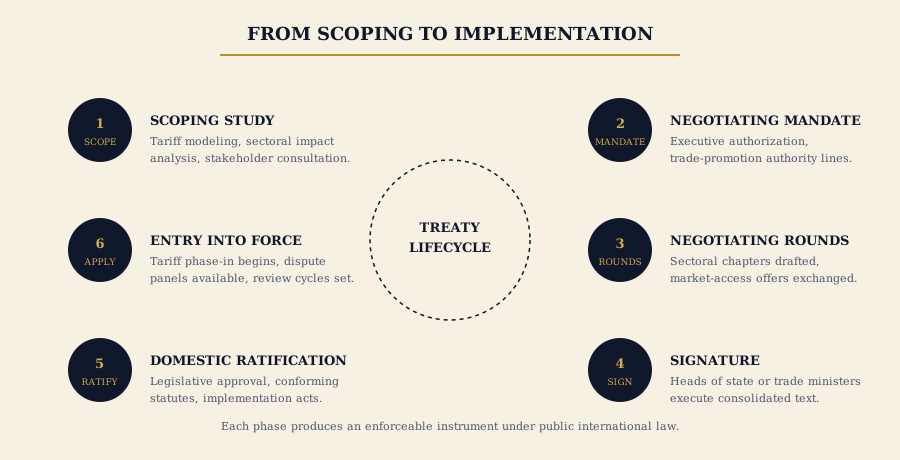
Scoping Study
Tariff modeling, sectoral impact analysis, and stakeholder consultation. Agencies model gains and losses by industry; ministries weigh the political economy of concessions; the executive determines whether the bargain is worth pursuing.
Negotiating Mandate
Executive authorization of negotiating priorities and red lines. In the United States, trade-promotion authority lines determine the speed of legislative review; in parliamentary systems, the cabinet typically authorizes the negotiating brief.
Negotiating Rounds
Sectoral chapters drafted by working groups; market-access offers exchanged; technical annexes developed. The most contested chapters (services, IP, agriculture) often run on separate tracks with their own deadlines and political escalation paths.
Signature
Heads of state or trade ministers execute the consolidated text. Signature creates an obligation not to defeat the object and purpose of the treaty pending ratification but does not yet create binding tariff concessions.
Domestic Ratification
Legislative approval, conforming statutes, and implementation acts. The China Trade Agreement of 2020, formally the Phase One Economic and Trade Agreement, is a useful comparator: although the United States and China signed and applied it, the instrument was not subject to traditional treaty ratification because its commitments were structured as executive action.
Entry Into Force
Tariff phase-in begins, dispute panels become available, and review cycles are calendared. Most modern agreements include built-in review clauses (USMCA Article 34.7, for example, calls for a six-year joint review) so the parties can adjust to changed circumstances without renegotiating from scratch.
The lifecycle is iterative rather than purely linear in mature systems. Built-in review clauses let parties reopen specific chapters without reopening the whole treaty, which allows the instrument to adapt to changed circumstances without repeating the full negotiation. For a related procedural framework at the private-commercial level, our partnership agreement guide walks through the equivalent lifecycle for a private joint venture, where the formation, execution, and amendment phases produce many of the same friction points the trade negotiator faces at sovereign scale.
Four Outcomes: USMCA, TPP, the China Phase One Deal, and ACTA
Outcomes from preferential trade agreements range across a wide spectrum: durable success, partial implementation, indefinite stall, and outright collapse. The US-China Phase One Economic and Trade Agreement of January 2020, often informally called the China US trade agreement, illustrates one operating mode in which speed of execution is bought at the cost of durability. The Office of the United States Trade Representative publishes the full list of free-trade and preferential agreements the United States is party to. Each of the four scenarios below shows what a different outcome path looks like in practice and what makes the difference between a treaty that survives and a treaty that does not.
For a complementary analysis at the private commercial level, our contract drafting service covers the equivalent drafting work for ordinary commercial contracts. The patterns are surprisingly similar: precise drafting, durable form, and aligned political incentives drive the difference between an instrument that lasts and one that does not.
Successful Outcome: USMCA Replacing NAFTA
The United States-Mexico-Canada Agreement, signed in 2018 and entering into force in 2020, replaced the original North American Free Trade Agreement. The renegotiation tightened automotive rules of origin, added a labor-rights enforcement mechanism unique to that agreement, and created a sunset provision requiring affirmative renewal at six and sixteen years. The instrument is the working model for what a successful modern preferential trade agreement looks like in operation.
Stalled Outcome: TPP and the Withdrawal Risk
The original Trans-Pacific Partnership was signed in 2016 and then abandoned by the United States in 2017 before ratification. The remaining eleven signatories restructured the deal as the Comprehensive and Progressive Agreement for Trans-Pacific Partnership, which entered into force in 2018 with several US-favored provisions suspended. The episode illustrates the political risk that a signed but unratified treaty carries, particularly across an electoral transition.
Limited Outcome: The US-China Phase One Deal
The Phase One Economic and Trade Agreement between the United States and China was signed in January 2020. It addressed intellectual-property enforcement, technology transfer, agricultural purchases, and currency commitments. The deal was structured as an executive instrument rather than a ratified treaty, which gave it speed at the cost of durability; subsequent administrations adjusted enforcement priorities. The episode highlights that the legal form of a preferential trade agreement matters as much as its substantive provisions.
Failed Outcome: ACTA and the Ratification Trap
The Anti-Counterfeiting Trade Agreement was negotiated by a coalition of developed economies between 2008 and 2011 to strengthen intellectual-property enforcement against counterfeit goods. Despite signature by the United States and several partners, ratification stalled in Europe after the European Parliament voted to reject the instrument in 2012. The negotiating text nonetheless influenced IP chapters in later agreements, demonstrating that an unratified deal can still shape the law through subsequent practice.
How Preferential Trade Agreements Grew Out of the GATT/WTO System
The legal architecture of every preferential trade agreement traces back to Article XXIV of the General Agreement on Tariffs and Trade (GATT 1947), which permits free-trade areas and customs unions as an explicit exception to the most-favored-nation principle. Without that exception, a country granting tariff cuts to one trading partner would have to extend the same cut to all 166 WTO members. Article XXIV instead allows two or more economies to lock in deeper-than-MFN access for each other, provided the agreement covers "substantially all the trade" between them and does not raise duties against third countries. The corresponding rule for services-only agreements lives in Article V of the General Agreement on Trade in Services (GATS), which requires substantial sectoral coverage and the elimination of substantially all discrimination among the parties.
Between 1948 and 1994, only a handful of regional blocs (the European Economic Community, EFTA, and the U.S.-Canada Free Trade Agreement) invoked Article XXIV. After the Uruguay Round established the World Trade Organization in 1995, the count exploded: more than 350 regional and bilateral agreements are now in force, and almost every WTO member is party to at least one. NAFTA entered into force in January 1994, ran for 26 years, and was replaced by the United States-Mexico-Canada Agreement (USMCA) on July 1, 2020. Other major architectures include the European Union (a full customs union with a common external tariff), the African Continental Free Trade Area (covering 1.3 billion people across 54 countries), the Comprehensive and Progressive Agreement for Trans-Pacific Partnership (CPTPP), and the Regional Comprehensive Economic Partnership (RCEP).
Tariff schedules and rules of origin
Every preferential agreement publishes tariff elimination schedules: staged commitments to phase out duties on listed product categories over five, ten, or fifteen years. Sensitive sectors (typically agriculture, textiles, sugar, dairy, and certain auto categories) are often carved out, given longer staging, or held to tariff-rate quotas instead of full elimination. Because the preference attaches only to goods actually originating in a party country, every agreement is paired with detailed rules of origin: qualifying criteria expressed as regional value content percentages, tariff-shift tests, or specific manufacturing processes. Importers must self-certify origin on the entry summary (CBP Form 7501 in U.S. practice) and retain documentation for the period set by the agreement, typically five years.
Dispute settlement and safeguard mechanics
Modern preferential agreements almost always include a state-to-state dispute settlement chapter, a separate investor-state dispute settlement mechanism (in older models) or an investment court system (in newer EU agreements), and a safeguards regime allowing temporary tariff reimposition when a domestic industry suffers serious injury from a surge of preferential imports. Anti-dumping and countervailing-duty actions remain available under WTO rules even between preferential partners, with USMCA Chapter 10 panels preserving binational review of the same. A party that believes the other is in breach of its tariff or services commitments invokes consultations first, then a panel; the panel report can authorize retaliatory tariff suspension calibrated to the value of the impaired commitment.
Economic effect: trade creation versus trade diversion
Trade economists since Jacob Viner have measured every preferential bloc by two opposing effects. Trade creation occurs when an import previously sourced from a high-cost domestic producer shifts to a more efficient producer inside the preferential zone, raising welfare. Trade diversion occurs when the import shifts away from a more efficient producer outside the zone (now disadvantaged by the MFN duty) to a less efficient producer inside the zone, lowering welfare. Empirical studies of USMCA, the EU single market, and the CPTPP generally find creation outweighs diversion for the participating economies but produces measurable losses for excluded efficient producers: the central reason third countries push for accession or for parallel preferential treaties of their own.
The Integration Ladder, Origin Mechanics, and Preference Programs
The full economic-integration ladder
The three tiers above sit on a longer ladder that economists use to grade how deeply two economies have merged. At the bottom are unilateral preference programs such as the Generalized System of Preferences, where one country grants access and receives nothing in return. Next come partial-scope preferential agreements, then free trade agreements like USMCA, then customs unions with a common external tariff, of which Mercosur and the EU-Turkiye customs union (in force since 1995 and limited mainly to industrial goods, excluding agriculture and services) are working examples. Above the customs union sits the common market, which adds free movement of workers and capital, and at the top the economic and monetary union, which adds a shared currency and coordinated fiscal rules. The European Union is the only bloc to have climbed every rung. Each step up trades more sovereignty for more integration, which is why most agreements never move past the free-trade-area rung.
Origin tests, de minimis, and cumulation
Rules of origin are the operational heart of every preference claim, because the tariff concession attaches to origin, not to the shipping route. A good is originating if it is wholly obtained in a party (extracted, grown, or harvested there) or if foreign inputs underwent substantial transformation there, proven by a tariff-shift test, a regional value content percentage, or a prescribed production process. Two softening doctrines do much of the practical work. A de minimis allowance, generally around 10 percent of value under USMCA, lets a good qualify despite a small share of non-qualifying inputs. Cumulation lets inputs from elsewhere in the preference zone count as originating: bilateral cumulation counts partner-country inputs, diagonal cumulation extends the pool to designated third countries operating under identical origin rules (the pan-Euro-Mediterranean system is the leading example), and full cumulation counts all processing performed anywhere in the zone even where intermediate goods would not qualify on their own. Origin analysis for a multi-country supply chain is document-intensive work, and firms often pair it with outside legal research support before committing to a sourcing decision that depends on the preference.
Certification and the cost of claiming the preference
The claiming paperwork has shifted from government-issued certificates of origin toward self-certification. USMCA prescribes no official form at all: the importer, exporter, or producer certifies origin through a set of minimum data elements (certifier identity and role, exporter, producer, importer, description and tariff classification of the good, the origin criterion relied on, any blanket period, and a signed responsibility statement), and records must be kept for at least five years against post-entry verification. Claiming is voluntary, and rational importers weigh the margin of preference, the gap between the MFN duty and the preferential duty, against the compliance cost. When the compliance cost exceeds the duty saved, the preference goes unclaimed and the importer pays the MFN rate, which is why preference utilization rates across major agreements typically run between roughly 60 and 90 percent rather than 100. Reviewing the origin and preference clauses in a supply contract before signature, through a structured contract review engagement, is the cheapest point at which to allocate that compliance burden between buyer and seller.
Unilateral programs: GSP, AGOA, and the Caribbean Basin Initiative
Alongside negotiated treaties sit the unilateral, non-reciprocal preference programs authorized by the Enabling Clause. The Generalized System of Preferences grants duty-free access to designated developing-country products, subject to graduation once a beneficiary or product line becomes competitive. Because GSP is a domestic statute rather than a treaty, it can simply expire: the US program has lapsed repeatedly, most recently on December 31, 2020, and each renewal requires congressional action, historically applied retroactively with refunds of duties paid during the lapse. The African Growth and Opportunity Act (AGOA), enacted in 2000, extends enhanced duty-free access to eligible sub-Saharan African countries subject to annual eligibility review, and the Caribbean Basin Initiative, anchored in the Caribbean Basin Economic Recovery Act of 1983, does the same for Caribbean economies. Traders relying on any of these programs carry renewal risk that a treaty-based preference does not present.
PTAs versus bilateral investment treaties, and the USMCA review clock
A preferential trade agreement is not a bilateral investment treaty. The BIT protects investment already made: guarantees against uncompensated expropriation, fair and equitable treatment, free transfer of capital, and investor-state arbitration. The PTA governs market access for goods and services through tariff schedules and origin rules. Modern practice folds investment chapters into trade agreements, and sometimes narrows them: USMCA sharply curtailed the investor-state mechanism that NAFTA Chapter 11 had provided, leaving state-to-state dispute panels as the primary enforcement track between the United States and Canada. USMCA also introduced a distinctive durability device: a 16-year term with a joint review every 6 years, at which the parties either confirm continuation for a fresh 16-year term or begin annual reviews until the agreement expires. The first joint review falls in 2026, making the sunset-and-review mechanism a live compliance calendar item rather than an academic footnote.
Frequently Asked Questions
Common questions about preferential trade agreements, the structural tiers, and the relationship to WTO multilateral rules.
What is an example of a preferential trade agreement?
What is the preferential trade agreement?
What is the difference between a free trade agreement and a preferential trade agreement?
What are rules of origin in a preferential trade agreement?
Is the Generalized System of Preferences a preferential trade agreement?
Why would an importer not claim a preferential tariff rate?

Drafts shareholder agreements, M&A documents, and cross-border commercial instruments. Seven years at a top-50 national firm, with a focus on international transactions.