Defamation Cease and Desist Letter, Professionally Drafted
A defamation cease and desist letter formally demands that the publisher remove a false statement of fact, retract it, and stop all further distribution. This service drafts the letter against your evidence record, classifies the claim as libel (written) or slander (spoken), and calibrates the demand to the applicable anti-SLAPP statute before a word is sent. The drafting work falls within our broader cease and desist letter drafting service.
By the Legal Tank editorial team·
When a Defamation Demand Covers Libel, Slander, or False Reviews
A cease and desist letter libel claim addresses written false statements that are published, permanent, and capable of supporting presumed damages without proof of special harm. The same demand framework adapts to oral slander, online false reviews, and competitor disparagement, each requiring distinct framing at the false-statement-of-fact element and at the fault-standard analysis. Below are the matter types that account for the majority of drafting engagements.
Cease and Desist Letter for Libel
Libel is a false statement of fact in a fixed medium: a written post, a published article, a social media caption, a review platform entry, or a video caption. A cease and desist letter for libel quotes the defamatory text verbatim, identifies the URL or publication date, and demands removal or retraction within a fixed window. Libel per se categories (imputing a crime, a loathsome disease, professional unfitness, or sexual misconduct) support presumed damages without proof of special harm.
Common scenarios: false Google reviews, competitor product-review fraud, false press releases, online news articles with unsupported accusations.
Cease and Desist Letter for Slander
Slander is a false statement of fact communicated orally or in a transitory form (a live broadcast, a voicemail, a verbal accusation at a public meeting). A cease and desist letter for slander identifies the specific occasion, the approximate words used (by witness declaration or transcript excerpt), and the audience reached. Slander typically requires proof of special damages unless it falls within a per se category.
Common scenarios: false statements at industry events, verbal false-accusation campaigns among colleagues, employer defamation in reference calls.
Sample Cease and Desist Letter for Defamation: Online Reviews
False reviews on Google Business, Yelp, Trustpilot, and Glassdoor account for the largest single category of defamation cease and desist letter engagements. The letter quotes the review verbatim, identifies the review date and platform, documents the falsity with business records or counter-evidence, and demands removal and retraction. A sample cease and desist letter for defamation in this context also identifies the reviewer by platform username (or by inference from circumstantial evidence, such as a terminated employee or a disgruntled competitor) so that the demand is directed at an identified party. Platform takedown requests are coordinated in parallel where the platform's content policy supports removal.
Cease and Desist Letter Defamation Template: Competitor Disparagement
False statements about a business's products or services made by a competitor constitute both defamation (trade libel or product disparagement) and potential Lanham Act §1125(a)(1)(B) commercial disparagement, depending on how the statement is framed. The cease and desist letter for this fact pattern layers both theories: state defamation law for the tort claim and federal Lanham Act framing where the false statement touches interstate commerce. A cease and desist letter defamation in a competitor context also preserves the right to seek a preliminary injunction if the defendant does not comply, because ongoing commercial harm can satisfy the irreparable-harm prong.
Anti-SLAPP Calibrated Drafting: Social Media Defamation
Social media defamation on X (Twitter), Facebook, Reddit, and TikTok frequently involves statements that mix false facts with protected opinions and commentary. The defamation cease and desist letter sample for social media matters must isolate the specific false statement of fact from the surrounding opinion context, because a demand letter that over-reaches into protected opinion invites anti-SLAPP exposure. Where the defendant resides in a strong anti-SLAPP state (California, Nevada, Texas, Oregon), the letter is reviewed against the applicable statute before sending so the demand stays within what the facts clearly support. For unpaid wages or security-deposit disputes that have escalated into false online accusations, see our unpaid wages demand letter service and our security deposit demand letter service.
Before We Draft
Evidence We Review at Intake
Before the letter is drafted, we assess six evidence categories. Gaps are identified and addressed before drafting begins.

Five Stages From Slander Evidence to Delivered Cease and Desist Letter
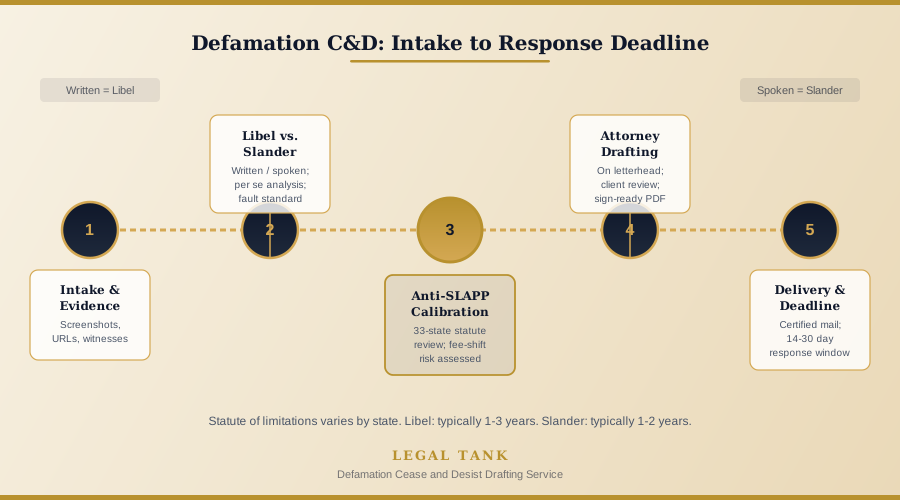
Every cease and desist letter slander or libel engagement moves through the same five-stage review before it leaves our hands. The sequence exists because each stage gates the next: an intake that fails to surface the anti-SLAPP risk produces a letter that damages the client, and a libel-vs-slander misclassification produces a letter the defendant can easily attack.
Stage 1: Intake and Evidence Review
The client provides screenshots, URLs, timestamps, and any witness declarations. We confirm that the alleged statement is a verifiable false assertion of fact, not a protected opinion, before any drafting begins. Statements that read as pure opinion on their face are flagged for the client before the engagement proceeds.
Stage 2: Libel vs. Slander Classification
The statement is classified as libel (permanent, written form) or slander (transient, oral form), which determines whether damages are presumed under a per se theory or must be specially proven. This classification also governs the statute of limitations, which varies from one to three years across states.
Stage 3: Anti-SLAPP Calibration
Thirty-three states have anti-SLAPP statutes that allow defendants to seek early dismissal with mandatory fee-shifting against a plaintiff who files a defamation suit targeting speech on a matter of public concern. The letter is reviewed against the defendant's jurisdiction before sending. Language that could recast a private dispute as a public-concern matter is tightened or removed.
Stage 4: Drafting on Letterhead
We draft the letter on formal letterhead, citing the defamatory statement verbatim, the publication date, the damages or per se category, the applicable pre-litigation demand under state law, and the response deadline (typically 14 to 30 calendar days). The client reviews a draft before the letter is finalized.
Stage 5: Delivery and Deadline
The finalized letter is delivered to the client as a sign-ready PDF. Most clients send the letter by certified mail with return receipt and by email to any known counsel of record. The delivery date establishes the plaintiff's pre-litigation demand record, which matters for both the limitations analysis and the damages record if the matter proceeds to suit. Filing, serving, and arguing in court are handled by retained trial counsel.
Platform Coordination (Where Applicable)
For online defamation, we coordinate platform takedown requests to Google (defamatory-content removal form), Yelp, Google Business Profile, and hosting providers running the defamatory content. Platform removal often produces faster relief than waiting for the defendant to comply with the letter, and the two tracks run in parallel. Section 230 of the Communications Decency Act immunizes platforms for hosting third-party content; the defamation claim runs against the original poster.
Ready to Stop the False Statement?
Get Your Defamation Letter Drafted Today
Submit your evidence. We assess the claim, classify libel vs. slander, and draft the letter against your anti-SLAPP risk before sending.
Everything That Goes Into a Cease and Desist Letter for Libel
A defamation cease and desist letter drafted by this service contains each element the recipient's attorney will look for when advising on compliance. The document is not a template with blanks filled in. Each engagement begins from the client's evidentiary record.
Verbatim Quote of the Defamatory Statement
The exact false statement, the URL or publication date, and the medium (written libel vs. oral slander). Verbatim quotation matters: paraphrase invites the argument that the defendant did not say what the letter claims.
False-Statement-of-Fact vs. Opinion Analysis
A statement must be objectively verifiable as false to be actionable. The letter identifies the specific false factual assertion and distinguishes it from any accompanying opinion language, using the Milkovich v. Lorain Journal totality-of-circumstances framework.
Fault Standard Identification
Actual malice for public figures and public officials (New York Times Co. v. Sullivan, 376 U.S. 254); negligence for private plaintiffs (Gertz v. Robert Welch, Inc., 418 U.S. 323). The correct fault standard is identified so the letter does not undersell a strong actual-malice record or overclaim for a private-person matter.
Per Se Category Allegation Where Applicable
Statements that impute a crime, a loathsome disease, professional unfitness, or sexual misconduct are defamatory per se. The letter identifies the per se category, which shifts the damages analysis: the plaintiff need not prove special harm to recover general damages.
Demand, Deadline, and Consequence Statement
The letter states exactly what the defendant must do (remove the content, publish a retraction, and refrain from further publication), by what date (typically 14 to 30 calendar days), and what legal action follows if the demand is not met. Specific demands paired with a clear deadline produce higher compliance rates than vague cease-and-desist language.
Anti-SLAPP Risk Notation
Where the defendant is in a strong anti-SLAPP jurisdiction, the letter is drafted to stay within the facts the plaintiff can clearly support. We identify and remove language that could be characterized as targeting protected speech on a public concern, which is the triggering condition for fee-shifting motions under most state anti-SLAPP statutes.
Statute of Limitations Preservation
The letter establishes the demand date and documents the publication date, which is critical under both the single-publication rule (most states: the clock starts on first publication) and the discovery rule (a minority of states: the clock starts when the plaintiff knew or should have known of the statement). The letter preserves the record without waiving any limitations argument.
Certificate of Service and Delivery Proof
The letter package includes instructions for certified-mail service and, where counsel of record is known, email delivery to that counsel. The certificate of service and docket of delivery create the evidentiary chain that the defendant received the demand and had notice of the false-statement allegation.
AI-Generated Defamation Letter
AI-drafted defamation cease and desist letter prepared from the supplied false-statement evidence, publication record, and jurisdiction. All core defamation elements addressed. Suitable for first-contact demands against individual publishers and review-platform posters.
- 24-hour delivery
- Libel vs. slander classification
- False-statement-of-fact vs. opinion framing
- Demand and response deadline language
- PDF and DOCX export
Professionally Drafted Defamation Letter
Full defamation cease and desist letter drafted on formal letterhead to your facts and the anti-SLAPP posture of the applicable state. Covers libel, slander, trade libel, false-light invasion of privacy, and online platform coordination where applicable. Anti-SLAPP risk assessed before drafting.
- Drafted from the supplied evidentiary record
- State-specific anti-SLAPP calibration
- Per se vs. per quod characterization
- Platform takedown coordination where applicable
- Statute-of-limitations analysis included
What a Cease and Desist Slander Letter Costs Across Three Engagement Tiers
Pricing for a defamation cease and desist letter depends on whether the matter requires an AI-generated draft, a fully custom letter, or a bundled letter-plus-platform-takedown package. Exact pricing for custom engagements is quoted after intake review, because the anti-SLAPP analysis and the complexity of the publication record determine the drafting scope.
AI-Generated Defamation Letter
$249
Single-recipient defamation cease and desist letter generated from the supplied false-statement evidence and jurisdiction. Libel and slander elements addressed. Ready for review before sending.
- Libel vs. slander framing
- False-statement-of-fact vs. opinion analysis
- Demand + response window language
- Single recipient
- Delivered in 24 hours
- PDF and DOCX export
Professionally Drafted Defamation Letter
Custom Quote
The cease and desist letter is professionally drafted on formal letterhead, calibrated to the false-statement record and the anti-SLAPP statute of the applicable state. Per se categories, actual-malice indicators, and platform coordination addressed as needed.
- Drafted on formal letterhead
- Anti-SLAPP statute review (33 states)
- Per se category and damages framing
- Actual-malice / negligence analysis
- Platform takedown coordination
- Sign-ready PDF
Defamation Plus Platform Takedown Package
Custom Quote
Professionally drafted defamation cease and desist paired with platform-specific takedown notices to Google (de-indexing request), Yelp, Google Business, and any hosting provider serving the defamatory content. Used where the statement appears on multiple platforms or is indexed and driving search-result harm.
- Professionally drafted defamation letter
- Google Defamatory Content removal request
- Review-platform coordinated notice
- Hosting-provider notice where applicable
- Statute-of-limitations analysis
- Drafted to be sent by retained counsel where needed
Frequently Asked Questions
Questions about the defamation cease and desist process, evidence requirements, and when litigation makes sense after the letter does not produce compliance.
Can you write a cease and desist letter for defamation?
Can a cease and desist letter backfire?
Can I write up my own cease and desist letter?
How serious is a cease and desist letter?
What evidence do you need for a cease and desist?
What evidence is needed for a cease and desist?
Can you sue for online defamation?
How do you prove defamation?
Is it worth it to sue for defamation?
Is it worth suing for defamation?
Related Letter Services
Cease and Desist Letter Drafting
Parent cease and desist drafting practice covering all matter types: harassment, trademark, copyright, and defamation.
Harassment Cease and Desist
Cease and desist letter for stalking, workplace harassment, and unwanted contact, distinct from the defamation claim pathway.
Lawyer Letter Writing Service
Full catalog of professionally drafted demand and enforcement letters across all practice areas.
Stop the False Statement
Ready to Send a Defamation Cease and Desist Letter?
Submit your evidence and we will assess the false-statement record, classify libel vs. slander, review your anti-SLAPP exposure, and produce a sign-ready letter. Filing, serving, and arguing in court are handled by retained trial counsel after the demand period expires.
Part of our professionally drafted cease and desist letter service covering harassment, trademark, copyright, and defamation matters.