Landlord-Tenant Drafting Service
Security Deposit Demand Letter Drafted to Your State's Statute
A security deposit demand letter is the formal pre-litigation instrument that tells your landlord the statutory deadline has passed, identifies each improper or undocumented deduction, and demands the return of your deposit within a short response window before you pursue double or treble damages in court.

By the Legal Tank editorial team
California's 2024 Deposit Cap and Your Demand
California Assembly Bill 12, effective July 1, 2024, capped most residential deposits at one month's rent for unfurnished units, which means California tenants are now owed smaller sums at the outset but face the same 21-day return clock and double-damages exposure under Cal. Civ. Code §1950.5 when that deadline passes. We draft the demand to the current statutory framework in every state, not last year's version. Below are the state-specific patterns that generate the most demand letter engagements.
N.Y. Gen. Oblig. Law §7-108
New York
14 days
Penalty: 2× deposit
Cal. Civ. Code §1950.5
California
21 days
Penalty: 2× deposit + atty fees
Tex. Prop. Code §92.103
Texas
30 days
Penalty: 3× deposit + $100
N.J. Stat. §46:8-21.1
New Jersey
30 days
Penalty: 2× deposit
Fla. Stat. §83.49
Florida
30 days
Penalty: Forfeit deductions
M.G.L. c. 186 §15B
Massachusetts
30 days
Penalty: 3× deposit + atty fees
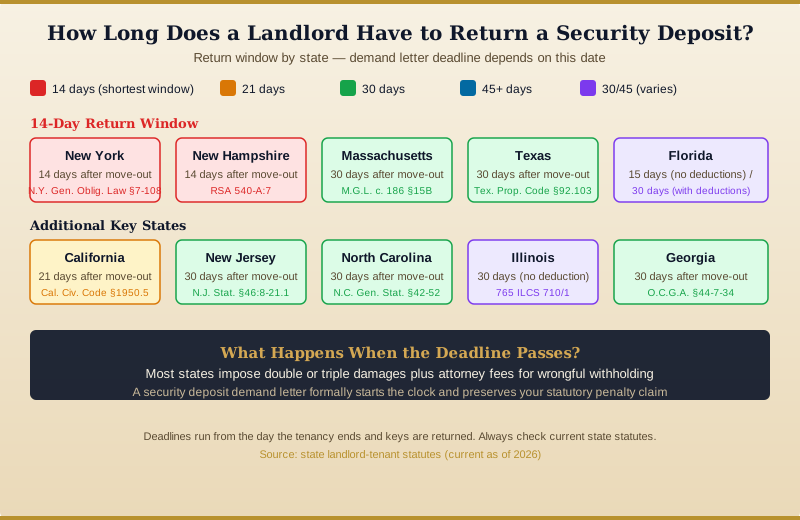
New York's 14-Day Return Window
N.Y. Gen. Oblig. Law §7-108 requires a landlord to return the security deposit within 14 days of the tenant vacating and to deliver a written, itemized statement of any deductions. A landlord who misses that 14-day window forfeits the right to retain any portion of the deposit and becomes liable for the full amount withheld plus reasonable attorney fees. It is one of the shortest return clocks in the country, and tenants who receive an untimely itemization have a strong statutory case. Our New York demand cites §7-108, calculates the deadline from the documented vacatur date, and sets a 10-day response window.
Texas Wrongful-Withholding Penalties
Tex. Prop. Code §§92.101 to 92.110 requires the landlord to return the deposit or provide an itemized statement of deductions within 30 days. A bad-faith retention triggers liability for the amount withheld plus $100, three times the amount withheld as a statutory penalty, and reasonable attorney fees under §92.109. The statute treats any retention without timely itemization as bad faith, which means the treble-damages exposure attaches automatically the moment the 30-day clock expires without an itemized accounting. Our Texas demand letter for security deposit recovery cites §92.109, documents the bad-faith withholding, and sets a 14-day response deadline before a Justice of the Peace court filing.
New Jersey's Double-Damages Posture
N.J. Stat. §46:8-21.1 requires the landlord to return the security deposit within 30 days of tenancy termination with an itemized statement of any deductions. A landlord who misses that deadline is liable to the tenant for twice the amount wrongfully withheld. New Jersey also requires landlords to hold deposits in a separate interest-bearing account and to notify the tenant of the bank and account number annually. Failure to comply with the banking requirement can independently void the landlord's right to retain any deductions. Our New Jersey security deposit demand letter identifies both the late return and any banking-compliance failures, giving the tenant two independent penalty theories.
State deadlines are governed by individual landlord-tenant statutes. Always verify the current statute for your jurisdiction before filing, as legislatures occasionally amend deposit return windows and penalty multipliers.
Has your landlord missed the return deadline?
We draft the demand in 24 hours with the penalty statute cited.
Four Steps to a Sent Demand Security Deposit Letter
Every demand security deposit letter we draft follows a four-step process that begins with the controlling statute and ends with a sign-ready package delivered in 24 hours. Because the statutory penalties for wrongful withholding turn on the landlord's failure to comply with precise procedural requirements, the demand must be equally precise to carry maximum weight.
Intake and Tenancy Review
You provide the lease, move-in and move-out inspection reports, rent payment history, and the landlord's itemized statement (if any). We review the tenancy end date, calculate the applicable statutory deadline, and identify each deduction being disputed.
Statutory Research and Penalty Calculation
We identify the controlling state security deposit statute, the return deadline, the allowable deduction categories, and the penalty multiplier. For states like Texas (three times the deposit plus $100) and Massachusetts (three times the deposit plus attorney fees), the penalty section of the demand must be framed with precision to maximize the landlord's incentive to pay.
Draft and Review
The demand letter is drafted with a formal caption, tenancy history, identification of each improper or time-barred deduction, the statutory violation, the penalty exposure, and a response deadline (typically 10 to 14 days). Every factual claim is tied to the documents you provided.
Final Review and Sign-Ready Package
The final draft receives a second review pass against the controlling statute. The delivered package includes the demand letter, a certified mail transmittal sheet, and a brief instruction note on how to serve and follow up.
The delivered package includes the demand letter on firm letterhead, a certified mail transmittal instruction, and a summary of the statutory penalty exposure so you understand exactly what pressure the demand creates. Legal Tank drafts the document; you retain your own demand letter lawyer or file the small claims case yourself. We do not appear in court, serve papers, or provide litigation representation.
For tenants whose landlord has already provided an itemized statement, we analyze each deduction against the controlling state statute and the move-in inspection record. Deductions for normal wear and tear, items that appear on the move-in inspection report as pre-existing, or costs for which the landlord has provided no invoice are identified as improper, catalogued in the demand, and challenged individually. This approach is far stronger than a blanket demand for the full deposit and is more likely to produce a partial or full return without court involvement.
What Attorneys Build Into Every Demand for Security Deposit Letter
A professionally drafted demand for security deposit letter covers far more than the deposit amount. The document must establish the procedural violation, catalogue the improper deductions, cite the controlling statute and its penalty provisions, and create a record that survives a small claims evidentiary hearing.
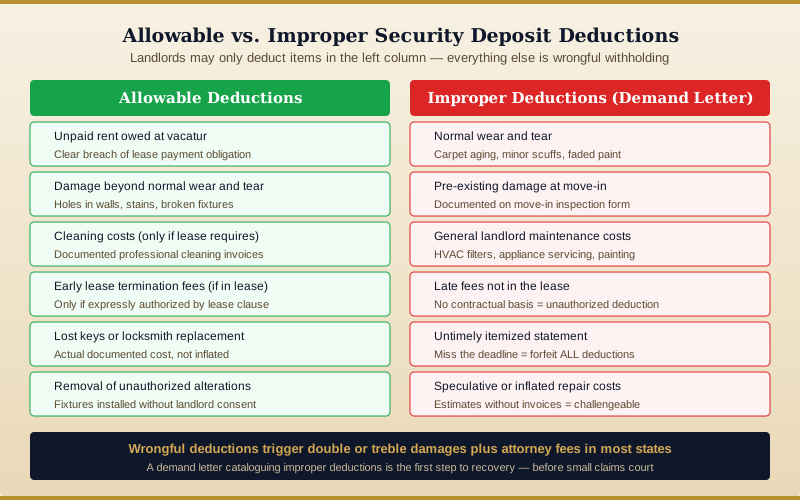
Allowable Deductions
Unpaid rent owed at vacatur
Any rent balance remaining when the tenant leaves
Damage beyond normal wear and tear
Holes in walls, broken fixtures, pet damage
Cleaning costs authorized by lease
Must be expressly authorized; invoices required
Lost keys and locksmith costs
Documented actual cost, not inflated estimates
Unauthorized alterations removal
Fixtures installed without consent
Improper Deductions: Demand Letter Basis
Normal wear and tear
Carpet aging, minor paint scuffs, small nail holes
Pre-existing damage at move-in
Documented on the move-in inspection report
General landlord maintenance
HVAC filters, appliance servicing, routine painting
Late fees with no lease basis
No contractual authorization = unauthorized deduction
Untimely itemized statement
Missing the deadline forfeits all deductions in most states
The six components we build into every letter of demand for security deposit return are: (1) a formal caption identifying the parties, the property address, the tenancy period, and the demand amount; (2) a chronological tenancy history from move-in to move-out with the deposit receipt date and the statutory return deadline; (3) an itemized challenge to each deduction taken, supported by the move-in inspection record; (4) the statutory citation and penalty exposure, calculated for the controlling jurisdiction; (5) a formal demand for the deposit amount plus any accrued statutory interest within a 10-to-14-day response window; and (6) a statement that failure to respond will result in a small claims filing and a request for statutory penalties, court costs, and attorney fees.
Tenants who commission a security deposit demand letter through this service receive a document formatted for service by certified mail, return receipt requested, which satisfies the service requirement in virtually every jurisdiction that mandates formal written notice before filing. The statute-cited format also carries substantially more weight at the small claims hearing than an informal letter, because the judge can see that the statutory framework was addressed before filing.
Flat-Rate Pricing for a Demand Letter Security Deposit Recovery
A demand letter security deposit engagement does not require hiring a litigation attorney on an hourly retainer. Legal Tank offers two flat-price options so tenants and landlords can commission a professionally drafted demand without the uncertainty of an open meter.
AI-Assisted Draft
$249
One-time flat fee
- Demand letter in your jurisdiction
- Statutory deadline calculated
- Penalty language included
- Certified mail instructions
Custom-Drafted
Custom Quote
Quoted within one business day
- Full tenancy file reviewed
- Itemized deduction challenge per document
- Penalty calculation by state statute
- Sign-ready final document
- Certified mail transmittal package
Both tiers include the demand letter itself, the statutory citation for your controlling jurisdiction, and instructions for service. The custom-drafted tier additionally includes a line-by-line review of the landlord's itemization (if provided) and a challenge to each improper deduction.
For comparison: a contingency-fee attorney handling a security deposit demand letter case on an hourly basis typically charges $200 to $400 per hour, with the demand letter itself taking two to four hours at a minimum. Our flat-fee model makes professional drafting accessible for deposits of any size. For very small-dollar disputes (under $500), the AI-assisted draft at $249 provides a professionally formatted, statute-specific demand that often produces payment without any further action.
For tenants dealing with unpaid wage disputes alongside a withheld deposit from the same landlord-employer arrangement, we draft both documents on a combined engagement. For tenants who have also received a defamation cease and desist letter from a landlord after leaving a negative review, we coordinate the response and the deposit demand in a single file.
Security Deposit Questions, Answered
Answers sourced from the most-searched questions tenants ask about security deposit demand letters, return deadlines, and statutory penalties.
Do you get a refunded security deposit?
How long does a landlord have to return your security deposit?
What happens if a landlord does not return a security deposit in 30 days in Texas?
What is the best way to get your security deposit back?
What is the security deposit law in Massachusetts?
Will a security deposit be refunded?
How long does a landlord have to return a deposit?
What are the rules for security deposits in NC?
What happens if my deposit is not returned within 10 days?
What happens if the landlord does not give back the deposit?
Start Your Demand Today
Ready to Recover Your Security Deposit?
We draft your security deposit demand letter in 24 hours, cite the controlling state statute, challenge each improper deduction, and deliver a certified mail package. If your dispute also involves unpaid rent, lease breach, or other tenancy claims, our demand letter drafting service covers the full package.