Defining a Motion and the Written Requests That Move a Case Through Court
In civil and criminal procedure, a motion is a written request asking a judge to take a specific action in a pending case. Every motion names the relief sought, identifies the rule that authorizes the request, attaches a supporting record, names the standard of review, and includes a proposed order the judge can sign. The architecture is the same across federal practice under the Federal Rules of Civil Procedure and state-court practice under the CPLR, the CCP, or the Texas Rules. The word also appears in two unrelated senses (a parliamentary motion made at a meeting under Robert's Rules and a physics motion describing an object changing position in space), which is why this page starts by disambiguating before anchoring on the litigation definition.
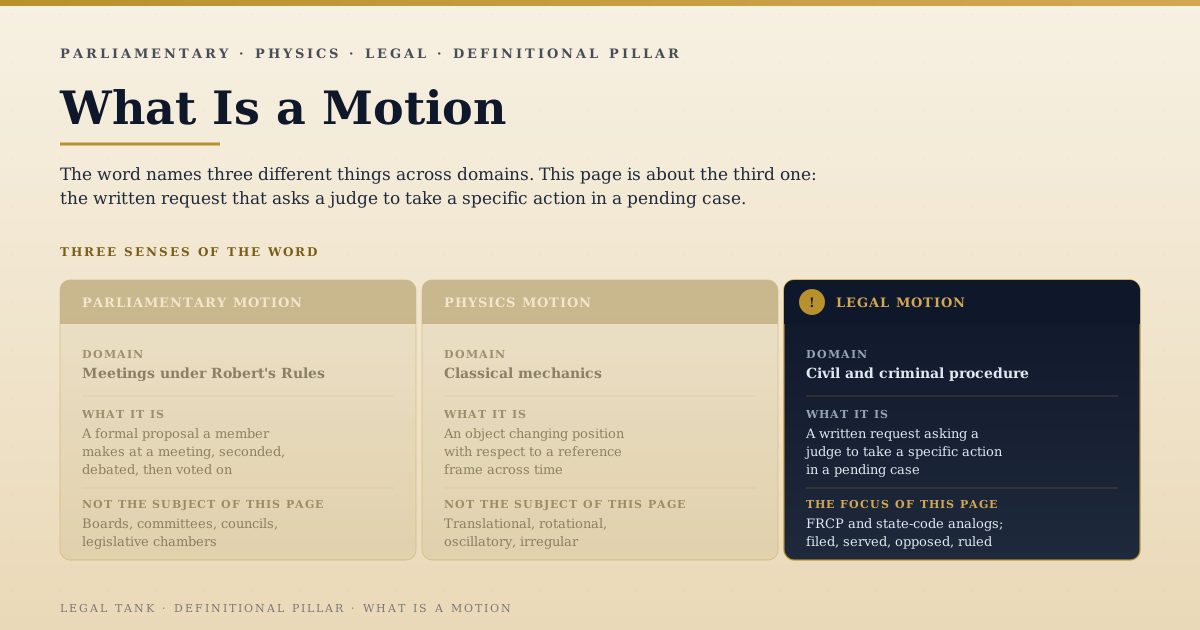
Legal Meaning, Without the Jargon: A Motion in Civil and Criminal Procedure
For a litigant encountering the term for the first time, the cleanest way to picture a motion is as a written question to a judge that carries its own answer attached. The motion poses the question (should the case be dismissed, should the witness be excluded, should the deadline be extended, should the deposition transcript be sealed) and supplies the proposed ruling on a separate page that the judge can sign as-is. The opposing party then has a fixed window to file written opposition, and the movant may file a reply addressing only the new arguments. The judge reads the bundle and rules. That four-step pattern (file, oppose, reply, rule) governs essentially every motion regardless of subject matter, civil or criminal, federal or state.
The phrase motion for is the prepositional opener that completes the title of nearly every filing: a motion for summary judgment, a motion for a protective order, a motion for reconsideration, a motion for default judgment. The preposition signals the relief the movant is asking the court to enter, and the noun that follows names the specific procedural device. Filings that omit a clear "motion for X" title fail to put the responding party on notice of what is being requested and routinely get bounced by the clerk before docketing. The Federal Rules of Civil Procedure govern federal civil motions, the Federal Rules of Criminal Procedure govern federal criminal motions, and parallel state codes (the CPLR in New York, the CCP in California, the Texas Rules of Civil Procedure, the New Jersey Rules of Court) govern state-court practice. A motion that is not authorized by any rule does not get docketed; the clerk rejects filings that fail to identify the rule under which the relief is sought.
Drafting service for one of the most frequently filed discovery-side motions is described in the companion piece on drafting service for a motion for sanctions targeting discovery abuse and bad-faith conduct, which walks through how a Rule 37 sanctions motion is built from the meet and confer record forward.
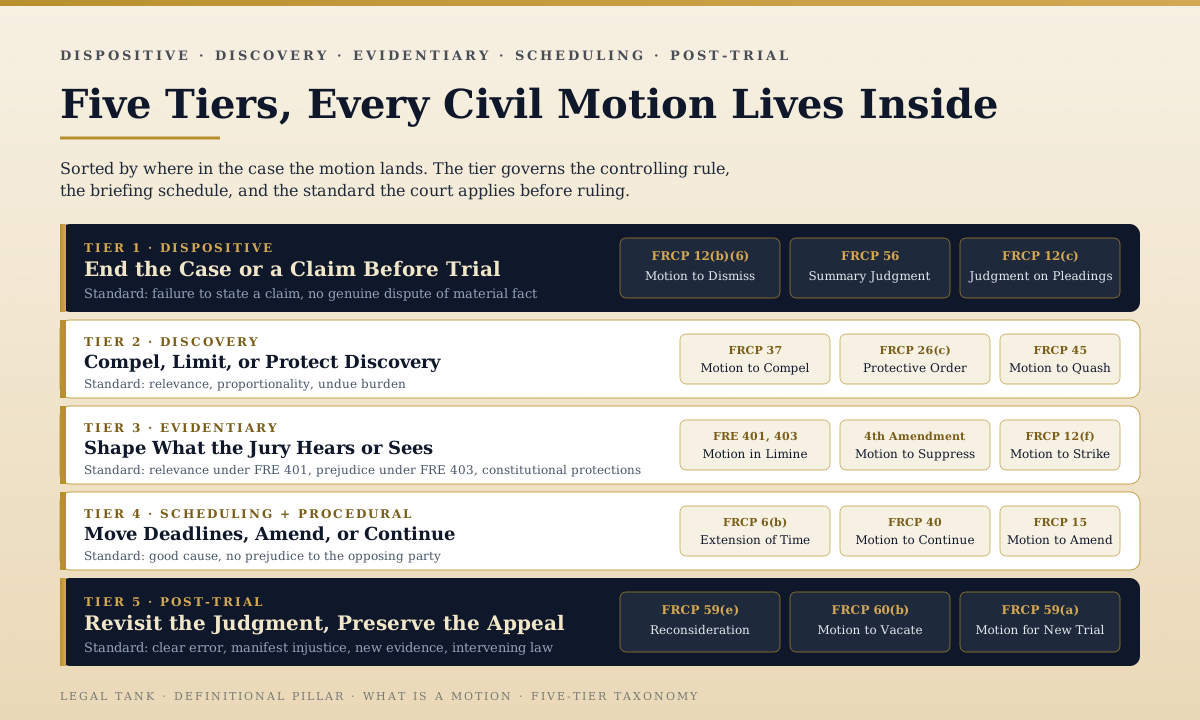
Reading the Five Tiers: Dispositive Through Post-Trial
The taxonomy above sorts the commonly filed civil motions by procedural posture (the moment in the case lifecycle when the filing lands). The tier matters because it predicts the controlling rule, the typical page limits, the briefing window, and the standard the court will apply before ruling. The same tier framework applies in criminal practice with the analogous rule citations (Federal Rules of Criminal Procedure 12, 16, 29, and 33 plus the state-code equivalents).
- Tier 1Dispositive MotionsEnd a claim or the whole case before trialExamples: Motion to dismiss (FRCP 12(b)(6)); motion for summary judgment (FRCP 56); motion for judgment on the pleadings (FRCP 12(c))Standard: Failure to state a claim; no genuine dispute of material fact
- Tier 2Discovery MotionsCompel, limit, or protect the exchange of informationExamples: Motion to compel (FRCP 37); motion for protective order (FRCP 26(c)); motion to quash subpoena (FRCP 45(d)(3))Standard: Relevance, proportionality, undue burden
- Tier 3Evidentiary MotionsShape what the jury hears or sees at trialExamples: Motion in limine; motion to suppress; motion to strike (FRCP 12(f))Standard: FRE 401 relevance, FRE 403 prejudice, constitutional protections
- Tier 4Scheduling and Procedural MotionsMove deadlines, amend pleadings, or continue a hearingExamples: Motion for extension of time (FRCP 6(b)); motion for continuance (local rule / FRCP 16 docket control); motion to amend pleadings (FRCP 15)Standard: Good cause; no prejudice to the opposing party
- Tier 5Post-Trial MotionsRevisit the judgment or preserve the appealExamples: Motion for reconsideration (FRCP 59(e)); motion to vacate (FRCP 60(b)); motion for new trial (FRCP 59(a))Standard: Clear error, manifest injustice, newly discovered evidence, intervening law
How a Motion Differs From a Pleading and From a Letter to the Court
A motion is not a pleading. The complaint, the answer, the counterclaim, and the cross-claim are pleadings (they state the parties' claims and defenses for the case as a whole). A motion is a written request directed at the judge for a specific ruling, not a statement of claims. A motion is also not a letter to the court: letters to chambers are disfavored in most federal districts and are limited to scheduling housekeeping or requests for status conferences. Any substantive request for judicial action must travel as a motion with the full bundled package (notice, memorandum, declaration, proposed order, certificate of service). Filers who try to obtain relief by letter rather than by motion almost always receive a docket entry directing them to refile correctly. For an umbrella treatment of the in-court angle that focuses on motion-calendar mechanics across jurisdictions, see the companion explainer on what is a motion in court and how written requests move a case forward.
Common Grounds and Practical Use: Why a Motion Is the Engine of Mid-Case Practice
The purpose of a motion is to ask the judge to take a specific action that the rules do not direct the court to take automatically. Motions narrow disputes before trial, force compliance with discovery obligations, exclude inadmissible evidence, dispose of claims that fail as a matter of law, set and modify case-management deadlines, and preserve appellate issues for later review. Without motion practice, every disputed point would have to wait for trial, and the docket would collapse under the weight. Motions are the steering mechanism that pushes a case forward in defined increments, giving the parties enforceable mid-case rulings on questions of procedure, evidence, and substantive law.
The Scheduling Order and FRCP Rule 16
The first court order most litigants encounter is the scheduling order entered under FRCP Rule 16. The scheduling order sets the deadlines for amending pleadings, completing discovery, filing dispositive motions, and exchanging trial witness lists. Every motion thereafter either follows the scheduling order or asks to modify it. A motion to amend pleadings under Rule 15 must be filed before the Rule 16 deadline expires (or, after that, must show good cause); a motion for summary judgment must be filed by the dispositive-motion cutoff. Litigants who miss the scheduling order's deadlines and try to file the same motion late find themselves arguing the strict good-cause standard rather than the more forgiving liberal-amendment standard, and the practical effect is a much harder uphill climb at the lectern.
The Meet and Confer Requirement
Most federal districts and every major state-court system require a documented meet and confer requirement for discovery motions and many scheduling motions. The local rule names the specific form (a written letter, a phone call, an in-person conference) and the certification that must be filed with the motion. The reason is institutional: judges do not want to spend bench time refereeing disputes that responsible counsel could have resolved by phone. A motion filed without a conferral certification is often stricken or denied without reaching the merits, and the time the movant spent drafting the papers is lost. The conferral record is also where the negotiating position that often produces a narrowed exchange without a court ruling first appears in writing.
What Pretrial Motions Decide That Trial Cannot Reach
Pretrial motions decide questions the trial itself cannot efficiently reach: whether the complaint states a legally cognizable claim, whether a piece of evidence is admissible at all, whether a witness must sit for a deposition that has been improperly noticed, whether a party in default has any further opportunity to defend, whether a written instrument is authentic. The list extends across every procedural posture in civil litigation. For an attorney-grade walkthrough of the role legal motions play in shaping the case record, see the companion piece on what a legal motion is and how courts categorize filings across pretrial, trial, and post-judgment stages.
Enforcement Motions and Mid-Case Court Power
A category of motion exists for almost every enforcement problem a litigant can encounter. Discovery abuse triggers a motion to compel and, where conduct is willful, a motion for sanctions. A party that has failed to appear or answer triggers a motion for default and, after the clerk's entry, a motion for default judgment. A party that has violated a standing court order triggers a motion for contempt. Each of these enforcement motions sits at the intersection of the underlying rule and the court's inherent authority to manage its docket. Counsel reach for them not as a first resort but as the second-stage tool that produces accountability when the meet and confer process has been exhausted. Service-firm pages exist on each, including attorney-prepared motion for contempt of court for enforcing orders against a noncompliant party and the closely related how a motion for default judgment lets the plaintiff secure relief after the clerk enters default.
Drafting Mechanics: From the Caption to the Certificate of Service
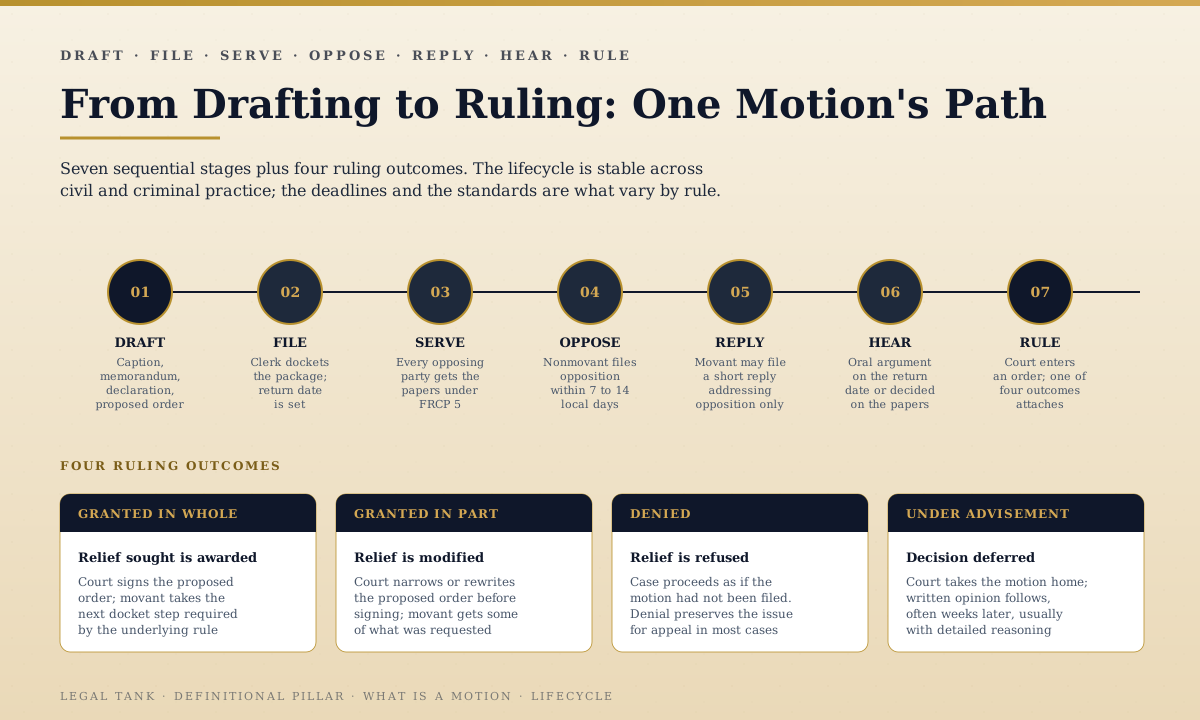
The lifecycle of a motion is stable across every jurisdiction: draft, file, serve, brief, hear, rule. The schedule varies, the page limits vary, the calendar mechanics vary, but the sequence does not. The drafting choices the movant makes at each step are what determine whether the motion succeeds. The seven-step walkthrough below covers the substantive choices a drafter makes from the moment of issue-spotting through the ruling.
Step 1: Identify the Authorizing Rule First, Draft Second
Every motion must point to a specific rule that authorizes the relief. The choice of rule controls the standard of review, the record the court will consider, the deadlines, and the page limits. A motion to compel cites FRCP 37 in federal practice and the analog (CPLR 3124, CCP 2030.300, NJ Rule 4:23) in state court. A motion to dismiss for failure to state a claim cites FRCP 12(b)(6) or the state equivalent. The rule belongs in the first sentence of the notice of motion and again in the opening paragraph of the memorandum of law.
Step 2: Build the Notice of Motion, Memorandum, and Declaration as One Package
The notice of motion is a single page identifying the court, the parties (using the same caption as the underlying complaint), the relief sought, the authorizing rule, and the return date or the date the motion will be submitted on the papers. The memorandum of law argues the merits: standard of review, statement of facts tied to the record, controlling authority, application to this case, and the prayer for relief. The supporting declaration carries the factual record under penalty of perjury, with exhibits attached as numbered tabs and authenticated paragraph by paragraph by a competent declarant.
Step 3: Draft the Proposed Order So the Judge Can Sign It Without Editing
The proposed order is the document the court actually signs. A clean proposed order mirrors the prayer for relief, fits on one page where possible, leaves blanks only for the date and the judge's signature, and avoids overreach. Proposed orders that ask for more than the motion supports get lined through, narrowed, or rejected entirely. Counsel who treat the proposed order as the most important page in the package draw judicial signatures that match what the motion asked for; counsel who treat it as an afterthought lose ground unnecessarily.
Step 4: Document the Meet and Confer Requirement Before Filing
Most federal districts and every major state-court system require a documented meet and confer effort before a discovery motion or a scheduling motion can be heard. The meet and confer requirement is satisfied by a written conferral letter that identifies the specific dispute, a follow-up live conferral with opposing counsel, and a certification attached to the motion confirming the conferral took place. Federal district courts in California and the District of New Jersey are especially strict on this point; a motion filed without a conferral certification is often stricken on sight, regardless of the underlying merits.
Step 5: File With the Court Clerk and Effect Service of Process
Filing with the court clerk may be electronic (most federal courts and many state systems) or in person (smaller state courts and some specialty calendars). Each jurisdiction publishes its filing procedure on the judiciary site. Service of process on the opposing party must follow the local rule, and the certificate of service must be filed to prove the opposing party received the papers. Self-represented filers most often fail at this step, either by serving by email when the rule requires personal service or by neglecting to docket proof of service before the return date.
Step 6: Brief the Motion: Opposition, Reply, and Page Limits
The opposing party files written opposition by the local deadline, typically seven to fourteen days after service of the moving papers. The movant has a shorter window to file a reply, often three to seven days. Each jurisdiction caps the page or word count for opposition and reply, and judges are unforgiving with over-length filings. The reply addresses only the points raised in opposition; new arguments raised for the first time in reply are routinely disregarded under the controlling case law in every federal circuit.
Step 7: Appear at the Hearing or Submit on the Papers
Most federal districts decide motions on the papers without oral argument; state courts in New Jersey, New York, and California typically calendar a hearing. At the hearing, the judge has already read the bundle and uses the time to ask questions, not to hear a full argument from the floor. Counsel for the movant speaks first, the responding party follows, and the movant gets a short rebuttal. The judge may rule from the bench, take the matter under advisement and issue a written decision later, or convert the appearance into a tentative ruling that becomes final unless a party objects within the local window.
Discovery-stage motions and pleading-stage motions follow the same lifecycle but differ in the record they rely on. A pleading-stage motion (Rule 12(b)(6), Rule 12(c)) is decided on the four corners of the complaint. A discovery-stage motion (Rule 37, Rule 26(c)) is decided on the discovery record, the conferral correspondence, and any in camera review. A post-judgment motion (Rule 59(e), Rule 60(b)) is decided on the trial record and the new evidence or intervening law that the movant relies on. Service-firm pages include drafting service for a motion to amend pleadings after discovery reveals new claims for the pleading-stage track.
How Courts Rule and What Tilts the Balance Before the Order Is Signed
A court rules on a motion in one of four ways: granted in whole, granted in part, denied, or taken under advisement for a later written decision. The chosen outcome is driven primarily by the strength of the record and the alignment between the requested relief and the prevailing standard of review. The factors below explain why two motions on the same facts can produce different outcomes in different courts.
Match the Standard of Review to the Record You Built
Every motion has a controlling standard of review (de novo for legal questions, clear error or abuse of discretion for factual or discretionary determinations, manifest injustice for reconsideration). The standard is what the judge applies when reading the record. Counsel who write to the wrong standard waste pages explaining factual disputes that the court will not resolve at this stage, or arguing pure law on a motion that requires a record showing. The reverse is the same kind of error in the other direction. The strongest motions name the standard explicitly in the first paragraph of the memorandum, cite the controlling case, and apply the standard to the record point by point.
Draft the Proposed Order So a "Grant in Part" Still Helps
Most motions are not granted in full. The most common outcome in discovery and scheduling practice is a "granted in part" order that narrows what the movant asked for. Counsel who draft the proposed order as a single take-it-or-leave-it document give the judge no path to grant partial relief without redrafting the order entirely. Counsel who draft the proposed order with separable paragraphs (numbered subparagraphs the judge can line through individually) make it procedurally easy for the court to grant the parts that are warranted and decline the parts that overreach. The hit rate on partial relief rises substantially when the proposed order is structured this way. For the template that ships with the structure built in, see building a motion for summary judgement template that tracks Rule 56 requirements and the related inside a motion for reconsideration template and the sections courts expect to see.
Preserve the Issue for Appeal Whether You Win or Lose
The ruling on a motion controls more than the immediate relief: it controls what is preserved for appeal. A denial without a written record of the controlling standard leaves the appellate court guessing at the trial court's reasoning. A grant without a clean order specifying the narrowed scope leaves the parties guessing at compliance. Counsel who care about appellate preservation draft motions that build the record explicitly, name the controlling standard, and request specific findings the trial court can adopt. The post-judgment track that revisits a final judgment runs through the companion definitional treatment in anatomy of a motion for default judgment template and how each section functions and the cross-cutting professionally drafted cross-motion for summary judgment briefs and Rule 56 opposition filings on the dispositive track.
The Pleading-Stage Sibling: Judgment on the Pleadings
Civil litigants frequently weigh whether to seek a Rule 12(b)(6) dismissal at the front end, a Rule 12(c) judgment on the pleadings after answer, or a Rule 56 summary judgment after discovery. The choice depends on what the record will support and how much delay the movant can absorb. For the service-firm view of the middle option, see our motion for judgment on the pleadings drafting for civil litigants seeking early resolution. The standards are stricter than for ordinary procedural motions because each disposes of a claim on the merits, but the basic bundle (notice of motion, memorandum, supporting record, proposed order, return date) holds across all three.