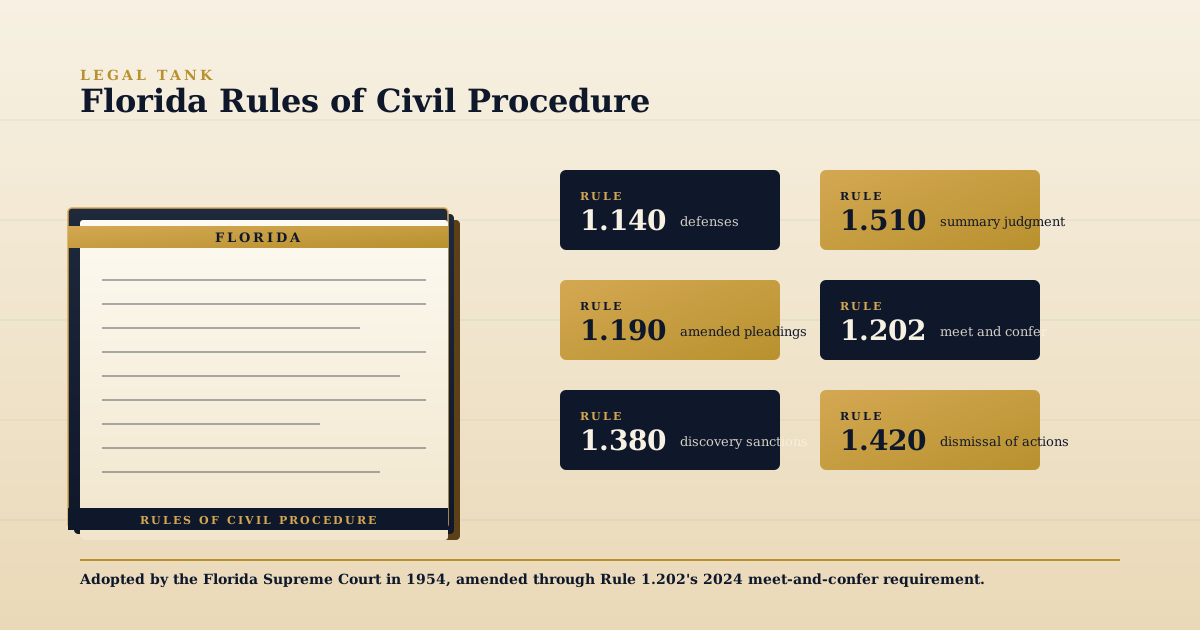
Florida Supreme Court adopts the rules under Article V, Section 2(a) of the Florida Constitution, with proposals from the Civil Procedure Rules Committee of The Florida Bar.
The Florida Rules of Civil Procedure are the body of procedural rules that govern every civil action in a Florida state court of general or limited jurisdiction. The Florida Supreme Court adopts and amends the rules in three-year cycles under its rulemaking authority. The rules are numbered by topic, with the 1.000 series covering general civil practice, the 1.100 series covering pleadings and motions, the 1.200 series covering case management, the 1.300 series covering depositions and discovery, the 1.400 series covering trial, the 1.500 series covering judgments, and the 1.600 series covering provisional and final remedies. Federal practice runs on the parallel Federal Rules of Civil Procedure, and California state practice runs on the California Code of Civil Procedure with the same procedural backbone but different numbering.
I, Process
Florida Civil Procedure Rules Practitioners Reach for First, With Federal Cross-References
Florida and federal pleading rules
Florida
Rule 1.140
Defenses, motion to dismiss, and pleading attacks
Federal
Rule 12
Pre-answer motions, including 12(b)(6) failure to state
Federal
Rule 60
Relief from a judgment or order
Federal
Rule 16
Pretrial conferences and scheduling orders
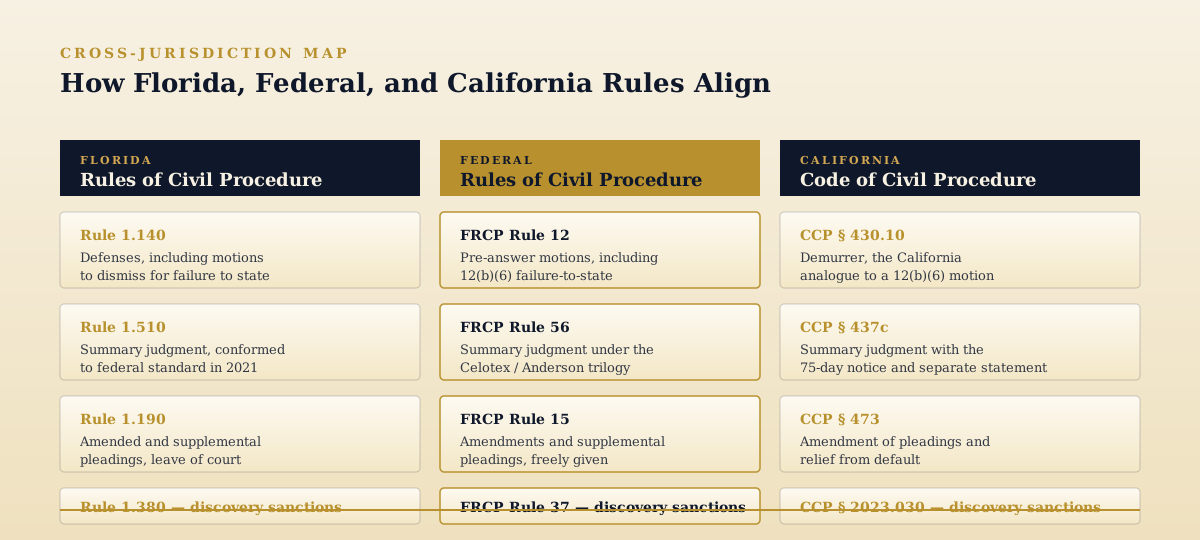
Most working litigators in Florida open three rules every week. The first is Florida Rule of Civil Procedure 1.140, the omnibus pleading-attack rule that lists the seven defenses available by motion before answer: lack of jurisdiction over the subject matter, lack of jurisdiction over the person, improper venue, insufficiency of process, insufficiency of service of process, failure to state a cause of action, and failure to join indispensable parties. The motion practitioners reach for most often is the failure-to-state motion, which is the Florida cousin of an FRCP 12(b)(6) motion. The two rules use different language but require the same threshold showing: assuming the well-pleaded factual allegations as true, the complaint must state a cause of action that the substantive law recognizes.
On the federal side, the parallel mechanism is Federal Rule of Civil Procedure 12, which the Federal Rules of Civil Procedure organize as the master pre-answer motion rule. The rule consolidates seven motion grounds into one numbered list and bars later assertion of certain defenses unless the defendant raises them in the first responsive paper or motion. Lawyers researching the federal rules of civil procedure for Rule 12 are typically looking for the failure-to-state-a-claim subsection at 12(b)(6), which is the gatekeeper for Twombly and Iqbal pleading review. The Florida 1.140 motion does not import Twombly plausibility wholesale; Florida courts continue to apply a notice-pleading, four-corners standard, under which the trial court tests only the well-pleaded allegations on the face of the complaint, articulated in cases like Provence v. Palm Beach Taverns, Inc., 676 So. 2d 1022 (Fla. 4th DCA 1996), and unchanged by the 2021 summary-judgment conformance amendment.
The companion federal rule a Florida practitioner cross-references for case-management workflow is FRCP 16, which governs pretrial scheduling orders, conferences, and the good-cause standard for modifying a scheduling order after entry. Florida adopted the analogous case-management mechanism in Florida Rule of Civil Procedure 1.200, which the 2025 amendments strengthened to require the court to enter a case-management order, with firm deadlines for service, fact and expert discovery, and dispositive motions, early in most civil cases. Rule 1.200 is the rule structurally parallel to FRCP 16(b); it pushes case-management decisions to the front of the docket so that complex commercial cases, mass tort matters, and multi-party litigation are placed on a managed track at the outset. A separate 2025 addition, Florida Rule of Civil Procedure 1.202, layers a conferral duty on top: before setting most non-dispositive motions for hearing, the moving party must meet and confer and file a Certificate of Conferral.
Motion for Reconsideration and Relief From Judgment
When a court enters an interlocutory or final order that the losing party believes overlooked a controlling fact or rule of law, the procedural mechanism is a motion for reconsideration in Florida or a Rule 59 or Rule 60 motion in federal court. FRCP 60(b) covers relief from a final judgment, order, or proceeding for mistake, inadvertence, surprise, excusable neglect, newly discovered evidence, fraud, voidness, satisfaction, or any other reason that justifies relief. Florida Rule 1.540(b) is the state analogue, but it is narrower: it enumerates only five grounds for relief, namely mistake or excusable neglect, newly discovered evidence, fraud, a void judgment, and a judgment that is no longer equitable to enforce prospectively, and, unlike FRCP 60(b)(6), it contains no residual "any other reason" catch-all. Counsel filing under FRCP 60 should watch the one-year ceiling on the first three federal grounds, which has caught more than one practitioner who counted from the wrong event date; Florida Rule 1.540(b) applies a comparable reasonable-time limit, capped at one year for the mistake, newly-discovered-evidence, and fraud grounds.
For a sequenced walkthrough of the discovery-side motion practice that ties into Florida Rule of Civil Procedure 1.380 and FRCP 37, see our motion to compel discovery procedural walkthrough, which sequences the conferral, the motion, the order, and the sanction stages in both jurisdictions. The responsive-pleading mechanics that follow a Rule 1.140 or FRCP 12 motion sequence are handled by Rule 1.110 in Florida and FRCP 8 in federal court, both of which require the answer to admit, deny, or plead lack of knowledge for each numbered allegation, then plead any affirmative defenses and counterclaims in numbered paragraphs.
The same FRCP 8 short-and-plain-statement standard that governs federal complaints continues to inform Florida pleading review. Rule 8 of the Federal Rules of Civil Procedure requires a complaint to contain a short and plain statement of the grounds for the court's jurisdiction, a short and plain statement of the claim showing entitlement to relief, and a demand for the relief sought. Florida Rule 1.110 is the state version and includes the same three components. Counsel pleading a federal claim in a Florida-removed posture should frame the complaint to the federal Twombly plausibility ceiling so the pleading survives both a 12(b)(6) motion in the federal forum and a 1.140(b)(6) motion in any pre-removal posture.
II, Definition
Defining Summary Judgment Under Florida Rule 1.510 (and the Federal Rule 56 Standard It Imports)
Summary judgment standard
Florida
Rule 1.510
Summary judgment, conformed to federal standard in 2021
Federal
Rule 56
Summary judgment under the Celotex / Anderson trilogy
Florida Rule of Civil Procedure 1.510 defines summary judgment as the procedural mechanism by which a party demonstrates, on the pre-trial record, that there is no genuine dispute of material fact and that the moving party is entitled to judgment as a matter of law. Florida amended Rule 1.510 in 2021 to conform the state's summary judgment standard to the federal Celotex standard. Before that amendment, the Florida summary judgment record was governed by the slightest-doubt standard in cases like Holl v. Talcott, which made it nearly impossible for a defendant to obtain summary judgment without affirmatively negating an essential element. The 2021 amendment imported the federal language wholesale, so Florida state-court summary judgment now operates on the Celotex burden-shifting framework.
The federal standard that Florida 1.510 now mirrors comes from Rule 56 of the Federal Rules of Civil Procedure, which was the subject of the so-called Celotex trilogy in 1986: Celotex Corp. v. Catrett, Anderson v. Liberty Lobby, Inc., and Matsushita Electric Industrial Co. v. Zenith Radio Corp. Those three opinions reorganized the federal summary judgment standard so that a moving defendant could shift the production burden by pointing to the absence of evidence in the non-moving plaintiff's record, rather than affirmatively producing evidence to negate the plaintiff's case. FRCP 56 codifies the trilogy's procedural mechanics, which is why Florida practitioners drafting summary judgment papers in state court can now cite federal authority directly.
Elements of a Florida Rule 1.510 Summary Judgment Motion
A Florida Rule 1.510 summary judgment motion, like the federal Rule 56 motion it now mirrors, has three working elements that the drafter has to land on the pre-trial record. First, the moving party identifies the claims or defenses on which judgment is sought and points to the absence of any genuine dispute of material fact. Second, the moving party supports each fact assertion with a record citation, typically an affidavit, deposition transcript page-and-line, interrogatory answer, request-for-admission response, or authenticated document. Third, the moving party briefs why, on the undisputed material facts, the controlling substantive law entitles the moving party to judgment. The non-moving party then files a response that either disputes the material facts with record citations of its own or argues that the moving party has not satisfied the legal standard on the undisputed record.
The standard of review on appeal is de novo, meaning the appellate court reviews the same record the trial court reviewed and reaches its own conclusion on whether a genuine dispute of material fact exists. That de novo posture is one reason summary judgment briefs are drafted with both the trial court and the inevitable appeal in mind. Counsel should anticipate that every fact citation and every legal authority will be reviewed by a different judge on appeal without deference to the trial court's view of the record.
The discovery record that a Rule 56 movant cites is usually built through the motion-to-compel mechanism. Our motion to compel discovery drafting service drafts the moving and reply papers that produce the deposition transcripts and document productions a summary judgment record relies on. For the consumer-facing definition of the discovery motion that frequently sets up the Rule 56 record, our what is a motion to compel overview defines the motion in plain terms.
III, Purpose
The Purpose of Florida Rule 1.190 Pleading Amendments, Mirroring FRCP 15
Pleading amendment windows
Florida
Rule 1.190
Amended and supplemental pleadings, leave of court
Federal
Rule 15
Amendments and supplemental pleadings, freely given
Florida Rule of Civil Procedure 1.190 exists for one reason: to give parties a structured second chance to plead their case correctly without losing it on a technicality. The rule reflects the same merits-over-pleading preference that drives federal practice. Rule 1.190 mirrors the structure of FRCP 15, with three operative subsections that align with three distinct procedural windows, and a fourth scheduling-order window that imports the Rule 16(b) good-cause standard once the court has set a pretrial schedule. The Florida and federal versions diverge in minor ways on relation-back doctrine, which we cover below.
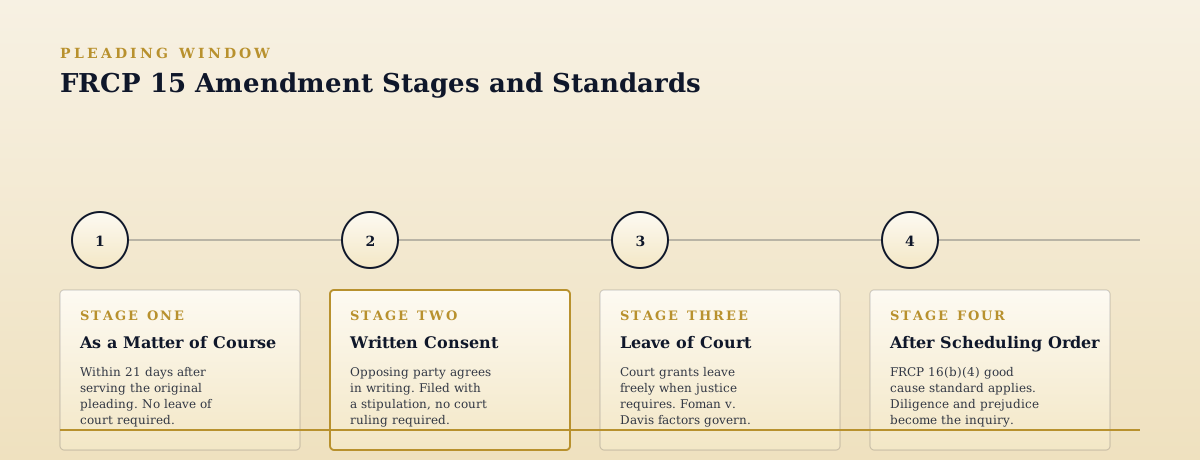
The first window under Rule 15(a)(1) lets a party amend a pleading once as a matter of course within 21 days after serving it, or within 21 days after a responsive pleading or a Rule 12(b), (e), or (f) motion is served, whichever comes earlier. No leave of court is required, no opposing-party consent is required, and the clerk does not need to docket a separate order. The second window under Rule 15(a)(2) lets a party amend with the opposing party's written consent or with leave of court. The rule directs the court to grant leave freely when justice so requires, a phrase that has launched thousands of citations to Foman v. Davis, the 1962 Supreme Court opinion that catalogs the factors a court considers when denying leave: undue delay, bad faith, dilatory motive, repeated failure to cure deficiencies, undue prejudice to the opposing party, and futility of the amendment.
The third window opens after the court enters a Rule 16(b) scheduling order. Once that order is in place, the freely-given standard yields to the more demanding good-cause standard in Rule 16(b)(4). The good-cause inquiry focuses on the moving party's diligence: could the party have moved to amend earlier with the information then available? If the answer is yes, leave is typically denied. If the answer is no because the basis for amendment surfaced only in discovery, courts grant leave under both the diligence and the prejudice prongs. FRCP Rule 16 governs the scheduling-order entry that triggers this transition, and the same Rule 16 conference fixes the dispositive-motion deadline that makes the difference between a freely-given Rule 15 amendment and a good-cause Rule 16 amendment.
Rule 15(c) governs relation-back, the doctrine that lets an amendment treat its filing date as the original pleading date for limitations purposes. Relation-back applies when the amendment asserts a claim or defense that arose out of the same conduct, transaction, or occurrence set out in the original pleading, or when the amendment changes the party against whom the claim is asserted and certain notice conditions are satisfied. Relation-back is the rescue mechanism for a plaintiff who learns the correct defendant's identity only after the limitations period has run.
Practitioners drafting amended pleadings in cases where the limitations period has nearly run should pair the leave motion with a relation-back showing under Rule 15(c), specifying the conduct, transaction, or occurrence link to the original pleading and, where the amendment changes a party, the Rule 4(m) notice timing. Counsel handling Rule 15(d) supplemental pleadings, which add events occurring after the original filing, should remember that supplemental pleadings require leave of court regardless of how early in the case they are filed; the 21-day matter-of-course window does not apply to supplemental pleadings.
IV, In Practice
The 2025 Florida Civil Procedure Amendments: Rules 1.200, 1.202, and Computing Deadlines
Florida case management and deadlines
Florida
Rule 1.200
Case-management order with firm pretrial deadlines (2025)
Florida
Rule 1.202
Conferral before non-dispositive motions; Certificate of Conferral (2025)
Florida
Rule 2.514
Computation of time, including the five-day mail extension
Florida
Rule 1.380
Failure to make discovery and sanctions
The 2025 Case-Management and Conferral Amendments
The most consequential recent change to the Florida Rules of Civil Procedure is the amendment package that took effect January 1, 2025. Two rules anchor it. Florida Rule of Civil Procedure 1.200 now requires the court to enter a case-management order early in most civil cases, setting firm, presumptive deadlines for completing service, fact and expert discovery, alternative dispute resolution, and dispositive motions. The amendment imports the active-management philosophy of Federal Rule of Civil Procedure 16(b): the deadlines are strictly enforced unless changed by court order, and a party who wants to move one must show good cause. Florida Rule of Civil Procedure 1.201 carries the parallel framework for complex litigation, tying the schedule to the time standards in Florida Rule of General Practice and Judicial Administration 2.250.
Florida Rule of Civil Procedure 1.202 is the second pillar of the 2025 package and the one practitioners ask about most. Before setting most non-dispositive motions for hearing, the moving party must confer with opposing counsel in a genuine effort to resolve or narrow the dispute, then certify that conferral in a Certificate of Conferral placed at the end of the motion above the signature block. The rule expressly exempts the motions on which conferral is either pointless or procedurally inappropriate, among them motions for summary judgment, to dismiss, for injunctive relief, and for entry of default. A movant who skips the conferral, or who treats it as a one-line email, risks denial of the motion without prejudice, and purposeful evasion of the duty can draw a further sanction. The conferral requirement is the Florida analogue of the meet-and-confer certification federal litigators know from discovery practice under Federal Rule of Civil Procedure 37(a)(1).
Computing Florida Deadlines Under Rule 2.514 and the 33-Day Mail Rule
Florida moved the mechanics of counting deadlines out of the individual procedure rules and into Florida Rule of General Practice and Judicial Administration 2.514. The day of the triggering event is not counted; the last day is counted unless it falls on a weekend or legal holiday, in which case the period runs to the next business day. When a paper is served by mail, Rule 2.514(b) adds five days to any deadline measured from service, the calculation practitioners loosely call the Florida 33-day rule. That five-day addition is no longer available for e-mail service: e-service under Florida Rule of Judicial Administration 2.516 is now the default and is treated as instantaneous, so the extra days apply only when a paper actually goes out by mail. The lesson for the calendar is to find the base period in the controlling rule first, then add the mail days under Rule 2.514(b) only if mail was actually used, rather than reaching for a flat 33-day figure.
Florida Rule of Civil Procedure 1.090(b) governs extensions of time and, just as important, lists the deadlines a court cannot extend at all: the time to move for a new trial or rehearing, to move for relief from judgment under Rule 1.540(b), to take an appeal, or to move for a directed verdict. A litigator calendaring a Florida case therefore works from two documents at once, the Rule 1.200 case-management order for the discovery and motion deadlines and Rule 2.514 for the day-count mechanics, and treats the Rule 1.090(b) non-extendable list as the bright line that no stipulation or good-cause showing can move.
Rule 1.380, Discovery Sanctions, and the Summary-Judgment Record
The discovery record that a Rule 1.510 summary-judgment motion ultimately cites is built and enforced through Florida Rule of Civil Procedure 1.380, the failure-to-make-discovery and sanctions rule that tracks Federal Rule of Civil Procedure 37. When an opponent stonewalls interrogatories, document requests, or a deposition, the remedy is a motion to compel, followed, if the resulting order is ignored, by escalating sanctions up to an adverse evidentiary ruling or dismissal. Because Rule 1.202 now requires conferral before most non-dispositive motions, the conferral step is itself part of the Rule 1.380 motion-to-compel sequence in Florida. For a sequenced walkthrough of that conferral-motion-order-sanction path in both Florida and federal court, see our motion to compel discovery procedural walkthrough.
Across the Florida Rules of Civil Procedure, the rule numbers are the chassis on which the substantive law rides. A litigator who masters the rules a Florida court reaches for most, Rule 1.140 for pleading attacks, Rule 1.510 for summary judgment, Rule 1.190 for amendments, Rules 1.200 and 1.202 for case management and conferral, and Rule 2.514 for the day count, files cleaner papers, draws fewer procedural-defect orders, and spends more of the client's budget on the merits. The most efficient way to learn the set is rule by rule, each paired with the federal counterpart it tracks: Rule 1.140 with FRCP 12, Rule 1.510 with FRCP 56 and the Celotex trilogy, Rule 1.190 with FRCP 15 and Foman v. Davis, and Rule 1.200 with FRCP 16.
FAQ
Florida Rules of Civil Procedure Questions Practitioners Ask
Who writes the Florida Rules of Civil Procedure?
What is the new rule of Civil Procedure 1.202 in Florida?
What are the four types of civil cases?
How many days do you have to respond to a complaint in Florida?
What is the 33 day rule in Florida?
Need a Motion Drafted to These Rules?
Legal Tank drafts motions and pleadings to the Florida and federal procedural standards covered in this guide. Send us the case posture and the controlling rule, and we return a sign-ready paper inside the published timeline.