Litigation Support Services for Trial Attorneys
Written discovery, e-discovery first-pass review, deposition summaries, summary judgment support, and trial-prep binders.
Our litigation support services run the FRCP case lifecycle workstreams that sit between trial-attorney strategy calls. Discovery drafted to local civil-rule numerical limits, e-discovery first-pass review on Relativity, Everlaw, or Reveal, deposition summaries with page-line indices and exhibit cross-references, and trial-prep binders built on the judge's standing orders. Trial attorney owns the Rule 5.3 review and signs every filing.
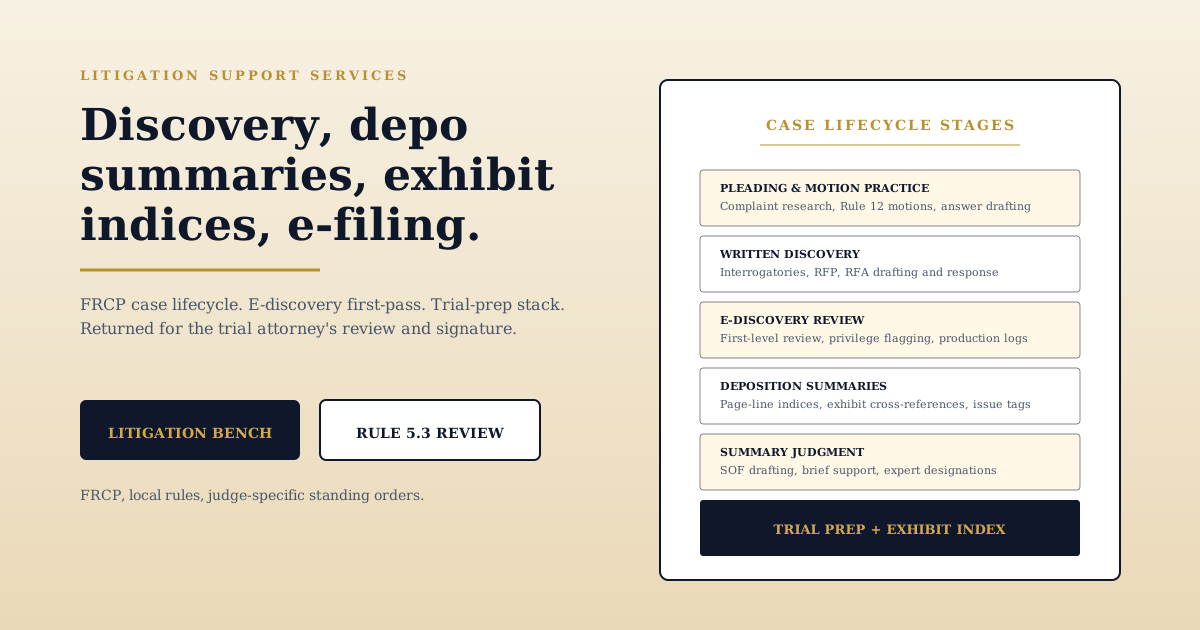
FRCP · Local Rules · Standing Orders
Local-rule and judge-specific conformance on every filing
Eight Workstreams That Carry the Case From Pleading to Trial
Discovery support services, deposition summary services, e-discovery support, and trial preparation support are bundled below into the eight workstreams that move a civil case through its lifecycle. Engage one workstream as a project, a stack as a sprint, or the full lifecycle as a case retainer.
Pleading & Motion Practice
Complaint drafting, answer drafting, Rule 12 motion practice (12(b)(6), 12(b)(1), 12(c)), and replies. Pleadings drafted to the controlling jurisdiction's Twombly/Iqbal pleading standard and local rule formatting.
Written Discovery
Interrogatories, requests for production, requests for admission, and the corresponding objections and responses. Drafted to the local civil rules' numerical limits and the protective order's confidentiality designations.
E-Discovery First-Pass Review
First-level relevance review, privilege flagging, redaction prep, and production-log maintenance on Relativity, Everlaw, or Reveal. Early case assessment (ECA) plus the processing steps that precede review: deduplication, metadata extraction, culling, and analytics with email threading. Technology-assisted review (TAR), predictive coding, and continuous active learning (CAL) prioritize likely-responsive documents on those same platforms. Privilege calls escalate to the trial attorney; first-pass relevance moves through the bench.
Deposition Summaries
Page-line summary indices with exhibit cross-references and issue tags. Same-day turnaround available on transcripts received before 3 PM ET for trial-prep sprints.
Summary Judgment Support
Statement of facts with record citations, brief support, expert-designation drafting, and Daubert-motion support. Drafted to the controlling jurisdiction's Rule 56 standard and the judge's individual rules.
Trial Prep & Exhibit Index
Pretrial order drafting, exhibit index construction with deposition cross-references, jury-instruction research and drafting, witness binders, and the trial-evidence binder for the trial attorney's lectern.
Document Production, Scanning & Bates Numbering
Legal document scanning and OCR that turns paper and image-only PDFs into text-searchable records, then Bates numbering across the full production set. Includes separator sheets, exhibit indices, continuous pagination, PDF bookmarking to each document, and splitting into volumes that meet a court's per-document file size limit. Scans are processed at their native resolution so a 1,300-page set stays legible without ballooning past what the e-filing system will accept.
Cite-Check & Brief Support
Citation passes on briefs and motions, Bluebook conformance, record-citation verification, and table-of-authorities drafting. Pairs with our research bench for cases that need new authority research alongside the cite check.
E-Filing Preparation
PACER/CM-ECF e-filing packets, state-court ECF packets, courtesy-copy mechanics, and judge-specific standing-order conformance. Filing signature stays with the trial attorney; we prepare the packet.
Federal Civil Case Lifecycle and the FRCP Rule Anchors
Our litigation-support bench maps every workstream to the FRCP rule that controls it. The table below is the case lifecycle our drafters work from on federal civil matters; state-court engagements substitute the state civil rules, and our bench carries the local-rule research separately.
| Lifecycle Stage | Workstreams Routed to the Bench | Rule Anchor |
|---|---|---|
| Rule 7 / Rule 8 pleading stage | Complaint research and drafting; answer with Rule 12 responses; Rule 12(b)(6) motion practice; Rule 15 amended pleadings. | FRCP 7, 8, 12, 15 |
| Rule 26(f) discovery plan | Rule 26(a) initial-disclosure drafting; Rule 26(f) conference outline; protective-order drafting; ESI-protocol drafting. | FRCP 26 |
| Written discovery | Interrogatories (limit 25 absent leave); RFP and RFA drafting; objections and responses; Rule 34 production logs. | FRCP 33, 34, 36 |
| E-discovery production | First-pass relevance review; privilege log drafting; redaction prep; load-file QC on Relativity / Everlaw / Reveal. | FRCP 26(b), 34(b), 37(e) |
| Depositions | Pre-deposition outline; exhibit binder; page-line summary; deposition-by-deposition issue tag log. | FRCP 30, 32 |
| Summary judgment | Statement of undisputed facts; brief support with record cites; response statement of facts; expert and Daubert support. | FRCP 56, FRE 702 |
| Pretrial and trial | Pretrial order drafting; motions in limine; jury instructions; exhibit index; trial-evidence binder; verdict-form drafting. | FRCP 16(e), 50, 51 |
What our bench does not do
Our litigation-support drafters do not appear in court, do not take depositions, do not sign filings, do not make privilege calls on flagged documents, and do not communicate with the underlying client. Those touchpoints stay with the trial attorney under Rule 5.3 because they require the licensed bar admission and attorney-client relationship the engagement does not transfer.
Adjacent workstreams we coordinate but do not staff: court reporting, records and subpoena retrieval, and trial presentation. We schedule around them and hand off cleanly, but the engaging firm keeps its own vendors on those lanes.
E-Discovery and Case-Management Platform Access on the Bench
Our litigation-support bench operates on the platforms the cases actually run on. E-discovery review goes through Relativity, Everlaw, or Reveal depending on the engaging firm's existing workspace; transcript management and deposition summaries run through TextMap and LiveNote with native exports from the Veritext or court-reporter file; case management and exhibit indices run through CaseFleet, NetDocuments, or iManage; and e-filing routes through PACER/CM-ECF for federal matters or the controlling state ECF system.
Mapped to the Electronic Discovery Reference Model (EDRM), our bench operates the Review, Analysis, and Production stages. Identification, preservation, collection, and processing hand off upstream, staying with the engaging firm or its e-discovery vendor, and our drafters pick up once the data lands in the workspace: review and analysis through first-pass relevance, TAR and predictive coding, and email threading, then production through privilege logs, redaction, and load-file QC.
Database access sits inside the Legal Tank bench, which means the engaging firm does not stand up new platform seats for the engagement, the case file does not live on a platform outside the matter portal, and the protective order's confidentiality designations are mapped to the platform's access controls at intake. Production logs, privilege logs, and load-file QC records all return to the engaging firm at engagement close.
For cases that need new authority research alongside the cite-checking pass, our research bench pairs directly with the litigation-support engagement. Legal research services are quoted as an add-on workstream at intake and the same named drafter coordinates across both.
How a Litigation Support Engagement Runs From Intake to Filing
Six-step engagement flow runs whether the workstream is a single discovery response, a deposition-summary sprint, or a full case-lifecycle retainer.
- 1
Case intake
Send the case caption, controlling jurisdiction, operative deadlines, and the workstream you need on the docket. We return scope in one business day.
- 2
Conflicts + protective-order check
We run the conflicts ledger against the parties and counsel, and confirm the protective order's confidentiality designations before any source material moves.
- 3
Engagement NDA + portal
Matter-specific engagement NDA executed; SOC-2 Type II matter portal provisioned with named-user access for the assigned drafter and the trial attorney.
- 4
Drafter assignment
We assign a senior litigation-support drafter on the workstream lane that fits (discovery, e-discovery review, deposition summary, motion practice, trial prep) plus a peer reviewer.
- 5
Drafting + peer review pass
Workstream runs end-to-end inside the portal: drafting on the controlling jurisdiction's local rules, peer review pass, and the deliverable returns through the portal.
- 6
Returned for trial-attorney review
Trial attorney owns the Rule 5.3 review, signs every pleading, makes the privilege call on every flagged document, and files the packet on the court docket.
What Trial Attorneys Say After the Discovery Sprint Settles
Five-star feedback from commercial litigators, solo practitioners, employment-litigation boutiques, and insurance-defense firms that routed litigation-support workstreams through our bench on a single matter, a sprint, or a multi-month case retainer.
“Eleven-attorney commercial litigation firm, four active cases in heavy discovery, and our paralegal bench was tapped out on the e-discovery review for the lead case. Engaged Legal Tank on a per-matter litigation-support retainer: first-pass review on Relativity, privilege flagging escalating to our lead partner, and weekly production logs. Three weeks in we cleared the backlog without pulling associates off depositions, and the privilege calls held up on a Rule 37 motion brought by the opposing side.”
“Solo personal-injury practice, a complex products case with eight depositions taken in two weeks, and a trial date six weeks out. Their deposition-summary bench turned around page-line summaries with exhibit cross-references on a same-day cadence for the entire deposition stack, then built the trial exhibit index against those summaries. I walked into voir dire with the binder, the witness file, and the deposition page-line index already cross-referenced. Verdict came back in our favor.”
“Mid-size employment-litigation boutique, summary-judgment season landed three motions across three cases at once. Their litigation-support drafter built the statements of undisputed fact with record citations on all three, plus first drafts of the brief support sections. Our partners did the final argument-and-strategy pass on each brief, signed under our own firm letterhead, and we got rulings in our favor on two of the three motions. Cleared the SJ season without burning associate hours we needed on trial prep.”
“Regional insurance-defense firm with a heavy state-court civil docket and a permanent demand for discovery responses on tight statutory clocks. Standing litigation-support retainer with Legal Tank covers interrogatories, RFP responses, and RFA responses across the docket. Their drafter pulls the privilege log against the firm's running privilege ledger, and our partner reviews and signs every response. Throughput is up roughly fifty percent on written discovery without adding headcount.”
Trial Attorney Signs Every Pleading; We Run the Workstream
Every litigation-support engagement is structured so the trial attorney is the supervising attorney of record under ABA Model Rule 5.3. Our drafter prepares the work product, we run a peer review pass, and the deliverable returns through the matter portal for the trial attorney's Rule 5.3 review and signature. Privilege calls on flagged documents escalate to the trial attorney rather than being made on the bench, and no filing reaches the court docket without the trial attorney's bar number on the signature block. Document review and drafting are performed by US-based reviewers under supervising-attorney (Rule 5.3) oversight.
Trial attorney is the signer of record
Pleadings, motions, discovery responses, expert designations, and trial-evidence packets all carry the trial attorney's signature and bar number. Our drafter prepares the deliverable; the trial attorney owns the strategy and the signature.
Senior drafter + peer review pass
Every workstream runs a senior litigation-support drafter plus a peer reviewer who runs the local-rule and citation conformance pass before the deliverable leaves the portal. The trial attorney still owns the Rule 5.3 review on delivery.
Legal Tank
- Drafts discovery, motions, deposition summaries, and trial-prep deliverables.
- Runs first-pass e-discovery relevance review with privilege flagging.
- Operates the platform stack inside our bench; protective-order designations honored.
- Prepares e-filing packets to local-rule and judge-standing-order conformance.
Trial Attorney
- Owns the case strategy, the privilege calls, and the witness preparation.
- Reviews every deliverable on return and signs every pleading on its own letterhead.
- Takes depositions, appears in court, and handles oral argument.
- Holds the attorney-client relationship with the underlying client.
For trial-level briefs only, see legal brief writing services. For ongoing paralegal capacity inside a firm, see paralegal services. For broader workstream routing, see outsource legal services. For extraordinary and post-conviction writs, see writ of mandamus drafting and the petition for writ of habeas corpus. The medical-record desks have their own pages: page-cited medical chronology services, the record review findings memo, and deposition summary services with page-line citations.
Questions Trial Attorneys Ask About Litigation Support
What does a litigation support specialist do?
What is included in litigation support?
How much do litigation support services cost?
What is the difference between paralegal and litigation support?
What software is used for litigation support?
Route Your Next Workstream to Our Bench
Send the case caption, jurisdiction, and the operative deadline through our quote form. We return scope and the named drafter in one business day.
Quotes return same business day on intakes received before 5 PM ET