Writ of Mandamus Petition Drafting for Federal Courts, State Mandate, and USCIS Delay Lawsuits
Prepared by a licensed U.S. attorney
A writ of mandamus is a court order that compels a government officer, an agency, or a lower court to perform a nondiscretionary duty the law requires of it. We draft federal, appellate, state mandate, and USCIS-delay petitions to the governing statute and rule.
Our drafters prepare the complaint or petition, the supporting memorandum, and the exhibit record, and cite-check every authority against the controlling law of the forum. Drafts return to you, whether you are counsel of record or a self-represented litigant, to review, sign, and file yourself. Mandamus compels a decision, not a favorable result.
28 U.S.C. 1361 · 1651 · APA 706(1) · FRAP 21
Clear right, nondiscretionary duty, no other adequate remedy
Every Petition for Writ of Mandamus the Bench Drafts End to End
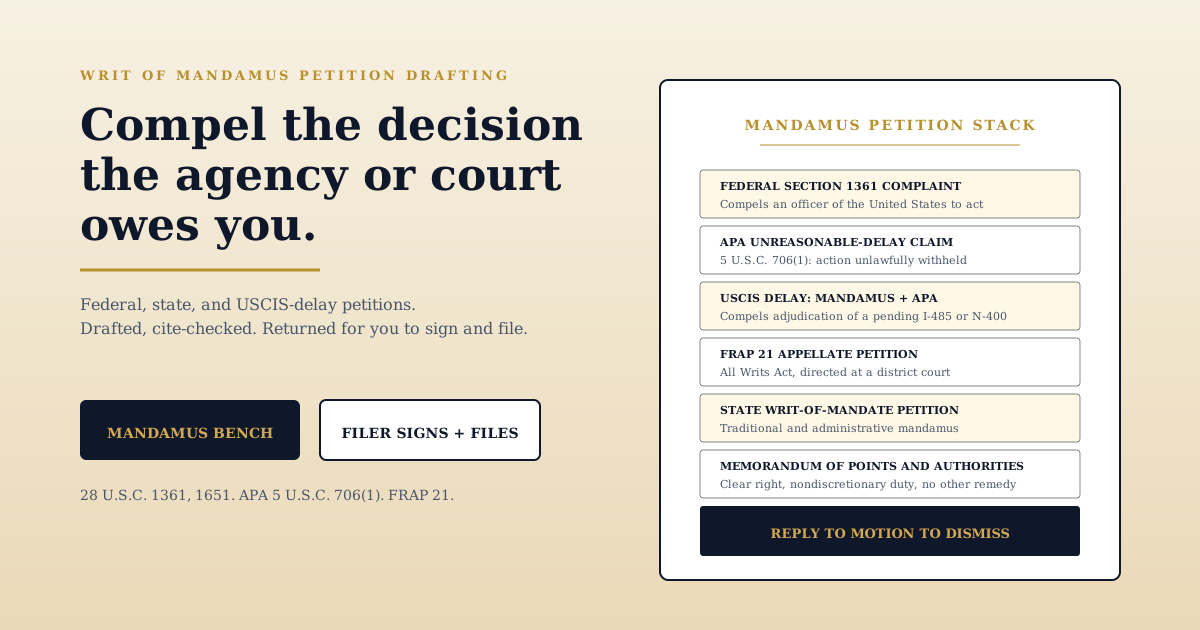
A petition for writ of mandamus takes a different shape in each forum. The eight workstreams below cover the federal statutory complaint, the APA delay complaint, the combined immigration-delay complaint, the FRAP 21 appellate petition, and the state writ-of-mandate petition, plus the memorandum and exhibit record that go with them. Engage one document as a project or the full complaint-and-memorandum package.
Looking at a different extraordinary writ? See our habeas corpus petition drafting, or route appellate merits work through appellate brief writing services.
Federal Section 1361 Mandamus Complaint
Complaint under 28 U.S.C. Section 1361 to compel an officer or agency of the United States to perform a nondiscretionary duty owed to the plaintiff. Venue pleaded under 28 U.S.C. Section 1391(e), jurisdiction and the three mandamus elements set out on the face of the pleading.
APA Unreasonable-Delay Complaint
Complaint under 5 U.S.C. Section 555(b) and Section 706(1) to compel agency action unlawfully withheld or unreasonably delayed. Pleaded with the delay timeline and the statutory or regulatory duty the agency has left unperformed.
Combined Mandamus + APA Complaint for USCIS Delay
The standard immigration-delay vehicle: a single complaint pleading both the Section 1361 mandamus count and the APA Section 706(1) count to compel USCIS to adjudicate a long-pending I-485, N-400, I-130, or I-751. The relief sought is a decision, not a grant.
FRAP 21 Petition for Writ of Mandamus
Appellate petition under the All Writs Act, 28 U.S.C. Section 1651, and FRAP 21, directed at a district court or judge that has failed to act or has clearly exceeded its authority. Framed around the demanding appellate mandamus standard and the absence of an adequate remedy by appeal.
State Writ-of-Mandate Petition
Petition for a state writ of mandate compelling a public officer or agency to perform a ministerial duty. Drafted to the governing state statute and rule, for example California CCP Section 1085 for traditional mandamus and Section 1094.5 for administrative mandamus. State procedures vary and are confirmed per matter.
Memorandum of Points and Authorities
Supporting memorandum of law that walks the three elements element by element: the clear right to the relief sought, the clear nondiscretionary duty to act, and the absence of any other adequate remedy. Authority pulled and cite-checked against the controlling law of the forum.
Delay-Timeline and Receipt-Notice Exhibit Record
Exhibit index and chronology assembling the receipt notices, service requests, prior inquiries, and processing-time data that establish the length and unreasonableness of the delay. Built so the record supports the petition on its face.
Reply to the Government's Motion to Dismiss
Reply brief answering the government's Rule 12(b) arguments on jurisdiction, the discretionary-function defense, and the reasonableness of the delay. Drafted to the government's actual filing and returned for the filer to sign and file on the docket.
The Three Elements of Mandamus and the APA Unreasonable Delay Lawsuit
Mandamus is an extraordinary remedy with a demanding threshold. Courts grant it only where three elements are met, and a petition that fails any one of them is vulnerable to a motion to dismiss. Every draft we prepare pleads each element on the face of the complaint.
A clear right to relief
The petitioner must have a clear and indisputable right to the action being demanded, grounded in a statute, a regulation, or a rule that entitles the petitioner to it.
A nondiscretionary duty
The official or agency must owe a clear, ministerial, nondiscretionary duty to act. Where the act is discretionary, mandamus cannot compel a particular choice, only, at most, that a choice be made.
No other adequate remedy
No other adequate remedy can be available. If an appeal or an ordinary cause of action would resolve the matter, the extraordinary writ is not the right vehicle.
In federal court, a delay claim is almost always paired with the Administrative Procedure Act. An APA unreasonable delay lawsuit is brought under 5 U.S.C. Section 555(b), which requires an agency to conclude a matter within a reasonable time, and 5 U.S.C. Section 706(1), which lets a reviewing court compel agency action unlawfully withheld or unreasonably delayed. Where the duty to act is nondiscretionary, the two theories reinforce each other: the mandamus count under Section 1361 and the APA count under Section 706(1) both ask the court to order the agency to do what it is required to do.
That is why most delay complaints plead both counts together. The mandamus count anchors the clear nondiscretionary duty; the APA count supplies the unreasonable-delay standard and the waiver of sovereign immunity for the relief sought. For the underlying authority research behind either count, our legal research services pair directly with the drafting engagement.
Writ of Mandamus for USCIS Delay: Compelling Adjudication, Not a Grant
A writ of mandamus USCIS suit is the most common use of the remedy we draft. When USCIS has left an application pending far past normal processing, the applicant can ask a federal district court to compel the agency to adjudicate it. USCIS has a nondiscretionary duty to decide the case; it does not have a duty to decide it a particular way. The relief the court can order is a decision, not an approval. Every draft we prepare says so plainly, because a petition that overreaches invites a motion to dismiss.
A mandamus lawsuit for immigration delay typically pleads both the Section 1361 mandamus count and the APA Section 706(1) count in a single complaint filed in the district where the applicant resides. The petitions we see most often target a long-pending I-485 adjustment of status, an N-400 naturalization application stalled after the interview, an I-130 family petition, or an I-751 petition to remove conditions on residence. The draft pleads the specific application, the receipt date, the elapsed time against published processing benchmarks, and the nondiscretionary duty to adjudicate.
The exhibit record does much of the work. We assemble the receipt notices, the service requests, the case-status history, and the prior inquiries into a chronology that shows the length of the delay on the face of the filing. The draft, the supporting memorandum, and the exhibit record return to you, the attorney of record or the self-represented applicant, to review, sign, and file. We never guarantee that filing will produce a decision by any date, because the timing belongs to the court and the agency.
State Writ of Mandate: Traditional and Administrative Mandamus
Outside the federal system, the same remedy usually goes by the name writ of mandate. It compels a state or local public officer, board, or agency to perform a duty the law imposes on it. Procedures are set by each state, so the governing statute and the filing forum are confirmed for your jurisdiction before any draft is prepared. We do not assume that one state's practice carries over to another.
California is a useful illustration of how state practice splits the remedy. A traditional writ of mandate under California Code of Civil Procedure Section 1085 compels a ministerial duty owed by a public officer or agency. An administrative writ of mandate under Section 1094.5 reviews the result of an agency's adjudicatory hearing, testing whether the agency proceeded without or in excess of its jurisdiction, gave a fair hearing, or abused its discretion. Other states use their own statutes and their own names for the same functions.
Whichever state applies, the draft pleads the ministerial or reviewable duty, the clear right to the relief, and the absence of another adequate remedy, then returns to you to sign and file with the correct court. For matters that span both federal and state exposure, our outsource legal services route the full workstream through one bench.
How to File a Writ of Mandamus, Step by Step From Intake
The six-step flow below is how a mandamus engagement runs, whether the matter is a single federal complaint, a combined mandamus-and-APA USCIS suit, an appellate FRAP 21 petition, or a state writ-of-mandate petition. The last step is always yours: you sign and file.
- 1
Mandamus intake
Send the forum, the duty at issue, the agency or lower court involved, and whether the petition pairs a mandamus count with an APA delay count. We return scope, the named drafter, and the timeline in one business day.
- 2
Duty + adequacy screen
We confirm the duty is nondiscretionary, that a clear right to the relief exists, and that no other adequate remedy is available, because a discretionary act or an available appeal defeats mandamus at the threshold.
- 3
Engagement NDA + portal
Matter-specific engagement NDA executed; SOC-2 Type II matter portal provisioned for receipt notices, agency correspondence, prior filings, and draft petitions. No email attachments, no shared drives.
- 4
Drafter assignment + count framing
Senior litigation drafter assigned. The mandamus count, any APA delay count, and the relief sought are framed before drafting starts. Peer-review drafter named at intake.
- 5
Draft + authority + cite-check pass
The complaint or petition, the memorandum of points and authorities, and the exhibit record are drafted inside the portal. A second drafter runs the cite-check pass against the controlling law of the forum.
- 6
Returned for you to sign and file
The draft returns in review-ready form. You, whether counsel of record or a self-represented filer, make the final calls, sign the petition, and file it with the clerk of the forum yourself.
You Review, Sign, and File Every Petition; We Prepare the Draft
Every mandamus engagement is structured as drafting support. We serve two audiences: attorneys who want the petition, memorandum, and exhibit record built to a filing-ready draft, and self-represented litigants who want the same work product in their hands. In both cases the draft returns to you. You make the final decisions, you sign, and you file with the clerk of the forum. Nothing reaches a docket without your signature, and we make no promise about the outcome, because mandamus compels a decision, not a grant.
The filer signs every petition
Federal complaints, APA delay complaints, FRAP 21 petitions, and state writ-of-mandate petitions all carry the filer's signature. Whether you are counsel of record or a self-represented applicant, the strategy calls and the signature are yours.
Senior drafter + cite-check pass
Every petition runs a senior litigation drafter plus a second drafter who runs the authority and cite-check pass against the controlling law of the forum before the draft leaves the portal. You still own the final review on delivery.
Legal Tank
- Screens the duty for the nondiscretionary, clear-right, no-other-remedy elements.
- Drafts the complaint or petition, pleading each count to the governing statute or rule.
- Prepares the memorandum of points and authorities with cite-checked support.
- Assembles the delay-timeline and receipt-notice exhibit record.
- Drafts the reply to the government's motion to dismiss when one is filed.
You, the Filer
- Own the strategy, the forum choice, and the decision to file.
- Review the draft on return and sign the petition yourself.
- File with the clerk of the forum and pay the court's filing fee.
- Serve the government and handle any appearance or hearing.
For the sibling extraordinary writ, see petition for writ of habeas corpus drafting. For merits work on appeal, see our appellate brief bench. For trial-court support, see litigation support services.
Questions Filers Ask About the Writ of Mandamus
What is a writ of mandamus?
How long does a USCIS mandamus lawsuit take?
How much does it cost to file a writ of mandamus?
What is the difference between mandamus and an appeal?
Can I file a writ of mandamus myself?
Route Your Mandamus Petition to Our Bench
Send the forum, the duty at issue, and the agency or lower court involved through our quote form. We return scope, the named drafter, and the timeline in one business day, and the draft comes back for you to sign and file.
Quotes return same business day on intakes received before 5 PM ET