Appellate Brief Writing Services
Opening, response, reply, amicus, cert-petition, and rehearing-en-banc briefs drafted to the operative word limit.
Our appellate brief writing services are produced by drafters who frame every issue around the standard of review, build each argument against the trial-court record, and run a Bluebooked table of authorities with a KeyCited citation pass. Briefs return to your firm in review-ready form for your counsel of record to file under your firm's letterhead and signature.
FRAP · Circuit Local Rules · State Appellate Rules
Standard of review framed per issue on every brief
Ten Appellate Workstreams the Bench Drafts End to End
Appeal brief drafting, cert petition writing, and amicus brief drafting are bundled below into the ten appellate workstreams our drafters run. Engage one brief as a project, the full opening-and-reply stack as an appeal, or a standing appellate retainer.
New to the format? Walk an appellate brief example section by section, or see what an amicus curiae brief requires before you commission one.
Appellant Opening Brief
Statement of jurisdiction, issues presented, statement of the case and facts with record citations, summary of argument, argument organized issue by issue, and prayer for relief. Drafted to the operative FRAP or state-rule word limit.
Appellee Response Brief
Counter-statement of the case, harmless-error and waiver defenses, argument organized to the appellant's issue framing, and request for affirmance. Standard of review confirmed or contested per issue.
Reply Brief
Focused replies to the appellee's argument with no new issues injected and no new authorities raised outside the scope of the opening brief. Drafted to FRAP 32's 6,500-word limit or the state-rule equivalent.
Cross-Appeal Brief
Combined principal-and-response briefing drafted to the FRAP 28.1 cross-appeal sequence: the appellant's principal brief, then the appellee/cross-appellant's combined principal and response brief on the enlarged word limit, then the appellant/cross-appellee's combined response and reply, then the cross-appellant's reply. Word counts and briefing order set by FRAP 28.1(c) and 28.1(e).
Record on Appeal & Exhibit Transmittal
Preparation of the record a brief has to cite: transmittal letters and exhibit indices under the controlling transmittal rule, continuous pagination across the whole exhibit set, separator sheets, and PDF bookmarking to each exhibit. Where the trial court no longer holds the designated exhibits and directs a party to send them to the reviewing court directly, we assemble that transmittal. Image-only scans are OCR'd so the set is text-searchable as the appellate e-filing rules require, and hyperlinking legal briefs to the record is available where the court accepts linked citations. Materials sealed below, such as tax returns lodged confidentially, are kept out of the public volume rather than transmitted with it.
Amicus Curiae Brief
Friend-of-the-court brief with statement of interest, consent-or-leave-of-court disclosure, and appellate-authority analysis that complements rather than duplicates the party briefs. Sized to half the party word limit.
Petition for Certiorari
Cert petitions to the U.S. Supreme Court and discretionary-review petitions to state supreme courts. Framed around the cert-worthiness factors: circuit split, exceptional importance, conflict with controlling authority.
Petition for Rehearing En Banc
Petitions for panel rehearing or rehearing by the full court of appeals after a panel decision. Anchored to the intra-circuit-conflict standard or the exceptional-importance standard under FRAP 35.
Table of Authorities + Citation Pass
Bluebook-conformed table of authorities, KeyCited and Shepardized citation pass, and record-cite verification against the trial-court record. Pairs with our research bench when new authority research is needed.
Appendix and Excerpts of Record
Joint appendix or excerpts of record assembly, designation-of-record drafting, and pinpoint-cite tables. Drafted to the circuit's appendix rules and the operative judge-specific standing orders on appendix format.
Extraordinary Writs and Appellate Motions
Petition for writ of mandamus, motion to extend time, motion for stay pending appeal, and motion to seal, drafted to the circuit's local rules and the operative appellate schedule. Motions and petitions return in review-ready form for counsel of record to sign and file on the appellate docket.
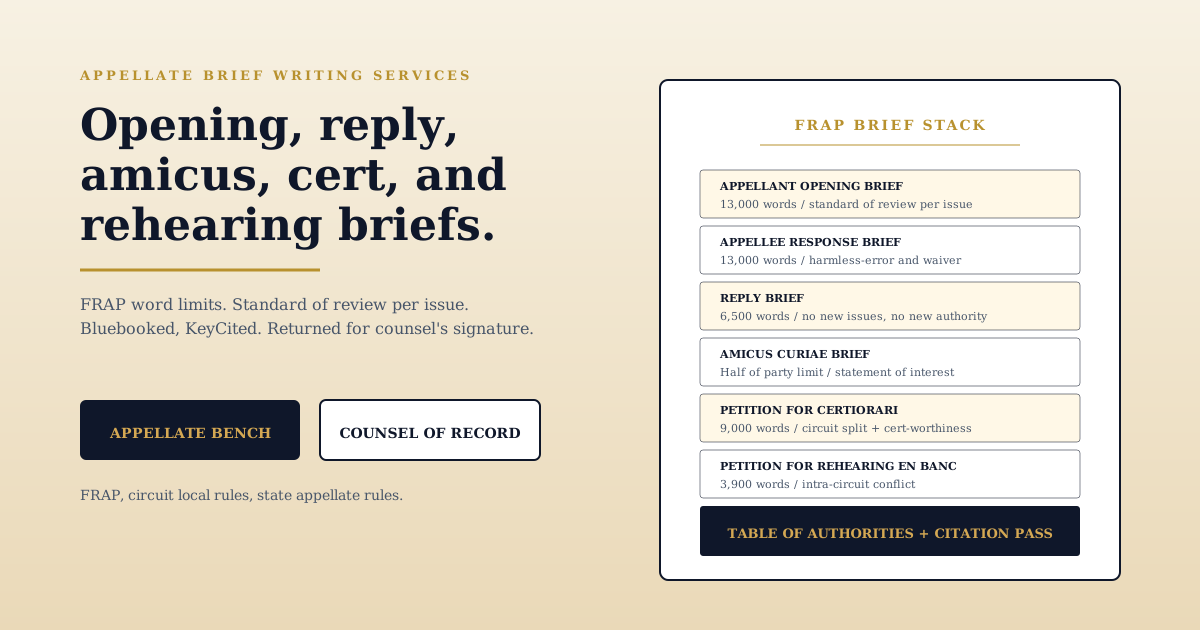
FRAP Brief Stack: Word Limits, Standard of Review, and Record Posture
The table below is the operational frame our drafters work from on federal appeals. Individual circuits and state appellate courts add local rules on top (cover-color requirements, table-of-authorities formatting, word-count certification language), and our bench carries the local-rule research separately per matter.
| Brief Type | Word Limit | Standard of Review | Record Cites | Rule Anchor |
|---|---|---|---|---|
| Federal appellant opening brief | 13,000 words | Per issue (de novo / abuse / clear error) | Yes, every fact | FRAP 32(a)(7) |
| Federal appellee response brief | 13,000 words | Confirmed or contested per issue | Yes, every fact | FRAP 32(a)(7) |
| Federal reply brief | 6,500 words | Adopted from opening | Yes, on contested facts | FRAP 32(a)(7) |
| Petition for certiorari | 9,000 words | Implied (cert-worthiness) | Yes, lower-court record | Sup. Ct. R. 33.1(g) |
| Brief in opposition to cert | 9,000 words | Contested cert-worthiness | Yes | Sup. Ct. R. 33.1(g) |
| Petition for rehearing en banc | 3,900 words | Intra-circuit conflict or exceptional importance | As needed | FRAP 35(b), 40(b) |
| Amicus curiae brief | Half of party limit | Adopted | As needed | FRAP 29 |
What our bench does not do
Our appellate drafters do not appear on appellate dockets, do not sign briefs, do not argue at oral argument, do not make the issue-selection or strategy calls, and do not communicate with the underlying client. Those touchpoints stay with counsel of record under ABA Model Rule 5.3 because they require the bar admission and attorney-client relationship the engagement does not transfer.
Research Bench Behind Every Appellate Brief
Every appellate brief our bench drafts is supported by a full research pass on Westlaw KeyCite and Lexis Shepard's for the controlling authority, plus Bloomberg Law for dockets and circuit-by-circuit treatment, plus HeinOnline for legislative history when statutory construction is at stake. The cite-check pass is run by a different drafter than the one who wrote the brief, which catches transposition errors, wrong-pin-cite errors, and overruled authority that survived an earlier draft.
For circuit-split research on cert petitions, for intra-circuit-conflict research on rehearing-en-banc petitions, and for new-authority research on issues that were not fully briefed at the trial-court level, our research bench pairs directly with the appellate engagement. The same named drafter coordinates across both engagements and the research memo is delivered into the matter portal alongside the brief drafts.
For a standalone research memorandum independent of an appellate brief, see legal research services. The appellate research add-on is quoted at intake on the same line item as the brief drafting.
How an Appellate Brief Engagement Runs From Intake to Filing
Six-step engagement flow runs whether the brief is a standalone opening, an opening-and-reply pair on a single appeal, or a multi-brief standing appellate retainer.
- 1
Appellate intake
Send the case caption, the appellate court, the operative briefing schedule, and the brief type. We return scope, the named drafter, and the timeline in one business day.
- 2
Conflicts + record posture
We run the conflicts ledger against parties and counsel, and confirm the operative briefing schedule (opening date, response date, reply date) against your firm's calendar before any record material moves.
- 3
Engagement NDA + portal
Matter-specific engagement NDA executed; SOC-2 Type II matter portal provisioned for the trial-court record, transcripts, sealed exhibits, and brief drafts. No email attachments, no shared drives.
- 4
Drafter assignment + issue framing
Senior appellate drafter assigned. Issue framing and standard-of-review analysis per issue locked before drafting starts. Peer-review drafter named at intake.
- 5
Draft + Bluebook + cite-check pass
First draft produced inside the portal with a complete Bluebooked table of authorities. Senior drafter runs the cite-check pass; peer reviewer runs the FRAP and local-rule conformance pass.
- 6
Returned for counsel's signature
Brief returns to your firm in review-ready form. Counsel of record owns the Rule 5.3 review, makes the final argument choices, signs the brief, and files it on the appellate docket under your firm's letterhead.
What Appellate Counsel Say After the Brief Files
Five-star feedback from civil appellate partners, solo appellate practitioners, appellate boutiques, and plaintiffs-side appellate counsel that routed appellate briefs through our bench on a single appeal or a standing appellate retainer.
“Mid-sized litigation firm with a Ninth Circuit appeal we wanted handled internally but with the brief drafting load routed out. Engaged Legal Tank on the opening brief: forty-two-thousand-page record, eight issues preserved at trial, standard-of-review analysis per issue, and a Bluebooked table of authorities running ninety entries. Draft came back inside the operative briefing schedule with the FRAP 32 word certification clean on the first pass. Our partner did the final argument-and-strategy pass and signed.”
“Solo appellate practice, an amicus brief landed on the calendar the same week as a panel oral argument in another circuit. Their drafter took the amicus from issue-framing through the half-party-limit word count, ran the consent-of-counsel diligence with both parties, and returned the brief in review-ready form with the table of authorities Bluebooked. I added the practice-area framing my organization wanted, signed, and filed on the deadline without dropping any oral-argument prep.”
“Boutique litigation firm took a loss at the panel level and we wanted a rehearing-en-banc petition in the Fourth Circuit on a fast clock. Their senior appellate drafter framed the intra-circuit-conflict argument around the actual splits we identified at trial, drafted to the FRAP 35 3,900-word limit, and ran the cite-check pass against the opinion the panel issued. Petition went out clean on the deadline. The court granted rehearing en banc.”
“Plaintiffs' litigation firm pursuing a cert petition out of a state supreme court loss with a circuit split on point. Engaged Legal Tank's appellate bench on the cert petition: split research, cert-worthiness framing, the Supreme Court Rule 33 word count, and the appendix. Draft came back with the question-presented framing tight enough that we signed it with minimal revisions. The case carries a real shot at a grant; either way the brief was filed on the deadline without burning our partners on the mechanics.”
Counsel of Record Signs Every Brief; We Draft Under Your Supervision
Every appellate engagement is structured so counsel of record is the supervising attorney under ABA Model Rule 5.3. Our drafter prepares the brief, the peer reviewer runs the cite-check and FRAP-conformance pass, and the brief returns through the matter portal for counsel of record's Rule 5.3 review and signature. Issue selection, strategy choices, and oral argument all stay with counsel of record. No brief reaches the appellate docket without counsel of record's bar number on the signature block.
Counsel of record signs every brief
Opening briefs, response briefs, reply briefs, amicus briefs, cert petitions, and rehearing petitions all carry counsel of record's signature and bar number. Our drafter prepares the brief; counsel of record owns the strategy, the signature, and any oral argument.
Senior drafter + cite-check pass
Every brief runs a senior appellate drafter plus a peer reviewer who runs the Bluebook conformance, KeyCite pass, and FRAP-or-state-rule conformance pass before the brief leaves the portal. Counsel of record still owns the Rule 5.3 review on delivery.
Legal Tank
- Reviews the trial-court record and maps issue preservation.
- Drafts the brief to FRAP or state-rule word count and local rules.
- Builds every FRAP 28(a) required section: the table of contents (FRAP 28(a)(2)), the argument organized under point headings (FRAP 28(a)(8)(A)), and the certificate of compliance.
- Runs the Bluebooked table of authorities and KeyCited citation pass.
- Assembles the appendix or excerpts of record to the circuit's rules.
Counsel of Record
- Owns issue selection, appellate strategy, and the standard-of-review choices.
- Reviews every brief on return and signs under firm letterhead.
- Argues the appeal and handles oral argument before the panel.
- Holds the attorney-client relationship with the underlying client.
Weighing us against a marketplace or a research-attorney firm? See ten brief writing vendors compared. For trial-court motion briefs, see legal brief writing services. For trial-court litigation support, see litigation support services. For broader workstream routing, see outsource legal services. For extraordinary-writ practice, see our petition for a writ of mandamus drafting and habeas corpus petition drafting.
Questions Appellate Counsel Ask About Brief Drafting
What is the meaning of appellate brief?
How do you write an appellate brief?
How much do appellate brief writing services cost?
What is the difference between a trial brief and an appellate brief?
How long does an appellate brief take to draft?
What drives the cost and effort of an appeal?
What is the word limit on a federal appellate brief?
Route Your Next Appeal Brief to Our Bench
Send the case caption, the appellate court, and the operative briefing schedule through our quote form. We return scope, the named drafter, and the timeline in one business day.
Quotes return same business day on intakes received before 5 PM ET