Opposition to Motion for Summary Judgment: What to File and How We Draft It
Prepared by a licensed U.S. attorney
An opposition to motion for summary judgment is the set of papers the non-moving party files to show the court that a trial is still needed: a memorandum of law, a response to the movant's statement of undisputed facts, and declarations with exhibits that put the disputed facts in evidence. We draft that set from your record, for you or your counsel of record to review, sign and file.
If the motion has just been served on you, two things matter today: the date your response is due, and the fact that the court decides this motion on evidence, not on what your pleading says. If you are still working out what a motion for summary judgment is, start there; this page is about answering one.
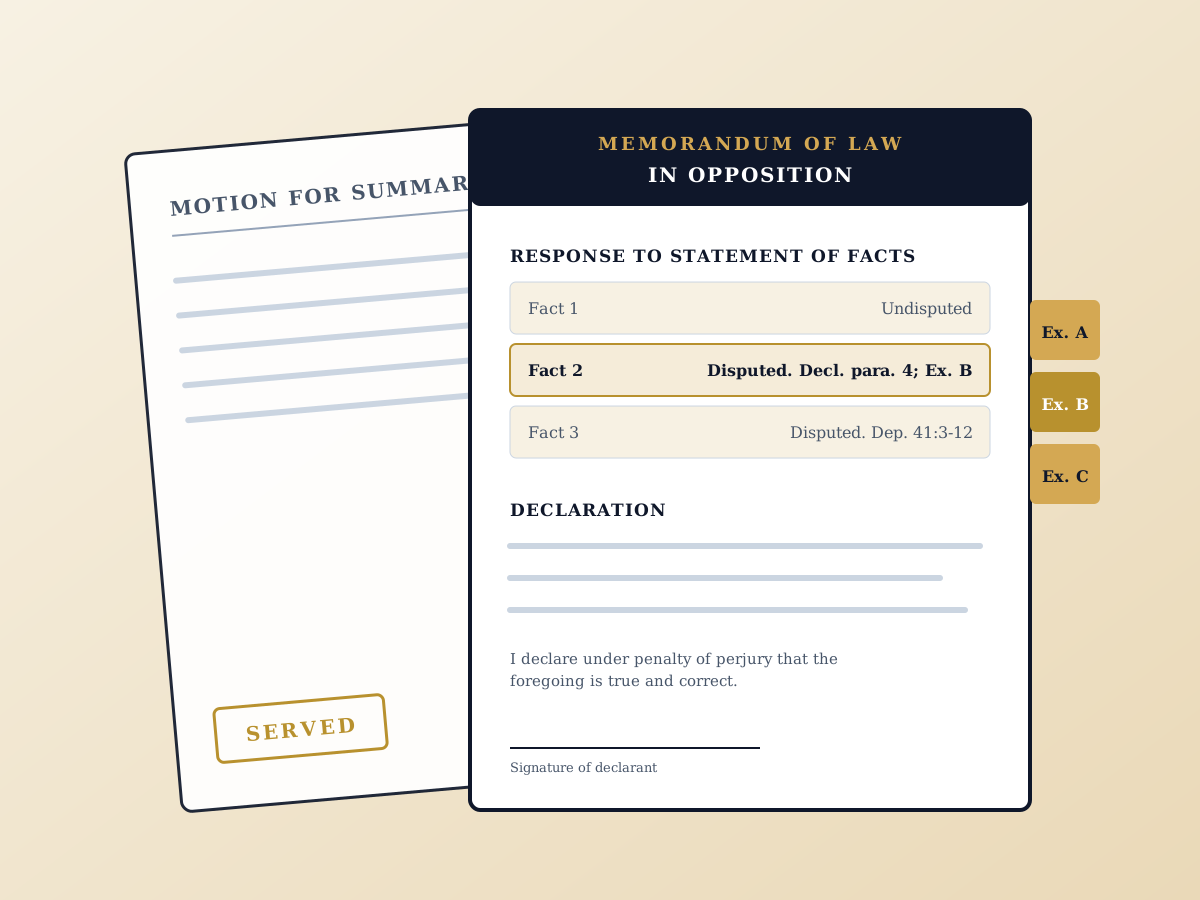
Rule 56(e)(2)
Fact left unanswered
If you fail to properly address a fact, the court may consider it undisputed for purposes of the motion.
Rule 56(c)(1)(A)
Fact disputed with evidence
A dispute counts when it cites particular parts of the record.
Rule 56(d)
Evidence you cannot get yet
A declaration giving specified reasons lets the court defer the motion, deny it, or allow time for discovery.
Served With the Motion: Your Response Deadline and Who Sets It
A response to a motion for summary judgment is due on a date the federal rule itself does not give you. Federal Rule of Civil Procedure 56 says when the motion may be filed: under Rule 56(b), "at any time until 30 days after the close of all discovery," unless a different time is set by local rule or the court orders otherwise. That is a limit on the moving party. For the opposing party the date comes from three places, and you should read all three before you count a single day: your court's local rule on motion papers, the scheduling order or the judge's individual practices, and any order the court entered on this particular motion. Lawyers often shorten the filing to a response to MSJ. For background, see our article on how summary judgment motions work.
Why Rule 56 Gives No Number of Days
Rule 56 sets no period for the response, so each court fills the gap. One example shows where to look. In the Southern and Eastern Districts of New York, Local Civil Rule 6.1(b), in the joint local rules effective January 2, 2026, provides that on civil motions "any opposing or response papers must be served within 14 days after service of the moving papers." The same rule opens by yielding to a statute, another rule, the judge's individual practices or a direction in a particular case. Your court's number may be different, so treat it as an example of where the deadline lives, not as your deadline. State courts set their own periods under their own rules.
In federal court, counting follows Rule 6(a)(1): exclude the day of the event that triggers the period, count every day including intermediate Saturdays, Sundays and legal holidays, and if the last day is a Saturday, Sunday or legal holiday, the period runs to the end of the next day that is not one.
Asking for More Time Before the Deadline Runs
Rule 6(b)(1) lets a federal court extend the time "for good cause." The timing of the request matters: the court may act if a request is made "before the original time or its extension expires," but after the time has expired it takes a motion and a showing that the party failed to act "because of excusable neglect." Ask early. People sometimes search for a motion to oppose summary judgement; there is no separate motion of that name to file. The opposition is the response itself, and a request for more time is its own short motion.
Silence has a cost. Under Rule 56(e), when a party fails to properly address another party's assertion of fact, the court may give an opportunity to address it, consider the fact undisputed for purposes of the motion, or grant summary judgment if the motion and supporting materials show that the movant is entitled to it. The notice that Local Civil Rule 56.2 requires represented movants in those New York districts to serve on self-represented opponents says it plainly: "you may NOT oppose summary judgment simply by relying on the allegations in your complaint."
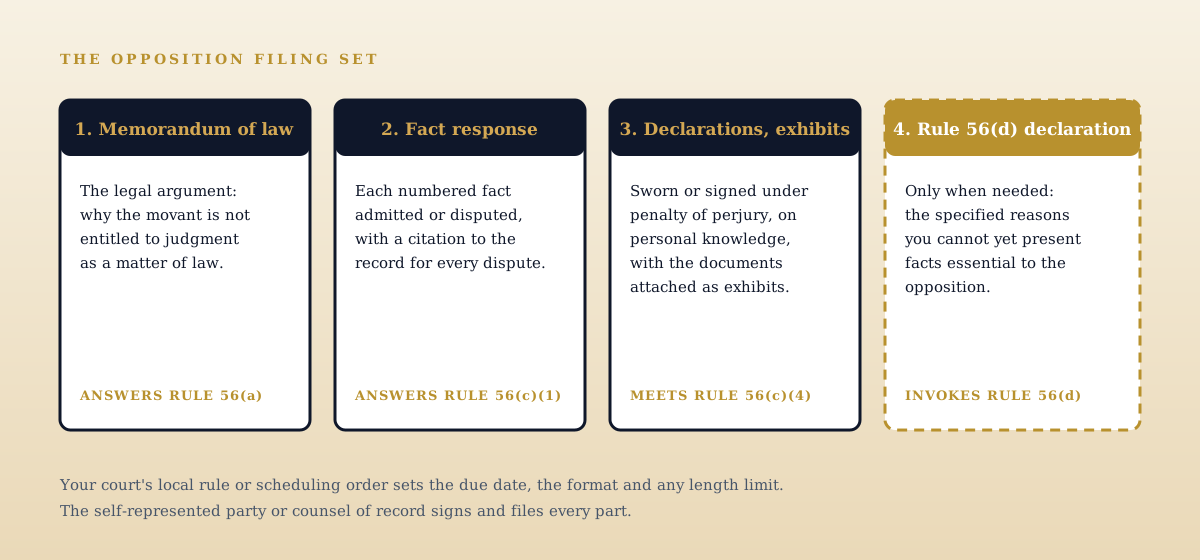
Opposition Papers We Draft: Memorandum, Fact Response and Declarations
An opposition to summary judgment motion filing is rarely one document. We draft the whole set for two kinds of client: self-represented parties who were served and need a response that meets the court's rules, and lawyers who are counsel of record and want an experienced drafter on a heavy record or a short clock.
Memorandum of law
The argument: why a trial is still needed on the claims or defenses the motion targets.
Response to the statement of facts
Every numbered fact admitted or disputed, each dispute followed by its record citation.
Declarations and exhibits
Witness statements on personal knowledge, with the documents attached and identified.
Rule 56(d) declaration
Added when discovery is incomplete and facts essential to the opposition are out of reach.
Memorandum of Law in Opposition
The memorandum of law is the argument. Some courts call it a brief in opposition or a memorandum of points and authorities, and many people call the whole filing a motion in opposition to summary judgment. It starts from the standard in Rule 56(a): the court grants summary judgment only "if the movant shows that there is no genuine dispute as to any material fact and the movant is entitled to judgment as a matter of law." Our memorandum takes the motion claim by claim and shows where the movant has not made that showing, with every factual statement tied to the fact response and the evidence behind it. The general mechanics of an opposition to a motion apply here too.
Response to the Statement of Undisputed Facts
Where the local rule requires the movant to file a numbered statement of material facts, the opposing party has to answer it paragraph by paragraph. Local Civil Rule 56.1 in the Southern and Eastern Districts of New York is a clear example: the opposing papers "must include a correspondingly numbered paragraph admitting or denying, and otherwise responding to, each numbered paragraph in the statement of the moving party," each denial must be followed by a citation to admissible evidence, and a paragraph in the movant's statement "will be deemed to be admitted for purposes of the motion unless specifically denied and controverted" by a correspondingly numbered paragraph in the opposing party's statement. Other courts use other names for the same document, such as a response to the statement of undisputed facts, a separate statement or a statement of genuine disputes, and prescribe their own layout. We follow the format your court's rule prescribes.
Declarations and Exhibits
Facts reach the court through sworn or signed statements and the documents attached to them. Rule 56(c)(4) sets the test: an affidavit or declaration used to oppose a motion "must be made on personal knowledge, set out facts that would be admissible in evidence, and show that the affiant or declarant is competent to testify on the matters stated." In federal matters, 28 U.S.C. 1746 allows an unsworn declaration that is dated and signed as true under penalty of perjury, in substantially the form the statute gives, to be used with like force and effect as a sworn affidavit. State courts have their own rules on this. We draft each declaration from what the witness actually knows, the witness reviews and corrects it before signing, and the exhibits are identified in the declaration that introduces them.
Rule 56(d) Declaration When Discovery Is Incomplete
Sometimes the motion arrives before you have the documents or testimony that would answer it. Rule 56(d) covers that: "If a nonmovant shows by affidavit or declaration that, for specified reasons, it cannot present facts essential to justify its opposition," the court may defer considering the motion or deny it, allow time to obtain affidavits or declarations or to take discovery, or issue any other appropriate order. Our Rule 56(d) declarations name the discovery that is outstanding, what it is expected to show and why those facts are essential. It goes in alongside an opposition on everything you can already answer.
Motion served? Send it with the scheduling order.
We read the movant's statement of facts against your evidence and tell you which facts can be disputed on the record you have.
Start the OppositionHow We Build the Opposition From the Record
The work of opposing a motion for summary judgment starts from two words in the rule. In Anderson v. Liberty Lobby, 477 U.S. 242 (1986), the Supreme Court explained both. A material fact is one that matters to the result: "Only disputes over facts that might affect the outcome of the suit under the governing law will properly preclude the entry of summary judgment." And a genuine dispute exists "if the evidence is such that a reasonable jury could return a verdict for the nonmoving party." The Court added: "The evidence of the non-movant is to be believed, and all justifiable inferences are to be drawn in his favor." It also said a scintilla of evidence is not enough: "there must be evidence on which the jury could reasonably find for the plaintiff." So our drafting sorts the movant's facts by whether they matter, then puts real evidence against the ones that do.
- 1
Intake and due date
You send the motion, the movant's statement of facts and evidence, the pleadings, the scheduling order and what discovery has produced. We find the response date first.
- 2
Fact map
We mark each of the movant's facts as admitted, disputed or immaterial, and note the evidence that answers it.
- 3
Evidence
We pull the record citations, list the declarations needed, and identify anything that calls for a Rule 56(d) request.
- 4
Drafting
We draft the fact response, the declarations for each witness to review, and the memorandum of law.
- 5
Your review, signature and filing
The finished set goes to you or your counsel of record to review, sign, file and serve.
Disputing Each Fact With a Record Citation
Rule 56(c) tells both sides how a fact is supported. A party asserting that a fact is genuinely disputed must support the assertion by "citing to particular parts of materials in the record, including depositions, documents, electronically stored information, affidavits or declarations," stipulations, admissions, interrogatory answers or other materials, or by showing that the materials the movant cited do not establish the absence of a genuine dispute. Rule 56(c)(3) adds that the court "need consider only the cited materials, but it may consider other materials in the record." So our fact responses cite the page, paragraph or line for every dispute. In Celotex Corp. v. Catrett, 477 U.S. 317 (1986), the Supreme Court read the rule to require the nonmovant "to go beyond the pleadings." When the dispute turns on what the law requires rather than on what happened, we pair the opposition with legal research on the governing law. A fuller walk through the rule's subdivisions is in Rule 56 section by section.
Objecting to Evidence the Movant Cannot Use
The movant's evidence has to meet the same test as yours. Under Rule 56(c)(2), "A party may object that the material cited to support or dispute a fact cannot be presented in a form that would be admissible in evidence." We read each declaration the movant filed against Rule 56(c)(4): whether the declarant has personal knowledge of what is stated, whether the statements would be admissible evidence, and whether the documents attached are what the declaration says they are. Where a fact in the motion rests on material that fails that test, the opposition says so, in the place and form your court's rules call for.
Plaintiff or Defendant: Opposing From Either Side
A defendant's response to plaintiff's motion for summary judgment and a plaintiff's opposition to a defense motion are filed under the same rule, but they press different points. When the plaintiff moves, it is asking for judgment on its own claim, so Rule 56(a) puts the showing on the plaintiff as movant. A defendant's opposition to a motion for summary judgment therefore goes through the facts the claim depends on and puts evidence against the ones that are genuinely contested, and it supports any defense with evidence of its own.
When the Defendant Moved Against Your Claims
A defense motion usually argues that the plaintiff cannot prove some part of the case. Celotex explains why that is enough to end a claim if it goes unanswered: "a complete failure of proof concerning an essential element of the nonmoving party's case necessarily renders all other facts immaterial." A plaintiff's opposition therefore answers element by element, pointing to the evidence in the record for each part of the claim the motion attacks.
Two other parts of the rule matter on either side. Under Rule 56(f)(1), after giving notice and a reasonable time to respond, the court may grant summary judgment for a nonmovant. And under Rule 56(g), a court that does not grant all the relief requested may still enter an order treating a material fact that is not genuinely in dispute as established in the case. The wider subject of summary judgment has its own page.
Example Response: How the Opposition Papers Fit Together
An example of a response to a motion for summary judgment is most useful for seeing how the parts point at each other. The illustration below is made up, not taken from any client file.
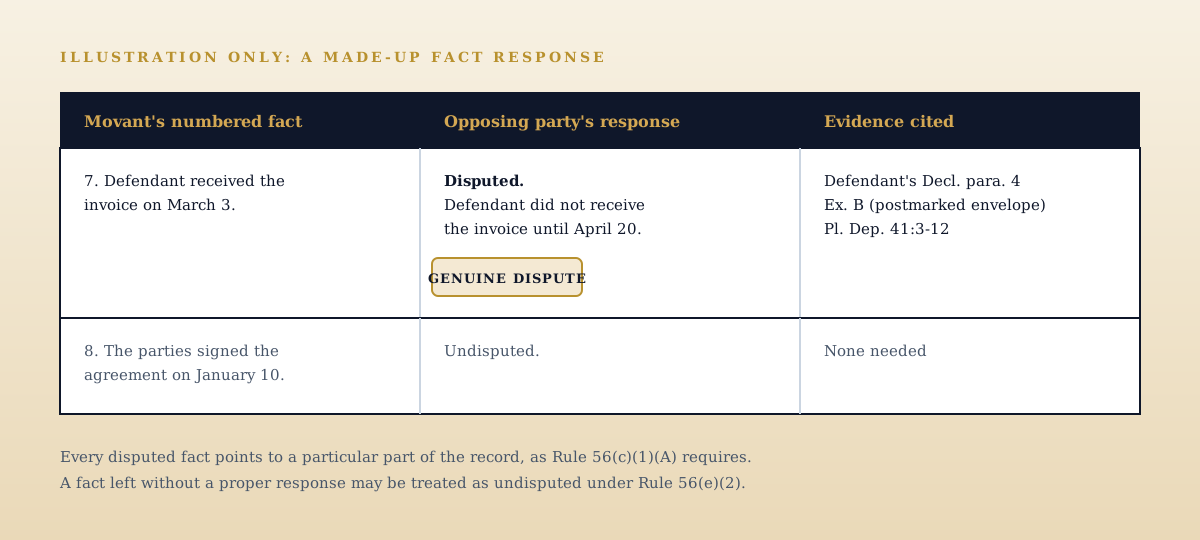
The memorandum then argues from that table. If fact 7 is disputed and fact 7 is material to the claim, the memorandum says why a jury could find for you on it and cites the same declaration paragraph and exhibit. Each document cites the others by name, so the judge can move from an argument to the fact to the proof without searching the record. A response to a motion for summary judgment example from another case can show you this layout, but the content has to come from your record and your court's rules, which is why we do not hand out client drafts.
If you are on the other side of the motion and want to see how the moving papers are laid out, our motion for summary judgment template shows the notice, the statement of facts and the supporting memorandum.
Who Signs, Files and Argues the Opposition
We draft. You, if you are self-represented, or your counsel of record reviews the papers, signs them, files them with the court and serves them on the other side. Legal Tank is not a law firm and does not give legal advice. We do not appear in your case, sign your filings, file them or argue the motion at a hearing, and we do not represent any party. Our opposition papers are prepared by a licensed U.S. attorney, and the decisions about what to file stay with the person who signs.
Declarations are signed by the people whose knowledge they state, never by us. And because the deadline is the part of this motion that cannot be fixed afterward, we tell you the response date we found and the rule or order it comes from, so you can check it against your own papers.
When Your Case Needs a Different Document
If a different motion was served on you
When the paper on your desk is a motion to dismiss, to compel or to strike, our motion drafting services cover the motion and the response.
If discovery requests are still unanswered
When interrogatories or requests for admission are waiting on your side while the motion is pending, getting discovery responses drafted is a separate job from the opposition.
If the case needs more than one filing
When the opposition is one of several papers due before trial, our litigation document drafting handles them together.
Questions People Ask Before They Respond
How to write an opposition to summary judgment?
What is the memorandum of points and authorities in opposition to motion for summary judgment?
How do you beat a motion for summary judgement?
Send the Motion and Your Response Date
Upload the motion, the movant's statement of facts and exhibits, and the scheduling order. We confirm the deadline from your court's rule and quote the opposition to motion for summary judgment papers for your review. Lawyers who need help across a motion calendar can also see our legal brief writing.