Discovery Responses: Answers to Interrogatories, RFA and RFP Responses
Prepared by a licensed U.S. attorney
Discovery responses are the written answers, objections, and production statements a party serves after the other side sends interrogatories, requests for admission (RFA), or requests for production (RFP), and in federal court each set is due 30 days after service. We draft the full response set for you to review, verify, sign, and serve.
Send us the served set and your documents. You get back request-by-request answers, specific objections, a privilege log where something is withheld, and a verification page laid out for the right signer. We draft; you or your attorney sign, serve, and file anything that needs filing. We do not appear in your case.
Discovery Responses We Draft
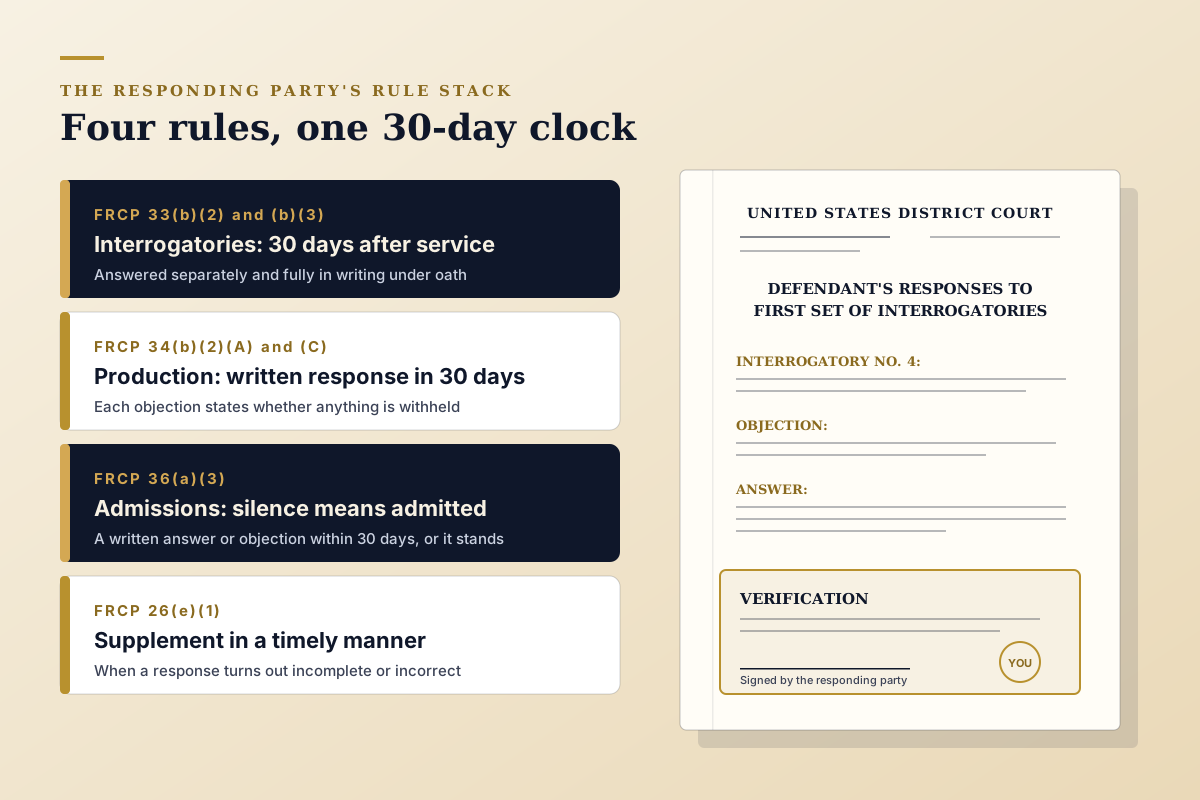
We draft four kinds of sets: interrogatory responses, admissions, production, and supplements. Most clients arrive holding two or three at once, mailed the same day under one caption, and the real risk is a fact conceded in one set and contradicted in another. Drafting them together prevents that.
Interrogatories
FRCP 33
Answers to Interrogatories
Our answers to interrogatories follow FRCP 33(b)(3): each interrogatory, to the extent it is not objected to, answered separately and fully in writing under oath. We count the set against the Rule 33(a)(1) limit of 25 interrogatories, including all discrete subparts, before answering, because a set that runs past the limit without a stipulation or court order is the first thing to raise. Where the answer sits in your business records and the burden of finding it is substantially the same for either side, Rule 33(d) lets the answer specify those records instead, and we identify them in enough detail for the other side to locate them as readily as you could. Contention interrogatories get particular care: Rule 33(a)(2) says they are not objectionable merely because they ask for an opinion or contention, so the answer has to commit to facts without overcommitting. For background on the device itself, see what interrogatories are under FRCP 33.
Admissions
FRCP 36
Responses to Requests for Admission
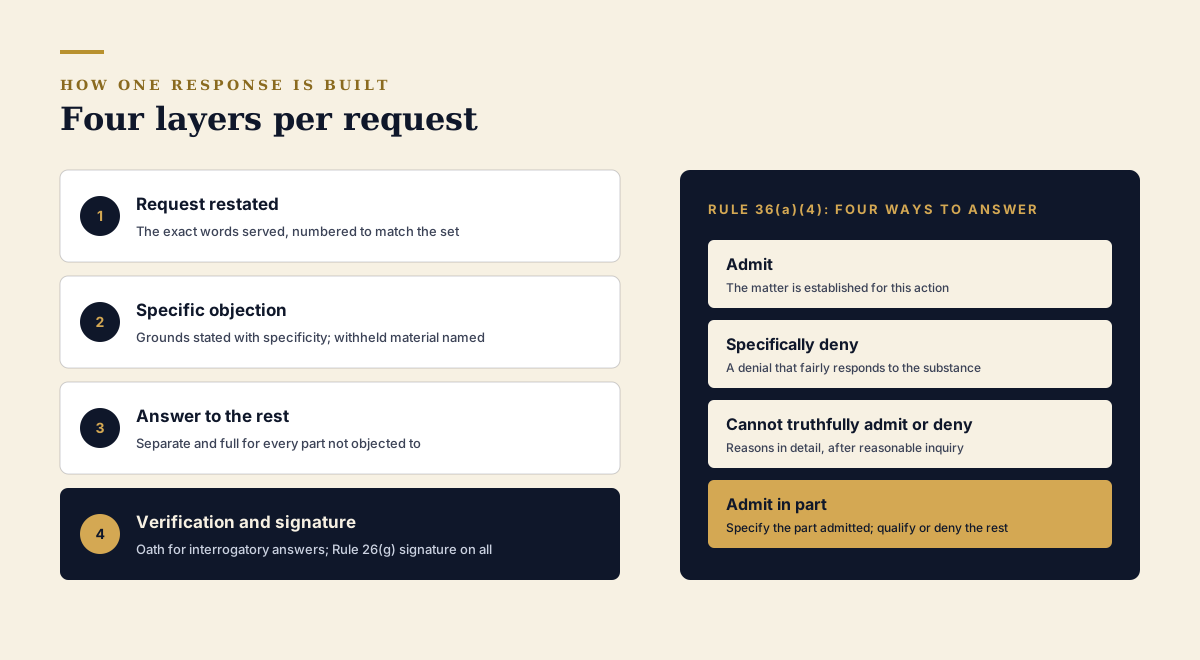
A response to request for admissions is the one set where a single word can decide an issue, so every request gets one of the answers FRCP 36(a)(4) allows: admit, a specific denial that fairly responds to the substance, a detailed statement of why you cannot truthfully admit or deny, or a partial admission that names the part admitted. Lack of knowledge is used only where you have made the reasonable inquiry the rule requires, and we tell you what that inquiry should cover. Objections state their grounds, and never rest solely on the request presenting a genuine issue for trial, which Rule 36(a)(5) forbids. Denials matter later too: under Rule 37(c)(2), a party that fails to admit something the other side then proves can be ordered to pay the reasonable expenses of that proof.
Production
FRCP 34
Responses and Objections to Requests for Production
Our objections to request for production sets track FRCP 34(b)(2): for each item or category, the response either states that inspection will be permitted as requested or states with specificity the grounds for objecting, including the reasons. Every objection says whether responsive materials are being withheld on the basis of that objection, as Rule 34(b)(2)(C) requires, and an objection to part of a request names the part and agrees to the rest. Where you will produce copies rather than permit inspection, the response gives a date. Anything withheld as covered by the attorney-client privilege or as work product goes on a privilege log built to Rule 26(b)(5)(A), describing each item without revealing what is protected. For how the request side of this device works, see requests for production under FRCP 34.
Supplements
FRCP 26(e)
Supplemental and Amended Responses
Supplementing discovery responses is a continuing duty, not a favor. Under the FRCP 26(e) duty to supplement, a party that has responded to an interrogatory, request for production, or request for admission must supplement or correct the response in a timely manner if it learns the response is incomplete or incorrect in some material respect and the corrective information has not otherwise been made known to the other parties. The cost of skipping it is set by Rule 37(c)(1): a party that fails to supplement as required is not allowed to use that information or witness on a motion, at a hearing, or at a trial, unless the failure was substantially justified or is harmless. We draft supplemental and amended responses that identify exactly which earlier answer changes and why.
When Requests Arrive: Deadlines and Deemed Admissions
In federal court, responding to request for admissions sets, interrogatories, and document requests all runs on the same clock: 30 days after service. Of the three, admissions punish delay the hardest, which is why we calendar them first. For how the device works from the requesting side, see how requests for admission work.
The 30-Day Response Window
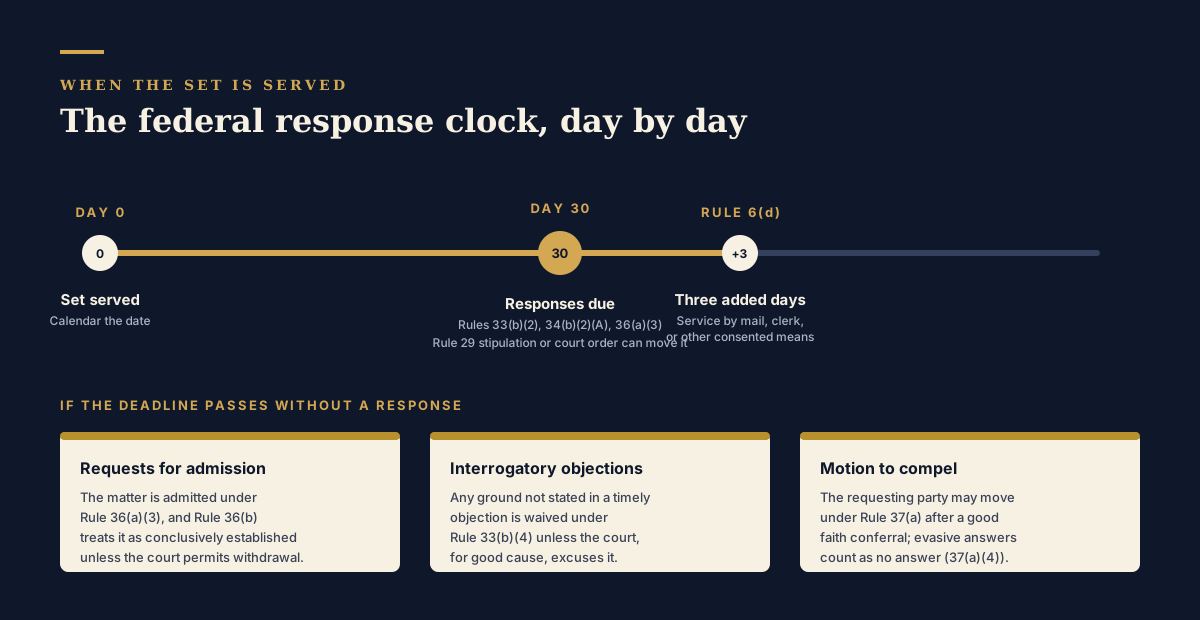
FRCP 33(b)(2) gives the responding party 30 days after service to serve answers and any objections to interrogatories. Rule 34(b)(2)(A) sets the same 30 days for a written response to requests for production, or 30 days after the parties' first Rule 26(f) conference when the request was delivered early under Rule 26(d)(2). Rule 36(a)(3) sets 30 days for requests for admission. Each rule lets the parties stipulate to a shorter or longer time under Rule 29 or the court order one, and Rule 6(d) adds 3 days when service was by mail, by leaving the papers with the clerk, or by other consented means. State courts run their own discovery codes and periods, so we confirm the deadline under the rules of the court where your case is pending before we commit to a delivery date.
California Discovery Responses Under the Code of Civil Procedure
California state court uses the same 30-day window, counted from service: CCP 2030.260 for interrogatories, 2031.260 for demands for inspection, and 2033.250 for requests for admission, unless the court shortens or extends the time. In an unlawful detainer case the time drops to five days. A late response is costly. Under CCP 2030.290 and 2031.300, every objection is waived, privilege and work product included, unless the court grants relief after a substantially compliant response is served and finds mistake, inadvertence, or excusable neglect. For admissions, CCP 2033.280 lets the requesting party move to have the matters deemed admitted, and the court must grant that motion unless a substantially compliant proposed response is served before the hearing. The same section makes a monetary sanction mandatory against whoever caused the motion by responding late.
What Happens When Admissions Go Unanswered
Silence is an answer. Under Federal Rule of Civil Procedure 36(a)(3), a matter is admitted unless, within 30 days after being served, the party serves a written answer or objection signed by the party or its attorney. Rule 36(b) then treats the matter as conclusively established unless the court, on motion, permits the admission to be withdrawn or amended. These deemed admissions can concede liability before anyone takes a deposition. Interrogatories carry their own trap: under Rule 33(b)(4), any objection ground not stated in a timely objection is waived unless the court, for good cause, excuses the failure. And a party that serves nothing at all faces a sanctions motion under Rule 37(d), which says the failure is not excused because the discovery was objectionable unless a protective order motion is pending. The other side can also bring a motion to compel discovery after conferring in good faith.
Already past day 30? We draft the late responses together with a Rule 36(b) motion asking the court to permit withdrawal, framed around the two things the rule says the court weighs: whether withdrawal would promote the presentation of the merits, and whether it would prejudice the requesting party. Send us the served admissions and the service date and we tell you how fast we can turn both around.
How We Respond to Interrogatories and Document Requests
Here is how to respond to interrogatories and document requests the way we do it: five steps, from the served set to a verified response you can sign, with every answer tied to your documents.
- 1
Intake of the served set
You upload every set you were served, the proof of service, the complaint and answer, and any protective order or scheduling order. We confirm the response date from the service method before drafting starts.
- 2
Your documents and your facts
We send a short fact questionnaire keyed to the actual requests, and we read the documents you already hold, so each answer is built from the record rather than from memory.
- 3
Answers and objections, request by request
Each request is restated, any objection is stated with its specific ground, and the rest is answered separately and fully. No preamble of general objections.
- 4
Privilege log and production notes
Anything withheld as privileged or as work product goes on a privilege log, and each production response says what is being produced, in what form, and when.
- 5
Verification page and your review
You review the full set with the verification page and signature blocks in place, send changes, and we revise until it says exactly what you can swear to. Then you or your attorney sign and serve.
Objections That Hold Up
Discovery objections hold up when they are specific. Rule 33(b)(4) requires interrogatory objections to be stated with specificity, and Rule 34(b)(2)(B) requires production objections to state their grounds with specificity, including the reasons. That is why we do not open a response with a page of boilerplate general objections. A ground like overbroad and unduly burdensome is tied to the scope rule in FRCP 26(b)(1) proportionality: discovery must be relevant to a claim or defense and proportional to the needs of the case, weighing the importance of the issues, the amount in controversy, the parties' relative access to the information, their resources, the importance of the discovery, and whether the burden or expense outweighs the likely benefit. The signer also certifies under Rule 26(g)(1)(B) that each objection is warranted and not interposed for an improper purpose. The table shows the difference.
| Boilerplate that invites a motion | Specific objection we draft |
|---|---|
| Responding Party objects to each request to the extent it seeks privileged information. | Objection, attorney-client privilege, limited to the 2024 emails with litigation counsel; those 14 emails are withheld and listed on the privilege log. All other responsive documents will be produced. |
| Objection: overbroad and unduly burdensome. | Objection, overbroad as to time: the request covers 15 years, while the contract at issue was signed in 2021. Responding Party will produce responsive documents dated January 1, 2021 forward. |
| Objection: vague and ambiguous. | Objection, the term 'the project' is undefined; Responding Party reads it to mean the Elm Street renovation named in paragraph 9 of the Complaint and answers on that reading. |
Verification and Signatures
Interrogatory answers carry a verification under oath: Rule 33(b)(5) requires the person who makes the answers to sign them, and the attorney who objects to sign the objections. Rule 26(g)(1) adds a signature by an attorney of record, or by the party personally if unrepresented, with an address, e-mail address, and telephone number, on every response and objection. We lay out each block for the right signer. For California verification discovery responses, CCP 2030.250 and 2033.240 require the party to sign interrogatory and admission responses under oath unless the response contains only objections, and the attorney signs any objection, so we prepare a separate verification page for the party. For other state courts, tell us the court at intake and we build the verification to that court's code. If you already served unverified responses, send them; we check what your court requires and draft the verification or amended set to match.
Responding is one side of the dispute. If the responses you received from the other side are the problem, that is a different engagement: see our page on drafting a motion to compel, built around the Rule 37(a)(1) good faith conferral certification.
Sample Answers to Interrogatories and Response Formats
These sample answers to interrogatories show the format our drafts follow: the request restated, any objection with its specific ground, then the answer. They were written for this page to illustrate structure; they are not client files, and your answers are drafted from your own record.
INTERROGATORY NO. 6:
Identify each person who inspected the roof at the Property between March 1 and June 30, 2025.
RESPONSE TO INTERROGATORY NO. 6:
Responding Party answers as follows: (a) J. Ortiz, project foreman, inspected on March 14, 2025; (b) the adjuster assigned by the insurer, whose name appears on the report produced as DEF000112, inspected on April 2, 2025. Responding Party knows of no other inspection during that period.
The point of a responding to interrogatories sample like this is what it avoids: no general objection preamble, no "see documents produced" without a Bates number, and a closing sentence that makes the answer full rather than partial.
REQUEST FOR PRODUCTION NO. 3:
All communications concerning the Agreement.
RESPONSE TO REQUEST FOR PRODUCTION NO. 3:
Responding Party objects to the request to the extent it seeks communications with litigation counsel after May 5, 2025, which are protected by the attorney-client privilege; those communications are withheld and listed on the privilege log. Responding Party will produce all other responsive communications, as kept in the usual course of business, on or before the date stated in the request.
Response to Request for Admissions Sample
REQUEST FOR ADMISSION NO. 9:
Admit that you received the invoice dated June 1, 2025 and did not pay it.
RESPONSE TO REQUEST FOR ADMISSION NO. 9:
Admitted in part. Responding Party admits receiving the invoice dated June 1, 2025. Responding Party denies the remainder: it paid part of the invoice on June 20, 2025, and disputes the balance.
A compound request like this one is where a careless "Denied" does damage, because it denies the receipt too. Rule 36(a)(4) requires the answer to specify the part admitted and qualify or deny the rest, which is what this format does.
Questions About Discovery Responses
How long does a party have to respond to discovery?
Do discovery responses in federal court need to be verified?
Who signs interrogatory responses?
What are the possible responses to a request for admission?
Do responses to requests for admission need to be signed?
Are interrogatory responses evidence?
Get Your Response Set Drafted Before Day 30
Send the served sets, the date and method of service, and the documents you hold. We reply with the scope and a delivery date that leaves you time to review and verify before the deadline.
When the other side's answers come back empty
If you served requests and got evasive answers, Rule 37(a)(4) treats them as a failure to answer, and the fix is a motion, not a response.
motion to compel draftingWhen admissions were deemed before you found us
If the 30 days passed, the Rule 36(b) motion to withdraw is a motion package of its own, with a memorandum and a proposed order.
motion draftingWhen discovery is one piece of a bigger filing
If the same case also needs declarations, an amended pleading, or a protective order request, we draft those under one engagement.
litigation document drafting