Petition for Writ of Prohibition
Prepared by a licensed U.S. attorney
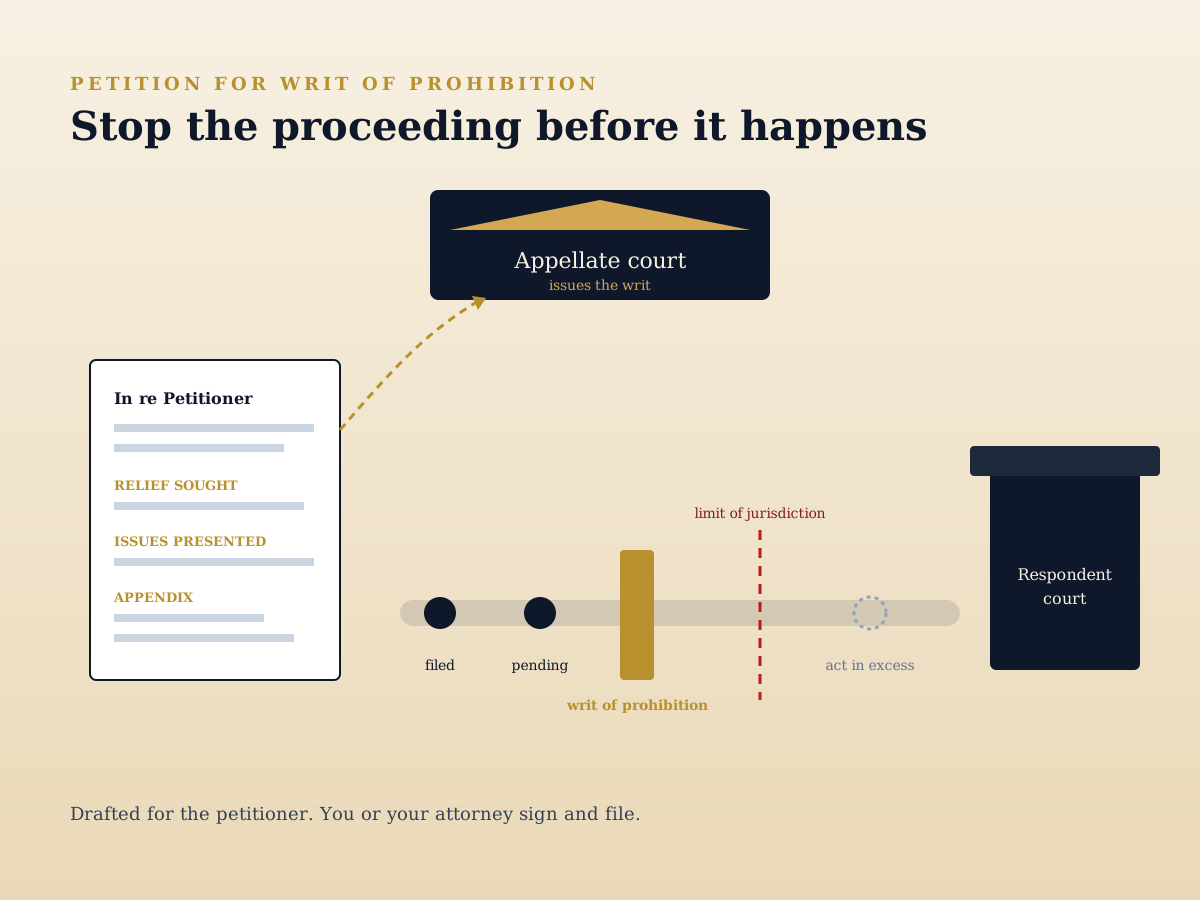
A writ of prohibition is an order from a higher court telling a lower court or tribunal to stop a proceeding it has no jurisdiction to conduct, issued before the tribunal acts, when an appeal afterward would come too late. We draft the petition, the appendix, and the stay request that go with it.
Our drafts are written for the petitioner, whether you are a self-represented party or an attorney who needs the petition built on a short clock. The finished package comes back to you, and you or your attorney sign and file it.
Petitions for Writ of Prohibition We Draft
Petitions for writs of prohibition have to persuade on their own. In federal court, for example, the court of appeals may deny the petition without calling for an answer (Federal Rule of Appellate Procedure 21(b)(1)), so the petition and appendix may be all the panel reads. We build every package around that reality: the jurisdictional defect stated in the first pages, the record that proves it attached and indexed, and the stay request filed alongside so the respondent court does not act while the petition waits.
The writ of prohibition meaning that matters for drafting is narrow. The writ is not a second chance to argue that a ruling is wrong. The working writ of prohibition definition in California, for example, is a writ that arrests proceedings without or in excess of jurisdiction (Code of Civil Procedure section 1102). So our petitions argue power, not preference: why this tribunal cannot hear this matter, or cannot take this step in it. That question of power is the only one prohibition writs answer.
The petition
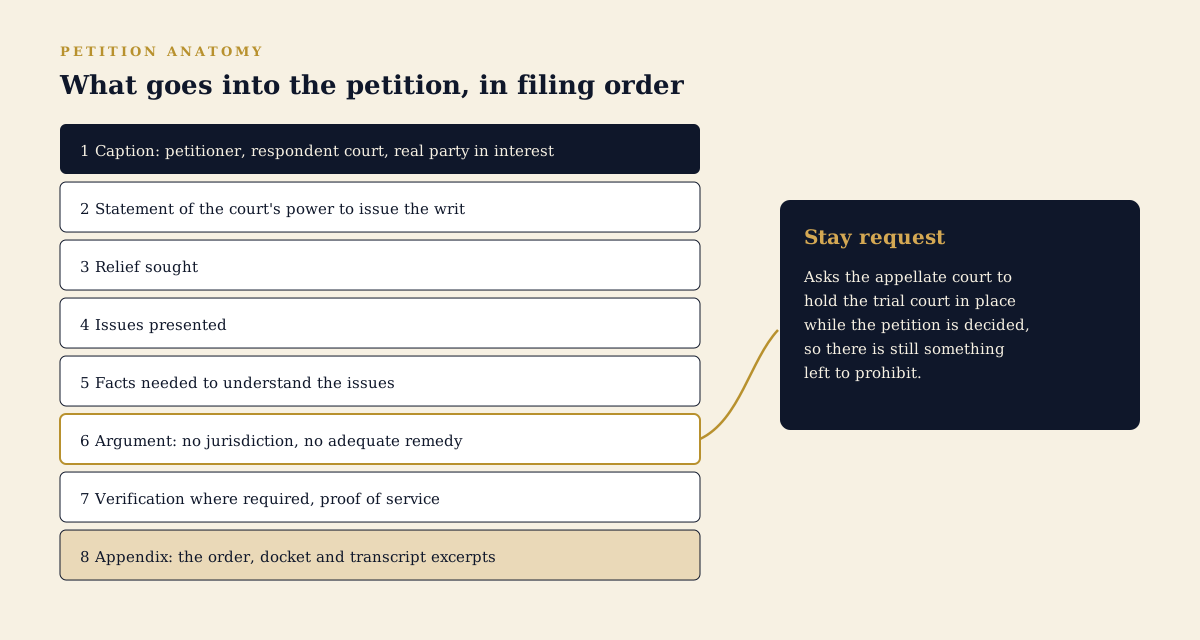
Caption, statement of the court's power to issue the writ, relief sought, issues presented, facts, and argument on lack of jurisdiction or excess of jurisdiction, written to the forum's length and format rules.
The appendix
The challenged order, the motion and opposition below, the docket, and the transcript pages the appellate court needs, indexed and paginated so every factual sentence in the petition points to a page.
The stay request
A request for a stay of proceedings in the trial court while the petition is pending, drafted to the forum's procedure, because a prohibition petition decided after the hearing has nothing left to stop.
Reply to the opposition
When the appellate court calls for a response, we draft the reply to the respondent court's or the real party in interest's opposition, addressed point by point.
Stopping a Court That Lacks Jurisdiction
The classic petition targets a trial court that is about to hear a case, or a part of a case, that belongs somewhere else: a matter assigned by statute to another tribunal, a proceeding against a party the court has no power over, or a step the court has no authority to take at this stage. We draft the argument around the source of the limit, the statute, rule, or order that fixes the court's power, and show from the appendix exactly where the respondent court is about to cross it.
Prohibition After a Denied Motion to Disqualify the Judge
A denied motion to disqualify the judge often prompts a writ petition, and the correct vehicle depends on the state's own statute. California is explicit that the ruling is not appealable and may be reviewed only by a writ of mandate, filed and served within 10 days after service of written notice of entry of the order (Code of Civil Procedure section 170.3(d)). Because each state assigns this review to its own writ and its own clock, we confirm both for your forum before drafting, so the petition is the right one and is on time.
Combined Petitions for Prohibition, Mandamus or Certiorari
Some situations sit on the line between writs: the tribunal has partly acted and is about to act further, or it is both refusing to rule on one motion and pressing ahead on another. Federal practice handles mandamus and prohibition in one rule, Federal Rule of Appellate Procedure 21. Where the facts support it and the forum allows it, we draft the petition to ask for the writs in the alternative, with a separate argument for each, so the court can grant the one that fits.
When a Writ of Prohibition Fits Your Case
If you are asking what is a writ of prohibition in practical terms, it is an extraordinary writ for one situation: a tribunal is acting, or about to act, without jurisdiction or in excess of it, and nothing in the ordinary course will fix that in time. Both halves have to be true. A ruling that is merely wrong, inside the court's power, is for appeal.
No Adequate Remedy by Appeal
The second half is the doctrine of no adequate remedy at law. California states it directly: the writ may issue where there is not a plain, speedy, and adequate remedy in the ordinary course of law, and it is issued on the verified petition of the person beneficially interested (Code of Civil Procedure section 1103). Federal courts of appeals issue the writ under the All Writs Act, 28 U.S.C. 1651, which allows writs necessary or appropriate in aid of the court's jurisdiction. Our petitions answer the obvious question every panel asks, why not just appeal later, with facts: the trial date, the cost of a proceeding that would be void, the harm that cannot be undone.
Prohibition Compared With Mandamus
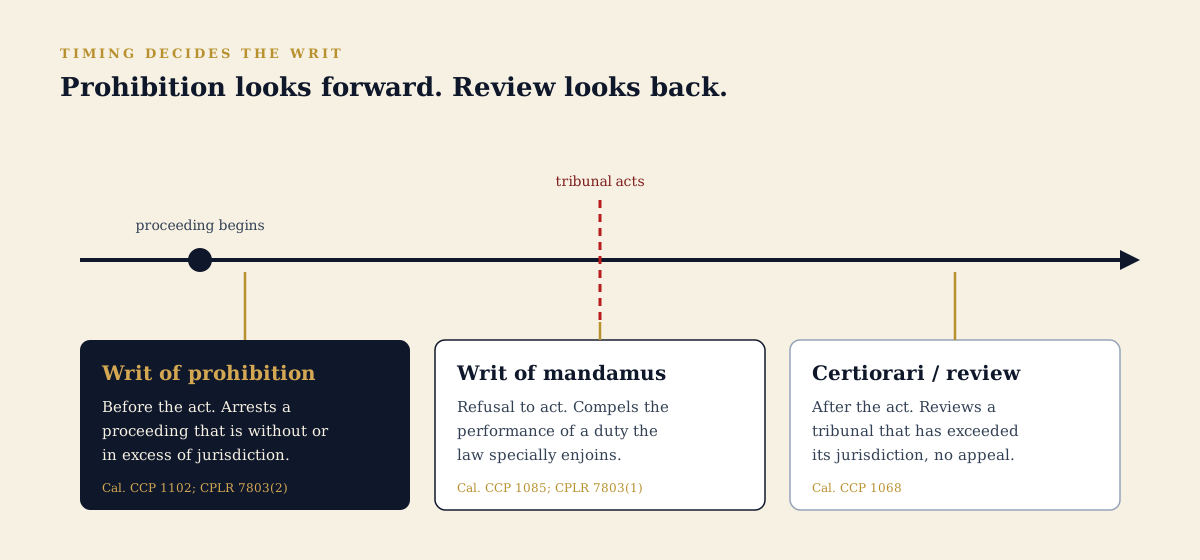
The two writs are mirror images. A writ of mandate compels the performance of an act the law specially enjoins as a duty (California section 1085); prohibition arrests a proceeding the tribunal has no power to conduct (section 1102). If your judge will not decide something the judge must decide, our writ of mandamus drafting is the better fit. If the judge is about to decide something the court cannot touch, you are in the right place. Where a ruling raises research questions about jurisdiction before anyone drafts, our jurisdiction research memo can answer them first.
How We Prepare the Petition, Appendix and Stay Request
A prohibition writ is only useful while there is still something to prohibit, so the engagement is organized around the date the respondent court is set to act. We work backward from that date, set the delivery date in writing at intake, and leave you time to review, sign, and file before the hearing. If the screen shows the matter can wait for final judgment, the work moves to our appeal brief drafting instead.
- 1
Send the order and the date
The pending motion or ruling, the docket, any transcript, and the date the tribunal is set to act. The hearing date drives everything else.
- 2
Jurisdiction and remedy screen
We test the two things every court asks first: is the tribunal acting without or in excess of its jurisdiction, and is there really no adequate remedy by appeal.
- 3
Forum and vehicle check
We confirm the right court, the right writ, and the current rule text for your state or circuit before drafting starts.
- 4
Draft, appendix, stay
The petition, appendix, and stay request are drafted together and cite-checked so the record and the argument match.
- 5
You sign and file
The package returns ready for your review. You, or your attorney, sign, verify where required, serve, and file it.
Filing Before the Lower Court Acts
Timing is the decisive fact. New York frames the question as whether the body or officer proceeded, is proceeding, or is about to proceed without or in excess of jurisdiction (CPLR 7803(2)), and California's writ arrests proceedings rather than undoing them. That is why the stay of proceedings request matters as much as the petition. In California, an alternative writ commands the respondent to desist from further proceedings until the court's further order and to show cause why it should not be absolutely restrained (section 1104). We draft the stay request to the forum's procedure, and if the appellate court issues an order to show cause or calls for a response, we draft the reply.
Intake is short but specific: the order or pending motion, the docket, the transcript of any hearing where the jurisdiction objection was raised, and the hearing date. If the trial court has not yet been asked to rule on its own jurisdiction, we flag it at intake, because the record should show the objection was raised below. When the writ work grows into a broader briefing schedule, our trial-court motion drafting covers the jurisdiction motion itself, and our litigation support team can assemble the record.
Prohibition Rules in California, Florida, Ohio, New York and Federal Court
Every forum names, routes, and formats the writ differently, and the differences decide whether a petition is heard. We confirm the current rule text for your forum at intake. Here is how five of the forums we draft for most often handle it.
California Writ of Prohibition
A California writ of prohibition lives in Code of Civil Procedure sections 1102 to 1105. Under California CCP 1102, the writ arrests proceedings without or in excess of jurisdiction; section 1103 lets any court issue it to an inferior tribunal on a verified petition, and lets the appellate division of the superior court direct it to the superior court in a limited civil, misdemeanor, or infraction case. Section 1107 requires proof of service on the respondent and the real party in interest, who may file opposition within five days after service and filing.
Florida Prohibition in the Appellate Courts
Florida's power to issue the writ comes from the state constitution. Article V, section 3(b)(7) provides that the Florida Supreme Court, the state supreme court, may issue writs of prohibition to courts, and section 4(b)(3) provides that a district court of appeal may issue writs of mandamus, certiorari, prohibition, and quo warranto. Florida Rule of Appellate Procedure 9.100 governs the petition. When the writ is directed to a judge, Rule 9.100(e) leaves the judge's name out of the caption but names the judge as a party in the body. Rule 9.100(g) caps the petition at 13,000 words if computer-generated, requires the basis for jurisdiction, the facts, the relief sought, and argument, and requires a rule 9.220 appendix when the petition seeks an order directed to a lower tribunal. Under Rule 9.100(h), an order to show cause in a prohibition proceeding stays further proceedings in the lower tribunal. The petitioner's reply is due within 30 days of the response unless the court sets another time, capped at 4,000 words.
Ohio Writ of Prohibition
An Ohio writ of prohibition is an original action. Article IV, section 2(B)(1) of the Ohio Constitution gives the Supreme Court of Ohio original jurisdiction in prohibition, and section 3(B)(1) gives the courts of appeals the same. In the Supreme Court, S.Ct.Prac.R. 12.02 starts the case with a complaint, not a petition: it must state specific facts, carry an affidavit made on personal knowledge, and set out all relief sought, including an alternative writ. The filer is the relator. The respondent generally answers or moves to dismiss within twenty-one days of service, and under Rule 12.05 an alternative writ in a prohibition case stays the proceedings sought to be prohibited unless the court orders otherwise.
New York Article 78 Prohibition
New York folded the old writs into one proceeding. Under CPLR 7801, relief previously obtained by writs of certiorari to review, mandamus, or prohibition is obtained in a proceeding under New York CPLR Article 78, and CPLR 7803(2) frames the prohibition question. Where the respondent is a justice of the supreme court or a county court judge, CPLR 506(b)(1) sends the proceeding to the appellate division in the judicial department where the underlying action is triable.
Federal Courts of Appeals
Federal Rule of Appellate Procedure 21(a) governs a petition for a writ of mandamus or prohibition directed to a court. The petition is filed with the circuit clerk, served on all parties, and copied to the trial-court judge, and the parties below other than the petitioner become respondents. Rule 21(d) caps a computer-produced petition at 7,800 words, excluding the required attachments. The appellate court may deny the petition without an answer.
Example of a Writ of Prohibition Petition
An example of a writ of prohibition petition follows the order the court reads it in. Federal Rule 21 makes the core sections explicit: the petition is titled "In re" the petitioner's name and must state the relief sought, the issues presented, the facts needed to understand them, and the reasons the writ should issue, with a copy of the order and the essential parts of the record. State petitions use the same bones.
In our drafts the petitioner opens with the jurisdictional defect in a single paragraph, names the respondent court and the real party in interest in the caption, and keeps the argument to two questions: lack of jurisdiction or excess of jurisdiction, and the absence of any adequate remedy. The appendix then carries the challenged order, the papers below, and the transcript pages. This outline describes structure only; it is not a client file.
If your forum needs a fully briefed merits argument instead, see our legal brief writing services.
If Prohibition Is Not the Right Tool for Your Situation
Our screen sometimes ends with a different answer. When it does, we say so before any drafting starts, and route the matter to the document that fits. A person held in custody, for instance, needs one of our habeas corpus petitions, not prohibition.
When the judge will not rule at all
If the problem is a motion that sits undecided or a duty the court refuses to perform, the remedy compels action rather than stopping it.
mandamus petitions we draftWhen the order has already been entered
If the tribunal has already acted and you want what it did examined, the review writs look backward in a way prohibition cannot.
petition for certiorariWhen the case reaches final judgment
If an appeal after judgment is an adequate remedy, the court will usually expect you to take it, and the merits brief becomes the main document.
appellate brief writingQuestions About Prohibition Petitions
What does a writ of prohibition do?
What is the difference between a writ of mandamus and a writ of prohibition?
What is the main difference between the writ of certiorari and prohibition?
Why is a writ issued?
Get the Petition Drafted Before the Hearing
Send the order or pending motion, the docket, and the date the tribunal is set to act. We reply with scope and a delivery date, draft the petition, appendix, and stay request, and return the package for you or your attorney to sign and file.