Have a filing deadline? Tell us the court and the date.

Reply Brief Drafting

Appellant's Reply Brief

Prepared by a licensed U.S. attorney

A reply brief is the appellant's last brief in an appeal: it answers the appellee's brief, and only that brief, and it is usually the final word the panel reads before it decides. We draft the appellant's reply brief from the appellee's brief and the record, inside the court's deadline and word limit.

The draft comes back to you ready for review. Counsel of record, or the appellant if self-represented, makes the final calls, signs it and files it. We do not file, sign or appear in any court.
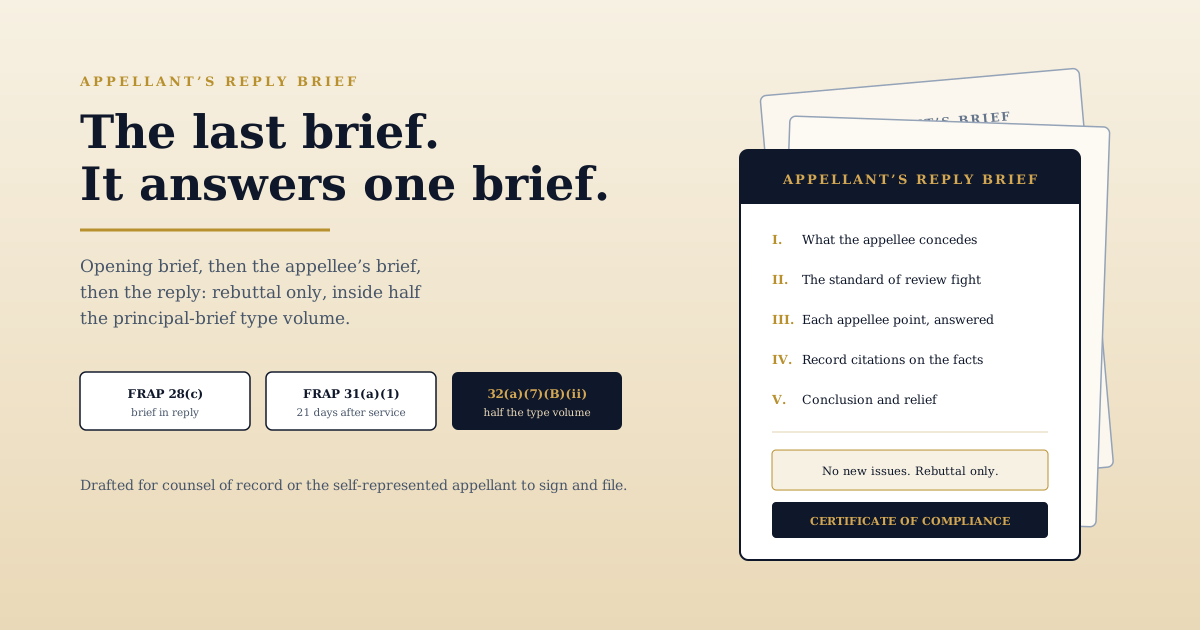
The appellant's reply brief stacked on top of the opening brief and the appellee's brief, with FRAP 28(c), FRAP 31(a)(1) and the half-length type-volume limit
FRAP 28(c)

The appellant may file a brief in reply

A reply answers the appellee's brief. It needs a table of contents and a table of authorities. No further briefs without the court's permission.

FRAP 31(a)(1)

21 days after service of the appellee's brief

And filed at least 7 days before argument, unless the court, for good cause, allows a later filing.

FRAP 32(a)(7)(B)(ii)

Half the principal brief's type volume

Half of 13,000 words is 6,500; the page safe harbor in Rule 32(a)(7)(A) is 15 pages.

What We Draft

Reply Briefs We Draft for Appellants

We draft reply briefs for one party: the appellant, after the appellee has filed. Our starting material is your opening brief, the appellee's brief, the record and the court's scheduling order. We do not draft the appellee's side on this engagement; if you are defending a judgment, that work belongs to the answering brief for the appellee, which is filed before any reply.

Federal Reply Briefs Under FRAP 28(c)

In the U.S. Courts of Appeals, the appellate reply brief rests on one sentence of the Federal Rules of Appellate Procedure: Rule 28(c) says the appellant may file a brief in reply to the appellee's brief. The same subdivision requires a table of contents with page references and a table of authorities, and it closes the door behind the reply: unless the court permits, no further briefs may be filed. Our federal drafts are built to Rule 28(c), the FRAP 32(a)(7)(B) word limit for replies, the certificate of compliance under Rule 32(g)(1), and the circuit's local rules, which can move the numbers. The Seventh Circuit, for one, opted out of the federal word changes and still accepts 7,000 words for a reply brief under its Circuit Rule 32(c).

Citations to the record follow Rule 28(e). Where an appendix was filed with the appellant's brief, references must be to the pages of the appendix, and where the admissibility of evidence is in controversy, the brief must cite the pages at which that evidence was identified, offered, and received or rejected. We hold the reply to the same pinpoint discipline as the opening brief, because the appellee's counter-statement of the facts is usually answered page by page, and a panel checking the reply against the appendix should find every page where we say it is.

State Court Reply Briefs

State appellate courts write their own rules, and small differences change the calendar. In California, rule 8.212(a)(3) of the California Rules of Court gives the appellant 20 days after the respondent files its brief, counted from filing rather than service, and rule 8.204(c)(1) caps a computer-produced brief at 14,000 words with a word-count certificate. Before we draft an appellant's reply brief in any state, we read that state's current rule on timing, length and format; our appellate briefing rules by state table is the starting point, and the court's own rule text is the final word.

Cross-Appeal Reply Briefs

A cross-appeal changes the brief count from three to four under FRAP 28.1. The appellant files a response and reply brief that must respond to the principal brief in the cross-appeal and may, in the same brief, reply to the response in the appeal; Rule 28.1(e)(2)(A) allows that combined brief 13,000 words, and Rule 28.1(f)(3) gives 30 days after the appellee's principal and response brief is served. The appellee's reply brief comes last, limited to the issues presented by the cross-appeal, at half the Rule 28.1(e)(2)(A) type volume. We draft either reply. For the opening brief and the rest of the appellate stack, see our appellate brief drafting service.

Should You Reply

When a Reply Brief Is Worth Filing

An appellant reply brief is optional; Rule 28(c) says the appellant "may" file one. In practice the question is whether the appellee's brief said anything the panel should not read unanswered. A silent appellant leaves the appellee's characterization of the record, its cases and its framing of the issues as the last thing the judges see before oral argument or decision.

Answering Each Point the Appellee Raised

A reply is worth the work when the appellee misstates the record, relies on authority your opening brief did not address, argues waiver or harmless error, or asks for a more deferential standard of review than the one you stated. Each of those calls for rebuttal with page cites. When the appellee's brief simply repeats the trial court's reasoning, a short, targeted reply often serves better than a long one.

Why New Arguments Do Not Belong in a Reply

A reply responds; it does not restart the appeal. The Seventh Circuit's Practitioner's Handbook for Appeals puts it directly: a reply brief must be limited to matters in reply, and new arguments raised for the first time in a reply brief may be stricken and deemed waived. The same passage notes that an appellant may respond to arguments raised for the first time in the appellee's brief, citing Loja v. Main Street Acquisition Corp., 908 F.3d 680, 684 (7th Cir. 2018). Other circuits and state courts apply their own case law on arguments raised for the first time in reply, so we check the deciding court's rule on forfeiture before drafting, and anything that belonged in the opening brief stays out.

Our Process

How We Write the Reply From the Appellee's Brief

Our answer to how to write a reply brief starts with the appellee's table of contents, not a blank page. We list every heading and sub-point in the answering brief, mark what it concedes and what it ignores, and build the reply against that list. Three moves shape most of our drafts: we lead with the appellee's weakest concession, we fight the standard of review where the appellee tries to change it, and we turn preservation arguments back with record citations.

Mapping the Answering Brief Point by Point

The appellee's brief
What our reply does
Leaves one of your arguments unanswered, or concedes a premise in passing.
We open the reply with it, quoting the appellee's own words and page.
Adds a standard of review statement, which Rule 28(b)(4) lets it omit unless it disagrees with yours.
We meet the standard of review fight head on, issue by issue, before the merits.
Argues an issue was not preserved below.
We answer with the record pages showing the objection, motion or ruling.
Offers a counter-statement of the facts.
We correct it with record citations under Rule 28(e), not with adjectives.
Defends the judgment on a ground the trial court never reached.
We show from the record where that ground was or was not presented below.

The standard of review row matters more than it looks. Rule 28(a)(8)(B) requires the appellant to state the standard for each issue, and Rule 28(b)(4) lets the appellee leave it out unless it is dissatisfied with the appellant's statement. When the appellee includes one, it is telling the panel to review more deferentially, and the reply answers that before anything else on the issue.
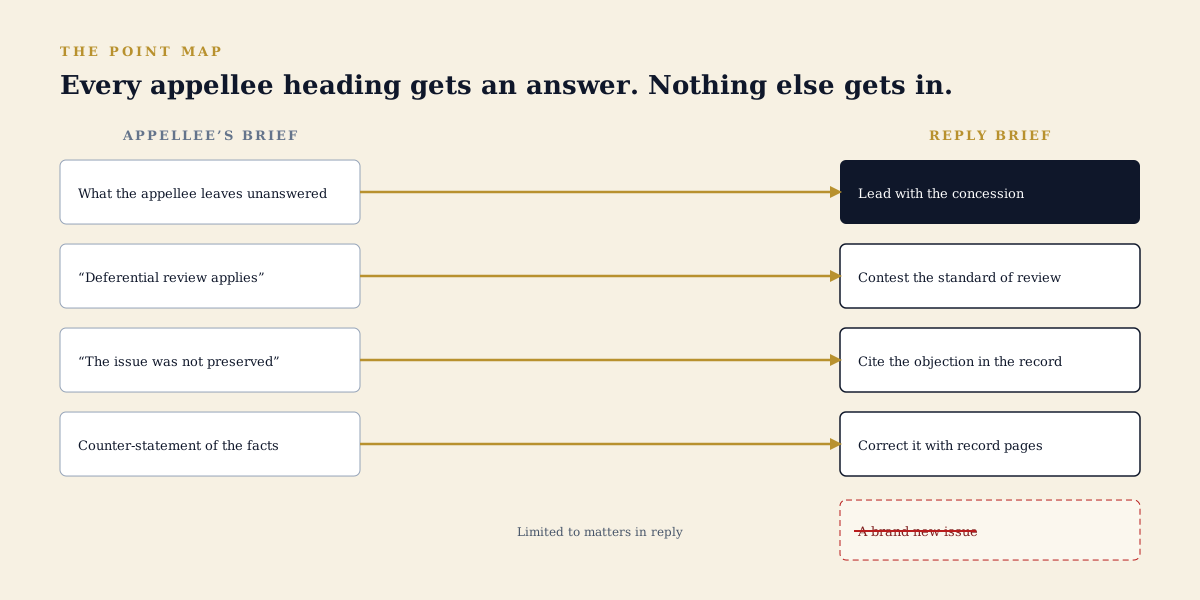
Point map: each heading in the appellee's brief joined by an arrow to the reply brief's answer, with a brand new issue crossed out

Deadlines and Word Limits for the Reply

Under FRAP 31(a)(1), the appellant may serve and file a reply brief within 21 days after service of the appellee's brief, but the reply must be filed at least 7 days before argument unless the court, for good cause, allows a later filing. Length runs on Rule 32(a)(7): a reply brief may not exceed 15 pages unless it meets the type-volume limit, which is no more than half of the principal brief's 13,000 words, so 6,500 words, or 650 lines in a monospaced face. Under Rule 32(f), headings, footnotes and quotations count toward that limit; the cover, tables, signature block and proof of service do not. Scheduling orders and local rules can change both numbers, so we confirm them against your docket at intake.

Florida runs on its own numbers. Under Florida Rule of Appellate Procedure 9.210(g), the reply brief, if any, must be served within 30 days after service of the answer brief, and rule 9.210(a)(2)(B) caps it at 4,000 words, or 15 pages if handwritten or typewritten. Rule 9.210(d) limits its content to argument in response and rebuttal to the answer brief, with a table of contents, a table of citations, a certificate of service and, for computer-generated briefs, a certificate of compliance.
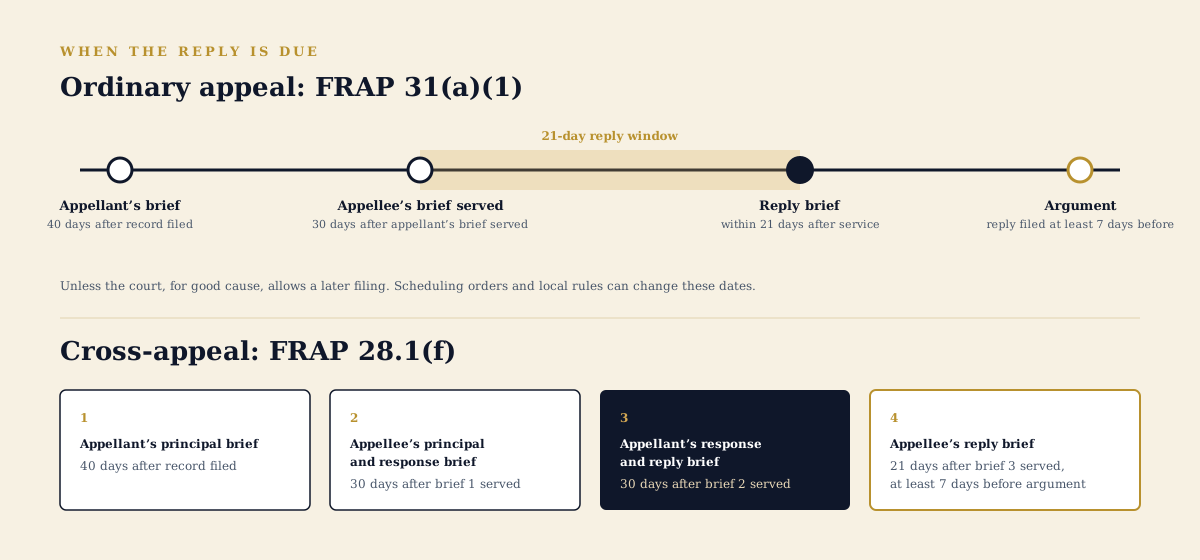
Timeline of reply brief deadlines under FRAP 31(a)(1) for an ordinary appeal and FRAP 28.1(f) for a cross-appeal
  1. 1. You send the briefs and the date

    Opening brief, the appellee's brief, the record or appendix, and the service date of the appellee's brief.

  2. 2. We build the point map

    Every appellee point, its record support, and the reply move for it, checked against the deciding court's rules.

  3. 3. We draft inside the limit

    Tables, argument in reply, conclusion, and the word count for the certificate of compliance.

  4. 4. The signer reviews, signs and files

    Counsel of record or the self-represented appellant makes the final edits and files on the court's docket.

Has the appellee's brief been served?

The 21-day reply clock under Rule 31(a)(1) runs from service. Send us the brief and the service date, and we will confirm the deadline and the word limit for your court.

Start the Reply
Finished Draft

Appellant Reply Brief Example: Structure of a Finished Draft

Anyone looking for an example of appellant reply brief structure will notice how much is missing compared with an opening brief. Rule 28(c) names only two required parts beyond the argument itself, the table of contents and the table of authorities, and there is no new jurisdictional statement, statement of the issues or statement of the case to write. Here is the order a finished federal reply follows in our drafts.

Appellate Reply Brief Sample Sections

  1. 1

    Cover

    Caption, court and the document title. The Seventh Circuit's handbook gives Appellant's Reply Brief as an example title and lists a grey cover for a reply brief.

  2. 2

    Table of contents, with page references

    Required by FRAP 28(c). Excluded from the word count by Rule 32(f).

  3. 3

    Table of authorities

    Cases alphabetically arranged, statutes and other authorities, with the reply-brief pages where each is cited, as Rule 28(c) requires.

  4. 4

    Introduction

    A page or less: what the appellee conceded, what it could not answer, and why reversal still follows.

  5. 5

    Argument in reply

    Organized against the appellee's headings, so each reply section answers a numbered point in the answering brief.

  6. 6

    Conclusion

    The precise relief sought, unchanged from the opening brief.

  7. 7

    Certificate of compliance

    Rule 32(g)(1): the attorney or unrepresented party certifies the word count. We fill in the count; the signer signs it.

  8. 8

    Certificate of service

    Prepared for the signer to complete under the court's filing system.

This appellate reply brief sample outline is a skeleton, not a form; the argument sections take their shape from the appellee's headings in each case, and the conclusion asks for the same reversal or other relief the opening brief requested. To see a full opening brief laid out section by section, walk through our sample appellate briefs; the reply is the shorter brief that follows it.

Rule 32(g)(1) puts the certificate of compliance on the attorney or the unrepresented party. That is the line in our engagements too: we draft the reply and prepare the certificate with the count; the person who signs the brief reviews it, signs it and files it. A request for leave to file a sur-reply or a longer reply is also the signer's motion to make, and we can draft it.

If the reply is not your next brief

When you won below and the other side appealed

You file before any reply, defending the judgment. See the appellee's answering brief.

If the opening brief is still ahead

Start with the principal brief and plan the reply with it. See opening brief drafting for appeals.

When the case is still in the trial court

Replies to oppositions, memoranda and trial briefs. See legal brief writing.

FAQ

Questions About the Reply Brief

What can be included in a reply brief?
A reply brief can include anything that answers the appellee's brief, and nothing that goes beyond it. In federal court, Rule 28(c) of the Federal Rules of Appellate Procedure requires a table of contents with page references and a table of authorities. The body then rebuts the appellee's arguments: its reading of the record, its cases, its framing of the standard of review, and any claim that an issue was not preserved, each answered with citations to the record. What a reply should not carry is a new issue. The Seventh Circuit's Practitioner's Handbook for Appeals says new arguments raised for the first time in a reply brief may be stricken and deemed waived, while an appellant may still respond to arguments the appellee raised for the first time. A word-count certificate of compliance is also required when the brief relies on the type-volume limit.
Is a reply considered a brief?
Yes. The appellate rules treat a reply as a brief in its own right. Federal Rule of Appellate Procedure 28(c) describes it as a brief in reply to the appellee's brief, and Rule 32(a)(7) gives a reply brief its own length limit: 15 pages, or no more than half of the principal brief's type volume. In California, the Advisory Committee Comment to rule 8.212 of the California Rules of Court lists an appellant's reply brief within the meaning of the word brief. That status carries consequences. A reply brief that relies on the federal type-volume limit must carry its own certificate of compliance under Rule 32(g)(1), and in federal court Rule 28(c) adds that no further briefs may be filed unless the court permits, which is why a sur-reply needs leave of court.
What is the legal definition of a reply?
A reply is a party's answer to the other side's last filing, and its meaning depends on the stage of the case. On appeal, it is the appellant's brief in reply to the appellee's brief under Federal Rule of Appellate Procedure 28(c). In trial-court motion practice, a reply answers the opposition to a motion; in the Northern District of California, for example, Civil Local Rule 7-3(c) sets the reply at no more than 15 pages and requires it to be filed and served not more than 7 days after the opposition was due. In federal pleading, Federal Rule of Civil Procedure 7(a)(7) allows a reply to an answer only if the court orders one. This page covers the appellate meaning: the appellant's last brief before the court decides the appeal.
Do not let the appellee have the last word

Send Us the Appellee's Brief and Your Deadline

Tell us the court, the case number and the date the appellee's brief was served. We confirm the reply deadline and word limit, scope the reply brief drafting, and return a quote.