Appellate Brief Example: A Complete Sample Brief, Annotated Section by Section
An appellate brief is the principal written argument to an appellate court for why a judgment should be reversed, affirmed, or revisited. Its parts are fixed by FRAP 28, and its length and formatting by FRAP 32.
Below is a complete sample appellate brief: a Seventh Circuit appellant's opening brief with every FRAP 28 part, from the cover and disclosure statement through the certificates, with a note beside each section explaining what it does. The parties and record are fictitious; every cited authority is real. Download it as a FRAP 32 formatted PDF, or read it on the page alongside the format rules and how to write one.
Free, no email required. 33 pages, 14-point type, double-spaced, 5,851 counted words. Need one drafted from your record? See appellate brief writing services.
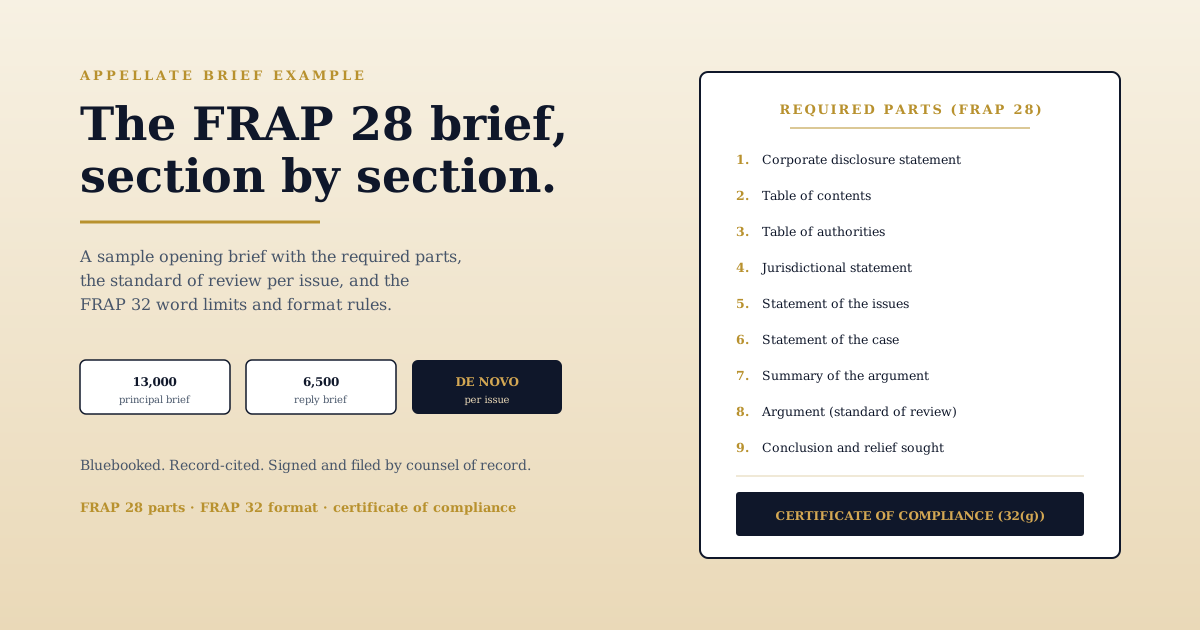
FRAP 28 Parts · FRAP 32 Format · 13,000 Words
The FRAP 28(a) parts, in a fixed order
What Is an Appellate Brief?
An appellate brief is the principal written argument submitted to an appellate court explaining why the trial-court judgment should be reversed, affirmed, or revisited. The appellant's brief argues for reversal, the appellee's brief argues for affirmance, and the reply brief answers the appellee. Because most appeals are decided on the briefs without oral argument, the brief is the primary vehicle for appellate advocacy.
An appellate brief differs from a trial-court motion brief in three ways that shape every section: it argues to a panel of judges rather than one, it argues on a closed record rather than a developing one, and it must frame every issue around the standard of review. Those constraints are why the FRAP 28 structure below is fixed rather than freeform.
A non-party who wants to weigh in files a different document. For that, see what is an amicus curiae brief.
Appellate Brief Format: The FRAP 28 Required Sections
An appellant's brief in a federal court of appeals must carry the parts below, in this order (the first and the last only when the rules require them). This sequence is the closest thing to an appellate brief template: the parts are fixed, and each is drafted from the specific record.
| # | Section | What It Contains | Rule Anchor |
|---|---|---|---|
| 1 | Disclosure statement | Identifies any parent corporation and any publicly held company owning 10% or more of a corporate party (FRAP 26.1). | FRAP 26.1 / 28(a)(1) |
| 2 | Table of contents | Every heading and subheading with page references, so the panel can navigate the argument at a glance. | FRAP 28(a)(2) |
| 3 | Table of authorities | Cases alphabetized, then statutes and other authorities, each with the pages of the brief where it is cited. Bluebooked. | FRAP 28(a)(3) |
| 4 | Jurisdictional statement | The basis for the district court's jurisdiction, the basis for the court of appeals' jurisdiction, and the filing dates that establish the appeal is timely. | FRAP 28(a)(4) |
| 5 | Statement of the issues | Each question presented for review, framed narrowly and in a way that suggests the answer the appellant seeks. | FRAP 28(a)(5) |
| 6 | Statement of the case | The facts relevant to the issues and the procedural history, with a record citation for every fact. Since the 2013 amendments, the facts live here. | FRAP 28(a)(6) |
| 7 | Summary of the argument | A clear, concise condensation of the argument that follows, not a mere repetition of the section headings. | FRAP 28(a)(7) |
| 8 | Argument | The contentions and reasons, with citations to authority and to the record, and a concise statement of the applicable standard of review for each issue. | FRAP 28(a)(8) |
| 9 | Conclusion and relief sought | A short statement of the precise relief the appellant asks the court to grant, followed by the signature block. | FRAP 28(a)(9) |
| 10 | Certificate of compliance | States the brief's word count. Required when the brief relies on the FRAP 32(a)(7)(B) word limit rather than the page limit. | FRAP 28(a)(10) / 32(g)(1) |
Type, spacing, and covers
FRAP 32 sets 14-point proportional type (or 10.5-cpi monospaced), double-spaced text, one-inch margins, and the cover colors: blue for the appellant's principal brief, red for the appellee's, and gray for the reply.
Word and page limits
13,000 words for a principal brief, 6,500 for a reply under FRAP 32(a)(7); or 30 and 15 pages if the page limit is used. A certificate of compliance under FRAP 32(g) closes the brief.
Sample Appellate Brief: A Full Annotated Opening Brief
The full appellant's opening brief below is an appeal to the Seventh Circuit from summary judgment for an insurer. It raises two issues: whether an Illinois homeowner's policy's resulting-loss exception restores coverage for water damage that followed faulty plumbing work, and whether the district court excluded the homeowner's engineer without applying Federal Rule of Evidence 702. Every FRAP 28(a) part appears in order, and the note beside each part explains what it does and which rule requires it.
Illustrative sample. The parties, caption, docket numbers, policy, record, counsel, and district judge are fictitious. The cases, statutes, and rules are real, and each citation was checked against the primary source for the proposition it supports. It shows structure and method; it is not legal advice and is not a substitute for a brief written from an actual record.
No. 26-1874
IN THE
UNITED STATES COURT OF APPEALS
FOR THE SEVENTH CIRCUIT
MARGARET A. HARROW,
Plaintiff-Appellant,
v.
CEDAR RIDGE MUTUAL INSURANCE COMPANY,
Defendant-Appellee.
Appeal from the United States District Court
for the Northern District of Illinois, Eastern Division
No. 1:24-cv-05512
The Honorable Ruth A. Kestrel, District Judge
BRIEF AND SHORT APPENDIX OF PLAINTIFF-APPELLANT MARGARET A. HARROW
Jonathan P. Ostrander
Counsel of Record
Leah M. Vale
OSTRANDER & VALE LLP
123 North Sample Street, Suite 1400
Chicago, Illinois 60606
(312) 555-0148
jostrander@ostrandervale.example
Counsel for Plaintiff-Appellant Margaret A. Harrow
CIRCUIT RULE 26.1 DISCLOSURE STATEMENT
| Appellate Court No. | 26-1874 |
| Short Caption | Harrow v. Cedar Ridge Mutual Insurance Co. |
| (1) Full name of every party the attorney represents | Margaret A. Harrow |
| (2) Law firms whose partners or associates have appeared for the party in this case (including the district court) or are expected to appear in this Court | Ostrander & Vale LLP |
| (3) Corporate disclosure under Fed. R. App. P. 26.1(a): parent corporations and publicly held corporations owning 10% or more of the party's stock | Not applicable. Margaret A. Harrow is an individual, not a corporation. |
| (4) True name of any litigant using a pseudonym | Not applicable. |
/s/ Jonathan P. Ostrander
Jonathan P. Ostrander, Counsel of Record
OSTRANDER & VALE LLP
123 North Sample Street, Suite 1400, Chicago, Illinois 60606
(312) 555-0148 | jostrander@ostrandervale.example
TABLE OF CONTENTS
TABLE OF AUTHORITIES
Cases
Statutes
Rules
Other Authorities
JURISDICTIONAL STATEMENT
District court jurisdiction. The district court had subject-matter jurisdiction under 28 U.S.C. § 1332(a)(1). Plaintiff-Appellant Margaret A. Harrow is a citizen of Illinois; she is domiciled in Evanston, Cook County, Illinois, where she owns and lives in the insured home. (R. 1 at 1.) Defendant-Appellee Cedar Ridge Mutual Insurance Company is a mutual insurance corporation incorporated under the laws of Wisconsin with its principal place of business in Madison, Wisconsin, and is therefore a citizen of Wisconsin only. 28 U.S.C. § 1332(c)(1); (R. 9 at 2). The amount in controversy exceeds $75,000, exclusive of interest and costs: Harrow seeks $179,820 in policy benefits for the loss to her dwelling and personal property. (R. 1 at 8.)
Appellate jurisdiction. This Court has jurisdiction under 28 U.S.C. § 1291. On March 10, 2026, the district court entered a memorandum opinion and order granting Cedar Ridge’s motion to exclude Harrow’s expert witness and its motion for summary judgment, and denying Harrow’s cross-motion for partial summary judgment (R. 71; A-1 to A-24), and on the same day entered final judgment for Cedar Ridge on both counts of the complaint (R. 72; A-25). The judgment disposes of all claims of all parties. No party filed a post-judgment motion that would toll the time to appeal. Harrow filed her notice of appeal on April 6, 2026 (R. 75), within the 30 days allowed by Fed. R. App. P. 4(a)(1)(A). This is not a direct appeal from a decision of a magistrate judge.
STATEMENT OF THE ISSUES
STATEMENT OF THE CASE
A. The policy
Cedar Ridge issued Harrow a homeowner’s policy, Form CR-HO 3, for the policy period May 1, 2023 to May 1, 2024. (R. 1-2 at 1; A-31.) The dwelling coverage is open-perils: Cedar Ridge insures “against risk of direct physical loss to property described in Coverage A,” except as excluded. (R. 1-2 at 12; A-36.) The policy defines a “Covered Peril” as “any risk of direct physical loss to covered property that is not excluded under this Section I.” (R. 1-2 at 3; A-33.) For personal property, the named perils include “[s]udden and accidental discharge or overflow of water or steam from within a plumbing, heating, air conditioning or automatic fire protective sprinkler system.” (R. 1-2 at 14; A-38.)
Two exclusions are at issue. The first, the faulty-workmanship exclusion, provides in full:
3. Faulty Workmanship. We do not pay for loss caused by faulty, inadequate or defective workmanship, repair, construction, renovation or installation, or materials used in repair, construction, renovation or installation. But if loss by a Covered Peril results, we will pay for that resulting loss. We do not pay the cost of correcting or making good the faulty, inadequate or defective work or materials itself.
(R. 1-2 at 19; A-41.) The second, the seepage exclusion, bars loss “caused by continuous or repeated seepage or leakage of water or steam over a period of 14 or more days from within a plumbing, heating, air conditioning or automatic fire protective sprinkler system.” (R. 1-2 at 18; A-40.)
B. The water loss
On September 14, 2023, a plumbing contractor replaced the water heater and the hot-water supply line in the utility room of Harrow’s finished basement. (R. 58-2 at 2.) On the evening of Friday, February 2, 2024, Harrow did laundry in the basement, a few feet from the new line, and saw no water on the floor or the walls. (R. 58-4, Harrow Dep. 41:3-22.) The next morning she drove to Milwaukee to stay with her sister, and she returned on the evening of Monday, February 5. (Id. at 43:1-17.) She found about two inches of standing water across the basement, closed the main valve at 6:40 p.m., and called Cedar Ridge that night. (Id. at 44:2-46:9; R. 58-5 at 1.)
Hourly consumption data from Harrow’s municipal water meter show average use of about six gallons per hour over the preceding 60 days, with no sustained overnight flow. (R. 58-6 at 2-4.) Beginning at about 2:00 a.m. on February 3, the meter recorded continuous flow of roughly 70 gallons per hour until the valve was closed on February 5, about 4,500 gallons in all. (Id. at 5-7.) The water soaked the drywall, flooring, cabinetry, and furnishings throughout the basement. (R. 58-7 at 3-11.) Harrow’s contractor estimated the cost to repair the dwelling at $148,620, and her contents loss totals $31,200. (R. 58-8 at 1; R. 58-9 at 1.) Neither figure includes the cost of re-making the supply-line connection. (R. 58-8 at 1.)
C. The claim and denial
Cedar Ridge retained an engineer, Dr. Kevin Ashby, who inspected the basement on February 20, 2024. (R. 61-3 at 1.) Dr. Ashby concluded that the compression fitting joining the new supply line to the water heater had been assembled without the tubing fully seated in the fitting body, and that mineral deposits at the joint and “tide-line” staining on the adjacent wall plate showed intermittent leakage “for a period of at least several weeks.” (Id. at 6-8.) He did not review the meter data. (R. 58-10, Ashby Dep. 77:4-12.) On April 2, 2024, Cedar Ridge denied the claim in full, citing the faulty-workmanship exclusion and the seepage exclusion. (R. 1-4 at 1-3.)
D. The expert evidence
Harrow retained Alan Brandt, a licensed professional engineer who has investigated residential water losses for 22 years. (R. 52-3 at 1-2.) Brandt inspected the basement, examined the retained fitting under magnification, mapped moisture in the walls and floor, photographed the joint and the wall plate, and analyzed the hourly meter data. (Id. at 3-9.) He agreed with Dr. Ashby that the tubing was not fully seated. (Id. at 6.) He concluded, however, that the partially seated joint held until the tubing pulled free on February 3, and that the loss resulted from that sudden separation rather than from weeks of seepage. (Id. at 10-12.) He based that conclusion on the onset of continuous flow in the meter record, on the absence of rot, decay, or microbial growth that he would expect after weeks of wetting, and on his reading of the deposits at the joint as consistent with condensation on a cold-water fitting rather than an active leak. (Id. at 10-14.) He explained that laboratory testing of the fitting would not have measured the duration of the leak, which was the question the meter data answered. (R. 58-11, Brandt Dep. 112:5-114:20.)
Cedar Ridge moved to exclude Brandt’s opinions on the ground that he had not tested the fitting in a laboratory and had “ignored” the staining. (R. 60 at 4-9.) Harrow responded with Brandt’s report, his deposition, and the meter data. (R. 64.) Neither party requested an evidentiary hearing, and the court did not hold one.
E. The rulings under review
Harrow sued for breach of contract and a declaration of coverage. (R. 1.) After discovery, Cedar Ridge moved for summary judgment on both exclusions (R. 61), and Harrow cross-moved for partial summary judgment on the meaning of the resulting-loss exception (R. 58).
In a single opinion, the district court first granted the motion to exclude Brandt. (A-6 to A-11.) Its analysis, in full, was that it found “Dr. Ashby’s analysis of the staining and corrosion more persuasive than Mr. Brandt’s reliance on meter data, which could reflect other water use,” that Brandt “did not conduct laboratory testing of the fitting,” and that his opinion was therefore “ipse dixit.” (A-9 to A-10.) The opinion does not quote or apply the text of Rule 702, does not mention the preponderance standard, and makes no finding on whether Brandt’s opinion rested on sufficient facts or data, used reliable methods, or reliably applied those methods to the facts. (A-6 to A-11.)
The court then granted summary judgment to Cedar Ridge. It held that the faulty-workmanship exclusion applied and that the resulting-loss exception did not, because “water escaping from an improperly installed fitting is the natural and foreseeable result of the faulty installation, not a separate and independent peril.” (A-14.) It relied on TMW Enterprises, Inc. v. Federal Insurance Co., 619 F.3d 574 (6th Cir. 2010), and Friedberg v. Chubb & Son, Inc., 691 F.3d 948 (8th Cir. 2012), and described Moda Furniture, LLC v. Chicago Title Land Trust Co., 2015 IL App (1st) 140501, in a footnote as “limited to its certified-question posture.” (A-13 to A-16 & n.4.) In the alternative, the court held that, with Brandt’s opinion excluded, “no admissible evidence establishes that the leak was sudden,” so the seepage exclusion also barred recovery. (A-18 to A-20.) It denied Harrow’s cross-motion and entered judgment for Cedar Ridge. (A-21 to A-25.) Harrow appeals the order excluding Brandt, the grant of summary judgment, and the denial of her cross-motion.
SUMMARY OF ARGUMENT
I. The policy answers the coverage question in its own words. It excludes loss caused by faulty installation, then says that “if loss by a Covered Peril results, we will pay for that resulting loss,” and then withholds only “the cost of correcting or making good” the faulty work itself. Read together, as Illinois law requires, those sentences draw a line between the defective joint, which Cedar Ridge need not pay to fix, and the water damage that followed when the joint failed, which it must pay for. The Illinois Appellate Court drew exactly that line in Moda Furniture, construing materially identical language. Because the Illinois Supreme Court has not addressed the question, Moda controls here unless there are persuasive indications that the state’s highest court would decide differently, and there are none.
The district court instead adopted a foreseeability test from Sixth and Eighth Circuit decisions applying Michigan and Minnesota law: if the damage is a natural result of the faulty work, the exception does not apply. That test is not in the policy, and it would leave the exception with almost nothing to do, because nearly every loss that follows faulty work is foreseeable in hindsight. Moda considered the same out-of-state cases and declined to follow them. At a minimum, Cedar Ridge’s reading is one of two reasonable readings, and Illinois resolves that ambiguity for the insured.
II. The order excluding Harrow’s engineer cannot stand. Rule 702 requires the court to decide whether the proponent has shown that it is more likely than not that the opinion rests on sufficient facts or data, uses reliable principles and methods, and reliably applies them. The district court did not ask those questions. It found the insurer’s engineer “more persuasive” on a disputed fact, whether the leak began suddenly or weeks earlier, and called the opinion it disbelieved “ipse dixit.” Choosing between two qualified experts who reach different conclusions on contested facts is the jury’s task, as the 2023 committee note to Rule 702 confirms. Because the court performed no Rule 702 analysis, this Court reviews the question de novo, and the record shows that Brandt’s opinion is anchored in objective data, including an hourly meter record the insurer’s expert never examined.
The alternative ruling on the seepage exclusion falls with the expert ruling, and it would fall without it. Cedar Ridge bears the burden of proving that an exclusion applies. Harrow’s testimony that the floor was dry the night before and the meter record showing flow beginning in the early morning of February 3 are evidence from which a reasonable jury could find that the loss did not result from 14 or more days of seepage. The court should not have resolved that dispute on summary judgment.
ARGUMENT
I. The resulting-loss exception restores coverage for the water damage that followed the failure of the faulty fitting.
A. Standard of review
This Court reviews a grant of summary judgment de novo. Nationwide Agribusiness Insurance Co. v. Dugan, 810 F.3d 446, 450 (7th Cir. 2015). Summary judgment is proper only if “there is no genuine dispute as to any material fact and the movant is entitled to judgment as a matter of law.” Fed. R. Civ. P. 56(a). Under Illinois law, which the parties agree governs, “[t]he construction of an insurance policy’s provisions is a question of law.” Outboard Marine Corp. v. Liberty Mutual Insurance Co., 154 Ill. 2d 90, 108 (1992). Sitting in diversity, this Court’s task is “to predict how the Illinois Supreme Court would decide the issues presented,” and where that court has not ruled, “decisions of the Illinois Appellate Courts control, unless there are persuasive indications that the Illinois Supreme Court would decide the issue differently.” Dugan, 810 F.3d at 450; accord Allstate Insurance Co. v. Menards, Inc., 285 F.3d 630, 637 (7th Cir. 2002) (federal courts give “great weight to the holdings of the state’s intermediate appellate courts”).
B. Read as a whole, the policy pays for the water damage and withholds only the cost of fixing the faulty work.
An Illinois court construing an insurance policy “must construe the policy as a whole,” giving unambiguous words “their plain, ordinary, and popular meaning.” Outboard Marine, 154 Ill. 2d at 108. It “must assume that every provision was intended to serve a purpose.” Founders Insurance Co. v. Munoz, 237 Ill. 2d 424, 433 (2010). And where the words “are susceptible to more than one reasonable interpretation, they are ambiguous and will be construed in favor of the insured and against the insurer who drafted the policy.” Outboard Marine, 154 Ill. 2d at 108-09 (citations omitted). The insured bears the burden of showing that a claim falls within the coverage grant; “the burden then shifts to the insurer to prove that a limitation or exclusion applies.” Addison Insurance Co. v. Fay, 232 Ill. 2d 446, 453-54 (2009).
Coverage is not disputed at the first step. Water discharging into a home and destroying its finishes is a “risk of direct physical loss” to the dwelling, and the “[s]udden and accidental discharge” of water from a plumbing system is a named peril for personal property. (A-36; A-38.) The question is what the faulty-workmanship clause takes away. Its three sentences answer that question in sequence. The first excludes “loss caused by” faulty installation. The second gives coverage back: “if loss by a Covered Peril results, we will pay for that resulting loss.” The third says what stays excluded even then: “the cost of correcting or making good the faulty, inadequate or defective work or materials itself.” (A-41.)
The third sentence is the key to the clause. It would be pointless unless the second sentence reached losses that the faulty work caused, because the cost of fixing the faulty work is always caused by the faulty work. By carving out only the repair of the defect “itself,” Cedar Ridge told its insured where the line falls: the defective joint is the insured’s problem, and the damage that results when the joint fails is Cedar Ridge’s. Harrow claims nothing for re-making the connection. (R. 58-8 at 1.) She claims the drywall, floors, cabinets, and belongings that 4,500 gallons of water destroyed. That water damage is “loss by a Covered Peril,” because water discharge is a risk of direct physical loss the policy does not exclude, and it “result[ed]” from the faulty installation. The clause says Cedar Ridge “will pay for that resulting loss.”
C. Moda Furniture adopts this reading of materially identical language, and nothing suggests the Illinois Supreme Court would reject it.
The Illinois Appellate Court construed a nearly identical clause in Moda Furniture, LLC v. Chicago Title Land Trust Co., 2015 IL App (1st) 140501. The policy there excluded loss caused by faulty “workmanship, repair, construction, renovation,” but provided that “[i]f an excluded cause of loss *** results in a Covered Cause of Loss, we will pay for the resulting loss or damage caused by that Covered Cause of Loss,” and withheld “[a]ny cost of correcting or making good the fault, inadequacy or defect itself.” Id. ¶ 26. A roofer’s faulty work let dirt and debris fall onto the insured’s inventory. Id. ¶¶ 4, 24. The insurer argued, as Cedar Ridge does, that the damage was so closely connected to the faulty work that there was no separate covered cause of loss, relying on the same Sixth and Eighth Circuit decisions. Id. ¶¶ 41-45, 58.
The court rejected that argument. It reasoned that the exception reached “resulting damage to other covered property,” and that the insurer’s decision to withhold only the cost of correcting the defect “evidences [its] intent to draw a distinction between a damage claim to correct the initial faulty construction or other defect (which is not covered) and a claim for resulting damage to other covered property (which is covered).” Moda, 2015 IL App (1st) 140501, ¶ 61. It found that view consistent with the earlier decision in Board of Education of Maine Township High School District 207 v. International Insurance Co., 292 Ill. App. 3d 14 (1st Dist. 1997), which read a similar clause to mean that “if a nonexcluded loss is caused by perils that either occur after an excluded peril or are causally related to an excluded peril, the nonexcluded loss will remain covered,” while “[t]he uncovered peril itself will not be covered.” Id. at 21; see Moda, 2015 IL App (1st) 140501, ¶ 64. Maine Township illustrated the point with a burst pipe: the defective pipe is excluded, but the “ensuing damage to the wall and floor” is covered. 292 Ill. App. 3d at 21. That is this case.
The district court set Moda aside in a footnote as “limited to its certified-question posture.” (A-16 n.4.) But the posture affected only which facts were assumed, not what the policy language means, and the meaning of a policy is a question of law. Outboard Marine, 154 Ill. 2d at 108. Moda answered that legal question, after surveying the out-of-state split, and the Illinois Supreme Court has not addressed it since. Under Dugan and Menards, the district court was bound to follow Moda unless it identified “persuasive indications” that the Illinois Supreme Court would disagree. 810 F.3d at 450; 285 F.3d at 637. It identified none. The Illinois Supreme Court’s own canons point the same direction as Moda: read the policy as a whole, give every provision a purpose, and resolve real doubt against the drafter. Outboard Marine, 154 Ill. 2d at 108-09; Founders, 237 Ill. 2d at 433.
D. The foreseeability test the district court borrowed is not in the policy and would read the exception out of it.
The district court held that the exception does not apply when the damage is “the natural and foreseeable result of the faulty installation.” (A-14.) That test comes from TMW, which held under Michigan law that “because defective wall construction naturally and foreseeably leads to water infiltration,” the exclusion and not the ensuing-loss exception applied, 619 F.3d at 579, and from Friedberg, which held under Minnesota law that once a house “was plagued with faulty construction, it was a foreseeable and natural consequence that water would enter.” 691 F.3d at 952. Those decisions do not control here, for three reasons.
First, the word “foreseeable” appears nowhere in Cedar Ridge’s policy. The exception covers loss by a Covered Peril that “results” from faulty work. A test that denies coverage whenever the result was foreseeable converts “results” into its opposite. Nearly every loss that follows faulty work is foreseeable in hindsight; that is what makes the work faulty. Under the district court’s reading, the second sentence of the clause would almost never apply, and the third sentence, which carves the repair cost out of a grant that would then cover almost nothing, would serve no purpose. Illinois does not read policies that way. Founders, 237 Ill. 2d at 433; Hobbs v. Hartford Insurance Co. of the Midwest, 214 Ill. 2d 11, 27 (2005) (the policy “must be construed as a whole” and a reading that takes a clause “completely out of the policy” is rejected).
Second, the facts of TMW and Friedberg are different in kind. Both involved water working its way through a defectively built exterior, in Friedberg over the course of several years, so that “the elements” doing the damage were the predictable byproduct of the defect itself. TMW, 619 F.3d at 575-76; Friedberg, 691 F.3d at 950. Here, a joint that held for nearly five months failed on a single night, and 4,500 gallons of pressurized supply water discharged into the house. (R. 58-6 at 5-7; R. 52-3 at 10-12.) A sudden discharge from a plumbing system is a peril the policy itself treats as distinct, naming it as a covered peril for personal property. (A-38.) Even TMW recognized that an ensuing-loss clause preserves coverage for “independent, non-foreseeable losses caused by faulty construction.” 619 F.3d at 578. Whether a sudden failure months after installation is such a loss is, at the least, a question the district court could not resolve against Harrow on summary judgment.
Third, the existence of a reasoned split is itself significant under Illinois law. TMW drew a dissent that read the same clause as covering the water damage, observing that the majority’s limitation “requires reading quite a lot into the plain language of the contract.” 619 F.3d at 584 (Cole, J., dissenting). And Moda held that even if the insurer’s narrower reading “may be reasonable, an interpretation in favor of [the insured] is also reasonable,” which “is sufficient to render the contract ambiguous” and “compels us to hold in favor of coverage.” 2015 IL App (1st) 140501, ¶¶ 65-66. Illinois courts “will not strain to find an ambiguity where none exists,” Hobbs, 214 Ill. 2d at 17, but none is needed here. If Cedar Ridge meant to exclude every foreseeable consequence of faulty work, it could have said so. It said instead that it “will pay for that resulting loss.”
The district court therefore erred in granting summary judgment on the faulty-workmanship exclusion, and it should have granted Harrow’s cross-motion declaring that the resulting-loss exception covers the water damage to her dwelling and personal property, excluding only the cost of correcting the faulty connection.
II. The district court erred in excluding Harrow’s engineer without applying Rule 702, and in granting summary judgment on the seepage exclusion.
A. Standard of review
“[W]hether the district court applied the Daubert framework properly is a question [this Court] review[s] de novo,” while the ultimate decision to admit or exclude is reviewed for an abuse of discretion. Gopalratnam v. Hewlett-Packard Co., 877 F.3d 771, 782 (7th Cir. 2017) (citation omitted); Gayton v. McCoy, 593 F.3d 610, 616 (7th Cir. 2010); see General Electric Co. v. Joiner, 522 U.S. 136, 146 (1997); Kumho Tire Co. v. Carmichael, 526 U.S. 137, 152 (1999). A court abuses its discretion when it commits “a serious error of judgment, such as reliance on a forbidden factor or failure to consider an essential factor.” Smith v. Ford Motor Co., 215 F.3d 713, 717 (7th Cir. 2000) (quotation omitted). Where the district court’s ruling is conclusory, so that it does not show that the court performed the required analysis, this Court reviews admissibility de novo. Metavante Corp. v. Emigrant Savings Bank, 619 F.3d 748, 760 (7th Cir. 2010). The grant of summary judgment is reviewed de novo. Dugan, 810 F.3d at 450.
B. The court did not perform the analysis Rule 702 requires.
Rule 702, as amended effective December 1, 2023, permits a qualified expert to testify “if the proponent demonstrates to the court that it is more likely than not that”:
(a) the expert’s scientific, technical, or other specialized knowledge will help the trier of fact to understand the evidence or to determine a fact in issue; (b) the testimony is based on sufficient facts or data; (c) the testimony is the product of reliable principles and methods; and (d) the expert’s opinion reflects a reliable application of the principles and methods to the facts of the case.
Fed. R. Evid. 702. The court decides those preliminary questions under Fed. R. Evid. 104(a). The 2023 amendment clarified that the preponderance standard governs each reliability requirement, and it did so because some courts had treated questions about the sufficiency of an expert’s basis as matters of weight alone. Fed. R. Evid. 702 advisory committee’s note to 2023 amendment. Harrow does not dispute that standard. Her point is that the district court never applied it.
The court’s ruling does not quote Rule 702, does not mention the preponderance standard, and makes no finding under subsections (b), (c), or (d). (A-6 to A-11.) It does not find that Brandt’s facts or data were insufficient; it does not identify any principle or method he used, or explain why it was unreliable; and it does not find that he misapplied a reliable method to the facts. It states only that the court found Dr. Ashby “more persuasive,” that the meter data “could reflect other water use,” that Brandt did no laboratory testing, and that his opinion was therefore “ipse dixit.” (A-9 to A-10.) A district court has latitude in how it tests reliability, but “the court must provide more than just conclusory statements of admissibility or inadmissibility to show that it adequately performed its gatekeeping function.” Gayton, 593 F.3d at 616; accord Naeem v. McKesson Drug Co., 444 F.3d 593, 608 (7th Cir. 2006) (“it is nonetheless crucial that a Daubert analysis of some form in fact be performed” (quotation omitted)).
Harrow does not contend that the court was required to hold an evidentiary hearing. This Court has “not required that the Daubert inquiry take any specific form.” Kirstein v. Parks Corp., 159 F.3d 1065, 1067 (7th Cir. 1998); see Kumho, 526 U.S. at 152 (trial courts have latitude “to decide whether or when special briefing or other proceedings are needed to investigate reliability”). The error is not the form of the inquiry but its absence: whatever procedure a court uses, it must answer the questions Rule 702 asks.
The court’s label of “ipse dixit” does not supply the missing analysis. Joiner permits exclusion of “opinion evidence that is connected to existing data only by the ipse dixit of the expert,” where “there is simply too great an analytical gap between the data and the opinion proffered.” 522 U.S. at 146. Brandt’s opinion is the opposite of a bare assertion. It rests on a dataset with a time stamp: an hourly meter record showing no sustained flow for 60 days, then continuous flow of about 70 gallons per hour beginning at about 2:00 a.m. on February 3. (R. 58-6 at 2-7.) It rests on his own inspection, moisture mapping, and examination of the fitting, and on the absence of the decay he would expect after weeks of wetting. (R. 52-3 at 3-14.) The court did not identify any gap between those data and his conclusion; it identified a different conclusion that it preferred.
Nor was the absence of laboratory testing a substitute for a reliability finding. Rule 702’s reliability inquiry is “flexible,” Daubert v. Merrell Dow Pharmaceuticals, Inc., 509 U.S. 579, 594 (1993), and in engineering cases “the relevant reliability concerns may focus upon personal knowledge or experience,” Kumho, 526 U.S. at 150. The question is whether the expert “employs in the courtroom the same level of intellectual rigor that characterizes the practice of an expert in the relevant field.” Id. at 152. Brandt explained, without contradiction, why a metallurgical test of the fitting would not answer the question in dispute, which was not whether the joint failed but when. (R. 58-11, Brandt Dep. 112:5-114:20.) The court did not address that testimony, and it made no finding that engineers investigating the timing of a water loss rely on laboratory testing rather than on consumption data and physical evidence. Treating one test as mandatory without asking whether it bears on the question is a “failure to consider an essential factor.” Smith, 215 F.3d at 717 (quotation omitted).
C. The court resolved a disputed question of fact by choosing between the experts.
What the court did instead was decide which expert was right. “The focus, of course, must be solely on principles and methodology, not on the conclusions that they generate.” Daubert, 509 U.S. at 595. “It is not the trial court’s role to decide whether an expert’s opinion is correct.” Smith, 215 F.3d at 719. The gatekeeper role “does not render the district court the trier of all facts relating to expert testimony,” and “[t]he jury must still be allowed to play its essential role as the arbiter of the weight and credibility of expert testimony.” Gopalratnam, 877 F.3d at 780 (quotation omitted).
The 2023 amendment did not change that division of labor. The committee note explains that “[i]t will often occur that experts come to different conclusions based on contested sets of facts,” and that “[w]here that is so, the Rule 104(a) standard does not necessarily require exclusion of either side’s experts. Rather, by deciding the disputed facts, the jury can decide which side’s experts to credit.” Fed. R. Evid. 702 advisory committee’s note to 2023 amendment. It adds that proponents “do not have to demonstrate to the judge by a preponderance of the evidence that the assessments of their experts are correct, they only have to demonstrate by a preponderance of evidence that their opinions are reliable.” Id. (quotation omitted).
This case is the committee note’s example. Both engineers agreed that the tubing was not fully seated. (R. 61-3 at 6-8; R. 52-3 at 6.) They disagreed about one fact, when the water began to escape, and each read the physical evidence in light of his answer: Dr. Ashby read the deposits and staining as signs of weeks of leakage, while Brandt read the meter record, the absence of decay, and the character of the deposits as signs of a sudden failure. (R. 61-3 at 6-8; R. 52-3 at 10-14.) Dr. Ashby never examined the meter data. (R. 58-10, Ashby Dep. 77:4-12.) By finding Dr. Ashby’s account “more persuasive,” the court resolved the central factual dispute in the case, and then held that, without Brandt, Harrow had no evidence on it. (A-9 to A-10; A-18 to A-20.) This Court reversed an exclusion with the same structure in Manpower, Inc. v. Insurance Co. of the State of Pennsylvania, 732 F.3d 796 (7th Cir. 2013), where the court’s criticisms of an expert’s inputs read as “a road-map for [the opponent’s] cross-examination” yet the exclusion left the proponent “with no competent evidence” and “ensur[ed] summary judgment” against it. Id. at 810. Harrow recognizes that Manpower predates the 2023 amendment, and she does not rely on it for the proposition that sufficiency of basis is always a matter of weight. She relies on it, and on the amended rule’s note, for the narrower point that a court may not exclude a reliable opinion because it prefers the other side’s version of a contested fact. “Vigorous cross-examination, presentation of contrary evidence, and careful instruction on the burden of proof are the traditional and appropriate means of attacking shaky but admissible evidence.” Daubert, 509 U.S. at 596.
Because the district court’s ruling is conclusory, this Court may review admissibility de novo on this record, as it did in Metavante, 619 F.3d at 760-61, and hold that Brandt’s opinion meets Rule 702. Alternatively, the Court should vacate the exclusion order and remand for the district court to apply Rule 702 in the first instance.
D. Summary judgment on the seepage exclusion was improper with or without Brandt’s opinion.
The district court’s alternative holding on the seepage exclusion rested entirely on the exclusion of Brandt. (A-18 to A-20.) If that ruling falls, the alternative holding falls with it, because Brandt’s opinion directly contradicts the premise that the water escaped over 14 or more days.
The holding was wrong even on the record the court allowed. Cedar Ridge, not Harrow, bears “the burden . . . to prove that a limitation or exclusion applies.” Addison, 232 Ill. 2d at 453-54. Rule 56 mandates judgment “against a party who fails to make a showing sufficient to establish the existence of an element essential to that party’s case, and on which that party will bear the burden of proof at trial.” Celotex Corp. v. Catrett, 477 U.S. 317, 322 (1986). On the seepage exclusion, that party is Cedar Ridge, so the absence of an expert for Harrow could not by itself entitle Cedar Ridge to judgment. And a dispute is genuine “if the evidence is such that a reasonable jury could return a verdict for the nonmoving party.” Anderson v. Liberty Lobby, Inc., 477 U.S. 242, 248 (1986).
A reasonable jury could find for Harrow on this record without any expert. Harrow testified that the floor and walls beside the new line were dry on the evening of February 2. (R. 58-4, Harrow Dep. 41:3-22.) The municipal meter record, a business record that requires no expert to read, shows no sustained flow for 60 days and continuous flow beginning hours later. (R. 58-6 at 2-7.) The district court discounted Harrow’s testimony as a “lay observation” that “cannot establish the duration of the leak.” (A-19.) But Harrow did not need to establish duration; Cedar Ridge did. Weighing her testimony against Dr. Ashby’s opinion was a credibility judgment, and “[c]redibility determinations, the weighing of the evidence, and the drawing of legitimate inferences from the facts are jury functions, not those of a judge.” Anderson, 477 U.S. at 255. At summary judgment “[t]he evidence of the non-movant is to be believed, and all justifiable inferences are to be drawn in his favor,” id., and the judge’s function “is not himself to weigh the evidence and determine the truth of the matter but to determine whether there is a genuine issue for trial.” Id. at 249. There is one here.
CONCLUSION
For these reasons, Plaintiff-Appellant Margaret A. Harrow respectfully requests that this Court (1) reverse the judgment entered March 10, 2026; (2) reverse the denial of her cross-motion for partial summary judgment and remand with instructions to enter partial summary judgment declaring that the policy’s resulting-loss exception covers the water damage to her dwelling and personal property, excluding only the cost of correcting the faulty supply-line connection; (3) vacate the order excluding the testimony of Alan Brandt; and (4) remand for trial on Cedar Ridge’s seepage exclusion and on damages.
Dated: June 22, 2026
Respectfully submitted,
MARGARET A. HARROW
By: /s/ Jonathan P. Ostrander
Jonathan P. Ostrander, Counsel of Record
Leah M. Vale
OSTRANDER & VALE LLP
123 North Sample Street, Suite 1400
Chicago, Illinois 60606
(312) 555-0148
jostrander@ostrandervale.example
Counsel for Plaintiff-Appellant
CERTIFICATE OF COMPLIANCE
1. This brief complies with the type-volume limitation of Fed. R. App. P. 32(a)(7)(B), as modified by Circuit Rule 32(c), because, excluding the parts of the brief exempted by Fed. R. App. P. 32(f), it contains 5,851 words.
2. This brief complies with the typeface requirements of Fed. R. App. P. 32(a)(5) and Circuit Rule 32(b) and the type-style requirements of Fed. R. App. P. 32(a)(6) because it has been prepared in a proportionally spaced typeface, 14-point Palatino Linotype, using a word-processing program.
/s/ Jonathan P. Ostrander, Counsel for Plaintiff-Appellant
CERTIFICATE OF SERVICE
I certify that on June 22, 2026, I electronically filed the foregoing Brief and Short Appendix of Plaintiff-Appellant with the Clerk of the Court for the United States Court of Appeals for the Seventh Circuit by using the CM/ECF system. All participants in the case are registered CM/ECF users and will be served by the CM/ECF system.
/s/ Jonathan P. Ostrander
SHORT APPENDIX
Under Circuit Rule 30(d), counsel certifies that all materials required by Circuit Rule 30(a) and (b) are included in the short appendix bound with this brief.
[The appendix documents themselves are omitted from this sample.]
ILLUSTRATIVE SAMPLE. The parties, caption, docket numbers, policy, record, counsel, and district judge in this brief are fictitious. The legal authorities are real. This sample is not legal advice and is not a substitute for a brief written from an actual record.
How to Write an Appellate Brief
Six steps turn a trial-court record into a filed appellate brief. The order matters: the standard of review is chosen before a word of argument is written, because it governs how every issue is framed.
- 1
Read the entire record and isolate preserved issues
An appellate court reviews what the trial court decided on the record made below. Read the full record and identify the issues that were preserved by objection or ruling; unpreserved issues rarely survive.
- 2
Pair each issue with its standard of review
De novo, abuse of discretion, clear error, or substantial evidence. The standard frames every argument, because it sets how much deference the panel owes the ruling below.
- 3
Frame the issues presented
Write each question narrowly enough that the framing suggests the answer, and order the issues by strength rather than by the sequence they arose at trial.
- 4
Write the statement of the case from the record
State the facts relevant to the issues and the procedural history with a record citation for every fact, and without argument. Credibility with the panel is built here.
- 5
Build the argument element by element
Open each argument with the standard of review, then prove each element with binding authority and record cites. Lead with the strongest issue.
- 6
Bluebook, certify, and file to the word limit
Assemble a Bluebooked table of authorities, confirm the FRAP 32(a)(7) word count with a certificate of compliance, and file under counsel of record's signature.
When you are ready to route the brief out, see appellate brief writing services for the full opening, response, reply, cert-petition, and rehearing-en-banc stack, or trial brief writing services for motion practice below. Further reading: the standard of review that frames every issue, and how to file a notice of appeal that starts the appeal.
Appellate Brief: Common Questions
What is an appellate brief?
What are the required parts of an appellate brief?
What is the format of an appellate brief?
What is the word limit for an appellate brief?
How do you write an appellate brief?
Is there a template for an appellate brief?
Turn the Record Into a Filed Brief
Send the case caption, the appellate court, and the operative briefing schedule through our quote form. We return scope and the timeline the same business day for intakes received before 5 PM ET, drafted to FRAP 28 and 32 for your counsel of record to sign and file.
Quotes return same business day on intakes received before 5 PM ET