What Is an Amicus Curiae Brief?
An amicus curiae brief is a “friend-of-the-court” brief filed by a person or organization that is not a party to the appeal but has a strong interest in the outcome. It offers the court perspective, expertise, or consequences the parties may not fully brief.
In the federal courts of appeals, amicus briefs are governed by FRAP 29. Most are filed with the written consent of all parties or with leave of court, carry a statement of the amicus interest, disclose their authorship and funding, and are limited to half the length of a party's principal brief. Below: the meaning, an annotated amicus brief example, the rules, and how to file.
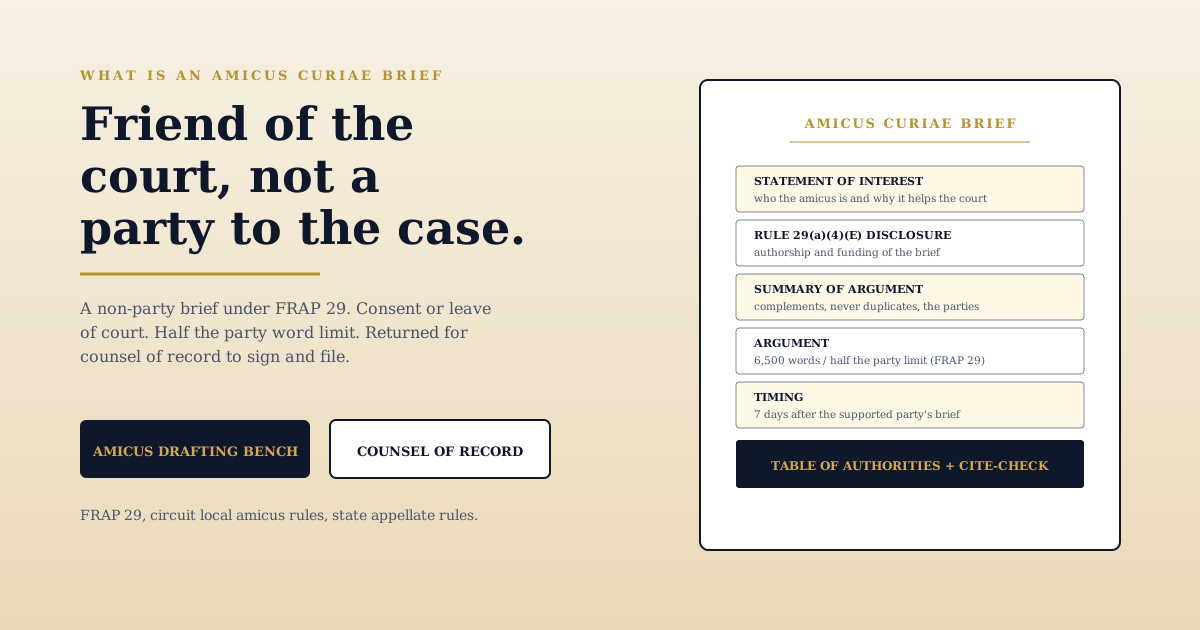
FRAP 29 · Consent or Leave · Half-Party Limit
Friend of the court, not a party to the appeal
Amicus Curiae Meaning: “Friend of the Court” in Plain English
Amicus curiae is Latin for “friend of the court.” It describes a non-party who assists the court by supplying information, expertise, or argument on a legal question. The plural is amici curiae. An amicus is not a litigant, holds no client in the case, and seeks no relief for itself. It files an amicus curiae brief to inform the court's decision on an issue that reaches beyond the two parties in front of it.
Courts accept amicus briefs because appellate decisions set precedent. A ruling between two parties can bind an entire industry, a class of regulated actors, or a field of law. The amicus tells the court what the parties cannot or will not: the downstream consequences, the empirical record, the historical or doctrinal context, or the practical stakes for those who are not in the caption but will live under the rule.
An amicus brief is not the same as an appellate brief filed by a party. For the party filing that carries the appeal, see the annotated appellate brief example. For the full appellate stack, see our appellate brief writing services.
Who Files an Amicus Brief, and Why Courts Accept Them
Trade associations, advocacy organizations, professional bodies, scholars, companies, and governments all file amicus briefs. FRAP 29(a) draws one bright line on who needs permission to file.
May file without consent or leave
The United States, its officers and agencies, and a state may file an amicus brief without the consent of the parties and without a motion for leave. Their institutional interest in the law is presumed.
Everyone else: consent or leave
Any other amicus must obtain the written consent of all parties, or move the court for leave to file. The motion must state the movant's interest and why an amicus brief is desirable and relevant to matters the parties have not fully addressed.
Amicus Brief Example: The FRAP 29 Structure, Section by Section
An amicus curiae brief follows a fixed skeleton. The six sections below are the ones a federal court of appeals expects, in order, followed by an illustrative excerpt showing how the statement of interest and the required disclosure read on the page.
Cover and Corporate Disclosure
Green cover (federal appeals), caption, and a FRAP 26.1 corporate disclosure statement identifying any parent corporation and any publicly held company owning 10% or more of the amicus.
Statement of Interest of Amicus Curiae
Who the amicus is, the concrete interest it holds in the question presented, and why its perspective helps the court. This is the section that persuades the court to accept the brief on a motion for leave.
FRAP 29(a)(4)(E) Authorship and Funding Disclosure
A statement of whether a party's counsel authored the brief in whole or part, whether a party or its counsel contributed money to fund it, and whether any other person contributed money intended to fund preparing or submitting the brief.
Summary of Argument
A tight preview of the amicus contribution, framed to complement the supported party rather than repeat it. Strong amicus briefs add a distinct angle: industry consequences, empirical data, historical context, or a doctrinal frame the parties underweight.
Argument
The substantive contribution, organized around the standard of review the panel will apply and anchored to binding authority. An amicus that merely echoes a party's brief wastes the court's attention and its own word count.
Conclusion, Signature, and Table of Authorities
A short statement of the disposition the amicus urges, counsel's signature block, a Bluebooked table of authorities, and the FRAP 32(g) certificate of compliance with the word count.
IN THE UNITED STATES COURT OF APPEALS
FOR THE NINTH CIRCUIT
MERIDIAN DIAGNOSTICS, INC.,
Plaintiff-Appellant,
v.
STATE BOARD OF CLINICAL LABORATORIES,
Defendant-Appellee.
No. 25-16204
BRIEF OF THE NATIONAL ASSOCIATION OF CLINICAL LABORATORIES AS AMICUS CURIAE IN SUPPORT OF PLAINTIFF-APPELLANT
STATEMENT OF INTEREST OF AMICUS CURIAE
The National Association of Clinical Laboratories (“the Association”) is a nonprofit membership organization representing more than 900 accredited clinical laboratories across the fifty states. Its members operate under the licensing regime the district court construed below, and the rule the panel adopts will govern how every one of them reports results across state lines. The Association files this brief to explain the operational consequences of the district court's construction, which the parties, focused on their own dispute, address only in part.
RULE 29(a)(4)(E) STATEMENT
No party's counsel authored this brief in whole or in part. No party, no party's counsel, and no person other than the Association and its members contributed money intended to fund preparing or submitting this brief.
SUMMARY OF ARGUMENT
This brief does not restate Appellant's statutory argument. It supplies the record the panel will need to measure the consequences of affirmance: the reporting architecture the challenged rule disrupts, the compliance cost it shifts onto out-of-state laboratories, and the interstate-uniformity concern that the standard of review brings to the fore. Because the district court's construction was a pure question of statutory interpretation, this Court reviews it de novo, and the practical effects the Association documents bear directly on the reading the statute will bear.
Illustrative only. Caption, parties, and docket number are fictitious and used to show the structure of the filing. Every amicus brief is drafted to the operative record, the supported party, and the circuit's local amicus rules.
Amicus Brief Rules: Consent, Leave of Court, Timing, and Word Limits
The four rules below decide whether an amicus brief is accepted and whether it is timely. Circuits add local amicus rules on top, and state appellate courts set their own equivalents.
| Requirement | What FRAP 29 Requires | Rule Anchor |
|---|---|---|
| Permission to file | Consent of all parties, or leave of court by motion. The United States, a federal agency or officer, and a state may file without either. | FRAP 29(a)(2) |
| Authorship + funding disclosure | Statement of whether a party's counsel authored the brief and whether any party, counsel, or other person funded it. | FRAP 29(a)(4)(E) |
| Word limit | No more than one-half the maximum length of a party's principal brief, generally 6,500 words in a federal appeal. | FRAP 29(a)(5) |
| Timing | Filed no later than 7 days after the principal brief of the party being supported, unless the court orders otherwise. | FRAP 29(a)(6) |
The half-limit is a ceiling, not a target
Panels reward amicus briefs that are short and additive. The most persuasive amicus briefs use a fraction of the 6,500-word ceiling to make one point the parties cannot, then stop. A brief that spends its word count restating the supported party's argument invites the court to skip it.
How to File an Amicus Curiae Brief
Six steps carry an amicus brief from interest to filing. The window is short because it is keyed to another party's deadline, so amicus counsel line up the drafter early.
- 1
Confirm your interest and the party you support
Identify the concrete interest the amicus holds in the question presented and whether the brief supports the appellant, the appellee, or neither party.
- 2
Obtain consent or move for leave under FRAP 29(a)
Seek the written consent of all parties. If any party withholds consent, file a motion for leave to file that states the amicus interest and why the brief is desirable and relevant.
- 3
Calendar the FRAP 29(a)(6) deadline
Amicus briefs supporting a party are due no later than 7 days after that party files its principal brief. Line up the drafter before the supported brief is on file.
- 4
Draft to the half-party word limit with the required disclosures
Draft within the 6,500-word federal limit, include the FRAP 29(a)(4)(E) authorship-and-funding statement, and build the argument to complement rather than duplicate the party briefs.
- 5
Bluebook, cite-check, and certify
Run a Bluebooked table of authorities, a KeyCited citation pass, and the FRAP 32(g) certificate of compliance before the brief is filed on the appellate docket.
- 6
File under counsel of record's signature
Counsel of record admitted to the court signs and files the amicus brief. The drafting bench does not appear on the docket or sign the brief.
Who signs and files
Counsel of record admitted to the court signs and files the amicus brief and owns every strategic call. Our drafting bench prepares the brief, runs the Bluebook and cite-check pass, and returns it in review-ready form. It does not appear on the docket, does not sign, and does not communicate with the court.
How Much Does It Cost to File an Amicus Brief?
Federal courts of appeals do not charge a separate docketing fee for the amicus brief itself, and a motion for leave to file is submitted without a filing fee. The cost of an amicus brief is the drafting: the statement of interest that earns the court's leave, the FRAP 29(a)(4)(E) disclosure, the argument built to complement rather than duplicate the party briefs, and the Bluebooked table of authorities.
Amicus drafting is quoted per brief after a short intake covering the court, the party being supported, the operative briefing schedule, and the interest of the amicus. Send the posture through our quote form and scope returns the same business day on intakes received before 5 PM ET.
Related reading: the appellate brief example walks a party brief section by section, and appellate brief writing services covers the full opening, response, reply, cert-petition, and rehearing-en-banc stack. For the underlying doctrine, our guide to how an appellate brief is structured covers the FRAP 28 components in depth.
Amicus Curiae Brief: Common Questions
What is an amicus curiae brief?
What does amicus curiae mean?
Who can file an amicus brief?
What is the word limit for an amicus brief?
How much does it cost to file an amicus brief?
When is an amicus brief due?
Have an Amicus Brief on the Calendar?
Send the court, the party you support, and the briefing schedule through our quote form. We return scope, the named drafter, and the timeline in one business day, drafted to FRAP 29 and the circuit's local amicus rules for your counsel of record to sign and file.
Quotes return same business day on intakes received before 5 PM ET