Appellee's Answering Brief and Respondent's Brief
Prepared by a licensed U.S. attorney
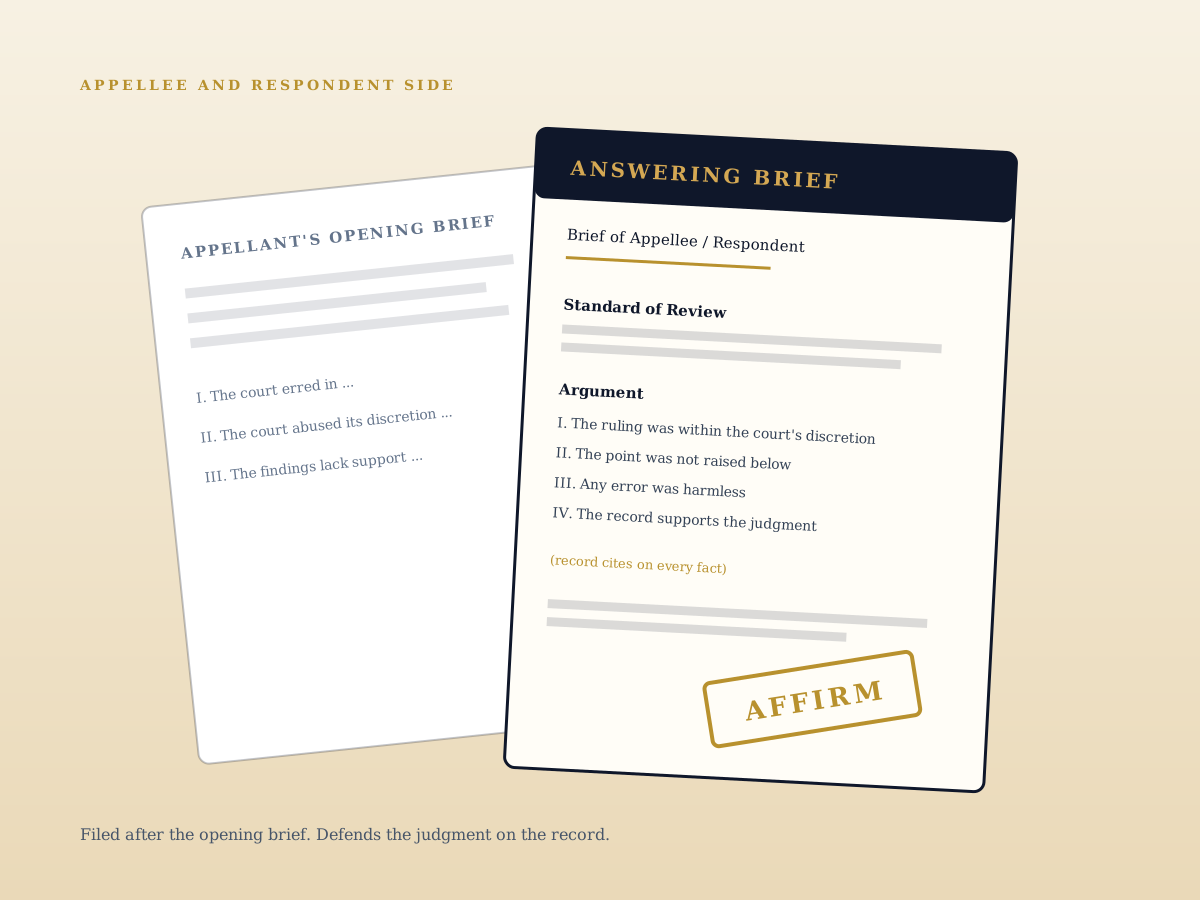
An answering brief is the brief the appellee or respondent files after the appellant's opening brief, answering each argument and asking the appeals court to affirm the judgment. In federal court it is due 30 days after the appellant's brief is served. We draft it from the record, for your counsel of record or for you, if you are representing yourself, to sign and file.
You won below, so the judgment is your starting point. Our drafting builds the brief around the standard of review, the record pages that support the ruling, and the arguments the appellant never made in the trial court.
FRAP 28(b)
Four statements are optional
Jurisdiction, issues, case and standard of review may be omitted unless you disagree with the appellant's version.
FRAP 31(a)(1)
30 days after service
The appellee serves and files within 30 days after the appellant's brief is served.
FRAP 32(a)(7)(B)
13,000 words
The type-volume limit for a principal brief, with a certificate stating the count.
FRAP 28.1
Cross-appeal: 15,300 words
The appellee's principal and response brief carries the cross-appeal and the answer together.
Answering Briefs We Draft for Appellees and Respondents
Whether your court calls it an answer brief, an answering brief, an appellee's brief or a respondent's brief, we draft the one document the winning side files in the middle of the briefing order. We work only on your side of that exchange: the brief that responds to the appellant and defends the result. Our appellee briefs go to two kinds of client. Lawyers who are counsel of record and want an experienced drafter for a heavy record or a short deadline, and self-represented appellees who received an opening brief and need a response that meets the court's rules.
Issue-by-issue answer
Every issue in the opening brief answered under its own heading, with the standard of review stated and argued for that issue.
Record citations on every fact
Each factual statement tied to the page of the appendix, excerpts of record or transcript where it appears.
Counter-statement where it helps
A counter-statement of the issues or of the case when the appellant's framing leaves out facts the court needs.
Formal parts and certificate
Table of contents, table of authorities, word count certificate and the court-specific cover and format items.
Federal Appellee Briefs
In the federal courts of appeals the document is the appellee brief governed by the Federal Rules of Appellate Procedure (FRAP). The Ninth Circuit uses the name answering brief in its own guidance: "To respond to the opening brief, the appellee or respondent files an answering brief," and it sets a 14,000-word limit for that brief. FRAP itself sets 13,000 words for a principal brief, so the circuit matters, and we confirm the circuit's rules and the court's briefing order on every matter before the first page is drafted. When your appeal sits inside a larger appellate engagement, such as a petition or a second brief later, our appellate brief writing services page covers the other brief types we take on.
Respondent's Brief in California Courts of Appeal
California calls the same filing the respondent's brief. Under California Rules of Court, rule 8.212(a)(2), "A respondent must serve and file its brief within 30 days after the appellant files its opening brief." The clock runs from filing, not service, which is one of the differences we track. Rule 8.204(c)(1) caps a computer-produced brief at 14,000 words, including footnotes, and requires a certificate stating the word count. Rule 8.204(a)(1)(C) requires that every reference to the record cite the volume and page where the matter appears, and our drafts follow that format from the first paragraph.
Cross-Appeal Principal and Response Briefs
If you also appealed, the brief changes shape. Under FRAP 28.1(c)(2) the appellee "must file a principal brief in the cross-appeal and must, in the same brief, respond to the principal brief in the appeal." That combined brief may run to 15,300 words under FRAP 28.1(e)(2)(B) and is due 30 days after the appellant's principal brief is served under FRAP 28.1(f)(2). The cross-appeal also sets your reply: you may file a reply limited to the cross-appeal issues within 21 days after the appellant's response and reply brief is served. In California, a combined brief in an appeal governed by rule 8.216 may not exceed double the ordinary limit under rule 8.204(c)(4). We draft both halves of the combined brief so the answer and the cross-appeal argument do not contradict each other.
When the Appellant's Opening Brief Has Been Served
The appellee's brief is triggered by one event: service of the appellant's opening brief. From that day the federal 30-day period under FRAP 31(a)(1) starts, unless a local rule or an order in the case shortens it under FRAP 31(a)(2). Missing it costs more than time. Under FRAP 31(c), "An appellee who fails to file a brief will not be heard at oral argument unless the court grants permission." In California, rule 8.220(a) has the clerk send a notice giving 15 days to file, and if the respondent's brief still does not arrive, "the court may decide the appeal on the record, the opening brief, and any oral argument by the appellant." If the opening brief is on your desk, this is the moment to start.
Defending the Judgment Under the Standard of Review
The standard of review is usually the appellee's best ground, because it decides how much the appellant has to prove. Under Federal Rule of Civil Procedure 52(a)(6), findings of fact "must not be set aside unless clearly erroneous," with due regard to the trial court's opportunity to judge credibility. Rulings reviewed for abuse of discretion leave the appellant a narrow path, while questions that get de novo review call for a full answer on the merits. We name the correct standard for each ruling and argue it, especially when the opening brief tries to recast a discretionary call as a legal error.
You are also not limited to the trial court's reasoning. The Supreme Court put it this way in Dandridge v. Williams, 397 U.S. 471 (1970), footnote 6: "The prevailing party may, of course, assert in a reviewing court any ground in support of his judgment, whether or not that ground was relied upon or even considered by the trial court." We search the record for those alternative grounds. One limit matters: under United States v. American Railway Express Co., 265 U.S. 425 (1924), an appellee may, without a cross-appeal, urge in support of a decree any matter appearing in the record, but may not attack it to enlarge its own rights or lessen the adversary's. If you want more than affirmance, you need a cross-appeal.
Waiver, Forfeiture and Harmless Error
Preservation arguments win appeals for appellees. In Singleton v. Wulff, 428 U.S. 106 (1976), the Court described "the general rule, of course, that a federal appellate court does not consider an issue not passed upon below," while leaving the question primarily to the discretion of the courts of appeals. So for every issue we check the record for the objection, the motion or the argument that should have raised it, and where none exists we argue waiver and forfeiture. Where an error did occur, we test whether it mattered: 28 U.S.C. 2111 directs federal appellate courts to give judgment without regard to errors or defects that do not affect the substantial rights of the parties. A harmless error argument built on the record often answers an issue the appellant thought was its strongest.
Opening brief served? Send it with the briefing order.
We read the appellant's issues against the record and tell you which grounds the answering brief should lead with and what the due date is.
Start the Answering BriefHow We Answer the Opening Brief Argument by Argument
A respondent brief that simply disagrees with the opening brief loses ground. Ours answer the appellant's issues in an order that serves the judgment, so the court reads the strongest reason to affirm first. The sequence below is the same on every matter; what changes is the record and the court's rules.
- 1
Intake and due date
You send the opening brief, the briefing order or notice, and the judgment. We confirm the due date and the length rule for your court before anything else.
- 2
Record review
We read the record on appeal: the rulings, the transcript and the exhibits the appellant cites, plus the pages the appellant left out.
- 3
Issue map
For each issue we record the standard of review, whether it was raised below, whether any error changed the outcome, and any other ground in the record that supports the judgment.
- 4
Draft and cite check
We draft the argument, check every record citation against the page it names and every authority for subsequent history, and run the word count.
- 5
Your review and filing
The finished draft goes back to you or your counsel of record to review, sign and file with the court.
Reading the Record Before the Arguments
The opening brief tells you what the appellant wants the court to see. The record on appeal tells you what happened. We read the record first, then the brief, so our draft can point to the testimony, the exhibit or the ruling the appellant skipped. FRAP 28(e) requires references to the record to be to the pages of the appendix when one is filed with the appellant's brief, and where admissibility is disputed, to the pages where the evidence was identified, offered, and received or rejected. Precise record citations are how a panel checks a factual claim, and a brief that cites accurately earns trust on the points that are close. When the answer turns on authority the trial court never considered, we pair the brief with targeted appellate research on the controlling authority.
Deadlines and Word Limits
Two numbers control the draft: the due date and the length limit. Under FRAP 32(a)(7)(B)(i), a principal brief is acceptable if it contains no more than 13,000 words, and FRAP 32(g)(1) requires a certificate of compliance by the attorney or an unrepresented party stating the number of words. Under FRAP 32(f), the cover page, tables, certificates, signature block and proof of service do not count; headings, footnotes and quotations do. The table below sets out the figures we confirmed for the courts we see most. Court orders and local rules can change them, so the briefing order in your case always wins. For other states, our state appellate brief rules table lists limits by jurisdiction.
| Court | Name used | Due | Length | Source |
|---|---|---|---|---|
| Federal courts of appeals | Appellee's brief | 30 days after the appellant's brief is served | 13,000 words (principal brief) | FRAP 31(a)(1); 32(a)(7)(B) |
| Federal cross-appeal | Appellee's principal and response brief | 30 days after the appellant's principal brief is served | 15,300 words | FRAP 28.1(f)(2); 28.1(e)(2)(B) |
| Ninth Circuit | Answering brief | Check the briefing schedule issued in your case | 14,000 words | Ninth Circuit briefs guidance |
| California Courts of Appeal | Respondent's brief | 30 days after the appellant files its opening brief | 14,000 words, including footnotes | Cal. Rules of Court 8.212(a)(2); 8.204(c)(1) |
| Florida appellate courts | Answer brief | 30 days after service of the initial brief | 13,000 words or 50 pages; 22,000 words or 85 pages as an answer/cross-initial brief | Fla. R. App. P. 9.210(a)(2)(B); 9.210(g) |
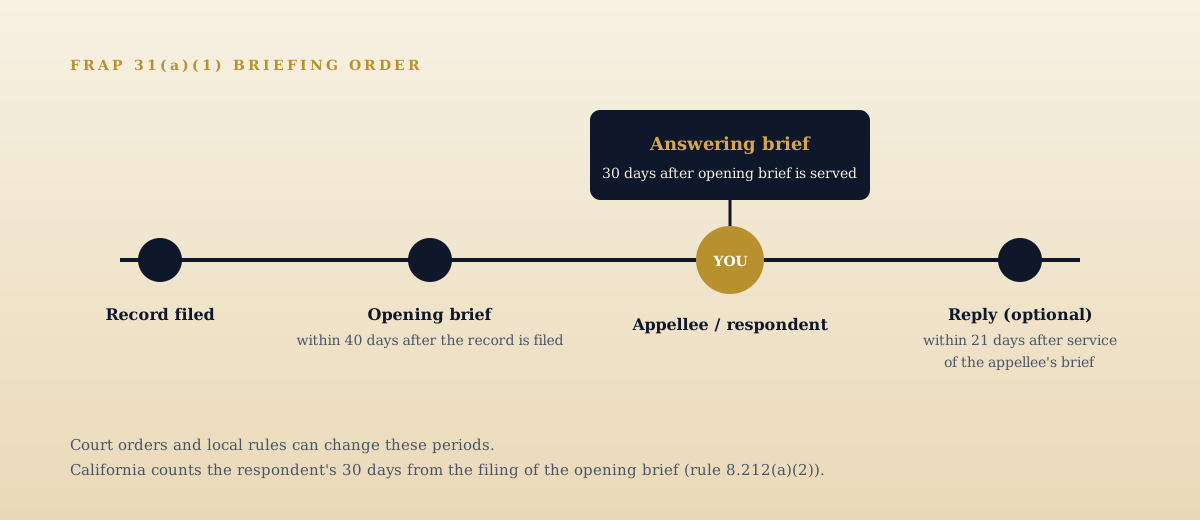
The answering brief is not the last word. Under FRAP 31(a)(1) the appellant may serve and file a reply within 21 days after service of the appellee's brief; in California the reply is due within 20 days after the respondent files under rule 8.212(a)(3); in Florida it is due 30 days after service of the answer brief under rule 9.210(g), capped at 4,000 words. Florida rule 9.210(c) also lets the answer brief omit the statement of the case and of the facts when the initial brief's version is deemed satisfactory. That brief belongs to the other side, and the appellant's reply brief is a separate service for appellants. For California, the parties may generally stipulate to extend each briefing period by up to 60 days under rule 8.212(b)(1), with the stipulation filed in the reviewing court before the brief is due; we flag that option at intake when the record is large.
Appellee Brief Example: How a Finished Draft Is Organized
An appellee brief example differs from an opening brief mostly in what it leaves out. Under FRAP 28(b), the appellee's brief must conform to Rule 28(a)(1) through (8) and (10), "except that none of the following need appear unless the appellee is dissatisfied with the appellant's statement": the jurisdictional statement, the statement of the issues, the statement of the case, and the statement of the standard of review. The diagram shows what stays and what may go.
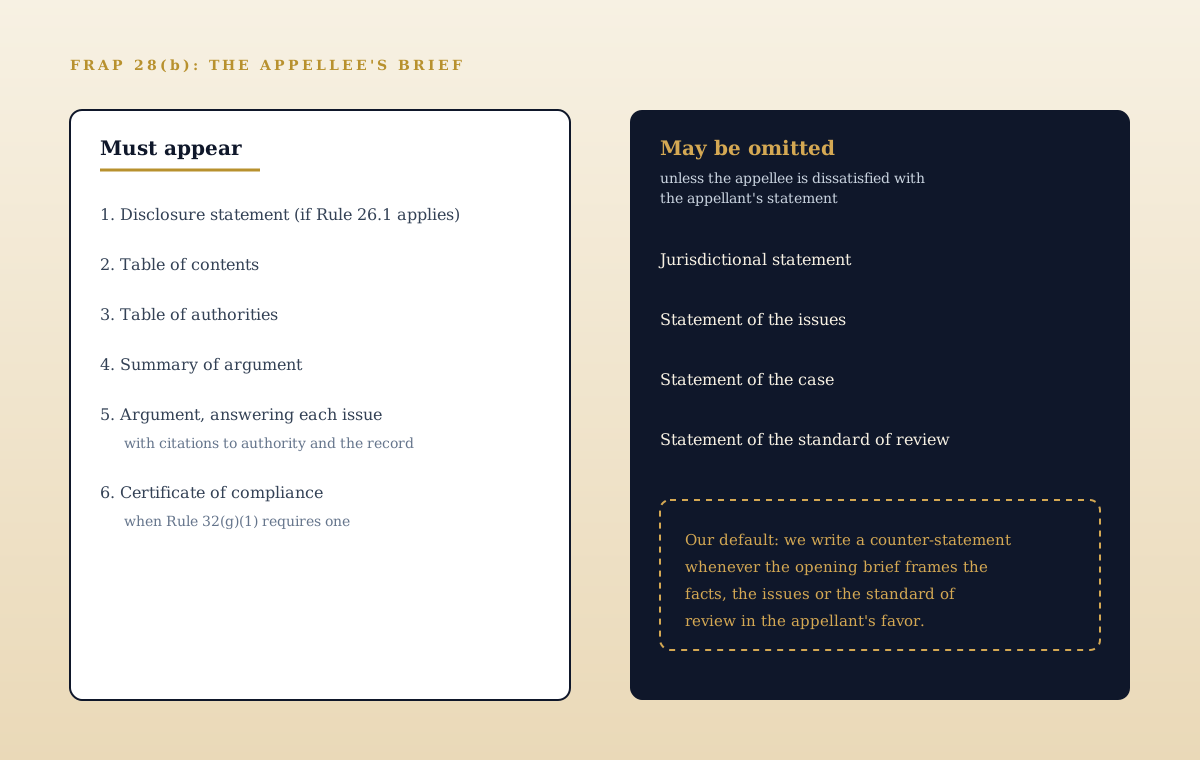
Appellee's Brief Sample Sections
In practice our appellee's brief sample structure keeps most of the optional parts, because the appellant wrote them to win. A typical draft runs in this order: the disclosure statement where Rule 26.1 requires one; the tables; a counter-statement of the issues that frames each question the way the judgment answers it; a statement of the case that restores the facts the opening brief omitted, each with a record cite; the standard of review for each issue; a summary of argument; the argument itself, one heading per issue; and the certificate of compliance. Where the parties agree on jurisdiction, the jurisdictional statement is the one optional part we usually drop.
An appellee brief sample from another case is useful for format, but the argument has to come from your record and your appellant's issues, which is why we do not hand out client drafts. To see how each required part reads on the page, our annotated appellate brief examples walk a full brief section by section.
When there are several appellees, FRAP 28(i) lets any number of them join in a single brief, and any party may adopt by reference a part of another's brief. We tell co-appellees at intake when joining saves words and when separate briefs protect different interests.
Who Signs, Files and Argues the Answering Brief
We draft. Your counsel of record, or you if you are representing yourself, reviews the draft, signs it and files it with the court. We do not appear in the case, sign the brief, file it, argue it or represent any party. That boundary keeps the brief yours: the person who signs makes the final calls on which arguments to press and which to drop, and the certificate of compliance under FRAP 32(g)(1) is made by the attorney or the unrepresented party.
What our drafting adds is time and attention on the record. Lawyers use us when an appeal lands on top of a trial calendar; self-represented respondents use us because the rules on format, length and record citation are strict and the court expects them to be followed. If the court later schedules oral argument, the brief we drafted is the outline the person arguing works from.
When Your Appeal Needs a Different Document
If you are the one who appealed
When the other side has already filed its answer and you need to respond within the reply period, the work is the appellant's final brief in the briefing order, not this one.
If the case is still in the trial court
When no judgment has been entered yet and the fight is over a motion, our trial-court motion briefs are the right starting point.
If counsel wants research, not a draft
When your lawyer is writing the brief and needs a memo on one issue, such as forfeiture in your circuit, a research memorandum fits better than a full brief.
Questions Appellees Ask Before They Respond
What is a response brief?
How to write a brief response?
What is included in an appellate brief?
Send the Opening Brief and Your Due Date
Upload the appellant's brief, the judgment and the briefing order. We confirm the deadline and the length rule for your court, and quote the answering brief for your review. Lawyers who need help across a trial docket as well can see our brief writing for litigators.