Declaratory Judgment Action: Drafting the Complaint for Declaratory Judgment
Prepared by a licensed U.S. attorney
A complaint for declaratory judgment is the pleading that opens a declaratory judgment action: it asks the court to declare what a contract, policy, deed, lease or statute means for the parties before the dispute turns into a breach, a denial or a damages suit. We draft it to your court's rules; you or your attorney sign and file it.
If you are still sorting out what a declaratory judgment is, start there. This page is for the drafting itself: the parties, the facts that make the controversy real, the exact declarations, and the further relief that goes with them.
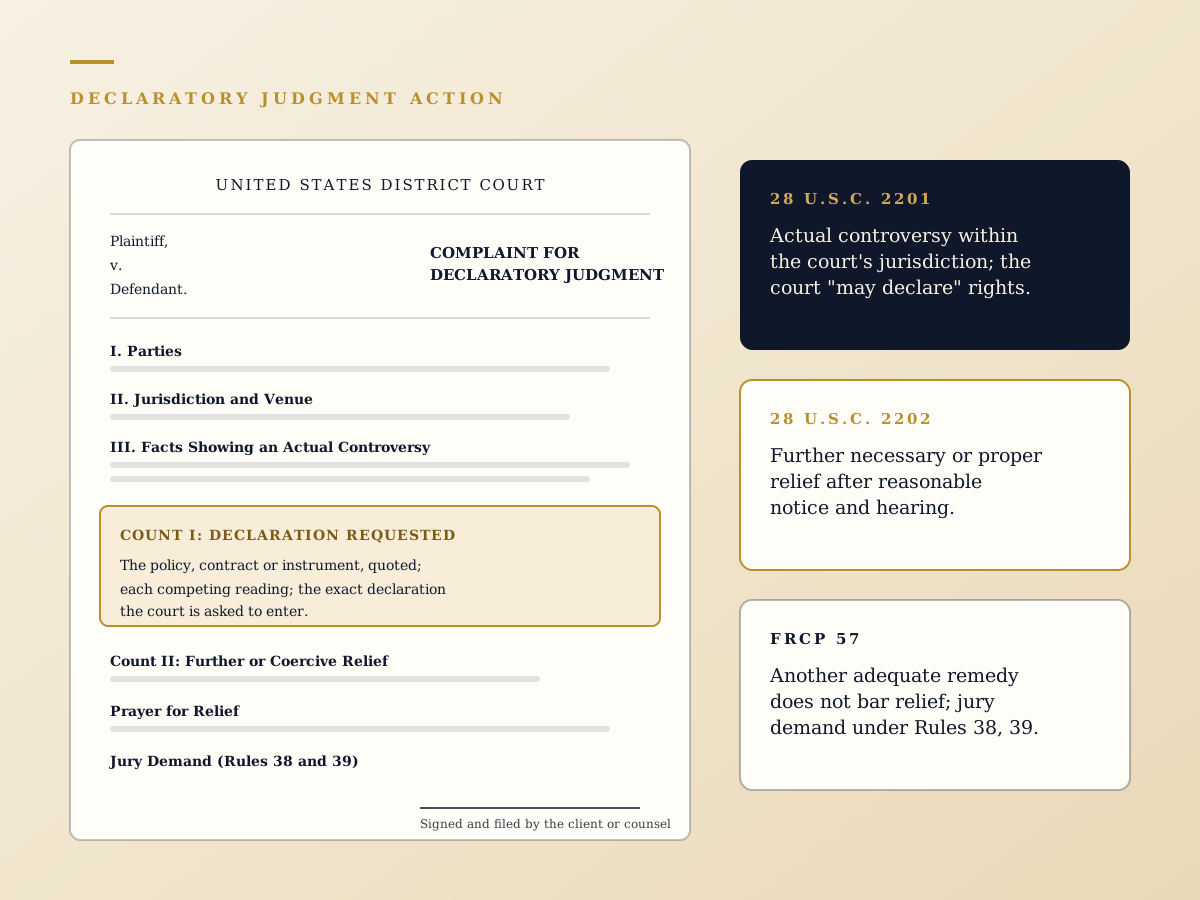
In a case of actual controversy within its jurisdiction, a federal court "may declare the rights and other legal relations" of an interested party.
Further necessary or proper relief based on the declaration may be granted after reasonable notice and hearing against an adverse party.
The existence of another adequate remedy does not preclude a declaratory judgment that is otherwise appropriate. Rules 38 and 39 govern jury demands.
Florida chapter 86, California Code of Civil Procedure 1060, and Texas chapter 37, which is cited as the Uniform Declaratory Judgments Act.
Complaints for Declaratory Judgment We Draft
Every declaratory judgment complaint we draft starts from the instrument in dispute and the moment the parties stopped agreeing about it. We work on the plaintiff or petitioner side, and on the counterclaim side when a defendant wants its own declaration in a case already filed. Most declaratory judgment actions fall into a handful of patterns, and each one changes what the facts section has to prove.
Insurance Coverage Declaratory Judgment Actions
The insurance coverage action is the classic use. Wilton v. Seven Falls Co. (1995) began exactly this way: insurers went to federal court for a declaration that their policies did not cover the insureds' liability. Policyholders file the mirror image, asking the court to declare a duty to defend or indemnify after a denial. Our draft quotes the insuring agreement, the exclusion at issue and the denial letter, then pleads why the claim falls inside or outside the policy language.
Contract and Lease Interpretation Complaints
When two parties read the same clause differently, a complaint declaratory judgment filing lets them get a ruling on contract interpretation before anyone has to breach to find out who was right. Texas says so directly: a contract "may be construed either before or after there has been a breach" (Tex. Civ. Prac. & Rem. Code 37.004(b)). The same structure covers leases, easements, deed restrictions, operating agreements and licenses. Patent licensees use it too: in MedImmune v. Genentech (2007) the Supreme Court held a licensee was not required to break its license before seeking a declaration that the patent was invalid, unenforceable, or not infringed.
Complaint for Declaratory and Injunctive Relief
A complaint for declaratory relief often needs a second count. If the other side is about to act on its reading (terminate the lease, enforce a restrictive covenant, block an easement), we pair the declaratory count with a claim for injunctive relief so the court can stop the conduct as well as name the right. A declaratory relief complaint built this way states the declaration first, then the injunction that follows from it.
Motion for Declaratory Judgment
People search for a motion for declaratory judgment, but the federal Act authorizes a declaration "upon the filing of an appropriate pleading," so the declaration is pleaded as a claim first. Once it is, the question can be decided fast: Rule 57 says the court may order a speedy hearing, and Rule 56(a) lets a party move for summary judgment on each claim or part of a claim, including the declaratory count. A motion for declaratory relief in that sense is usually that summary judgment motion. We draft both pieces; the motion package runs through our motion drafting services, and a motion for summary judgment template shows the format if you want to see it first.
When a Declaratory Judgment Action Is the Right Filing
A declaratory judgment action fits when the disagreement is already real, the parties are already adverse, and a ruling on rights would actually settle what comes next. If any of those is missing, the filing invites a motion to dismiss, so we test the facts against each one before we draft.
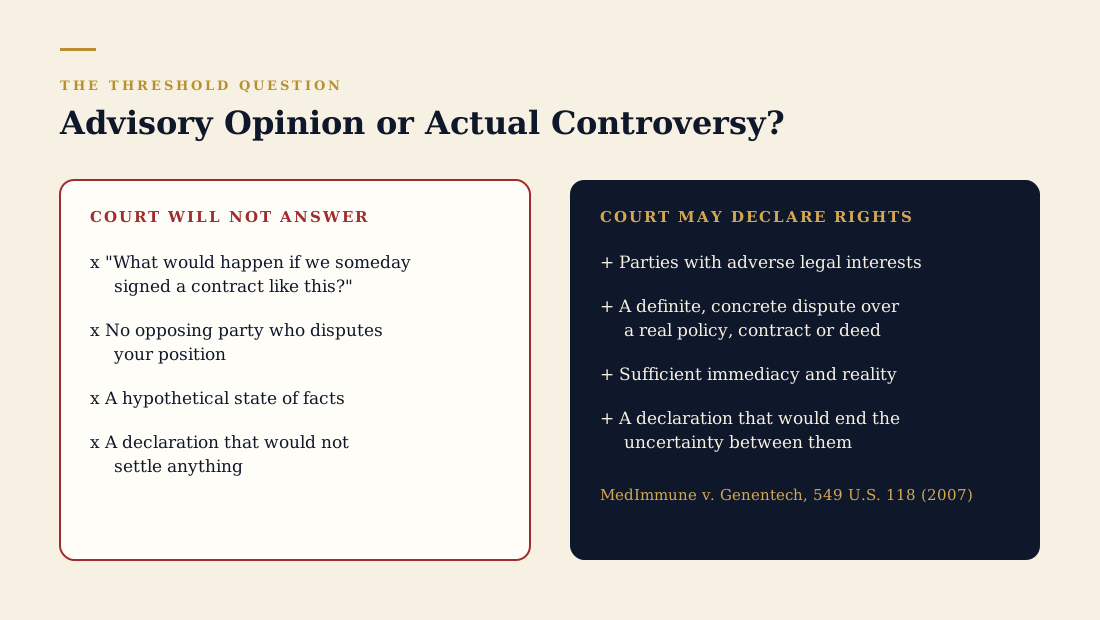
An Actual Controversy, Not an Advisory Opinion
The Act reaches only "a case of actual controversy" (28 U.S.C. 2201(a)). The Supreme Court reads that phrase as the same cases and controversies that are justiciable under Article III, so we check Article III standing and ripeness on the facts you send before drafting. The working test from MedImmune is whether the facts alleged show "a substantial controversy, between parties having adverse legal interests, of sufficient immediacy and reality to warrant the issuance of a declaratory judgment." A question about a contract you might sign someday asks for an advisory opinion, and courts decline those.
Courts also keep discretion to say no even when the controversy is real. Wilton describes "unique and substantial discretion in deciding whether to declare the rights of litigants," and under Brillhart that discretion governs whether to stay a federal case while a parallel state case runs. The Rule 57 advisory note adds that a court may decline when a declaration would not settle the controversy, and Texas section 37.008 lets the court refuse a judgment that would not terminate the uncertainty. We plead facts showing the declaration ends the dispute.
Declaratory Relief Action Alongside Damages
You do not have to choose between a declaration and money. A declaratory relief action can stand alone or ride with damages claims, because Rule 57 provides that another adequate remedy does not preclude a declaratory judgment that is otherwise appropriate, and Rule 8(a)(3) allows a demand for relief that includes different types of relief. When the other side has already broken the deal, we usually plead the declaration together with the breach of contract claims so one case answers both what the contract means and what the breach cost. A declaratory judgement action on its own is the better fit when the relationship continues and both sides mainly need to know the rules going forward.
How We Draft the Parties, Controversy and Prayer for Relief
An action for declaratory judgment is still a civil case, so the pleading carries the same skeleton as any legal complaint. What changes is the weight: the facts and the prayer for relief carry the whole case. If you want the general background on how a complaint is structured, read that first; below is how we adapt each block for a declaration.
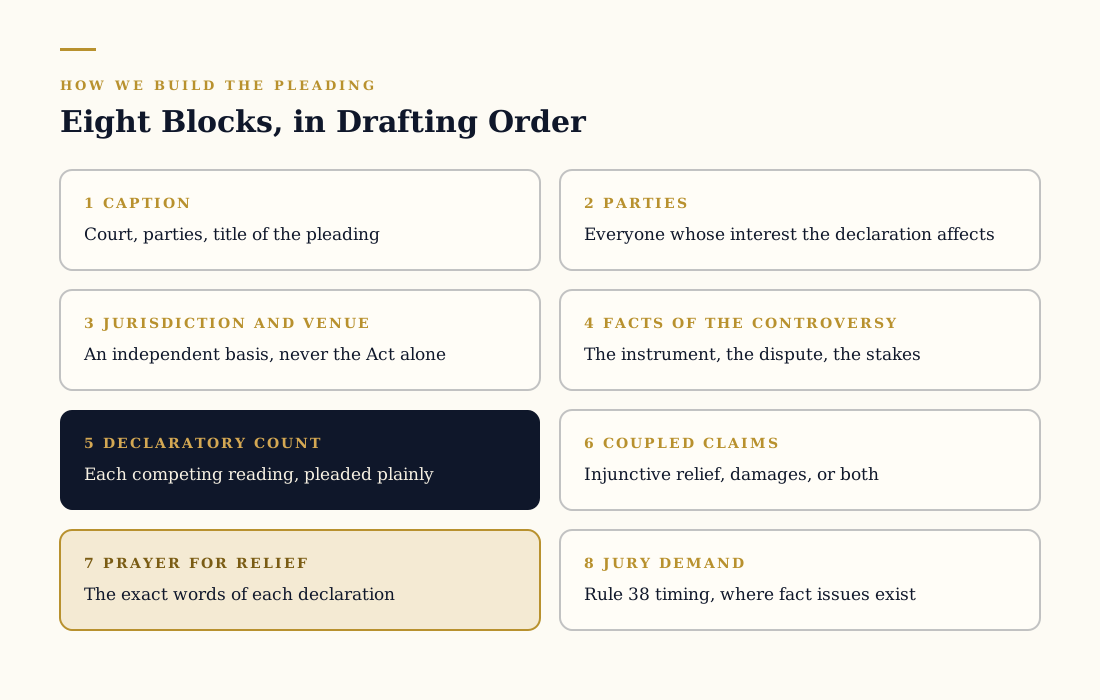
Parties. The 1937 advisory note to FRCP 57 says that all parties having an interest in the declaration or adversely affected by it "must be made parties or be cited," and Texas section 37.006(a) uses similar mandatory language. We list every co-insured, co-owner, beneficiary or assignee whose rights the declaration would touch, because a declaration that leaves one out invites a second lawsuit.
Facts and counts. We quote the operative language, plead each side's reading, and lay out the events that made the dispute concrete. The declaratory count then states the competing positions plainly. Coercive counts follow: the same note allows a demand for coercive relief "cumulatively or in the alternative," and 28 U.S.C. 2202 further relief lets the court grant necessary or proper relief based on the declaration after reasonable notice and hearing.
Prayer and jury. The note requires that the demand for relief "state with precision the declaratory judgment desired," so we write each declaration as the exact sentence you want the court to sign. Rule 57 sends jury demand questions to Rules 38 and 39; under Rule 38(b) a written demand may be included in a pleading, served on the other parties no later than 14 days after the last pleading directed to the issue is served, and filed under Rule 5(d). We flag whether a demand makes sense when fact issues exist.
Federal Court Under 28 U.S.C. 2201
The Declaratory Judgment Act, 28 U.S.C. 2201 does not open the federal courthouse door by itself. Skelly Oil held that Congress "enlarged the range of remedies available in the federal courts but did not extend their jurisdiction." Our jurisdiction section therefore pleads an independent basis for subject-matter jurisdiction: a claim arising under federal law (28 U.S.C. 1331), or diversity between citizens of different states with more than $75,000 in controversy, exclusive of interest and costs (28 U.S.C. 1332). We also check the Act's own carve-outs, such as most disputes over federal taxes, before choosing federal court.
State Court Petitions
Many disputes belong in state court, where the pleading may be styled a complaint or a petition depending on local usage. We caption it the way your court does, pull the local rules for format, and cite the state's own declaratory statute instead of the federal Act. The section below covers the three state statutes we draft under most.
From intake to your signature
- You send the instrument, the correspondence that shows the dispute, and the court you have in mind.
- We test the controversy, the parties and the jurisdiction basis, and tell you what is missing.
- We draft the complaint, the declarations and any coupled counts to that court's rules.
- You or your attorney review, sign and file. We do not file, sign or appear in the case.
State Rules: Florida, California, Texas and Missouri
State courts apply their own declaratory statutes, and the differences decide who can sue, what can be declared and who pays the fees. Texas labels its chapter the Uniform Declaratory Judgments Act. These are the points each statute changes in our draft.
Florida Chapter 86 Elements
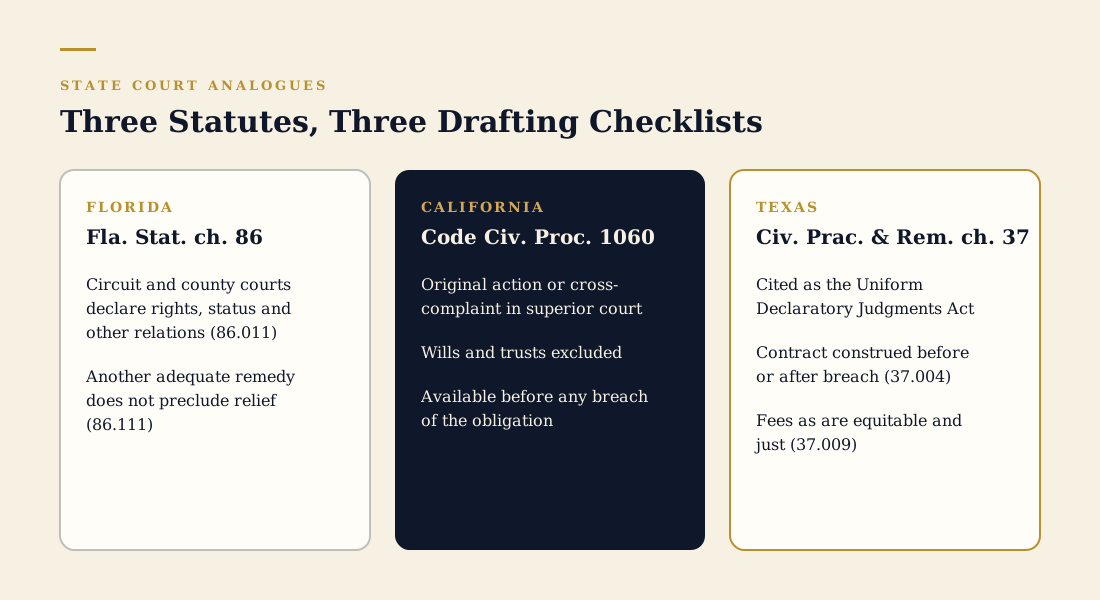
The florida elements of declaratory judgment we plead come from the statute's text. Fla. Stat. ch. 86 gives circuit and county courts power, within their jurisdictional amounts, to declare rights, status, and other equitable or legal relations (86.011). Section 86.021 covers anyone in doubt about rights under a deed, will, contract or other writing, or affected by a statute, regulation or ordinance.
Three more provisions shape the elements of declaratory judgment florida pleadings must address: a judgment may be rendered by way of anticipation of an act not yet done (86.051), interested persons may be made parties (86.091), and another adequate remedy does not preclude relief (86.111).
California Cause of Action for Declaratory Relief
The cause of action for declaratory relief california recognizes sits in Cal. CCP 1060. A person interested under a written instrument or contract, or who wants a declaration about property, may bring "an original action or cross-complaint in the superior court" in cases of actual controversy about the parties' legal rights and duties.
Three drafting points matter. Section 1060 excludes wills and trusts, so trust disputes need a different vehicle. The declaration "may be had before there has been any breach of the obligation." And CCP 1061 lets the court refuse a declaration "not necessary or proper at the time," so we plead why it is needed now.
Texas Chapter 37 and Fees
Tex. Civ. Prac. & Rem. Code ch. 37 lets a court of record declare rights, status, and other legal relations whether or not further relief is or could be claimed (37.003(a)). Unlike California, Texas reaches trusts and estates expressly: section 37.005 lets executors, trustees, beneficiaries and heirs seek declarations about the administration.
Section 37.009 is the reason Texas plaintiffs plead fees: the court "may award costs and reasonable and necessary attorney's fees as are equitable and just." We add the fee request to the prayer on every Texas draft.
Missouri Petition for Declaratory Judgment
A missouri petition for declaratory judgment rests on RSMo ch. 527. Section 527.010 gives circuit courts power to declare rights, status, and other legal relations whether or not further relief is or could be claimed. Section 527.020 reaches anyone interested under a deed, will or written contract, or affected by a statute, ordinance, contract or franchise.
The draft must show the judgment ends the dispute: under 527.060 the court may refuse a declaration that would not terminate the uncertainty or controversy. Section 527.100 lets the court award costs as may seem equitable and just.
Sample Complaint for Declaratory Relief
Below is an annotated outline in the shape of a sample complaint declaratory relief california courts would see, built on a hypothetical commercial lease dispute. It is an illustration of structure, not a client file and not a form to copy: the real draft turns on your lease, your letters and your county's local rules. Readers looking for a california sample complaint for declaratory relief usually need exactly this map of what goes where.
Superior Court of California, County of [County]
[Tenant LLC], Plaintiff, v. [Landlord LP], Defendant. | Complaint for Declaratory Relief (Code Civ. Proc. 1060)
- Parties. The tenant entity, the landlord entity, and any guarantor or subtenant whose rights the declaration would affect.
- Jurisdiction and venue. Why this superior court and this county, tied to the premises and the parties.
- The lease. The renewal option quoted word for word, with the lease attached as an exhibit.
- The controversy. Tenant's timely exercise notice, landlord's letter rejecting it, and the date landlord says the tenancy ends.
- First cause of action: declaratory relief. Each side's reading of the option, and why an actual controversy exists now, before any holdover or eviction.
- Second cause of action, if needed. Injunctive relief against interference with possession while the declaration is decided.
- Prayer. A declaration, in one sentence, that the option was validly exercised and the term runs through [date]; any injunction; costs; further relief the court finds proper.
The same outline moves to federal court with a jurisdiction section built on 1331 or 1332, or to Texas with a fee request under 37.009. What does not move is the discipline of the prayer: one declaration per sentence, each one something the judge can sign as written.
Questions About Declaratory Judgment Complaints
Does the declaratory judgment Act provide a cause of action?
What is the difference between declaratory relief and declaratory judgment?
What is the key difference between an advisory opinion and a declaratory judgment?
What is a declaratory judgement case?
Have the Declarations Drafted Before the Other Side Moves
Send us the instrument, the letters that show the dispute and the court you are considering. Our attorneys draft the complaint and prayer to that court's rules and return it for you or your counsel to sign and file. It sits within our wider legal document drafting work, and firms that want it as overflow can route it through litigation support for law firms.
Get a Drafting QuoteRelated drafting work
When the count is pleaded and you need it decided
If the facts are not really in dispute, the declaratory count is often teed up for decision on the papers. We draft that motion package too.
summary judgment motion on the declaratory countWhen the fight is over who holds title
If the dispute is ownership of land itself rather than what a deed or easement allows, the pleading may need to be built as a title action instead.
quiet title pleadingWhen the case needs more than one document
If you also need the demand letter, declarations, or a settlement agreement once the court rules, the work sits in one engagement.
the full drafting catalog